
A patient-friendly guide by RealMedVision.
Medically reviewed | 10 to 12 min read
Chandipura virus is a fast moving brain infection that mainly affects young children in rural India, and it can turn serious within a single day.
For a worried parent, the hardest part is that the early signs look just like an ordinary fever, right up until they suddenly do not.
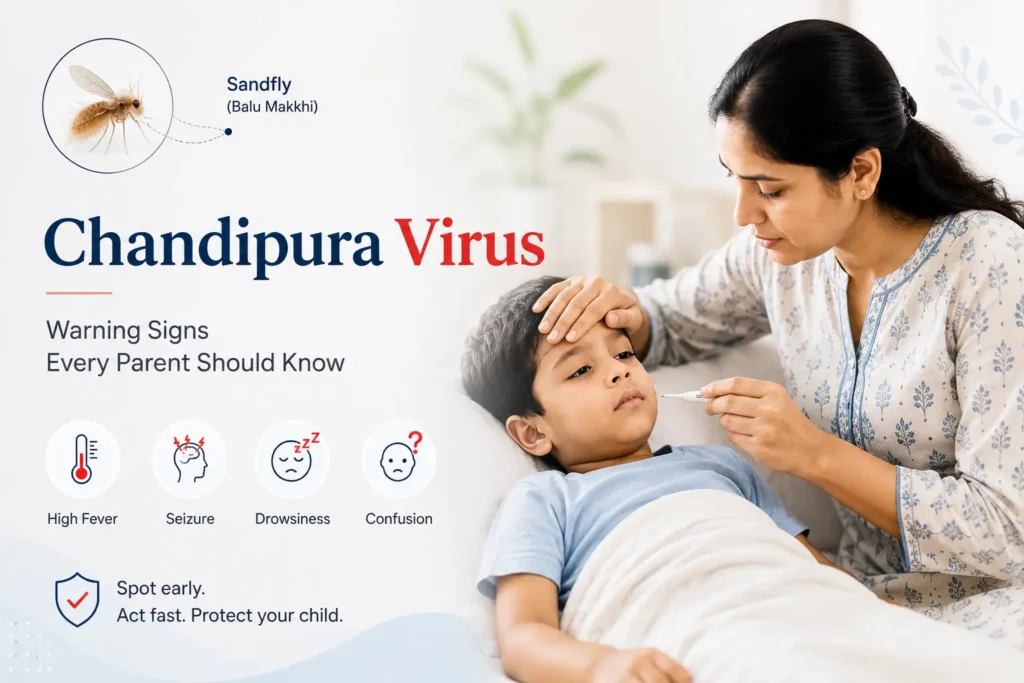
If your child has a sudden high fever along with a seizure, unusual drowsiness, or confusion, treat it as an emergency and reach the nearest hospital straight away. Do not wait to see whether it settles. Early Chandipura virus symptoms often look like a common viral fever, then move fast and affect the brain within hours. Reaching hospital early is the single biggest factor in how a child does. This guide covers the warning signs, what the illness does, why there is no cure, and the steps that lower your family’s risk.
Quick answer
- Chandipura virus is a viral infection spread mainly by sandflies, and it mostly affects children under 15.
- The first Chandipura virus symptoms include a sudden high fever, headache, and vomiting.
- Danger signs are seizures, deep drowsiness, and confusion, and they can appear within 24 to 48 hours.
- There is no specific antiviral medicine and no vaccine, so care is supportive and given in hospital.
- Reaching hospital early gives a child the best chance, so never wait out these symptoms at home.
- Prevention focuses on controlling sandflies and avoiding their bites, especially through the monsoon.
What is Chandipura virus?
Chandipura virus was first identified in 1965 in Chandipura village in Maharashtra, which is how it got its name. It belongs to the Rhabdoviridae family, the same family as the rabies virus, though it causes a very different illness. In plain terms, it is an RNA virus that can inflame the brain, a condition doctors call acute encephalitis. It is not new to India and has caused scattered cases and seasonal outbreaks for decades, usually in the rainy season.
Doctor’s Tip: Encephalitis simply means inflammation of the brain. That is why the serious signs show up as changes in a child’s alertness and behaviour, not just fever.
Chandipura virus symptoms in children
The illness usually begins the way many childhood infections do, which makes it easy to underestimate. Within a day, the picture can change sharply. Knowing which of the Chandipura virus symptoms are ordinary and which mean you should not wait can change a child’s outcome.
Early symptoms in the first day
Most children start with a high fever that comes on suddenly. Alongside it you may see a headache, body ache, nausea, and repeated vomiting, sometimes with loose motions. The child may simply seem unwell and irritable, much like with a common viral fever. Nothing here clearly marks the illness out, so any fever in a young child during an outbreak deserves close watching.
Warning signs that need emergency care
The signs that matter most point to the brain being affected. Watch for a fit, unusual sleepiness where the child is hard to wake, confusion, not recognising you, or a stiff neck. In severe cases a child can lose consciousness. These can develop within 24 to 48 hours of the first fever, sometimes faster, so never dismiss them as tiredness.
If a feverish child has a fit, will not wake properly, or seems confused, take them to hospital immediately.
Watching a child go from playing to barely responsive in hours is frightening. That speed is why doctors urge parents not to wait for a morning appointment. Once the brain is involved, every hour counts.
| Stage | What you may notice | What to do |
|---|---|---|
| Early signs (first day) | Sudden high fever, headache, body ache, vomiting, sometimes loose motions | Watch closely, keep the child hydrated, do not ignore worsening |
| Danger signs (within 24 to 48 hours) | Seizure or fit, deep drowsiness, confusion, stiff neck, loss of consciousness | Go to the nearest hospital straight away, this is an emergency |
How doctors tell it apart from other fevers
Since the early Chandipura virus symptoms overlap closely with dengue, malaria, and ordinary viral fever, no doctor can be sure from symptoms alone. To rule these in or out, doctors look at the full picture and send blood for tests such as RT-PCR and ELISA, often to a centre like the National Institute of Virology in Pune. This is why a child may be admitted and monitored while tests are pending.
| Feature | Chandipura virus | Dengue | Common viral fever |
|---|---|---|---|
| Main age affected | Children under 15 | All ages | All ages |
| Typical spread | Sandfly bite | Aedes mosquito bite | Person to person |
| Key danger sign | Brain signs like seizures and drowsiness | Bleeding, low platelets | Usually settles on its own |
| Speed of serious illness | Can be very fast, within a day | Usually several days in | Rarely serious |
Keep in Mind: A child can have dengue and Chandipura in the same season, and the tests exist so doctors do not have to guess. Trust the lab work over self diagnosis at home.
Which children are most at risk
The virus mainly affects children between roughly 9 months and 14 years. Risk is higher in rural and semi urban homes with mud or sand walls where sandflies shelter, and it rises during the monsoon when these insects breed freely. Families near cattle sheds and damp surroundings see more exposure. If that describes your home, stay alert to any fever in a young child during outbreak season.
How Chandipura virus spreads
The sandfly vector
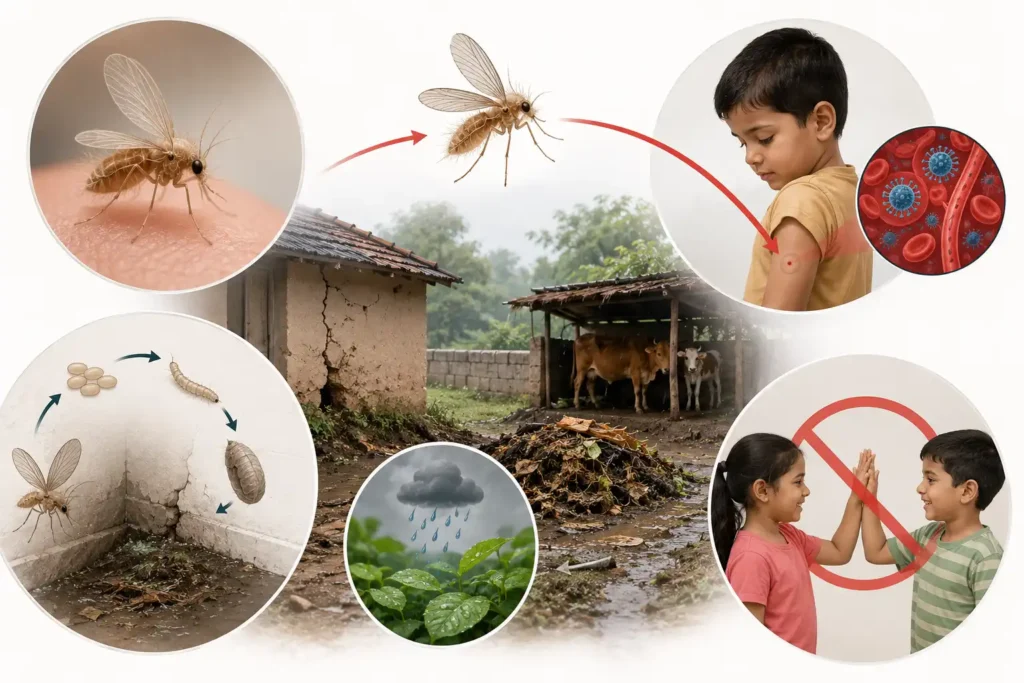
The main suspected carrier is the phlebotomine sandfly, a tiny biting insect much smaller than a mosquito. Mosquitoes and ticks may also carry it. One honest gap is that insects caught in recent outbreaks have not confirmed the exact vector, so investigators are still checking which ones spread it, and sandfly control stays the best available step. When an infected sandfly bites, it passes the virus into the bloodstream, and children are bitten more often where these insects live close by.
Where sandflies live and breed
Sandflies favour cracks in mud walls, cattle sheds, and damp debris. Monsoon humidity gives ideal breeding conditions, which is why cases cluster in the rainy months. One reassuring point is that person to person spread has not been documented, so you cannot catch it from a sick child the way you catch a cold.
| How it can spread | How it does not spread |
|---|---|
| Bite of an infected sandfly, the main route | Casual contact with a sick person |
| Possibly some mosquitoes and ticks | Coughing or sneezing between people |
| Higher risk near cattle sheds and mud walls | Sharing food or water with a patient |
Chandipura virus treatment
Here is the honest position. There is no antiviral drug that cures Chandipura virus, and no vaccine. What saves lives is prompt hospital care that supports the child while the body fights the infection, which is why speed matters far more than any single medicine.
What hospital care involves
In hospital, the focus is on supporting the child and controlling complications. That can mean medicines to stop seizures, control of fever, fluids to prevent dehydration, close monitoring of breathing and consciousness, and intensive care with breathing support if the brain is badly affected. None of this cures the virus, but it keeps a child stable and gives the best chance to recover.
Why early treatment matters so much
Because the illness can worsen within hours, early admission is not a formality. It lets the team catch the first sign of a seizure or breathing trouble and act at once. A child brought in early can be supported through the most dangerous window, which is not possible at home.
No home remedy, herbal preparation, or over the counter medicine can treat this infection. Reaching a hospital quickly is the only safe path.
Patient Reminder: On the way to hospital, keep a drowsy child on their side, do not force food or water if they are not alert, and tell staff when the fever and drowsiness began.
The 2026 outbreak, what we know so far
As of early August 2026, officials in Gujarat reported 35 laboratory confirmed cases of Chandipura virus and 22 child deaths in August, with more suspected cases under investigation. Cases were also reported from Rajasthan, and central and state teams were deployed for investigation, vector control, and awareness. This is a live situation, so always check the latest official update for the count.
For context, the World Health Organization described the 2024 season as the largest Chandipura outbreak in about two decades, a serious infection with a historically high fatality rate. That history is why early action by families saves lives.
Good to Know: An outbreak alert in your district is not a reason to panic, but a strong reason to act on the first worrying sign in a child.
How to prevent Chandipura virus
With no vaccine, prevention comes down to two goals, cutting sandfly numbers around the home and stopping bites. Small, consistent steps make a real difference through the monsoon, and preventing bites is the surest way to avoid Chandipura virus symptoms.
Protect your home
Seal cracks and gaps in mud and plastered walls where sandflies shelter. Cooperate with insecticide spraying when health workers carry it out. Keep cattle sheds away from where children sleep, and clear damp debris and clutter that let insects breed.
Protect your child
Dress children in clothes that cover arms and legs, especially at dusk and night when sandflies are active. Use bed nets and a child safe repellent as directed. Keep young children away from cattle sheds at peak biting hours. Above all, seek care early for any fever with drowsiness or a fit.
| Around the home | For your child |
|---|---|
| Seal wall cracks and gaps | Cover arms and legs at dusk and night |
| Allow insecticide spraying by health teams | Use bed nets while sleeping |
| Keep cattle sheds away from sleeping areas | Apply child safe repellent as directed |
| Clear damp debris and clutter | Seek care early for fever with drowsiness |
Myth versus fact
Myth, it spreads between children like a cold. Fact, person to person spread has not been documented, the virus passes mainly through sandfly bites.
Myth, a special medicine cures it. Fact, no specific antiviral or vaccine exists yet, and supportive hospital care is what protects a child.
Myth, only poor hygiene causes it. Fact, the real risk is the environment and sandfly exposure, so even careful families in affected areas must take precautions.
When to call your doctor
Go to a hospital without delay if a child has any of the following.
- A high fever together with a seizure or fit.
- Drowsiness where the child is hard to wake or unusually floppy.
- Confusion, not recognising familiar faces, or strange behaviour.
- A stiff neck, repeated vomiting, or a rapid decline in alertness.
A short illustrative example, not a real case. A five year old develops a high fever one evening and seems mildly unwell. By morning she is hard to wake and has a brief fit. Her parents rush her to hospital, where she is supported through the worst of it. That early decision, rather than waiting, gave doctors room to act.
Key takeaways
- Learn the Chandipura virus symptoms, and treat drowsiness, a fit, or confusion as an emergency.
- The illness can worsen within a day, so early hospital care matters more than any home step.
- No medicine cures it yet, which is why prevention and speed are your real tools.
- Sandfly control at home, sealing wall cracks, and covering skin at night lower the risk.
- During a known outbreak nearby, act on the first worrying sign rather than waiting.
Frequently asked questions
What are the first symptoms of Chandipura virus?
The first Chandipura virus symptoms are usually a sudden high fever, headache, body ache, and vomiting. At this stage the illness resembles a common viral fever, so any fever in a young child during an outbreak should be watched.
How quickly does Chandipura virus become serious?
Very quickly. A child can move from an ordinary fever to brain signs such as seizures and drowsiness within 24 to 48 hours, sometimes faster, so warning signs must never be delayed.
Is there a vaccine for Chandipura virus?
No, there is currently no vaccine. Protection depends on reducing sandfly numbers around the home and avoiding bites, especially during the monsoon when cases tend to rise.
How is Chandipura virus treated?
Care is supportive and given in hospital, because no antiviral drug cures the infection. It includes controlling seizures, managing fever, giving fluids, and breathing support when the brain is affected.
How does Chandipura virus spread?
Sandflies are the main suspected carriers, and the virus passes to a child through their bite. Some mosquitoes and ticks may also carry it, and the exact vector is still under study. Risk is higher near cattle sheds and homes with mud walls where sandflies shelter.
Can Chandipura virus spread from person to person?
No, person to person spread has not been documented. You cannot catch it from a sick child the way you catch a cold, a small reassurance for worried families.
Which children are most at risk?
Children between roughly 9 months and 14 years are most affected, especially in rural and semi urban homes with mud walls. Living near cattle sheds and damp surroundings during the monsoon raises exposure.
How is Chandipura virus different from dengue?
Both begin with fever, but differ. Dengue spreads through Aedes mosquitoes and often shows bleeding or low platelets, while Chandipura spreads through sandflies and tends to affect the brain, with seizures and drowsiness as danger signs.
Can Chandipura virus be prevented at home?
Yes, much of prevention starts at home. Sealing wall cracks, supporting insecticide spraying, keeping cattle sheds away from sleeping areas, using bed nets, and covering a child’s skin at night all lower the risk.
When should I take my child to hospital?
Take your child to hospital straight away if a fever comes with a seizure, deep drowsiness, confusion, or a stiff neck. For this infection, acting early is always safer than waiting.
References
- World Health Organization, Disease Outbreak News, acute encephalitis syndrome due to Chandipura virus, India
- National Centre for Disease Control, Ministry of Health and Family Welfare, CD Alert communicable disease surveillance
- Temporal trends and epidemiological features of Chandipura virus infections in India, PMC
- Chandipura virus, a looming threat to children in India, New Microbes and New Infections, PMC
- Chandipura virus, a comprehensive review, ScienceDirect
- Chandipura virus causing large viral encephalitis outbreaks in India, Pathogens
- Re-emergence of Chandipura virus infection in India, Virulence
- Chandipura virus, the 2024 resurgence and Gujarat outbreak, LWW
- Encephalitis International, Chandipura encephalitis factsheet
- The Hindu, Explained, what is the Chandipura virus
Medically reviewed by
This guide was checked for medical accuracy by our review board before publishing.
Dr. Praveen Verma, MBBS, MD (Pathology), Pathologist and Clinical Laboratory Specialist.
Dr. Himanshu Morya, MBBS, Medical Educator.
About the author
Iraphan Khan, BSN, RN, D.Pharm, is the founder of RealMedVision and a Public Health Researcher who creates evidence-based health content from trusted medical sources.