
A patient-friendly guide by RealMedVision.
Medically reviewed | 10 to 12 min read
One insulin injection a week instead of seven. Where the approvals now stand, what the trials showed, and why India still cannot buy it.
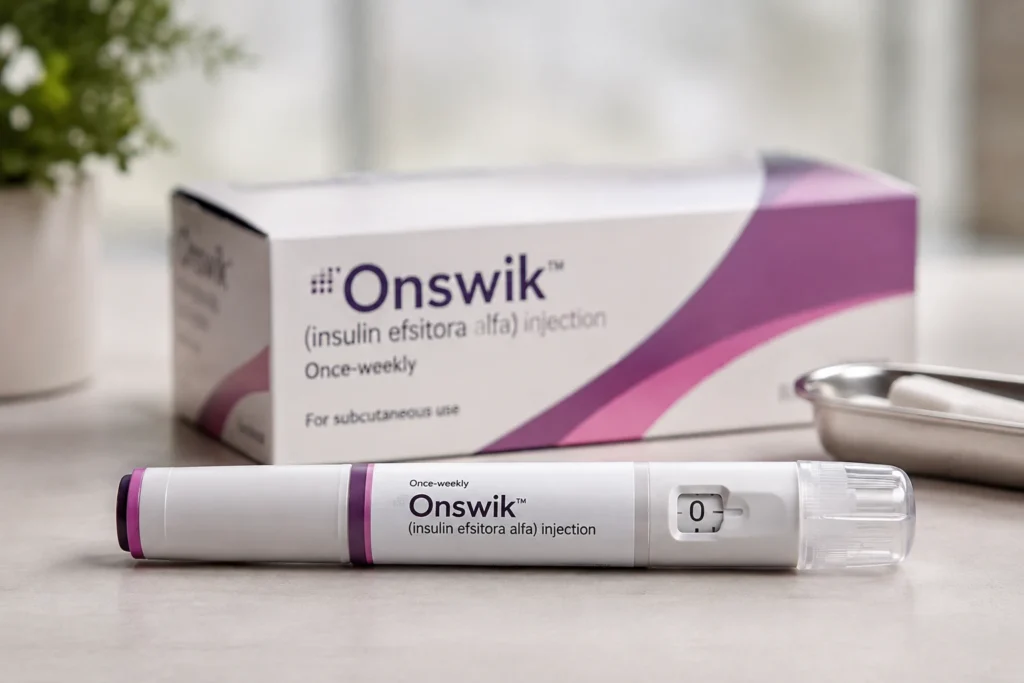
Seven basal insulin injections a week, for years. That is the part many people dread about starting insulin.
Efsitora is one of two weekly insulins now cleared by regulators. Here is where it stands, what the evidence shows, and what it means in India.
Quick Answer
- A once-weekly basal insulin from Eli Lilly, sold as Onswik. It is designed to provide basal insulin coverage across a weekly dosing interval.
- It is approved in the United States, European Union, Mexico and Japan, in every case for adults with type 2 diabetes only.
- In trials it lowered HbA1c about as much as daily insulin, and low blood sugar remains the main risk.
- It is not approved or sold in India. A rival weekly insulin, Awiqli, launched here in July 2026.
Where the Approvals Stand
This moved quickly through 2026. The European Medicines Agency’s committee gave a positive opinion on 25 June 2026, and the European Commission has since granted marketing authorisation. Onswik now appears on the EMA’s list of medicines under additional monitoring, a list that only covers authorised products. The United States approved it on 24 September 2026, under the full name insulin efsitora alfa-gobe. Lilly describes that as its fourth approval, after the European Union, Mexico and Japan.
The United Kingdom is a step behind. NICE published final draft guidance on 20 August 2026 recommending the medicine for NHS use, but that recommendation only takes effect once the Medicines and Healthcare products Regulatory Agency grants a licence, which it has not. Approval also does not mean stock on a shelf. Lilly says the pen reaches United States pharmacies in the months after approval.
Every one of these approvals covers adults with type 2 diabetes. None covers type 1 diabetes, and there is a specific reason for that, covered further down.
What Efsitora Is and How It Works
Basal insulin is the background supply that holds blood sugar steady between meals and overnight, and most are injected daily. Efsitora covers that interval with one weekly dose.
Two changes make that possible. The molecule is fused to an antibody fragment, called an Fc domain, which slows how fast the body clears it, and the insulin binds less tightly to the insulin receptor. Together these flatten the effect into a slow, even release.
One misunderstanding is worth correcting. Daily basal insulins are not taken daily because they vanish within 24 hours. Insulin degludec acts for well over 42 hours. The daily schedule simply holds a steady level, and efsitora stretches that interval to a week.
How It Is Given
Efsitora is injected under the skin of the stomach, thigh or upper arm, once a week on the same day. The European filing lists a pre-filled pen and the United States product is the Onswik KwikPen, both at 500 and 1000 units per millilitre. Check your own leaflet, because device details differ by market.
Doses are individual and set by a doctor, based on weight, sugar readings, other medicines and response. In QWINT-1 the dose rose in fixed steps every four weeks and most participants settled on one of four.
With a weekly medicine, the missed dose is the risk. Pick a fixed day and set a phone reminder. If a dose is missed or taken twice, follow the instructions in your product leaflet and call your prescriber. Do not work out a catch-up schedule yourself.
What the QWINT Trials Found
Five phase 3 trials tested efsitora against standard daily insulins, each designed to show it was no worse rather than better. HbA1c reflects average blood sugar over about three months, and the figures below are reductions in percentage points.
| Trial | HbA1c drop, efsitora vs comparator |
|---|---|
| QWINT-1 | 1.19 vs 1.16 points at week 52, against glargineType 2, new to insulin |
| QWINT-2 | 1.26 vs 1.17 points at week 52, against degludecType 2, new to insulin |
| QWINT-3 | 0.81 vs 0.72 points at week 26, against degludecType 2, already on basal insulin |
| QWINT-4 | 1.01 vs 1.00 points at week 26, against glargineType 2, on basal and mealtime insulin |
| QWINT-5 | 0.51 vs 0.56 points at week 26, against degludecType 1 diabetes, see the caution below |
Treatment-regimen analysis at each trial’s primary timepoint. Low blood sugar rates were measured over different windows and are given in the text, because mixing the two in one table misleads. These are separate trials, not a ranking.
Across the four type 2 trials the differences were tiny, the largest 0.09 percentage points. Low blood sugar was lower with efsitora in QWINT-1, measured over 52 weeks, at 0.50 against 0.88 events per patient-year, and broadly similar in the others.
The Type 1 Diabetes Caution
QWINT-5 tested efsitora in 692 adults with type 1 diabetes, alongside mealtime insulin. Blood sugar control held up. Safety did not.
Over 52 weeks, severe low blood sugar occurred in 10 percent of people on efsitora against 3 percent on daily degludec, and combined moderate to severe episodes ran at 14.03 against 11.59 events per patient-year, highest in the first 12 weeks. The authors concluded that dose initiation in type 1 needs further evaluation.
No regulator has approved efsitora for type 1 diabetes, and Lilly states plainly that it should not be used by people with type 1 because of the increased risk of severe low blood sugar.
Side Effects
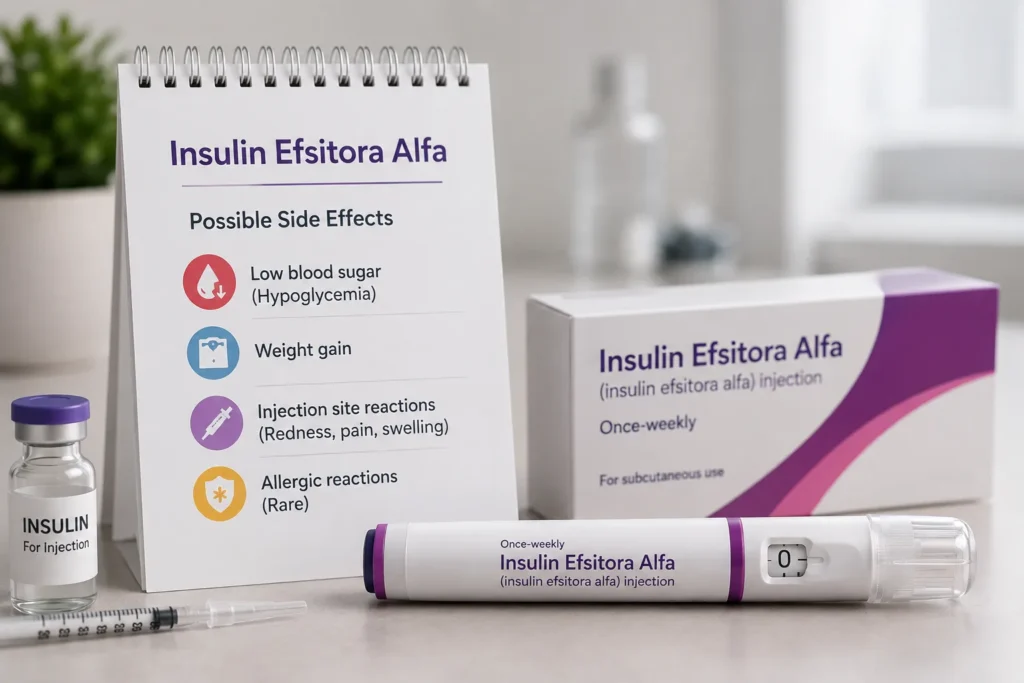
The side effect that matters with any insulin is low blood sugar, or hypoglycaemia. Insulins can also cause redness or a small lump at the injection site, and some people see a modest weight change as control improves. Across the type 2 trials, side effect rates were similar for weekly and daily insulin.
Mild low sugar shows up as shaking, sweating, sudden hunger, a fast heartbeat, dizziness or irritability. Standard advice is about 15 grams of fast-acting sugar, such as glucose tablets or a small glass of juice, then a recheck after 15 minutes, repeating if it is still low. A snack afterwards helps hold it. Follow your own care plan where it differs.
- Confusion, slurred speech, or a fit. This is different from mild low sugar and is not treated with a sugary drink
- Drowsiness, fainting, or unable to swallow safely
- Very high sugar with vomiting, deep breathing or drowsiness
- In India, call 112 or 108. Never put food or drink into the mouth of someone who is not fully awake.
If glucagon has been prescribed and a family member is trained to use it, it can be given while waiting. Because a dose stays active for a week, low sugar after a severe episode needs ongoing monitoring.
Who Needs Extra Care
| Situation | Why it matters |
|---|---|
| Other diabetes medicines | Some tablets and injections raise the chance of low blood sugar when combined with insulin. |
| Kidney or liver problems | Insulin needs shift, so doses often need rechecking. |
| Illness that stops you eating | A weekly dose is already given and cannot be taken back, so call your doctor early. |
| Pregnancy or planning one | Insulin needs change a great deal and must be managed by a specialist. |
| Children | Use in children has not been established and is not covered by any approval. |
Is Efsitora Available in India
No. As of 9 October 2026 efsitora is not approved or launched in India, and there is no official Indian price. Approvals elsewhere do not carry over, because the Indian regulator runs its own review. Eli Lilly has said it planned to file worldwide, so a submission here is plausible but unconfirmed.
If a weekly insulin is what you are after, one is already on the Indian market. Novo Nordisk launched Awiqli, the brand name for insulin icodec, in India in July 2026 for adults with type 1 and type 2 diabetes, pricing a weekly 70 unit dose at 261 rupees.
These are different molecules from different companies and not interchangeable. Whether either suits you is a decision for your diabetes team. We recheck this page monthly.
Key Takeaways
- If the daily injection is your sticking point, raise weekly insulin with your doctor. One option is already in India.
- Learn the signs of low blood sugar and keep fast acting sugar within reach, whichever insulin you use.
- If you have type 1 diabetes, be aware that no approval covers efsitora for it.
- Treat any Indian price quoted online as invented, because there is no approved product here to price.
Frequently Asked Questions
What is efsitora?
A once-weekly background insulin from Eli Lilly, sold as Onswik. It is designed to provide basal insulin coverage across a weekly dosing interval.
Is efsitora approved?
Yes, in several markets. The European Union authorised it in 2026 and the United States approved it on 24 September 2026, with Mexico and Japan before that. Every approval covers adults with type 2 diabetes.
Is efsitora available in India?
No. As of 9 October 2026 efsitora is not approved or launched in India. Approval abroad does not apply here, where the drug regulator runs a separate review.
What is the price of efsitora in India?
There is none, because the medicine is not sold here. Any rupee figure online is guesswork. The rival weekly insulin Awiqli launched in India in July 2026 at 261 rupees for a 70 unit weekly dose.
How is efsitora different from daily insulin?
Mainly frequency. Daily basal insulins are injected every day to hold a steady level, not because they disappear in 24 hours. Efsitora releases slowly enough that one dose covers a week.
Can efsitora be used for type 1 diabetes?
No approval covers type 1 diabetes. In the QWINT-5 trial severe low blood sugar occurred in 10 percent of people on efsitora against 3 percent on daily insulin, which is why regulators limited it to type 2.
Is efsitora the same as Awiqli?
They are different medicines. Awiqli contains insulin icodec from Novo Nordisk, efsitora comes from Eli Lilly. Both are weekly basal insulins and direct rivals, but not interchangeable.
Can I switch from my daily insulin to a weekly one?
Only with your doctor. Switching insulin changes dose, timing and monitoring at once, and is never a change to make alone.
References
- European Medicines Agency. Onswik (insulin efsitora alfa), medicine overview and CHMP opinion, June 2026. ema.europa.eu
- Eli Lilly and Company. FDA approves Onswik (insulin efsitora alfa-gobe) for adults with type 2 diabetes, 24 September 2026. investor.lilly.com
- Bergenstal RM, et al. Once-weekly efsitora versus degludec in adults with type 1 diabetes (QWINT-5). The Lancet. 2024. sciencedirect.com
- Rosenstock J, et al. Weekly fixed-dose insulin efsitora in type 2 diabetes without previous insulin therapy (QWINT-1). New England Journal of Medicine. 2025. doi.org
- Insulin efsitora versus degludec in type 2 diabetes without previous insulin treatment (QWINT-2). New England Journal of Medicine. 2024. doi.org
- Once-weekly efsitora versus degludec in type 2 diabetes already on basal insulin (QWINT-3), trial record NCT05275400. The Lancet. 2025. clinicaltrials.gov
- Once-weekly efsitora versus glargine U100 in type 2 diabetes on basal and mealtime insulin (QWINT-4). The Lancet. 2025. doi.org
- National Institute for Health and Care Excellence. Insulin efsitora alfa for treating type 2 diabetes, ID6499, final draft guidance 20 August 2026. nice.org.uk
- European Medicines Agency. List of medicines under additional monitoring, Onswik added in the September 2026 update. ema.europa.eu
- FDA approves Onswik, and NICE backs Onswik for NHS use ahead of UK approval. The Pharma Letter, September 2026. thepharmaletter.com
- Novo Nordisk brings once-weekly insulin Awiqli to India. Medical Dialogues, July 2026. medicaldialogues.in
All sources checked 9 October 2026.
Iraphan Khan, BSN, RN, D.Pharm, Public Health Researcher. Founder of RealMedVision, writing from regulatory records and published trials.
Dr Praveen Verma, MBBS, MD (Pathology)
Dr Himanshu Morya, MBBS, Medical Educator
Reviewed 9 October 2026 against the current regulatory position and published trial data.
This article is for education only. As of 9 October 2026 efsitora is not approved in India, and no dose here is a recommendation for you. Always follow what your own doctor tells you, and never begin, stop or change any insulin on your own.