
A patient-friendly guide by RealMedVision.
Medically reviewed | 10 to 12 min read
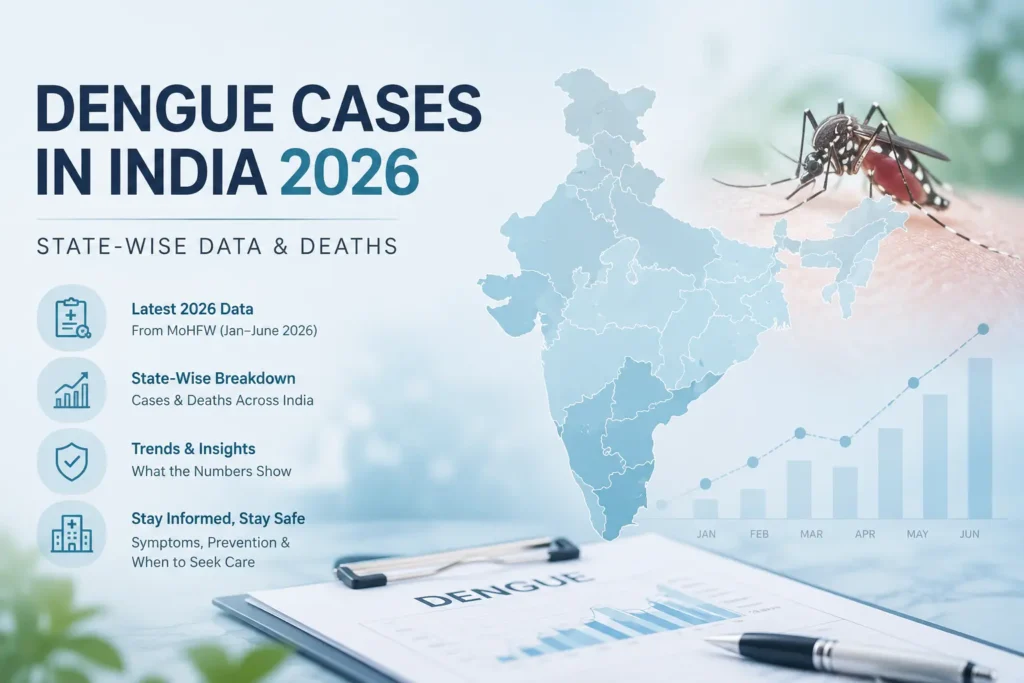
India has recorded 23,952 dengue cases and 31 deaths in the first half of 2026, and the monsoon peak season has only just begun.
Behind every number is a family watching a fever that will not break, wondering when a normal illness turns into an emergency.
Quick Answer: Dengue in India, 2026
- 23,952 dengue cases and 31 deaths were reported across India between January and June 2026 (provisional MoHFW data).
- Tamil Nadu had the most cases (7,511); Kerala recorded the most deaths (19).
- Five southern states account for about 63% of all cases this year.
- India’s official dengue fatality rate has stayed below 1% since 2008 (0.13% in 2024).
- Cases usually rise sharply from August to October, so mid-year totals are not the final picture.
- Seek urgent care for warning signs like severe abdominal pain, repeated vomiting, or any bleeding.
How Many Dengue Cases Are There in India in 2026?
The most recent figures for dengue cases in India 2026 come from the Union Ministry of Health and Family Welfare, tabled in the Rajya Sabha on 28 July 2026. They show 23,952 dengue cases and 31 deaths between January and June 2026. These numbers cover only the first six months, and in India the heaviest dengue transmission falls in the weeks after the monsoon rains. The season is far from over, and the final tally for 2026 will be considerably higher.
What stands out in 2026 is how early the season began. Even before the monsoon set in, hospitals in several cities were reporting a rise in suspected dengue. Researchers link this shift to factors including changes in circulating virus strains and local conditions that help mosquitoes breed.
State-Wise Dengue Cases and Deaths in India (Jan–June 2026)
The table below lists the states with the highest dengue burden in the first half of 2026. The national total of 23,952 covers every state and union territory, so these are the largest contributors, not the full list.
| State | Cases (Jan–June 2026) | Deaths |
|---|---|---|
| Tamil Nadu | 7,511 | 3 |
| Kerala | 4,458 | 19 |
| Maharashtra | 2,676 | 1 |
| West Bengal | 1,831 | 8 |
| Karnataka | 1,601 | 0 |
| Andhra Pradesh | 968 | 0 |
| Telangana | 599 | 0 |
| Gujarat | 488 | 0 |
| Madhya Pradesh | 452 | 0 |
| Delhi | 360 | 0 |
| India total (all States/UTs) | 23,952 | 31 |
Which States Have the Most Dengue Cases?
South India carries the heaviest share of the country’s dengue this year. Tamil Nadu, Kerala, Karnataka, Andhra Pradesh and Telangana together reported 15,137 cases, roughly 63% of the national total, with Tamil Nadu the single largest hotspot. The bar chart below shows the leading states side by side.
Top states by dengue cases, Jan–June 2026
Tamil Nadu 7,511 cases
Kerala 4,458 cases
Maharashtra 2,676 cases
West Bengal 1,831 cases
Karnataka 1,601 cases
Andhra Pradesh 968 cases
Bars are scaled relative to Tamil Nadu, the highest-reporting state. Data: MoHFW, Jan–June 2026.
Good to Know: A high case count does not always mean a high death count. Tamil Nadu reported the most cases but only three deaths, while Kerala had fewer cases yet far more deaths. We explain why in the next section.
Dengue Deaths in India 2026: Where and Why
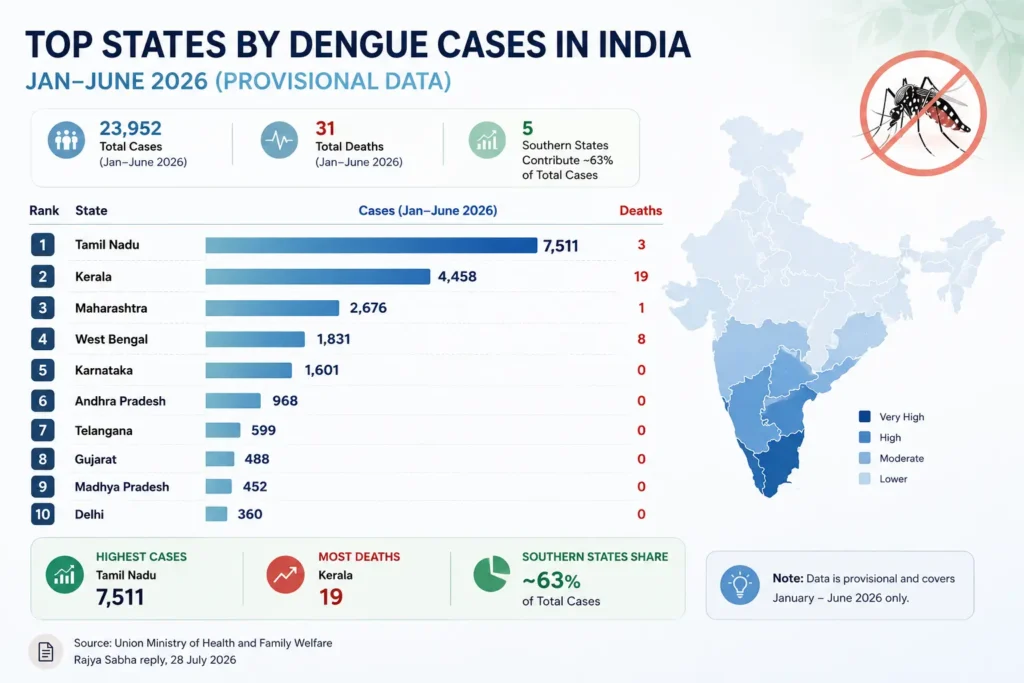
Of the 31 dengue deaths reported nationally in the first half of 2026, Kerala accounted for 19, or about 61% of the total. West Bengal followed with eight. This is a striking contrast with Tamil Nadu, which had by far the most infections but recorded only three deaths.
Why would a state with fewer cases see more deaths? There is no single reason, and provisional figures should not be over-read. How deaths are audited, the age and health of those affected, and how quickly patients reach hospital can all shift the numbers. Dengue is caused by four related virus types, and a repeat infection with a different type is known to carry a higher risk of severe disease, which is one reason outcomes vary from place to place.
A note on the “death rate”
You may see a dengue death rate calculated by dividing deaths by cases. We have avoided that with these mid-year figures, because death audits lag behind case counts and a provisional ratio can mislead. The more reliable measure is the government’s long-term figure: India’s dengue case-fatality rate has stayed below 1% since 2008 and was 0.13% in 2024. In short, most people who get dengue recover, especially when warning signs are caught early.
2026 vs Previous Years
To keep the comparison fair, remember that the 2026 figure is a half-year, provisional number, while the earlier years are complete annual totals. A direct year-on-year comparison is only possible once 2026 closes.
| Year | Dengue cases | Deaths |
|---|---|---|
| 2025 (full year) | 1,21,824 | 131 |
| 2026 (Jan–June, provisional) | 23,952 | 31 |
Sources: MoHFW / NCVBDC. The 2026 row covers six months only and will rise through the monsoon peak.
Why Dengue Cases Rise Every Monsoon
Dengue spreads through the bite of infected Aedes mosquitoes, which thrive in the conditions the monsoon creates. Rainwater collects in buckets, discarded tyres, plant pots, coolers and blocked drains, giving them countless places to lay eggs, and warm, humid weather speeds up breeding. Historically, this is why case numbers in India have tended to climb from around August and stay high into October, though in recent years the season has started earlier.
Case numbers also swing from year to year for reasons beyond rainfall. After a big outbreak, part of the population carries short-term immunity, which can quieten the following season. A change in the dominant virus strain can then push cases back up. It is a moving target, which is one reason prevention has to happen every single year rather than only after a bad season. The monsoon also brings other mosquito and vector-borne illnesses to watch for, including the rarer but serious Chandipura virus, whose symptoms in children, treatment and prevention are worth knowing.
Dengue Symptoms and Warning Signs
Most dengue infections are mild, and many people never develop symptoms. When symptoms do appear, they usually begin abruptly a few days after the bite, and fever tends to last two to seven days.
Common symptoms
Typical signs include high fever, severe headache, pain behind the eyes, muscle and joint aches (dengue has long been nicknamed “breakbone fever”), nausea, and a skin rash. These usually settle with rest, fluids and simple fever control.
Warning signs that need urgent attention
A small number of people go on to develop severe dengue, which can be life-threatening. The World Health Organization identifies a specific set of warning signs, and they most often appear as the fever starts to fall, around days three to seven. This is the critical window to watch.
Get medical help immediately if you or your child has:
- Severe abdominal (tummy) pain or tenderness
- Persistent vomiting (repeated episodes over a few hours)
- Any bleeding, from the gums, nose, in vomit or stools
- Difficulty breathing or rapid breathing
- Extreme tiredness, restlessness or confusion
- Cold, clammy skin or feeling faint
When to Call Your Doctor:
Do not wait for all of these signs to appear. Even one of them, especially in a child, an older adult, or a pregnant woman, is a reason to reach a hospital straight away. Early recognition and appropriate hospital care can greatly improve outcomes.
How Dengue Is Diagnosed
Dengue is confirmed with a blood test, and which one your doctor chooses depends largely on how many days you have had symptoms, because each test detects something different.
| Test | Best window | What it tells you |
|---|---|---|
| NS1 antigen | Day 0–7 (early) | Detects the virus itself; a positive result supports an acute (current) dengue infection. |
| IgM antibody | From day 4–5 onwards | Shows a recent infection; the main test after day 7. |
| IgG antibody | Weeks after onset | Usually reflects a past infection or earlier exposure; read alongside other results. |
A negative NS1 test does not fully rule out dengue, particularly if taken very early or a little late. If your doctor still suspects it, they may repeat testing or add an antibody test. Doctors also track your platelet count, which commonly dips during the illness and recovers as you improve. On its own, a platelet number does not decide how severe dengue is; doctors weigh it together with the warning signs and your overall condition.
Doctor’s Tip: Note down the day your fever started and share it at the clinic. That single detail helps your doctor pick the right test and read the result correctly.
How to Prevent Dengue
There is no home remedy that cures dengue, so prevention is your strongest tool, and most of it means denying mosquitoes places to breed. The Aedes mosquito bites mainly during the day, which is useful to remember.
Simple, effective steps include:
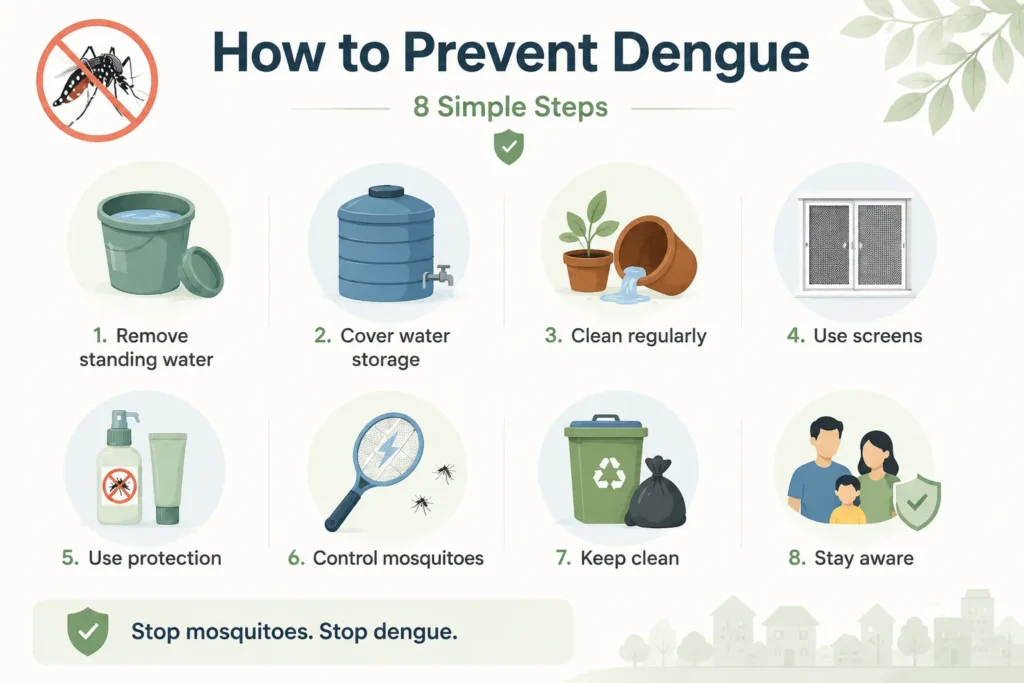
- Empty and scrub water from coolers, buckets, pots and pet bowls at least once a week.
- Cover stored water and clear blocked drains and gutters.
- Throw away or turn over items that collect rainwater, such as old tyres and containers.
- Use mosquito repellent, and wear full-sleeved clothing during the day.
- Fit window screens or use bed nets, especially for young children and the elderly.
Alongside these everyday measures, India is moving towards vaccine-based protection as an added layer for the future. You can read more about the Qdenga dengue vaccine, its price, age eligibility and availability in India.
Keep in Mind: Dengue mosquitoes often breed in clean, still water inside and around the home, not dirty drains. A quick weekly check of your own balcony and terrace does more than you might expect.
AN ILLUSTRATIVE EXAMPLE
Riya, a college student in Chennai, had a high fever for three days and assumed it was flu. On the fourth day her fever dropped, but she developed bad stomach pain and vomited repeatedly. Her family, knowing that falling fever can be the danger point in dengue, took her to hospital that evening. Early fluids and monitoring meant she recovered within days. The lesson: feeling briefly “better” as the fever falls is exactly when to stay alert. (An illustrative example, not a real patient.)
Dengue: Myth vs Fact
| Myth | Fact |
|---|---|
| Dengue mosquitoes breed only in dirty water. | They breed mainly in clean, standing water in and around homes. |
| A low platelet count always means a life-threatening emergency. | Platelets often fall in dengue and recover on their own; treatment is guided by warning signs and a doctor’s assessment, not the number alone. |
Key Takeaways
- Treat mid-2026 figures as a snapshot, not the full year; expect higher numbers through the monsoon peak.
- If you live in a high-burden state, be extra vigilant about a fever during the rains.
- Watch most carefully after the fever breaks, when warning signs tend to appear.
- Get tested with your symptom-day in mind, and let a doctor guide treatment.
- Spend a few minutes each week removing standing water at home.
Frequently Asked Questions
How many dengue cases have been reported in India in 2026?
According to provisional government data, India recorded 23,952 dengue cases and 31 deaths between January and June 2026. Because the monsoon peak drives most cases, the year-end total is expected to be considerably higher.
Which state has the most dengue cases in India?
Tamil Nadu reported the highest number of cases in the first half of 2026, with 7,511. Southern states together made up around 63% of the national caseload.
Why does Kerala have more dengue deaths than states with more cases?
Kerala reported 19 of India’s 31 dengue deaths this year despite not having the most cases. Death figures can be shaped by how deaths are audited, the health of those affected, how fast patients reach care, and the circulating virus strain. Provisional counts should be read with caution.
What are the danger signs of dengue?
Seek urgent care for severe stomach pain, repeated vomiting, bleeding from the gums or nose, difficulty breathing, extreme tiredness or restlessness, or cold, clammy skin. These warning signs often appear as the fever drops.
When is dengue most dangerous during the illness?
The riskiest phase is usually when the fever starts to fall, roughly days three to seven. This is when severe complications can develop, so watchfulness should increase rather than relax at that point.
Which blood test confirms dengue?
In the first week, an NS1 antigen test detects the virus directly. From about day four to five, and especially after day seven, an IgM antibody test is used. Your doctor chooses based on how many days you have had symptoms.
Does a low platelet count mean I need a transfusion?
Not usually. Platelet counts commonly fall in dengue and rise again as you recover. Whether any treatment is needed depends on warning signs and a doctor’s overall assessment, not the platelet number by itself.
How can I protect my family during the monsoon?
Empty standing water at home weekly, cover stored water, use repellent and full-sleeved clothing, and fit screens or nets. The dengue mosquito bites mostly during the day, so daytime protection matters as much as night.
Disclaimer:
This article is for general information and public awareness only. It is not a substitute for professional medical advice, diagnosis or treatment. Case figures are provisional and may change as authorities update them. Always follow what your doctor tells you, and seek urgent care for any dengue warning signs.
Written by:
Iraphan Khan, BSN, RN, D.Pharm is the founder of RealMedVision and a Public Health Researcher who creates evidence-based health content from trusted medical sources.
Medically reviewed by:
Dr. Praveen Verma, MBBS, MD (Pathology)
Dr. Himanshu Morya, MBBS, Medical Educator.
About the author:
Iraphan Khan is a registered nurse and public health researcher who writes evidence-based health explainers for Indian readers, drawing on primary sources such as the NCVBDC, WHO and peer-reviewed medical literature.
References
- Ministry of Health & Family Welfare, Government of India. Rajya Sabha reply on monsoon disease surveillance, 28 July 2026 (state-wise dengue cases and deaths, Jan–June 2026).
- National Center for Vector Borne Diseases Control (NCVBDC), MoHFW. Dengue Situation in India. ncvbdc.mohfw.gov.in
- World Health Organization. Dengue and severe dengue – fact sheet and clinical guidance. who.int
- Centers for Disease Control and Prevention. Clinical Features of Dengue (warning signs, severity). cdc.gov
- Centers for Disease Control and Prevention. Clinical Testing Guidance for Dengue (NS1, IgM, IgG timing). cdc.gov
- Al Jazeera. Why India’s dengue crisis is no longer confined to the monsoons, 11 June 2026. aljazeera.com
- The South First. South India dominates India’s dengue burden (MoHFW Rajya Sabha data), July 2026. thesouthfirst.com
- Seasonal variation and environmental correlates of dengue outbreaks in India (2017–2023), PMC, 2024. Dengue peaks in the monsoon and post-monsoon months. pmc.ncbi.nlm.nih.gov