
A patient-friendly guide by RealMedVision.
Medically reviewed | 10 to 12 min read
On 21 July 2026, India announced approval of its first dengue vaccine. Qdenga is cleared for ages 4 to 60.
In the main trial, two doses cut dengue hospitalizations by 84.1 percent over 4.5 years.
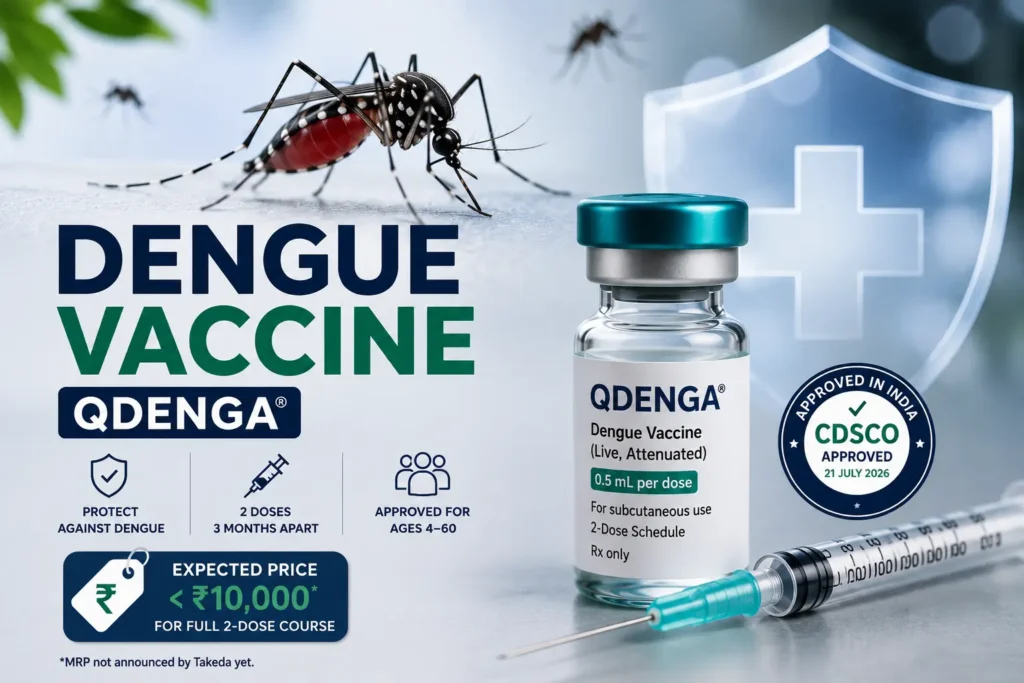
Every monsoon, dengue pulls thousands of Indian families into the same loop of fever, tests and worry. That is starting to change. On 21 July 2026, the Central Drugs Standard Control Organisation (CDSCO) announced marketing authorization for Qdenga, the first dengue vaccine in India to receive it. This guide covers who can take it, how well it works, its likely cost, and when it will reach you. [Chandipura virus explainer]
Quick Answer
- Qdenga is India’s first approved dengue vaccine, cleared by CDSCO on 21 July 2026.
- It is approved for ages 4 to 60 and covers all four dengue virus types.
- The course is two injections three months apart, given under the skin.
- No dengue test is needed before vaccination, even after past dengue.
- The Indian price is not announced yet, and launch is targeted around mid-2027.
What Is the Qdenga Vaccine
Qdenga is a live attenuated tetravalent dengue vaccine from the Japanese company Takeda. Tetravalent means it targets all four dengue virus types, called serotypes 1 to 4. Live attenuated means it carries weakened viruses that train your immune system without causing the disease.
It was built with recombinant DNA technology, using a weakened dengue type 2 virus as the base, with surface proteins of the other three serotypes engineered into it. It comes as a freeze dried powder mixed with a solvent just before injection.
It is already approved in 42 countries, including the European Union, the United Kingdom, Indonesia and Thailand. The World Health Organization (WHO) prequalified it in May 2024, and more than 24 million doses have been distributed worldwide.
How the vaccine works
After the injection, the weakened viruses multiply briefly and your immune system builds antibodies and memory cells against all four serotypes. If a real infection arrives later, the body recognizes the virus early and fights it before severe illness. A second infection can be more serious, particularly when it involves a different serotype.
Is the Qdenga Vaccine Available in India Now?
Approved, yes. Available, not yet.
The CDSCO, under the Ministry of Health and Family Welfare, granted marketing authorization after reviewing quality, safety and efficacy data. The clearance covers prevention of dengue in people aged 4 to 60 years, with the vaccine made by Takeda GmbH in Germany and imported by Takeda Biopharmaceuticals India. The review also drew on an Indian Phase 3 safety and immunogenicity study. Officials called it a milestone that supports, not replaces, mosquito control and early diagnosis under the national programme.
| Qdenga at a Glance | Details |
|---|---|
| Vaccine type | Live attenuated, tetravalent, covers serotypes 1 to 4 |
| India approval | CDSCO marketing authorization announced 21 July 2026 |
| Approved age group | 4 to 60 years |
| Doses | Two doses of 0.5 ml, at 0 and 3 months |
| Route | Subcutaneous injection, usually the upper arm |
| Pre vaccination dengue test | Not required |
| Global status | Approved in 42 countries, WHO prequalified, 24 million plus doses distributed |
| India availability | Not in the market yet, launch targeted around mid-2027 |
Approval alone does not put the shot at your nearest hospital. Takeda is targeting a market launch around mid-2027, with supply planned through a manufacturing partnership with Hyderabad based Biological E, which can produce up to 50 million doses a year. Once launched, Qdenga, at present the only approved dengue vaccine in India, will be sold through the private market on prescription, outside the government immunization programme for now.
Keep in Mind: Until the launch, anyone selling you a Qdenga shot in India is a red flag. Verify availability only with a registered hospital or your doctor.
Qdenga Vaccine Price in India
Takeda has not announced the Indian MRP. Company statements speak of access oriented pricing, and a doctor quoted in Indian media expects a figure below Rs 10,000, though the estimate is unofficial and does not clarify one dose or both. Treat any number online as speculation until Takeda confirms it.
Qdenga Vaccine Age Limit and Who Can Take It
In India, the approved age range is 4 to 60 years. Children below 4 were not part of the trials, and there is no usage data in adults above 60, which is why both sit outside the approval. Within this range, the vaccine can be taken with or without past dengue. Being inside the band does not make the shot automatic. A doctor still reviews your health history first.
The WHO position paper recommends children aged 6 to 16 in areas with intense transmission, partly because efficacy was lower in the youngest trial participants and school age children carry a heavy share of severe dengue. Indian guidance on priority groups will come closer to launch.
| Within the Approved Group | Not Approved or Contraindicated |
|---|---|
| Ages 4 to 60 years | Under 4 or over 60, outside the approval |
| Previous dengue infection | Pregnancy or breastfeeding |
| No previous dengue infection | Immune deficiency or immunosuppressive treatment, including chemotherapy and high dose steroids |
| A mild cold on the day, subject to doctor review | Symptomatic HIV, or HIV with reduced immune function |
| Controlled chronic conditions after medical review | Serious allergy to a previous dose or any ingredient |
How Many Doses of Qdenga Are Needed
The two dose schedule
The full course is two injections of 0.5 ml each, three months apart. Both doses are needed for the protection seen in trials, so note the second date at the first shot. The injection goes under the skin of the upper arm, never into a vein or muscle. A mild cold on the day is no reason to postpone. Only an acute illness with high fever defers the shot.
If the second dose gets delayed
Missed the three month window? The course does not restart. WHO guidance says the second dose is simply given at the earliest opportunity. A longer gap is acceptable, a shorter one is not advised.
Patient Tip: Before your shot, tell the doctor about your medicines, any past vaccine allergy, and any recent blood or immunoglobulin transfusion, since a six week to three month gap is advised after these.
How Effective Is the Qdenga Vaccine
The main evidence comes from the TIDES trial, which followed over 20,000 children and adolescents aged 4 to 16 years across eight dengue endemic countries, with the longest follow up reported for any dengue vaccine.
What the trial found
Twelve months after the second dose, the vaccine prevented 80.2 percent of lab confirmed dengue cases compared with placebo, and protection against hospitalization reached 90.4 percent through 18 months. Over 4.5 years, cumulative efficacy settled at 61.2 percent against confirmed dengue and 84.1 percent against hospital admission. Follow up to seven years found protection sustained, and the schedule stays at two doses without a booster.
What prior infection changes
Results were somewhat better after past dengue. At 4.5 years, efficacy against confirmed dengue was 64.2 percent in previously infected participants and 53.5 percent in those never infected, while against hospitalization the figures were 85.9 percent and 79.3 percent. One gap deserves honesty. In people with no past dengue, protection was shown against serotypes 1 and 2, was not observed against serotype 3, and serotype 4 cases were too few to judge. Adults were not part of the efficacy trial, so approval for ages 17 to 60 rests on immune response studies, including data from India.
| Outcome Measured | Time Point | Vaccine Efficacy |
|---|---|---|
| Confirmed dengue, overall | 12 months after dose 2 | 80.2 percent |
| Dengue hospitalization | Through 18 months | 90.4 percent |
| Confirmed dengue, overall | Through 4.5 years | 61.2 percent |
| Dengue hospitalization | Through 4.5 years | 84.1 percent |
| Confirmed dengue, previously infected | Through 4.5 years | 64.2 percent |
| Confirmed dengue, never infected | Through 4.5 years | 53.5 percent |
Qdenga Vaccine Side Effects and Safety
Common side effects
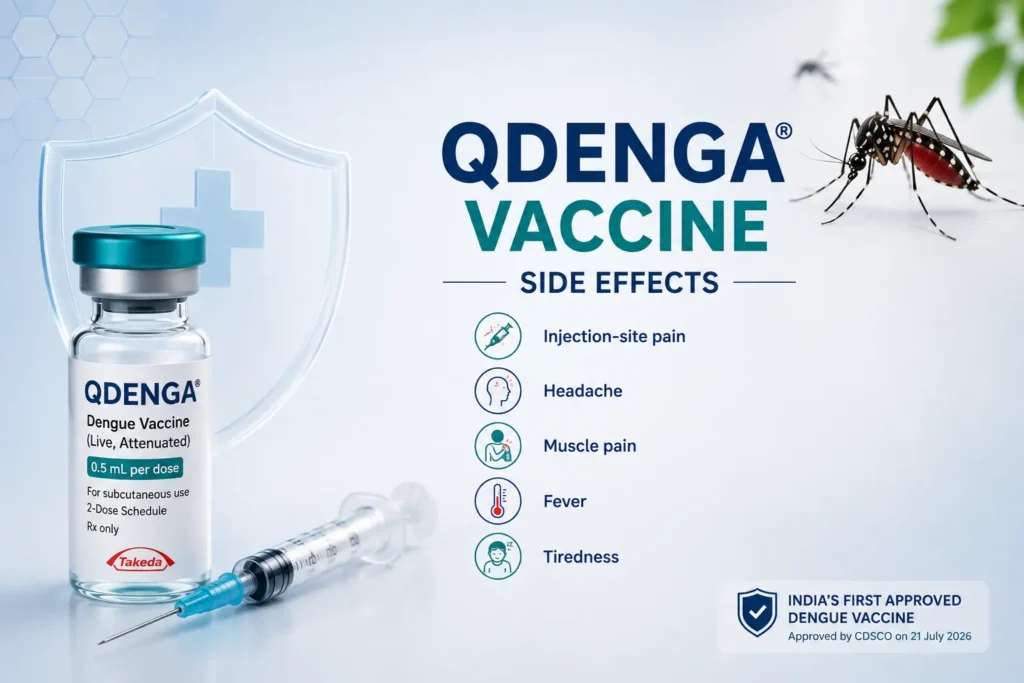
Most reactions are mild and settle in one to three days. In clinical studies the most frequent were injection site pain (50 percent), headache (35 percent), muscle ache (31 percent), site redness (27 percent), feeling unwell (24 percent), tiredness (20 percent) and fever (11 percent). Reactions were fewer after the second dose. Some people, mostly those never infected before, notice brief flu like symptoms in the second week as the weakened vaccine virus circulates. This can even turn a dengue test positive temporarily, so mention your recent vaccination if you get tested.
Rare but serious reactions
Severe allergic reactions, including anaphylaxis, are rare but possible, so the shot is given where staff can respond. Very rare reports include angioedema, a deep skin swelling, and a drop in platelet count. Post marketing data from countries using the vaccine show a favourable safety record with no major concerns.
Who Should Not Take the Qdenga Vaccine
Because it is a live vaccine, Qdenga is contraindicated in pregnancy and breastfeeding, and women who can become pregnant should avoid pregnancy for at least one month after each dose. It must also be avoided in weakened immunity, whether from a congenital condition, cancer chemotherapy, high dose steroids, or HIV that is symptomatic or has reduced immune function. A serious allergic reaction to a previous dose or any ingredient also rules it out. A high fever on vaccination day means the dose is postponed, not cancelled.
Can You Take Qdenga After Having Dengue
Unlike the older Dengvaxia vaccine, Qdenga needs no blood test for past dengue infection before vaccination. People with and without a dengue history can receive it within the approved age range.
How Qdenga Compares With Other Dengue Vaccines
Dengvaxia, the world’s first dengue vaccine, was never launched in India and requires proof of past infection, because it raised severe disease risk in people vaccinated without prior exposure. Qdenga carries no such screening requirement. India is also building its own option. DengiAll, an indigenous tetravalent candidate from Panacea Biotec and ICMR, entered a Phase 3 trial in 2024 with over 10,000 adults aged 18 to 60 across 19 sites. It is not approved yet, but success could widen supply and cut prices.
Myth vs Fact
Myth: A live vaccine like Qdenga gives you dengue.
Fact: The weakened viruses cannot cause dengue disease. Some people get brief, mild symptoms while immunity builds, which pass on their own.
Myth: Once vaccinated, mosquito protection is no longer needed.
Fact: Protection is strong but not complete and varies by serotype. Repellents and covered clothing remain necessary after vaccination.
When to Call Your Doctor
Seek medical help without delay if you notice difficulty breathing, swelling of the face or throat, a widespread rash within hours of the shot, or a high fever that refuses to settle. Vaccinated or not, treat these dengue warning signs as emergencies during any fever: severe stomach pain, persistent vomiting, bleeding gums, blood in vomit or stool, extreme drowsiness, or cold, clammy skin.
Key Takeaways
- Ask your doctor whether you and your children fall in the 4 to 60 age band so you are ready when booking opens.
- Plan two clinic visits three months apart, because a single dose is not the tested course.
- Budget only after Takeda announces the MRP, and ignore any seller claiming stock before the official launch.
- Keep using repellents and removing stagnant water after vaccination, since protection is not absolute.
- If pregnant, breastfeeding, or on immunity lowering treatment, this vaccine is not for you, so discuss alternatives with your doctor.
Frequently Asked Questions
What is the Qdenga vaccine?
Developed by Takeda, Qdenga is a live attenuated vaccine covering all four dengue virus serotypes. Its approval, announced on 21 July 2026, made it the first dengue vaccine approved in India.
What is the price of the Qdenga vaccine in India?
The Indian price is not announced yet. Takeda speaks of access oriented pricing, and a doctor quoted in Indian media expects under Rs 10,000, but no official MRP exists.
What is the age limit for the Qdenga vaccine in India?
Ages 4 to 60 years. Children under 4 and adults over 60 fall outside the approval because of limited data in those groups.
How many doses of Qdenga are needed?
Two doses of 0.5 ml each, three months apart, injected under the skin. A delayed second dose does not restart the course.
Is the Qdenga vaccine available in India now?
Not yet. Approval was announced on 21 July 2026, and Takeda targets a launch around mid-2027 through the private market on prescription.
Can I take Qdenga if I have already had dengue?
Yes. No blood test for past infection is needed, and previously infected people showed strong protection, with 85.9 percent efficacy against hospitalisation over 4.5 years.
What are the common side effects of the Qdenga vaccine?
Injection site pain, headache, muscle ache, redness, feeling unwell, tiredness and mild fever are the most reported, usually settling within one to three days.
Can pregnant or breastfeeding women take the Qdenga vaccine?
No. As a live vaccine it is contraindicated in pregnancy and breastfeeding, and pregnancy should be avoided for at least one month after each dose.
How effective is the Qdenga vaccine?
In the TIDES trial, efficacy was 80.2 percent at 12 months after dose two, and over 4.5 years it was 61.2 percent against dengue and 84.1 percent against hospitalisation.
Is India making its own dengue vaccine?
Yes. DengiAll, from Panacea Biotec with ICMR, is an indigenous tetravalent candidate in Phase 3 trials with over 10,000 participants aged 18 to 60. It is not approved yet.
Disclaimer:
This article is for education and general awareness only. It is not medical advice, diagnosis or treatment. Vaccine decisions depend on your health history, so always follow what your doctor tells you. If symptoms worsen or an emergency develops, contact your nearest hospital or a qualified medical professional immediately.
Medically reviewed by:
This guide was checked for medical accuracy by our review board before publishing.
Dr. Praveen Verma, MBBS, MD (Pathology), Pathologist and Clinical Laboratory Specialist.
Dr. Himanshu Morya, MBBS, Medical Educator.
Written by:
Iraphan Khan, BSN, RN, D.Pharm is the founder of RealMedVision and a Public Health Researcher who creates evidence-based health content from trusted medical sources.
References
- Press Information Bureau, Ministry of Health and Family Welfare. CDSCO approves India’s first dengue vaccine. 21 July 2026.
- World Health Organization. WHO prequalifies new dengue vaccine. 15 May 2024.
- World Health Organization. WHO position paper on dengue vaccines. Weekly Epidemiological Record. May 2024.
- World Health Organization. Vaccines and immunization: Dengue. Questions and answers. 2025.
- Biswal S, et al. Efficacy of a tetravalent dengue vaccine in healthy children and adolescents. New England Journal of Medicine. 2019.
- Tricou V, et al. Long term efficacy and safety of a tetravalent dengue vaccine (TAK-003): 4.5 year results. The Lancet Global Health. 2024.
- Electronic Medicines Compendium. Qdenga Summary of Product Characteristics. Updated 2024.
- European Medicines Agency. Qdenga medicine overview. 2022.
- Takeda. New Phase 3 data show dengue vaccine delivers 7 years of sustained protection. October 2025.
- Takeda and Biological E Limited. Partnership to accelerate access to dengue vaccine. February 2024.
- Citeline Scrip. Takeda sees Qdenga India launch by mid-2027. July 2026.
- The Tribune. ICMR, Panacea Biotec begin Phase 3 trial of indigenous dengue vaccine. August 2024.