
H1N1 virus in India is back in the news in 2026. Not sure if your symptoms are ordinary flu or H1N1? Here is what people in India need to know.
Evidence-based patient guide · Updated 24 August 2026 · RealMedVision
H1N1 Virus in India 2026: Quick Answer
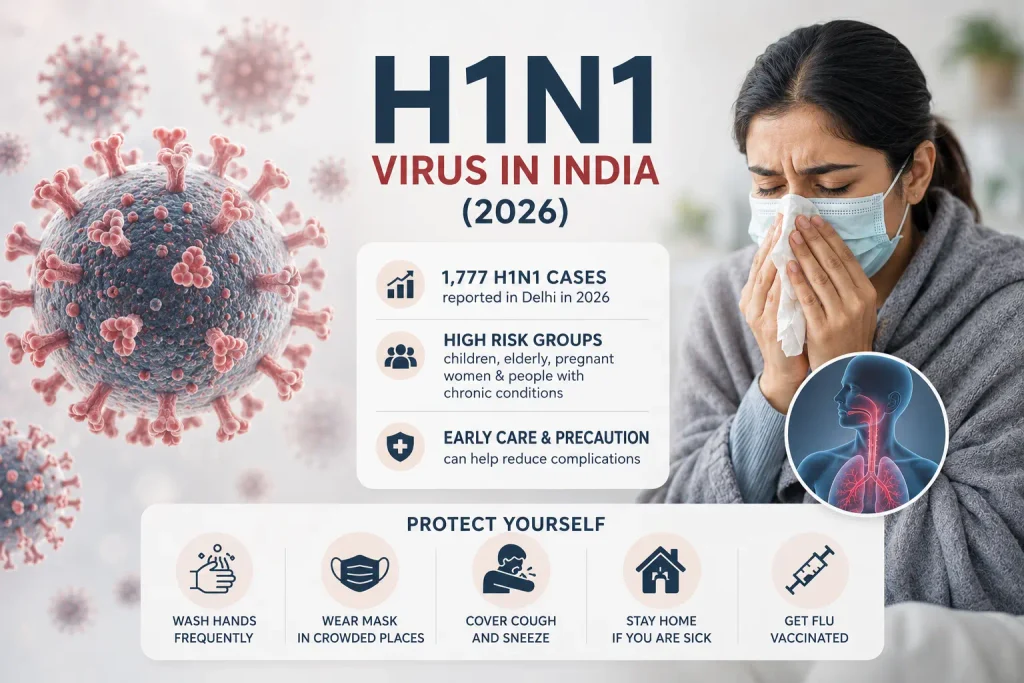
The H1N1 virus in India is a seasonal strain of influenza A, better known as swine flu. Delhi has reported 1,777 H1N1 cases in 2026 as of 21 August, nearly eight times the count for the same period last year, and ICMR has confirmed that no new strain is behind the rise.
- Common symptoms: sudden fever, cough, sore throat, body aches, headache and tiredness.
- Highest risk: children under 5, adults 65 and older, pregnant women and people with chronic health conditions.
- Treatment: rest, fluids and fever control for mild illness. Doctors may prescribe antivirals such as oseltamivir for severe or high-risk cases, ideally within 48 hours of symptoms starting.
- When to act: breathing difficulty, chest pain, confusion or symptoms that keep getting worse need urgent medical care.
What Is the H1N1 Virus in India?
H1N1 is a subtype of the influenza A virus. Most people know it as swine flu, a name that stuck after the 2009 pandemic, when the virus was first linked to flu viruses found in pigs. That pandemic strain never went away. Doctors now call it A(H1N1)pdm09, and it returns every year as part of normal seasonal flu.
So the H1N1 virus in India is not something new in 2026. It circulates during flu season alongside other strains such as H3N2, and the National Centre for Disease Control tracks cases and outbreaks across states each year.
How Does H1N1 Spread?
The virus spreads mainly through droplets released when an infected person coughs or sneezes. You can catch it when these droplets reach your nose, mouth or eyes. Unwashed hands matter too. If you touch a contaminated surface and then touch your face, the virus can enter the same way.
Symptoms usually appear quickly, about one to four days after infection. This short gap is one reason flu can move fast through homes, schools and offices.
H1N1 Cases in Delhi 2026: What Is Happening?
Delhi Health Department data released on 21 August 2026 put the city’s influenza A count at 2,392 for the year, with 1,777 of those confirmed as H1N1. The pace has been steep. On 20 August alone, 114 new H1N1 cases were added to the tally.
That takes Delhi to nearly eight times the 229 H1N1 cases it had recorded by the same point in 2025. The pressure is visible inside hospitals too. Several healthcare workers, including doctors treating flu patients, have tested positive during the surge, which has stretched staffing in some wards.
Is a New H1N1 Strain Behind the Delhi Surge?
No. The Indian Council of Medical Research has confirmed that no new H1N1 strain has been detected in India. The viruses circulating now belong to the A/Missouri/11/2025 (H1N1)pdm09-like strain, which has been around since 2025. ICMR also noted that these viruses match the strains covered by this season’s influenza vaccines. In short, a familiar virus is spreading widely, not a new threat.
Have Any H1N1 Deaths Been Confirmed in Delhi?
As of 24 August 2026, the Delhi Health Department has not attributed any deaths to H1N1 this year. Some media reports have mentioned suspected hospital-linked deaths, but health authorities have not officially confirmed them. Case and death counts are a snapshot, not a final total, and they can change as testing continues. When the numbers matter to you, rely on official government updates rather than isolated headlines.
What Is the Government Doing About the Surge?
The response has moved on several fronts. The Delhi government issued a health advisory on 22 August urging people to follow respiratory hygiene, wear masks in crowded places and seek medical advice early. Union Health Minister J P Nadda reviewed Delhi’s influenza preparedness on 21 August, and hospitals have been asked to strengthen testing, surveillance and bed capacity. The health department has also designated two referral laboratories, at AIIMS and the National Centre for Disease Control, for influenza testing.
A rise in cases does not mean every cough or fever in Delhi is H1N1. Several respiratory viruses can cause similar symptoms. Testing and clinical assessment are needed when knowing the exact cause will change management or public health decisions.
History of the H1N1 Virus in India: The Longer Pattern
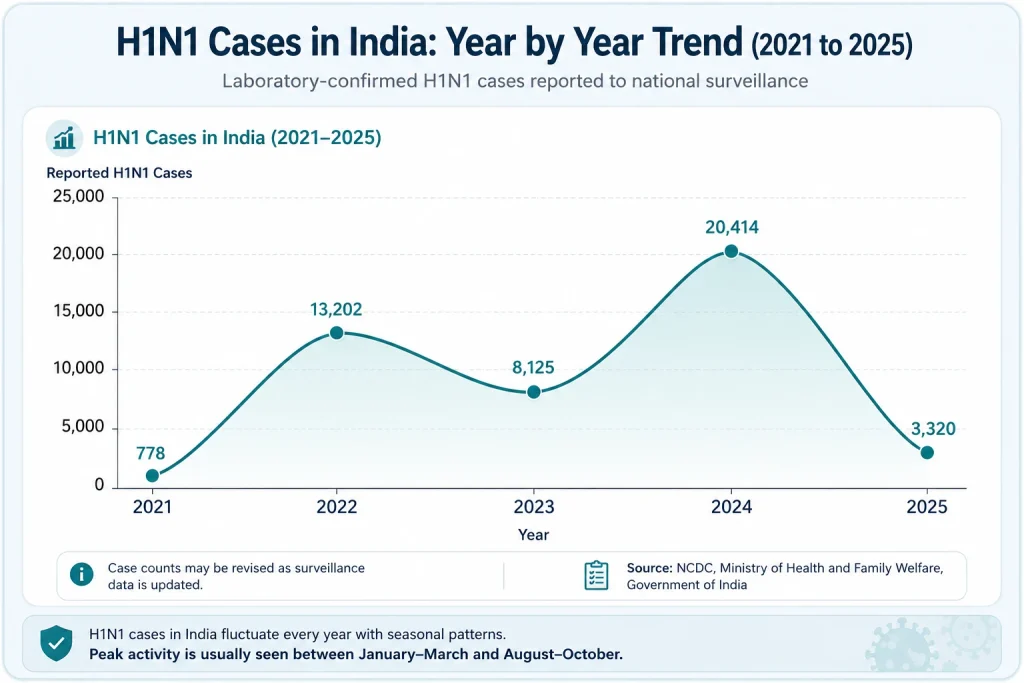
H1N1 activity in India does not move in one steady line. Case counts swing sharply from year to year, which is why a single year read in isolation can mislead. India also runs on a twin-wave flu calendar, with cases climbing between January and March and again after the monsoon, from August to October.
The swings continued after 2024. In 2025, India recorded 3,320 cases and 14 deaths, according to NCDC data, far below the 2024 peak. Delhi alone has already reported more than half that national figure in 2026, with 1,777 cases as of 21 August. A peer-reviewed analysis of 2010 to 2017 surveillance data points the same way, finding Maharashtra, Delhi and Gujarat among the worst-affected states, both in total cases and relative to population.
H1N1 Symptoms in India
The symptoms of H1N1 are similar to those of other influenza infections. This is why it is difficult to identify the strain from symptoms alone.
Common Symptoms of H1N1
- Sudden fever
- Dry or persistent cough
- Sore throat
- Runny or blocked nose
- Headache
- Body aches
- Muscle or joint pain
- Chills
- Feeling unusually tired or weak
Vomiting or diarrhoea can also occur, more often in children. Not everyone gets every symptom, and a few people never develop a noticeable fever.
Most healthy people start feeling better within about a week. The cough, however, can last longer.
When Should You See a Doctor?
Seek medical advice if symptoms are getting worse instead of better, especially if you have breathing difficulty, chest pain, severe weakness, confusion, signs of dehydration or a worsening of an existing medical condition.
Children with fast or difficult breathing, poor fluid intake, unusual sleepiness or other worrying symptoms should be assessed promptly.
Who Has a Higher Risk of Serious Flu?
Most people recover from H1N1 without complications. The groups below are more likely to become seriously ill, so early medical advice matters more for them.
Treatment for H1N1 Flu: What Actually Helps?
There is no single treatment that every person with H1N1 needs. Most mild cases settle with rest, fluids and simple fever control at home, and staying home while unwell also limits spread to others.
Antibiotics do not work on H1N1 because it is a virus, not bacteria. A doctor may add them only for a separate bacterial infection.
What About Oseltamivir?
Oseltamivir is a prescription antiviral that doctors may use for people who are severely ill, hospitalised or at higher risk of complications. It works best when started early, ideally within 48 hours of symptoms beginning, though later treatment can still help in severe or high-risk cases.
Do not start it on your own because someone at home has a cough and fever. Whether it is needed depends on symptoms, health history and risk factors, and that call belongs to a doctor.
H1N1 Test: How Is Swine Flu Diagnosed?
Not everyone with flu symptoms needs an H1N1 test.
When flu is circulating widely, doctors often diagnose it from symptoms and the local situation alone. Testing matters more when the result will change treatment, infection control or hospital decisions.
Laboratories confirm influenza from respiratory samples, usually with an RT-PCR test. Rapid tests exist too, but they are less sensitive.
When May Testing Be Considered?
- Severe or progressive illness
- Hospital admission
- People at high risk of complications
- Situations where the result may change treatment
- Public health surveillance or outbreak investigation
H1N1 Vaccine Name in India
There is no separate H1N1 vaccine to look for. Protection against H1N1 is built into the seasonal influenza vaccine, whose composition the World Health Organization reviews twice a year, once for each hemisphere.
For the 2026 to 2027 Northern Hemisphere season, the recommended composition includes an A/Missouri/11/2025 (H1N1)pdm09-like strain, along with an H3N2 strain and an influenza B/Victoria strain. That H1N1 component is the same strain ICMR has identified in the current Indian surge, which is reassuring for this season’s vaccines.
Which exact product you can get in India depends on the country’s own approval and supply process. Ask a doctor or pharmacist which influenza vaccine is currently available near you, and about the right timing for your age and medical history.
Annual vaccination matters most for higher-risk groups, including pregnant women, young children, older adults, people with chronic conditions and healthcare workers. It cannot promise zero flu, but it clearly lowers the risk of severe illness.
Vaccination against some other monsoon infections works differently. Dengue, for example, now has a licensed vaccine option in India, covered in our Qdenga vaccine guide, while flu vaccines are updated and repeated every year.
H1N1 Virus in India Death Rate: Is There One Fixed Number?
No. The risk of death from H1N1 shifts with age, pregnancy, underlying disease, access to care and how many mild cases ever get tested, so no single percentage fits every outbreak. For background on how flu severity is assessed worldwide, the WHO seasonal influenza fact sheet is a useful reference.
Be careful with websites quoting one fixed H1N1 death rate for every country and year. A peer-reviewed analysis of India’s surveillance data from 2010 to 2017 recorded 114,667 cases and 8,543 deaths, a 7.5% fatality rate among laboratory-confirmed, generally sicker patients. Recent years have seen far lower fatality rates even when case counts stayed high.
Most people with seasonal influenza recover. Serious illness and deaths occur more often among people in higher-risk groups. Influenza can lead to complications such as pneumonia and can worsen existing heart, lung, kidney or metabolic conditions.
H1N1 vs H3N2: What Is the Difference?
H1N1 and H3N2 are both subtypes of influenza A. They can cause very similar symptoms, including fever, cough, sore throat, body aches and fatigue, so you usually cannot tell the difference just by looking at symptoms.
If knowing the exact strain matters, laboratory testing is needed. For most patients, the more important question is how severe the illness is and whether they have risk factors for complications.
Is H1N1 the Only Virus Circulating This Season?
Far from it. India’s monsoon months bring several infections at once. Alongside the H1N1 rise, authorities are tracking dengue, malaria and chikungunya in cities like Delhi, plus localised outbreaks such as Chandipura virus. Our guide on Chandipura virus symptoms and treatment explains how that infection differs from seasonal flu.
Because several illnesses can overlap in symptoms during this period, a proper clinical assessment is more reliable than guessing the cause based on symptoms alone.
How to Protect Yourself From H1N1
- Wash your hands regularly with soap and water.
- Cover your mouth and nose when coughing or sneezing.
- Avoid close contact with others when you are sick.
- Stay home when you have significant flu symptoms.
- Do not share personal items if someone in the home is ill.
- Avoid touching your eyes, nose and mouth with unwashed hands.
- Ask a doctor about annual influenza vaccination if you are in a higher-risk group.
H1N1 in India 2026: Key Takeaways
- H1N1 is a strain of influenza A and is now part of seasonal flu circulation.
- Delhi has reported 1,777 H1N1 cases as of 21 August 2026, nearly eight times the count for the same period in 2025.
- ICMR has confirmed no new H1N1 strain is behind the rise.
- Symptoms alone cannot reliably tell H1N1 apart from H3N2 or other flu viruses.
- Most mild cases improve with rest, fluids and symptom care.
- High-risk patients may need early medical assessment and antiviral treatment.
- Seasonal influenza vaccination can help reduce the risk of serious flu illness.
- India typically sees two influenza waves each year, one from January to March and another after the monsoon between August and October.
Frequently Asked Questions
What is H1N1, and is it the same as swine flu?
H1N1 is a subtype of the influenza A virus, commonly known as swine flu. The strain behind the 2009 pandemic now circulates as part of seasonal flu in India and worldwide, and it can cause outbreaks like the current one in Delhi.
Is a new H1N1 strain spreading in India in 2026?
No. ICMR has confirmed that no new H1N1 strain has been detected. The rise in Delhi is driven by the A/Missouri/11/2025 (H1N1)pdm09-like strain, which has been circulating since 2025 and is covered by this season’s influenza vaccines.
What are the first H1N1 virus symptoms?
H1N1 virus symptoms may begin suddenly and can include fever, cough, sore throat, body aches, headache, chills and tiredness.
How long does H1N1 last?
Many people recover from fever and other symptoms within about a week. A cough may last longer.
Is H1N1 contagious, and how does it spread?
Yes. H1N1 spreads mainly through respiratory droplets released when an infected person coughs or sneezes, and through contact with contaminated surfaces followed by touching the face. A person can be infectious from around a day before symptoms start until about a week after becoming sick.
Do I need an H1N1 test for every fever and cough?
No. A doctor may recommend testing when the result will affect treatment or when illness is severe or the patient is at higher risk.
Can H1N1 be treated with antibiotics?
No. Antibiotics do not treat the H1N1 virus itself. They may only be used if a doctor diagnoses a separate bacterial infection.
Is there a separate H1N1 vaccine, and what is it called?
No separate vaccine is needed. Protection against H1N1 is built into the annual seasonal influenza vaccine, which is updated each year to cover the strains expected to circulate. The exact product available in India varies, so ask a doctor or pharmacist about the current option near you.
Can H1N1 affect children differently than adults?
Children, especially those under 5 years, are considered a higher risk group for complications from influenza, including H1N1. Warning signs in children include fast or difficult breathing, poor fluid intake, unusual sleepiness or irritability, and these should be assessed by a doctor promptly.
When should I go to the hospital?
Seek urgent medical care for difficulty breathing, chest pain, confusion, severe dehydration, blue lips or a rapid worsening of symptoms.
Bottom Line on the H1N1 Virus in India
The rise in H1N1 cases in Delhi is a reason to stay informed, not to panic. The H1N1 virus in India is a seasonal influenza strain, and most people recover. The bigger concern is for people who are more likely to develop complications.
If you have mild symptoms, rest, drink fluids and watch how you feel. If you are pregnant, elderly, very young, living with a serious health condition or your symptoms are getting worse, speak with a doctor early.
Written by
Iraphan Khan, BSN, RN, D.Pharm is the founder of RealMedVision and a Public Health Researcher who creates evidence-based health content from trusted medical sources.
Medically reviewed by
Dr. Praveen Verma, MBBS, MD (Pathology)
Dr. Himanshu Morya, MBBS, Medical Educator.
About the author
Iraphan Khan is a registered nurse and public health researcher who writes evidence-based health explainers for Indian readers, drawing on primary sources such as the NCDC, WHO and peer-reviewed medical literature.
References
- National Centre for Disease Control (NCDC), Ministry of Health and Family Welfare, Government of India. Seasonal Influenza A (H1N1) state and UT-wise surveillance data.
- The Tribune. “No new H1N1 strain identified, says ICMR as Delhi cases cross 1,777.” 23 August 2026.
- Business Standard. “Delhi records 1,777 H1N1 cases as health dept issues flu advisory.” 22 August 2026.
- Business Today. “Delhi records 1,777 H1N1 cases: What are the symptoms, who are at risk and how to stay safe.” 22 August 2026.
- Business Today. “H1N1 surge in Delhi: Cases jump six fold year on year to 1,449 as hospital doctors test positive.” 21 August 2026.
- Outlook India. “Delhi H1N1 Cases Near 1,800: Is the Rise a New Swine Flu Outbreak?” 22 August 2026.
- World Health Organization. Recommendations for influenza vaccine composition for the 2026 to 2027 Northern Hemisphere influenza season. 27 February 2026.
- World Health Organization. Influenza (seasonal) fact sheet.
- Chatterjee P, Seth B, Biswas T. “Hotspots of H1N1 influenza in India: analysis of reported cases and deaths (2010-2017).” Tropical Doctor. 2020;50(2):166-169. Via PMC, National Library of Medicine.