
Medically Reviewed: 11 October 2026 • Last Updated: 11 October 2026 • 8 minute read
A positive Widal result is a clue, not a diagnosis. Here is how O and H titres are read, and what Indian studies actually say about confirming typhoid.
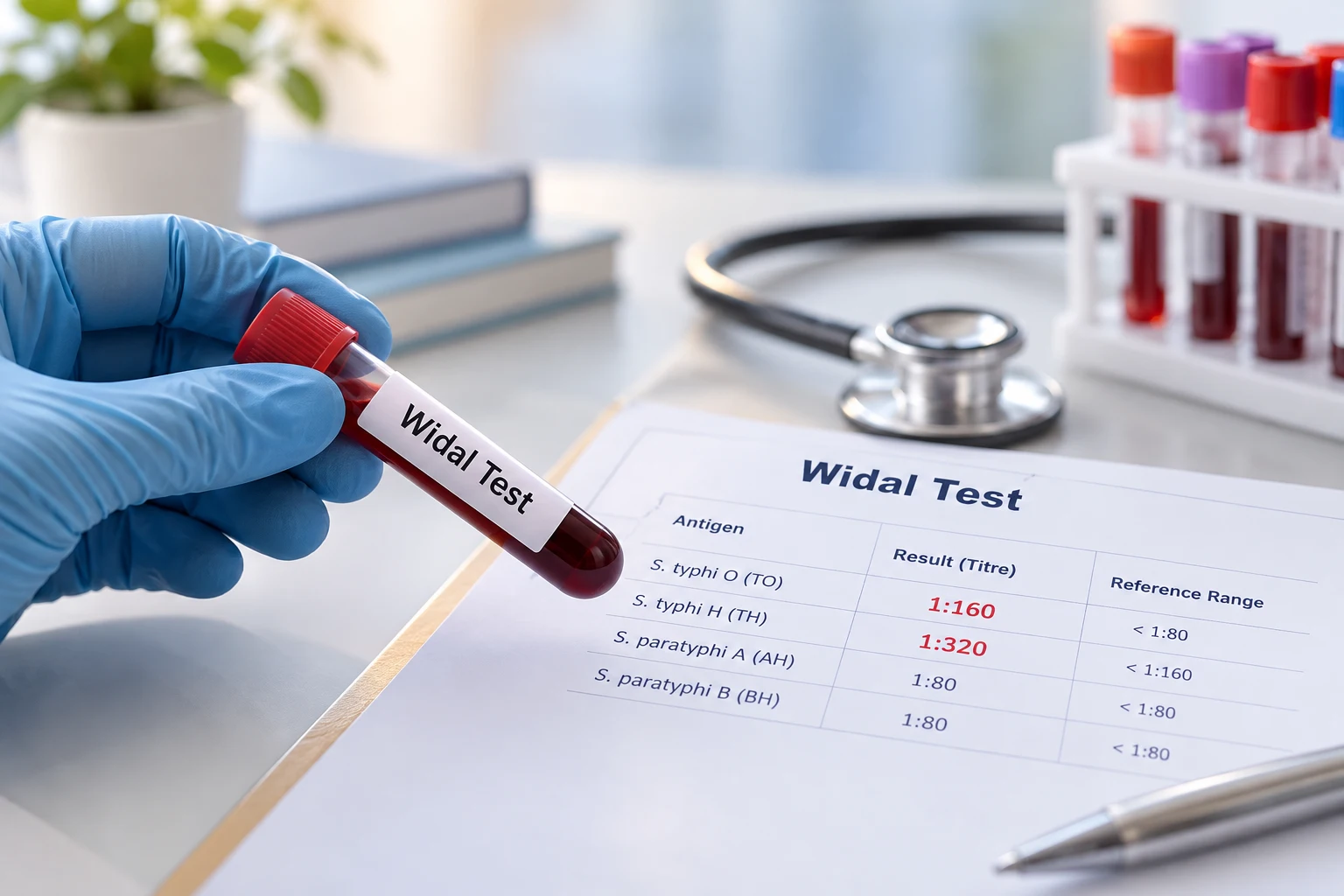
Fever for a few days, a Widal report in your hand, and on it a number like 1:80 or 1:160 with the word reactive beside it. Hard not to read that as a yes.
That result is hard to interpret alone. The test measures antibodies against Salmonella rather than detecting the bacteria, and in a country where typhoid is common, well people already carry some.
Quick Answer
- A positive Widal does not confirm typhoid. It shows antibodies, not bacteria.
- The O and H rows mean different things, so one number cannot be read the same way for both.
- Cutoffs vary by antigen, laboratory method and region. Use the reference range printed on your own report.
- Blood culture is the main confirming test, though a negative one does not rule typhoid out either.
What a Widal Test Positive Report Actually Means
Your serum is mixed with Salmonella antigens and watched for clumping, then diluted until clumping stops. That last dilution becomes the titre, which is why results read as 1:40 or 1:160.
Positive means your blood carries Salmonella antibodies above your laboratory’s threshold, not that bacteria were found. They may come from a current infection, an earlier one, or another illness that cross-reacted.
Widal Test Normal Range in India
Two numbers get confused here. The baseline titre is what healthy people without fever carry. The diagnostic cutoff is the higher level a laboratory uses before calling a result significant.
In 400 healthy Mumbai blood donors the baseline was 1:40 for the S. Typhi O antigen and 1:80 for H, and the authors suggested cutoffs of 1:80 for O and 1:160 for H in that city. A study of 2,164 samples in Garhwal, Uttarakhand, found the same baselines. Both sets of figures are local, not national.
These figures come from specific regional studies. They are not universal diagnostic cutoffs, and your titre cannot confirm or exclude typhoid by itself.
| Titre | Possible interpretation | Keep in mind |
|---|---|---|
| S. Typhi O antigen, the TO row | ||
| 1:40 or lower | At or below the baseline reported in the cited regional studies | Not read as evidence of typhoid |
| 1:80 | The cutoff the Mumbai and Garhwal studies suggested for O | Needs symptoms and a doctor’s reading behind it |
| 1:160 or higher | Above those suggested cutoffs, so more likely to be flagged | Read alongside symptoms. One high titre on its own does not confirm typhoid |
Why the Range Changes From Place to Place
Baseline levels track local transmission, so a healthy adult in a high-burden district may carry titres that would look abnormal elsewhere. Cutoffs also shift with the antigen tested and whether the tube or slide method was used. Indian studies in several states have reached different figures.
What 1:80, 1:160 and 1:320 Mean on Your Report
A Titre of 1:80
The antigen decides how much this matters. On the O row it reaches the cutoff two Indian studies suggested. On the H row it sits at the baseline those same studies measured, which makes it far weaker evidence. Suspicion is not confirmation, and 1:80 alone does not diagnose typhoid.
A Titre of 1:160
On the O row this sits above those proposed cutoffs, and with a week of fever behind it that reasonably increases concern. On the H row it only reaches the cutoff, and because H antibodies linger for months, a raised H alone says less about current illness.
A Titre of 1:320 or Above
High titres with a matching fever history make typhoid more plausible. Whether that changes treatment is a clinical judgement made with the examination and other investigations, not from the number alone.
O, H, AH and BH on Your Report
TO and TH are your antibody levels against Salmonella Typhi. The O antigen comes from the body of the bacterium, and those antibodies often rise earlier and fade sooner. The H antigen comes from the tail, and those tend to appear later and persist for months. Individual responses vary, so this is a pattern, not a timetable.
AH and BH are the same measurements for Salmonella Paratyphi A and B, which cause a similar illness. They sit on separate rows because these are different organisms, with their own cutoffs.
| Week of illness | O antibodies, the TO row | H antibodies, the TH row |
|---|---|---|
| Week 1 | Often negative, and may only begin to rise late in the week | Usually still negative |
| Week 2 | Rising, and usually the first of the two to reach a cutoff | Starting to rise |
| Week 3 | Around its highest point | Rising further, often reaching a cutoff by now |
| Week 4 | Falling back | Still raised, and can stay raised for months |
Illustrative pattern only. Individual responses vary, so this is a guide rather than a timetable.
That timing is why a Widal taken on day two or three of fever can read negative in someone who does have typhoid.
Why a Widal Test Positive Result Can Still Be Wrong
False positives are the main weakness, and the United States Centers for Disease Control and Prevention advises against serological tests such as the Widal for diagnosis. Antibodies from other infections can cross-react with the Salmonella antigens, and background exposure in endemic areas lifts titres in well people.
Dengue deserves a mention, for a different reason than most pages give. It overlaps with typhoid clinically, circulates in the same season, and the two can occur together, so a dengue outbreak complicates any fever workup. How often dengue antibodies cross-react in the Widal itself is less established, so treat it as a differential to exclude.
In October 2026, researchers writing in the Bulletin of the World Health Organization argued for eliminating Widal testing in India altogether, because false positives drive unnecessary antibiotic use and distort surveillance. That is a research argument, not WHO policy, but it shows where expert opinion is moving.
Clinical Note
Where paired testing is used, the second sample is taken about one to two weeks after the first, and a fourfold rise between them carries far more weight than any single number. Repeating is not routine, and your doctor decides whether a second sample would add anything.
Does a Typhoid Vaccine Make the Widal Positive?
This claim is repeated everywhere, and the answer depends on which vaccine you had.
Older whole-cell typhoid vaccines, the TAB type, contained O and H antigens and could raise the titres a Widal measures. Today’s vaccines differ. Typbar-TCV, Typhim Vi and similar products are built around the Vi capsular antigen and raise anti-Vi antibodies. A standard Widal reports TO, TH, AH and BH, and does not measure Vi.
Vi-based vaccines are therefore not expected to directly raise the O or H titres this test measures. The cause of a raised titre still needs clinical interpretation, so tell your doctor which vaccine you had and roughly when.
Why a Negative Widal Does Not Rule Out Typhoid
The test also misses a great deal. In one single-centre North India study covering 2023 to 2024, the Widal detected 7 of the 34 culture-confirmed S. Typhi cases there, a sensitivity of 20.6 percent in that sample. One hospital and a small number of patients, so that is not a national figure, but it points the same way as the wider literature.
One reason for a negative result is testing early in the illness, before antibody levels have risen. If fever persists and typhoid is still suspected, a negative Widal should not end the investigation.
Which Test Actually Confirms Typhoid
Blood culture is the mainstay, and CDC guidance names it as the test to rely on. It grows the organism, which allows laboratory confirmation. Susceptibility testing is then run on that isolate, and that second step is what shows which antibiotics the strain responds to. Its yield is far from perfect, though. A systematic review found blood culture detected about 61 percent of confirmed cases, against about 96 percent for bone marrow culture, and the yield falls further once antibiotics have started. A negative culture does not rule typhoid out.
| Test | What it does for you | Keep in mind |
|---|---|---|
| Blood culture | Identifies the organism, allowing laboratory confirmation | About 61 percent sensitivity in one systematic review. Best taken before antibiotics |
| Susceptibility testing | Run on the cultured organism to guide antibiotic choice | A separate step, only possible if something grows |
| Widal test | Supportive at best, and not recommended for diagnosis by CDC | Cheap and quick, which is why it remains in use |
| Bone marrow culture | Around 96 percent in the same review, including after antibiotics | Invasive, so reserved for difficult cases |
What To Do After a Widal Test Positive Report
Take your Widal report to a doctor and explain when the fever started, how high it has been, what other symptoms you have, and which medicines you have taken. These details help the doctor interpret the result.
A Widal result alone cannot confirm typhoid. Your doctor may recommend a complete blood count to assess your general condition, along with other tests based on your symptoms and examination. Liver function tests or kidney function tests may be needed in some cases. If dengue is also suspected, your doctor may advise a dengue test. A blood culture may be recommended to look for the bacteria that cause typhoid.
Emergency: Go to Hospital Now
Untreated typhoid can bleed from or perforate the bowel, usually after two to three weeks of illness, though timing varies. Do not wait for an appointment if any of these appear.
- Severe or worsening abdominal pain, or a swollen, rigid abdomen
- Blood in the stool, or black tarry stools
- Confusion, drowsiness, or difficulty waking the person
- Breathlessness, or no urine passed for many hours with persistent vomiting
When to Call Your Doctor
Arrange a prompt review if fever continues beyond a week, returns after settling, or is not improving on treatment. If you feel seriously unwell, do not wait out a set number of days.
Illustrative Scenario
Four days of fever, a Widal showing TO 1:80 and TH 1:160, and a chemist offering antibiotics. The doctor sends a blood culture and a dengue test instead, and repeats the Widal later. Culture is negative, dengue positive, titres unchanged. Together that makes typhoid less likely, though it does not establish where the H antibodies came from.
Composite example, not a specific patient.
What To Do Next
- Do not start antibiotics on a Widal result alone. Ask whether a blood culture should be sent first.
- Check which row is raised, O or H, before drawing any conclusion from the number.
- Tell your doctor which typhoid vaccine you have had, and roughly when.
- Go back if fever continues past a week, even if the Widal was negative.
Frequently Asked Questions
Does a Widal test positive result confirm typhoid?
No. It detects antibodies rather than bacteria, and CDC guidance advises against serology for diagnosing typhoid because false positives are frequent.
What does a Widal titre of 1:80 mean?
That depends on the row. On the O line it reaches the cutoff two Indian studies proposed. On the H line it sits at the healthy baseline, so it carries much less weight.
Is a Widal titre of 1:160 high?
For the O antigen it sits above the cutoffs Indian regional studies suggested, which increases concern when fever fits. For H it only reaches that cutoff, and H antibodies persist for months.
What is the normal range of a Widal test in India?
No national range exists. Mumbai and Garhwal studies found a healthy baseline near 1:40 for O and 1:80 for H locally. Use the range printed on your own report.
Does a typhoid vaccine cause a positive Widal?
Older whole-cell TAB vaccines contained O and H antigens and could raise these titres. The Vi polysaccharide and conjugate vaccines used today target the Vi antigen, which a standard Widal does not measure.
Is the slide Widal as reliable as the tube test?
The tube method gives a measured titre and is the one Indian baseline studies used. Slide testing is quicker and is better thought of as a screening step.
Can a Widal test be negative if I still have typhoid?
Yes. Antibodies have not risen in the first days. One single-centre North India study found the Widal detected 7 of its 34 culture-confirmed S. Typhi cases, a sensitivity of 20.6 percent in that sample.
Can someone have typhoid and dengue at the same time?
Yes. Co-infection is documented in India, and both circulate in the same season, which is one reason doctors test for both rather than settling on the first positive result.
References
- Walia K, et al. A case for eliminating Widal testing for enteric fever, India. Bulletin of the World Health Organization, 2026, volume 104, issue 10, pages 714 to 716. DOI 10.2471/BLT.26.295696. ncbi.nlm.nih.gov
- Clinical Guidance for Typhoid Fever and Paratyphoid Fever. Centers for Disease Control and Prevention. cdc.gov
- Baseline antibody titre against Salmonella enterica in a healthy population of Mumbai, Maharashtra, India. International Journal of Microbiology. 2017. ncbi.nlm.nih.gov
- The baseline Widal titre among healthy individuals of the hilly areas in the Garhwal region of Uttarakhand, India. Journal of Clinical and Diagnostic Research. 2013. jcdr.net
- Nishi, Meena RK, Airen L. Antibiotic resistance trends and diagnostic accuracy of Typhi Dot and Widal in enteric fever: a 2023-24 single-centre study from North India. International Journal of Research in Medical Sciences, 2026, volume 14, issue 8, pages 3237 to 3240. DOI 10.18203/2320-6012.ijrms20262329. doi.org
- Evaluating alternatives to the Widal test for typhoid fever diagnosis in developing countries: a targeted literature review. Journal of Public Health in Africa. 2025. publichealthinafrica.org
- Use of Widal test in the diagnosis of typhoid fever in a North Indian population by estimating baseline titer in a control group. Asian Journal of Pharmaceutical and Clinical Research, 2017. innovareacademics.in
- Efficacy and immunogenicity of a Vi-tetanus toxoid conjugate vaccine using a controlled human infection model of Salmonella Typhi, describing Typbar-TCV and Typhim Vi as Vi antigen vaccines. 2017. ncbi.nlm.nih.gov
- Mogasale V, Ramani E, Mogasale VV, Park J. What proportion of Salmonella Typhi cases are detected by blood culture? A systematic literature review. Annals of Clinical Microbiology and Antimicrobials, 2016. ncbi.nlm.nih.gov
- Typhoid fever: control and challenges in India. Indian Journal of Medical Research. ijmr.org.in
Written By
Iraphan Khan, BSN, RN, D.Pharm, Public Health Researcher. Founder of RealMedVision, writing patient-focused health content based on clinical guidelines and peer-reviewed research.
Medically Reviewed By
Dr Praveen Verma, MBBS, MD (Pathology)
Dr Himanshu Morya, MBBS, Medical Educator. Reviewed 11 October 2026.
Disclaimer
This article is general education and does not diagnose any individual. Titre cutoffs vary between laboratories and regions, so read your report against the range printed on it. Always follow what your doctor tells you.