
Medically Reviewed: 11 October 2026 • Last Updated: 11 October 2026 • 8 minute read
MCHC is reported in g/dL, and a high value is more often a laboratory problem than a disease. Here is how to read the number on your blood report.
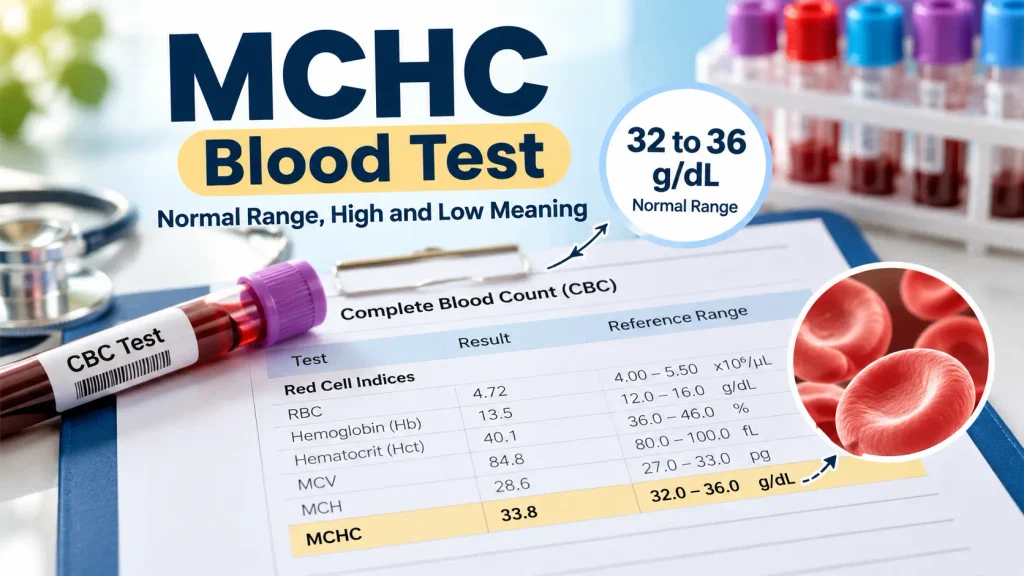
Your blood report has a row marked MCHC, and the number sits just outside the range printed beside it. Nobody explained it at the lab, so you looked it up, and now half the pages say one thing and half say another.
Some of that confusion is real. Even the units get mixed up online, and the upper cutoff is quoted differently from one page to the next. So let us start with what MCHC actually is, then what a low or high value usually means.
Quick Answer
- For adults, MCHC is usually 32 to 36 g/dL. Limits differ slightly between laboratories, so the range printed on your own report is the one that applies.
- The unit is g/dL. It is not picograms, which belong to MCH, and it is not a percentage.
- A low MCHC most often points to iron deficiency, which is very common in India.
- A high MCHC is uncommon. Laboratories treat it as a likely sample or analyser problem before treating it as a finding.
What the MCHC Blood Test Measures
MCHC stands for mean corpuscular haemoglobin concentration. In plain terms, it tells you how tightly packed the haemoglobin is inside your red blood cells. Haemoglobin is the protein that carries oxygen around your body.
It is one of the red blood cell indices included in a complete blood count, so it is not ordered separately. On most analysers, MCHC is calculated from haemoglobin and haematocrit rather than measured directly. The method does vary between instruments. Haematocrit is the share of your blood made up of red cells.
The calculation is haemoglobin divided by haematocrit, multiplied by 100. That last step is there because haematocrit is reported as a percentage, and it is what puts the answer in g/dL. Take a haemoglobin of 13.0 g/dL with a haematocrit of 39 percent. Divide 13.0 by 39, then multiply by 100, and you get an MCHC of 33.3 g/dL, comfortably inside the usual range.
Being a derived figure is the important part. On the analysers that calculate it this way, anything disturbing the haemoglobin reading or the haematocrit disturbs MCHC with it, which is why odd values turn up on otherwise ordinary reports.
MCHC Normal Range
For most healthy adults the range is 32 to 36 g/dL, and it differs little between men and women. Reference limits are set by each laboratory and vary a little with the analyser used, so a borderline value such as 31.8 can be flagged on one report and left unmarked on another. Read your value against the range printed beside it, not one you found online.
Why the Unit Is g/dL, Not pg
This trips up a lot of pages, including some that rank well. MCHC is a concentration, so it is written in grams per decilitre, g/dL. Picograms, written pg, belong to MCH, which is a weight. Any source quoting an MCHC range in pg or pg/dL has mixed up two different values on the same report. You may also see MCHC written as a percentage, an older convention that means the same numbers.
What a Low MCHC Means
Low is the direction most people see, and iron deficiency anaemia is by far the commonest reason. Without enough iron the body cannot fill red cells with haemoglobin, so the concentration drops. India carries a lot of this. The Ministry of Health and Family Welfare, citing NFHS-5 for 2019 to 2021, reports anaemia in 57 percent of women aged 15 to 49.
Other causes come up regularly. Long-term inflammation from rheumatoid arthritis or chronic kidney disease interferes with how the body uses iron even when stores are adequate, which is why a kidney function test is often ordered alongside. Coeliac disease and inflammatory bowel disease cut how much iron you absorb from food. Lead exposure blocks haemoglobin formation directly.
You may feel tired, breathless on stairs, or notice pale skin and brittle nails. Plenty of people with a mildly low MCHC feel completely normal, which is why the number alone never decides anything.
Why Thalassaemia Trait Can Hide Behind a Normal MCHC
Beta thalassaemia trait behaves differently from iron deficiency, and that matters here. It makes red cells distinctly small and lowers MCH, but published red cell index tables list MCHC as typically normal in carriers. So a normal MCHC does not rule it out. Work from ICMR’s National Institute of Immunohaematology estimates the carrier rate in India at 3 to 4 percent of the general population, rising to 8 to 10 percent or higher in certain communities and tribal groups. India has no national carrier registry, so those are estimates drawn from screening studies rather than a headcount. Either way, this is a pattern worth recognising rather than a rarity.
What a High MCHC Means, and Why It Is Often Not Real
Here is the part most pages skip. In most people haemoglobin does not pack much more densely than the top of the usual range, so a clearly raised MCHC is uncommon. Laboratory guidance treats a value above roughly 36.5 g/dL as a signal to look first at the sample rather than the patient. It is not an impossible value, and red cell disorders can push it well higher, but interference is checked before anything is read into it.
Most high readings trace back to one of the two numbers behind the calculation. Analysers measure haemoglobin by passing light through the sample, so anything that changes how that light behaves can distort the reading. Lipaemia, meaning a fatty sample, can make plasma cloudy, while high bilirubin can interfere with some haemoglobin measurements. The effect depends on the analyser and the degree of interference. In affected samples, the haemoglobin result may be falsely high, which can raise the calculated MCHC. If red cells rupture inside the tube, which happens with a difficult draw or vigorous shaking, the released haemoglobin is still counted while the red cell measurements fall, pushing MCHC up from the other side.
Cold agglutinins work by a different route. These antibodies make red cells clump together once the sample cools, and the analyser reads each clump as a single cell. The red cell count comes out falsely low, so the calculated MCHC jumps. Warming the sample to body temperature before reanalysis usually corrects it, and many newer analysers have a heated channel that reduces the problem.
When the value is real, it is usually because the cells themselves are dense and dehydrated. Hereditary spherocytosis is a recognised cause of a genuinely high MCHC, where red cells are small and round instead of disc shaped. Sickle cell disease and haemoglobin SC disease can raise it by the same mechanism. Other red cell disorders may also affect the result, and the cause has to be assessed alongside the rest of the blood count and the clinical picture.
Good to Know
If your MCHC is slightly high but the rest of your blood count looks fine, ask whether the sample should simply be repeated. Many of these readings do not reappear on a fresh sample.
Reading MCHC With the Rest of Your Blood Count
MCHC on its own says very little. Read with cell size, cell count and haemoglobin, it starts to point somewhere. The first two rows matter most in India, because iron deficiency and thalassaemia trait both shrink red cells, yet iron tablets help one and not the other.
These are patterns, not diagnoses. Your doctor reads them alongside your symptoms, your history and earlier reports before deciding what to test next.
MCH, MCV and MCHC, How They Differ
These three sit together on your report and are easy to mix up. MCV is the average size of a red cell, in femtolitres. MCH is the average weight of haemoglobin in one cell, in picograms. MCHC is the concentration, in g/dL.
One way to picture it: MCV is how big the container is, MCH is how much sits inside, and MCHC is how full it is. Doctors lean on MCV and MCHC most, because MCH tends to move with the other two.
What Your Doctor Checks Next
A result outside the range rarely leads straight to treatment. It usually leads to one or two more tests, chosen by which direction the value went and what the rest of your count looks like.
Why a Normal Ferritin Does Not Always Rule Out Low Iron
Ferritin is the usual first test, but it carries a catch worth knowing. It rises during infection and long-term inflammation, so it can read normal or even high while iron stores are genuinely empty. WHO guidance recognises this. Where inflammation is present it suggests reading ferritin against a higher figure, around 70 micrograms per litre instead of the 15 used in otherwise healthy adults, and checking inflammatory markers such as CRP at the same time. That higher figure is a conditional suggestion for that specific situation, not a universal cutoff, and different thresholds again are used in kidney disease and heart failure. The practical point is simpler: a normal ferritin taken during an illness does not settle the question on its own, which is why transferrin saturation is often checked with it.
How the Test Is Done and How to Prepare
There is no separate MCHC test to book. A technician takes blood from a vein in your arm, and the analyser works out MCHC from the same sample as the rest of your count.
Fasting is not needed for a CBC, although you may be asked to fast if other tests are being done at the same visit, such as sugar or liver function tests. The same sample also gives your white cell and platelet counts.
Sample collection and handling can sometimes affect a CBC result. Haemolysis, which means red cells breaking open, can interfere with MCHC. An underfilled collection tube may also affect some blood measurements because the ratio of blood to anticoagulant changes. The laboratory can check whether a sample issue explains an unexpected result.
The ranges on this page are adult ranges. Newborns and children are read against age-specific values, and laboratories apply different thresholds in the first month of life. In pregnancy, blood counts shift as plasma volume expands, so results are read against pregnancy-specific guidance. Go by what the treating doctor or paediatrician says.
When to Get Help
Get emergency medical care now, or go to the nearest emergency department, if you have chest pain, breathlessness that is severe or comes on at rest, or heavy bleeding. Do not wait for an appointment and do not drive yourself.
An abnormal MCHC on its own is not an emergency. Book a prompt appointment, rather than waiting for a routine slot, if you notice any of these alongside it.
- A racing or pounding heartbeat
- Yellowing of the eyes or skin, or unusually dark urine
- Blood in stool, black stools, or periods heavier than usual
- Tiredness that is getting steadily worse rather than staying steady
Illustrative Scenario
On a routine report a 34-year-old sees MCHC 33.2, which is normal, next to an MCV of 68, which is clearly low. Reading that her cells are small, she assumes anaemia from a poor diet and buys iron tablets. Her doctor sends ferritin instead, which comes back normal, and a haemoglobin electrophoresis then shows beta thalassaemia trait. Iron was never the problem, and taking it without a confirmed deficiency is not harmless.
Composite example, not a specific patient.
What To Do Next
- Find MCV on the same report and read it next to MCHC. The pair says far more than either alone.
- Do not start iron tablets on your own. Ask whether iron studies are needed first, since low iron is only one of several explanations.
- If your cells are small but iron studies come back normal, ask whether thalassaemia trait has been ruled out.
- If only MCHC is high and everything else is normal, ask whether a repeat test makes sense first.
Frequently Asked Questions
What is the normal range for an MCHC blood test?
For adults it is usually 32 to 36 g/dL. The exact limits are set by each laboratory and vary a little with the analyser, so compare your value with the range printed on your own report rather than one found online.
What is the full form of MCHC?
Mean corpuscular haemoglobin concentration. Corpuscular simply refers to the red blood cell, so it is the average haemoglobin concentration inside those cells.
Is MCHC measured in pg or g/dL?
In g/dL. Picograms are used for MCH, which is a different value on the same report. Any source quoting MCHC in pg has confused the two.
What does a low MCHC mean?
Red cells are holding less haemoglobin than expected. Iron deficiency is the commonest reason, though long-term inflammation and poor iron absorption also cause it.
Should I worry if my MCHC is slightly high?
Usually not on its own. A mildly high reading with an otherwise normal count is often laboratory interference, and doctors commonly repeat the test on a fresh sample before investigating further.
Does dehydration raise MCHC?
Only mildly, and it is rarely the answer. Severe dehydration can shrink red cells a little, which nudges MCHC up, but laboratory reviews describe that rise as moderate at most. A clearly high reading is usually sample interference.
What is the difference between MCH and MCHC?
MCH is the average weight of haemoglobin in one red cell, in picograms. MCHC is how concentrated that haemoglobin is, in g/dL, which takes cell size into account.
Can MCHC be normal even if something is wrong?
Yes, and this catches people out. Several types of anaemia leave MCHC inside the normal range, and thalassaemia trait often does too, which is why haemoglobin and MCV are read with it.
References
- Red Blood Cell (RBC) Indices. MedlinePlus, National Library of Medicine. Accessed October 2026. medlineplus.gov
- Complete Blood Count (CBC). MedlinePlus, National Library of Medicine. Accessed October 2026. medlineplus.gov
- Girard S, Berda-Haddad Y, Brouzes C, et al. Breaking free from MCHC interferences. French-speaking Cellular Haematology Group (GFHC) review of causes, rising trends and practical solutions. International Journal of Laboratory Hematology, 2025. pmc.ncbi.nlm.nih.gov
- Red cell indices in screening of thalassemia trait during the antenatal period. Indian Journal of Hematology and Blood Transfusion, 2020. pmc.ncbi.nlm.nih.gov
- Red blood cell indices in beta-thalassemia. GeneReviews, NCBI Bookshelf, National Library of Medicine. Accessed October 2026. ncbi.nlm.nih.gov
- WHO guideline on use of ferritin concentrations to assess iron status in individuals and populations. World Health Organization, 2020. Recommended cut-off values table. ncbi.nlm.nih.gov
- Anaemia among women. Lok Sabha Unstarred Question No. 1867, Ministry of Health and Family Welfare, Government of India, 2 August 2024, citing NFHS-5 (2019 to 2021). eparlib.nic.in
- Cascade screening for beta-thalassemia. A practical approach for identifying and counseling carriers in India. National Institute of Immunohaematology, Indian Council of Medical Research, 2010. pmc.ncbi.nlm.nih.gov
- Prenatal hemoglobinopathy screening and prevention in India. A cross-sectional study. Indian Journal of Medical Research. ijmr.org.in
- Hereditary Spherocytosis. Cleveland Clinic. Accessed October 2026. my.clevelandclinic.org
- Anemia of Chronic Disease. Cleveland Clinic. Accessed October 2026. my.clevelandclinic.org
- Beta Thalassemia. Johns Hopkins Medicine. Accessed October 2026. hopkinsmedicine.org
Written By
Iraphan Khan, BSN, RN, D.Pharm, Public Health Researcher. Founder of RealMedVision, writing patient-focused health content based on clinical guidelines and peer-reviewed research.
Medically Reviewed By
Dr Praveen Verma, MBBS, MD (Pathology)
Dr Himanshu Morya, MBBS, Medical Educator. Reviewed 11 October 2026.
Disclaimer
This article is general education and does not diagnose any individual. Reference ranges differ between laboratories, so read your result against the range printed on your own report. Always follow what your doctor tells you.