
What SGPT, SGOT, bilirubin and albumin values mean on your report, and when a result needs a doctor.
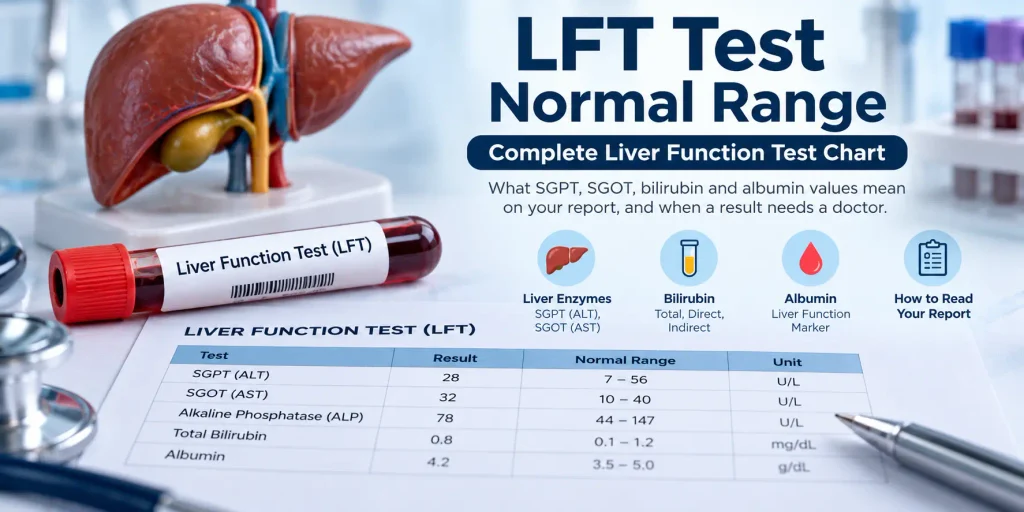
You open your blood report, see a number next to SGPT or SGOT sitting just outside the printed range, and think the worst. In most cases it is not that.
A liver function test, or LFT, is a panel of values read together. One value slightly outside the LFT test normal range rarely means liver disease on its own. This guide covers each value, how to read the pattern, and what genuinely needs a doctor.
Quick Answer
- The LFT test normal range printed by most laboratories is SGPT (ALT) 7 to 56 U/L, SGOT (AST) 10 to 40 U/L and bilirubin 0.1 to 1.2 mg/dL.
- These are reference ranges, not health targets. The American College of Gastroenterology puts a truly healthy ALT lower, at 29 to 33 IU/L in men and 19 to 25 IU/L in women.
- Ranges differ by laboratory, method, age and sex, so use the range printed on your own report.
- Yellow eyes, dark urine, severe abdominal pain, bleeding or confusion need a doctor at once, whatever the numbers say.
What an LFT Actually Measures
The name misleads. Following the ACG 2017 guideline, ALT, AST and alkaline phosphatase mainly indicate liver injury or bile duct involvement rather than liver function. Bilirubin adds something different again, showing how well the liver processes and clears it.
Only two values reflect what the liver makes. Albumin is one. Prothrombin time, reported as PT or INR, is the other, and it shifts faster when liver function is badly affected. Neither is always included.
LFT Test Normal Range Chart
Below are commonly used adult reference ranges. Your own laboratory range always takes priority.
| Marker | Reference range | What it points to |
|---|---|---|
| SGPT (ALT) | 7 to 56 U/LMost specific marker of liver cell injury | Most specific marker of liver cell injury |
| SGOT (AST) | 10 to 40 U/LAlso present in heart and muscle | Also present in heart and muscle |
| ALP | 44 to 147 U/LHigher in children and in pregnancy | Higher in children and in pregnancy |
| Total bilirubin | 0.1 to 1.2 mg/dLWaste the liver clears through bile | Waste the liver clears through bile |
| Direct bilirubin | 0.0 to 0.3 mg/dLRead together with total bilirubin | Read together with total bilirubin |
| Albumin | 3.5 to 5.0 g/dLReflects what the liver makes | Reflects what the liver makes |
| Total protein | 6.3 to 8.2 g/dLRead together with albumin | Read together with albumin |
| GGT | Varies by laboratory, age and sexUse the range printed on your report | Use the range printed on your report |
Source: American Liver Foundation and Testing.com, checked 6 October 2026. These are laboratory reference ranges, not personal targets. Always read your result against the range printed on your own report.
Ranges follow the American Liver Foundation and Testing.com, checked 6 October 2026. Assay methods give different upper limits. Our thyroid test normal range guide carries the same caution.
Why Normal Is Not One Single Number
A reference range is not a healthy level. The ACG 2017 guideline put a truly healthy ALT at 29 to 33 IU/L for men and 19 to 25 IU/L for women, and said higher values deserve assessment. Many laboratories still print a far higher limit.
Laboratory values from the American Liver Foundation and Testing.com. Healthy normal values from the ACG 2017 guideline.
So an ALT of 45 can read as normal at one laboratory and still be worth raising with your doctor.
What Each Value Means on Your Report
SGPT (ALT) and SGOT (AST)
Both leak out of irritated cells. ALT is the more liver specific of the pair. AST also comes from heart and skeletal muscle, so a hard gym session can lift it with no liver involvement.
Bilirubin
Waste left when old red blood cells break down, cleared through bile. A raised level with normal enzymes often turns out to be Gilbert syndrome, a harmless inherited quirk. Raised alongside raised enzymes, it reads differently.
ALP and GGT
A raised ALP with a raised GGT suggests a liver or bile duct source. Cholestasis, including bile duct obstruction, is one possible cause among several. ALP alone also comes from bone, and runs naturally higher in growing children and in pregnancy.
Albumin and PT or INR
Albumin falls slowly over weeks, so a low result points to a longer standing problem. It is not liver specific either, since inflammation, kidney disease, poor nutrition and fluid overload all lower it. A prolonged PT or raised INR appears sooner.
How to Read Your LFT Report
Knowing the LFT test normal range is only half of it. Work down your report in this order:
- Check ALT and AST, the liver cell injury markers.
- Check ALP and GGT, the bile flow markers.
- Check bilirubin, total and direct.
- Check albumin and, if present, PT or INR.
- Note which group is raised together, not one number.
Doctors sort the result into one of these patterns.
| Pattern | What the report shows | What it suggests |
|---|---|---|
| Hepatocellular | ALT and AST raised, ALP less affectedLiver cell irritation from fatty liver, alcohol, medicines or viral hepatitis | Liver cell irritation from fatty liver, alcohol, medicines or viral hepatitis |
| Cholestatic | ALP and GGT raised, while ALT and AST are less raisedA bile flow problem, such as gallstones | A bile flow problem, such as gallstones |
| Mixed | Both groups raised togetherNeeds history and further testing to separate | Needs history and further testing to separate |
How Far Above Normal Matters
The range is drawn so most healthy people fall inside it. By design a few healthy people sit just outside. The illustration below shows how values move from that range into higher levels.
Conceptual illustration, not population data. Zone boundaries are not fixed cutoffs.
What Causes an Abnormal LFT Result
Fatty liver is a common cause of mildly raised enzymes, particularly with metabolic risk factors such as raised blood sugar or central weight gain. Indian screening studies have found it to be common, although reported prevalence varies considerably by population and screening method.
The ACG guideline also lists alcohol, viral hepatitis, medicines and supplements, autoimmune hepatitis, haemochromatosis and Wilson disease. Thyroid problems and gallstones come up too. Fatty liver is graded on ultrasound, and the grade shapes what follows. See grade 1 fatty liver and grade 2 fatty liver.
When a Raised LFT Needs a Doctor Quickly
See a doctor without waiting for your next appointment if you have:
- Yellowing of the eyes or skin, or urine that has turned dark
- ALT or AST several times above your report upper limit
- Pain in the upper right abdomen, fever, or persistent vomiting
- Swelling of the abdomen or legs, or unusual bruising
- Vomiting blood, black stools or heavy bleeding, which needs emergency care
- Confusion or unusual drowsiness, which also needs emergency care
Reading any report is easier once you know what normal looks like. Same for the ECG test and its normal results and for grade 1 diastolic dysfunction on an echo report.
How to Prepare for an LFT Test
Laboratories usually ask for 8 to 12 hours of fasting when the LFT is bundled with a lipid or sugar panel. On its own fasting is often not needed.
- Tell your doctor about recent alcohol use, all medicines and any supplements, since each can affect results.
- If a raised AST is being investigated, avoid unusually strenuous exercise before the repeat test.
- Carry previous reports so values can be compared.
What Happens After an Abnormal LFT
Depending on the level and pattern, your doctor may repeat the test or investigate straight away. Further testing can include a full blood count, PT or INR, hepatitis B and C testing, iron studies, an ultrasound and a medicine review. Not everyone needs all.
Where fatty liver is the cause, lifestyle change is the foundation of treatment. For people who are overweight or carry metabolic risk factors, gradual weight loss and better blood sugar control help most. Medicines may be considered in selected patients, since the FDA approved the first drug for fatty liver disease with moderate to advanced scarring in March 2024, to be used alongside diet and exercise. The same work helps with reversing prediabetes. Later stages are covered in grade 3 fatty liver.
A 38 year old office worker has a company health check. SGPT 72, SGOT 55, everything else normal, no symptoms. An ultrasound shows grade 1 fatty liver. His doctor reviews his medicines, advises on weight and diet, and repeats the panel after three months. Values come down.
Composite example, not a specific patient.
Key Takeaways
- Check your result against the LFT test normal range printed on your own report, not one found online.
- Read the pattern across the panel before worrying about one value.
- Ask whether your value is healthy, not only whether it is inside the printed range.
- Act at once on jaundice, bleeding, severe abdominal pain or confusion.
Frequently Asked Questions
What is the normal range for an LFT test?
The LFT test normal range on most adult reports is SGPT 7 to 56 U/L, SGOT 10 to 40 U/L, ALP 44 to 147 U/L, bilirubin 0.1 to 1.2 mg/dL and albumin 3.5 to 5.0 g/dL. GGT varies by laboratory, age and sex. Use your own report range.
What do ALT and AST mean on an LFT report?
ALT is the newer name for SGPT, and AST for SGOT. Both are enzymes released when cells are damaged. ALT sits mainly in the liver, making it the more specific marker. AST spans liver, heart and muscle, so a rise in AST alone sends the doctor wider.
Is an SGPT of 60 dangerous?
A value of 60 sits just above the usual upper limit and is a mild elevation, not an emergency. Doctors look for the cause, which may include fatty liver, alcohol, medicines or viral hepatitis. It deserves a conversation rather than being ignored.
What does a high SGOT level mean?
Raised SGOT means cells are leaking this enzyme, but the source is not always the liver. Heart and skeletal muscle contain it too, so heavy exercise or injury can lift it. Doctors read it alongside SGPT.
Can fatty liver cause abnormal LFT results?
Yes, it is a common cause of mildly raised enzymes in an adult who feels well, especially with metabolic risk factors. Indian screening studies have found it to be common, though reported prevalence varies by population and method. Many people with fatty liver still have normal enzymes.
Do I need to fast before an LFT test?
Often not, if the LFT is done on its own. Laboratories usually ask for 8 to 12 hours of fasting when it is combined with sugar or lipid tests. Check what your laboratory says when you book.
How long do raised liver enzymes take to come back to normal?
It depends on the cause. Enzymes raised by a short illness or a medicine often settle within weeks once the trigger goes. Where fatty liver is responsible, improvement follows metabolic change over months, not days.
Can a normal LFT rule out liver disease?
No. The ACG guideline states plainly that a normal ALT may not exclude significant liver disease. Some people with early scarring have a normal panel, which is why doctors sometimes order an ultrasound even when blood values look fine.
References
- Kwo PY, Cohen SM, Lim JK. ACG Clinical Guideline: Evaluation of Abnormal Liver Chemistries. Am J Gastroenterol. 2017. journals.lww.com
- ACG. Abnormal Liver Chemistries Guideline Summary. 2017. acgcdn.gi.org
- NHS Specialist Pharmacy Service. Interpreting liver blood tests. 2026. sps.nhs.uk
- American Liver Foundation. Liver Function Tests. liverfoundation.org
- Testing.com. Liver Panel. 2026. testing.com
- US Food and Drug Administration. FDA Approves First Treatment for Patients with Liver Scarring Due to Fatty Liver Disease. 14 March 2024. fda.gov
- Indian Journal of Community Medicine. Prevalence of NAFLD in an Urban Adult Population, Chennai. 2023. journals.lww.com
- AIIMS Bhopal and ICMR NIREH. Community screening for non-alcoholic fatty liver using FibroScan in Indian adults. 2026. pmc.ncbi.nlm.nih.gov
All sources checked 6 October 2026.
Iraphan Khan, BSN, RN, D.Pharm, Public Health Researcher. Writes patient facing medical content for RealMedVision, focused on test interpretation and metabolic health.
Dr Praveen Verma, MBBS, MD Pathology and Dr Himanshu Morya, MBBS, Medical Educator. Reviewed 6 October 2026.
This article is general information. It does not diagnose any condition and does not replace an assessment of your own results. Always follow your doctor.