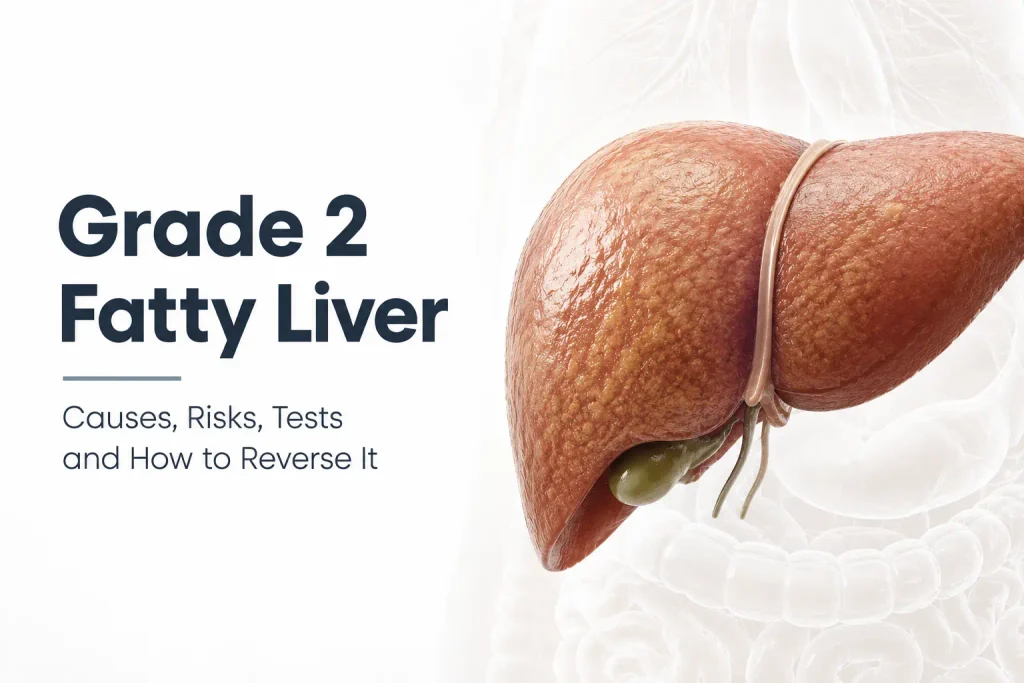
Grade 2 fatty liver means your ultrasound found a moderate amount of fat in the liver. It can often improve, but the ultrasound grade cannot show inflammation or liver scarring (fibrosis), which is more closely linked to long-term liver risk. The next step may include a fibrosis check, such as the FIB-4 score, calculated using your age and routine blood-test results.
What does grade 2 fatty liver mean?
A grade 2 fatty liver ultrasound report means the scan found a moderate amount of fat in your liver. Doctors may also call it moderate fatty liver or moderate hepatic steatosis. On an ultrasound report, it falls between grade 1, which is mild, and grade 3, which is more severe.
Fat can make liver tissue appear brighter on an ultrasound. With a higher degree of steatosis, structures deeper in the liver and some blood vessels may become harder to see clearly.
Your report may use terms such as Grade II fatty liver, fatty infiltration or increased echogenicity. Depending on the cause and your metabolic risk factors, fatty liver may fall under the newer term MASLD. Many reports still use the older term NAFLD.
What does grade 2 fatty liver not tell you?
An ultrasound grade cannot reliably tell you whether the liver is inflamed or how much scarring, called fibrosis, is present. You may also see websites saying grade 2 means that 33 to 66 percent of liver cells contain fat. That figure comes from a biopsy-based grading system, where liver tissue is examined under a microscope. An ultrasound cannot measure the exact percentage of liver cells containing fat.
Chart 1: What a grade 2 ultrasound report can and cannot tell you
The scan can tell you
The scan cannot reliably tell you
Fat is visible in the liver, with ultrasound features described as moderate
Whether the liver inflammation meets the criteria for MASH
Whether the liver appears enlarged
Whether fibrosis is present, or exactly how much scarring there is
Other visible structural findings on the ultrasound
The exact percentage of fat in the liver or the exact cause of the fatty liver
Is grade 2 fatty liver dangerous?
A grade 2 fatty liver ultrasound result does not, by itself, tell you how much liver damage is present. The bigger concern is whether inflammation or liver scarring, called fibrosis, is also present. In a New England Journal of Medicine study of 1,773 adults with fatty liver disease, deaths and liver complications increased with higher fibrosis stages.
That means two people can have the same grade 2 ultrasound report but different levels of risk. A fibrosis assessment, together with your medical history and blood tests, helps show which situation needs closer attention.
What is the difference between grade 1, grade 2 and grade 3 fatty liver?
The ultrasound grades describe how much fat appears to be present: grade 1 fatty liver is described as mild, grade 2 as moderate and fatty liver grade 3 as severe. The grade alone does not measure liver scarring.
Chart 2: Grade 1 vs grade 2 vs grade 3 on ultrasound
Grade
What the scan may show
What it describes
What to discuss next
Grade 1
Mildly increased liver brightness
Mild steatosis
Cause, metabolic risks and whether fibrosis assessment is needed
Grade 2
More obvious brightness with reduced visibility of some structures
Moderate steatosis
Cause, metabolic risks and fibrosis risk assessment
Grade 3
Marked brightness and poorer visibility of deeper structures
More severe steatosis
Prompt assessment of the cause and fibrosis risk, with further tests if indicated
Myth vs Fact
Myth: Grade 2 means the liver is already scarred. Fact: The ultrasound grade describes fat. Fibrosis requires a separate assessment.
Myth: Normal SGPT and SGOT mean there is no liver fibrosis. Fact: Liver enzyme results alone cannot reliably rule out fibrosis.
What are the symptoms of grade 2 fatty liver?
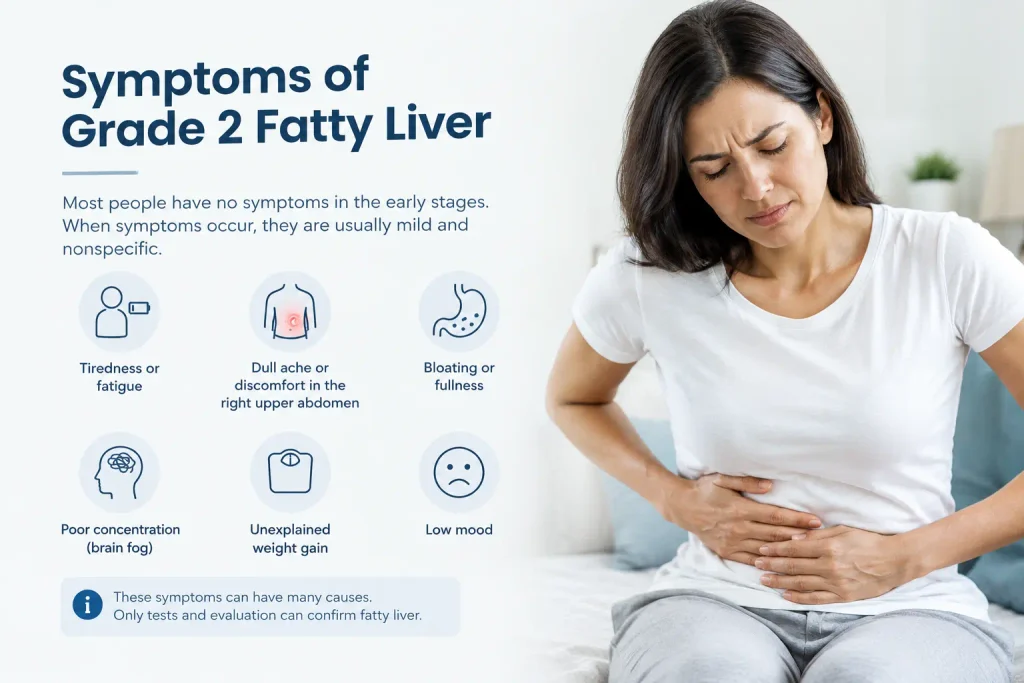
Most people with grade 2 fatty liver have no symptoms. It is often found by chance during an ultrasound done for another reason.
If symptoms do occur, you may notice:
Tiredness or low energy
A dull ache or discomfort under the right ribs
A feeling of heaviness or fullness in the upper right side of the abdomen
These symptoms do not tell you how much liver damage there is. You can feel completely well and still have liver fibrosis.
See a doctor promptly if you have: yellow eyes or skin, a swollen abdomen, vomiting blood, or black tarry stools. These are not typical grade 2 fatty liver symptoms and can be signs of serious liver disease or bleeding.
What causes grade 2 fatty liver?
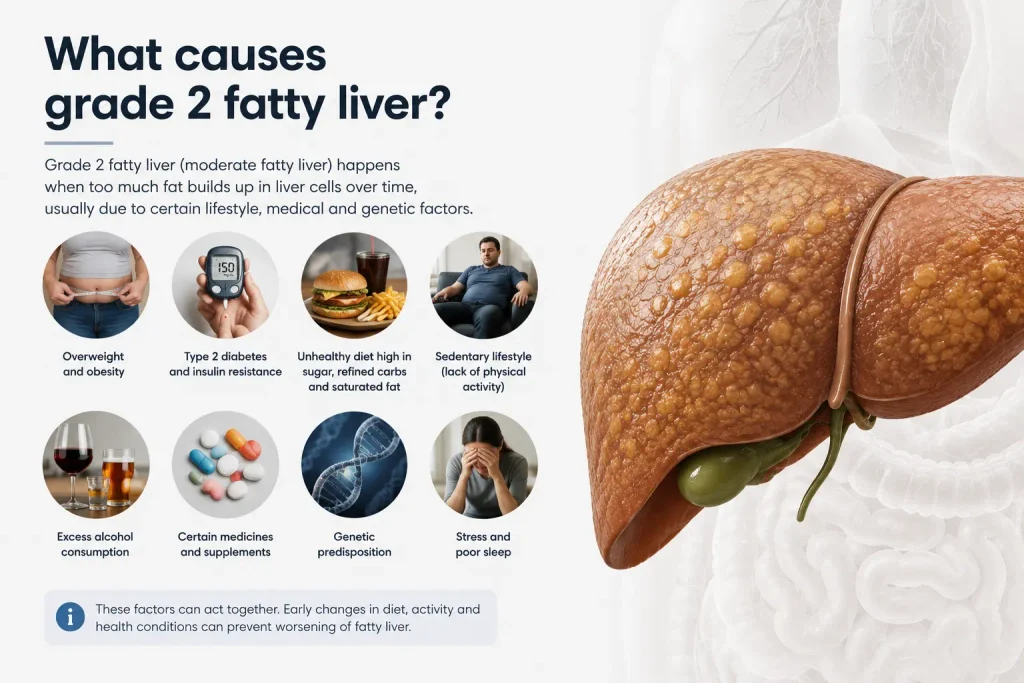
Grade 2 fatty liver develops when the body stores more fat than the liver can safely handle. The root cause is usually insulin resistance, the same process behind prediabetes, type 2 diabetes and belly fat.
Waist size: Above 90 cm in men or 80 cm in women is the most useful everyday sign, even at normal weight.
Alcohol and some medicines: Regular drinking and medicines such as steroids add fat on top.
Can you have grade 2 fatty liver at a normal weight?
Yes, and in India this is common. In a 2023 PGIMER Chandigarh study of 1,040 fatty liver patients, 14.3 percent were lean (BMI below 23), with liver disease just as severe as in heavier patients. A slim person with a grade 2 report still needs the fibrosis check.
How do doctors confirm grade 2 fatty liver and check for scarring?
The ultrasound usually identifies the fatty liver. The next tests look for the cause and, more importantly, for liver scarring.
Liver function test: ALT (SGPT) and AST (SGOT).
Sugar and fats: Fasting sugar, HbA1c and lipid profile. A blood sugar chart by age helps you read the numbers.
Complete blood count: Platelets are needed for FIB-4.
Other tests when needed: Your doctor may check for hepatitis B, hepatitis C or other causes of liver disease.
Which tests show fibrosis?
FIB-4 (Fibrosis-4 index) often comes first. It is a score, not a new test: it uses your age, ALT, AST and platelet count, so it can often be calculated from existing reports. If the result is not clearly low, a FibroScan may be used as the next step. FibroScan is a painless scan that measures liver stiffness in kPa.
Chart 3: What to do based on your FIB-4 score
FIB-4 score
What it means
Next step
Below 1.3
Low chance of advanced scarring
Lifestyle changes and repeat assessment based on your risk factors
1.3 to 2.67
Intermediate or unclear risk
FibroScan or further assessment may be needed
Above 2.67
Higher chance of advanced scarring
See a liver specialist
Important: FIB-4 is less reliable in people under 35. In people over 65, doctors use different age-adjusted cutoffs, so do not interpret the score on your own.
Can grade 2 fatty liver be reversed, and how long does it take?
Yes, in many people. Liver fat can start improving within months when weight loss and lifestyle changes are maintained. If scarring is present, improvement may take longer.
What to aim for: Around 5% weight loss can reduce liver fat. Greater weight loss may improve liver inflammation and, in some people, fibrosis.
For an 80 kg person, 5% is 4 kg and 10% is 8 kg. Gradual, sustainable weight loss is usually easier to maintain than rapid dieting.
Regular physical activity also helps reduce liver fat and improves insulin resistance. A common target is at least 150 minutes of moderate activity a week, such as brisk walking. Treatment also includes controlling diabetes, blood fats and other metabolic risk factors.
Illustrative example: A person with a grade 2 report and a low-risk fibrosis score loses weight gradually, improves their diet and becomes more active. Over time, liver fat may decrease, but follow-up testing is needed to assess progress.
Which diet is best for grade 2 fatty liver?
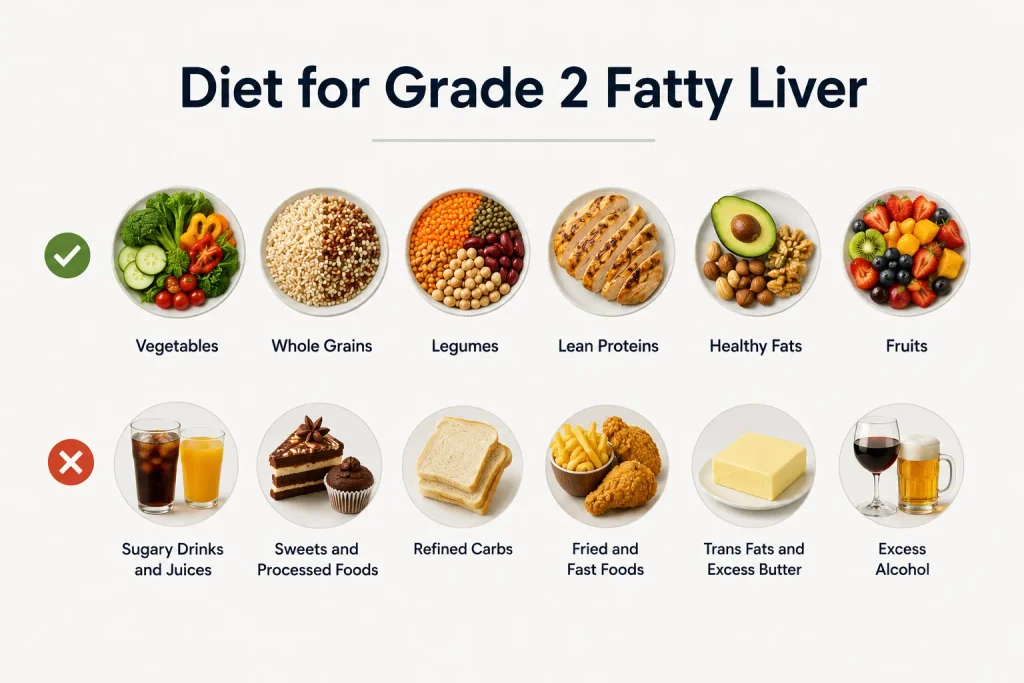
The best grade 2 fatty liver diet cuts sugar and refined flour, limits fried and packaged food, and keeps total calories a little below what you burn. No single food clears liver fat.
Cut first: Sugary drinks, packaged juices, sweets, biscuits, maida items such as naan and white bread, fried snacks and large rice portions.
Eat more: Dal, vegetables, whole wheat roti, millets, curd, eggs, fish, chicken and a few nuts.
Cook smarter: Less oil, avoid reused oil and skip second helpings at dinner.
Can you drink alcohol with grade 2 fatty liver?
It is best to avoid or minimise alcohol. Alcohol can add further stress to a fatty liver and may increase the risk of liver injury. If significant fibrosis or cirrhosis is found, avoiding alcohol completely is generally recommended. Fatty liver with both metabolic risk factors and higher alcohol intake may be classified as MetALD.
When should you see a doctor about grade 2 fatty liver?
You should arrange a routine doctor visit after a grade 2 fatty liver report, even if you feel completely well. Your doctor may check your blood sugar, cholesterol and liver fibrosis.
After your ultrasound: Get a routine review and discuss whether you need a FIB-4 or other fibrosis check.
If your fibrosis tests are abnormal: Your doctor may recommend a FibroScan or refer you to a liver specialist.
Get urgent medical help for: Yellow eyes or skin, vomiting blood, black stools, new confusion or a rapidly swollen belly.
Key takeaways
Grade 2 fatty liver means a moderate amount of fat was seen on ultrasound. The scan grade alone cannot show how much scarring is present.
A FIB-4 score can help estimate the risk of advanced fibrosis using routine blood-test results. Some people may then need FibroScan or another fibrosis test.
Around 5% weight loss can reduce liver fat. Greater weight loss may improve inflammation and, in some people, fibrosis.
Most people do not need a medicine specifically because an ultrasound says grade 2. Treatment depends on whether MASH, fibrosis, diabetes, obesity or other conditions are present.
Frequently asked questions about grade 2 fatty liver
Is grade 2 fatty liver curable?
Reversible is usually the better word. Grade 2 fatty liver can often improve, and in some people the amount of liver fat can return to normal with sustained lifestyle changes. Around 5% weight loss can reduce liver fat, while greater weight loss may bring further benefits. The exact response varies from person to person.
Can grade 2 fatty liver go back to grade 1?
Yes. If the amount of liver fat falls, a later ultrasound may show grade 1 or even no visible fatty liver. Your doctor can decide when repeat imaging is useful based on your weight, liver tests and risk of fibrosis.
Can grade 2 fatty liver become cirrhosis or liver cancer?
It can progress in some people, but the ultrasound grade itself does not predict who will develop cirrhosis or liver cancer. The main concern is whether inflammation and fibrosis develop over time. Diabetes, obesity, alcohol intake and the degree of fibrosis can all affect risk.
What does grade 2 fatty liver with mild hepatomegaly mean?
It means the ultrasound found moderate fatty change and a mildly enlarged liver. Fatty liver can be associated with an enlarged liver, but this finding alone cannot tell whether inflammation or fibrosis is present.
Can exercise alone reverse grade 2 fatty liver?
Exercise can reduce liver fat even when weight loss is modest. For many people, combining regular physical activity with dietary changes that support healthy weight loss gives the best chance of improving fatty liver.
Do I need Udiliv or a liver tablet for grade 2 fatty liver?
Usually, an ultrasound grade alone is not a reason to start a liver medicine. UDCA, sold in India under brands including Udiliv, is not recommended as a specific treatment for fatty liver by major international guidance. Other medicines may be appropriate in selected people depending on conditions such as MASH with fibrosis, diabetes or obesity, so treatment should be decided by a doctor.
How often should I repeat tests for grade 2 fatty liver?
There is no single schedule for everyone. Follow-up depends on your FIB-4 result, diabetes or other metabolic risk factors, liver blood tests and whether fibrosis is suspected. Your doctor may repeat blood tests or imaging after a period of lifestyle treatment when it would help assess progress.
Does grade 2 fatty liver reduce life expectancy?
A grade 2 ultrasound result alone cannot predict life expectancy. Long-term risk depends more on factors such as advanced fibrosis and overall cardiometabolic health, including diabetes, blood pressure and cholesterol.
This article is general information and cannot replace an examination or advice from your own doctor. Always follow your doctor’s recommendations about medicines, tests and follow-up.
Founder of RealMedVision and Public Health Researcher. Registered nurse who writes evidence based health explainers using trusted medical and public health sources.