
Originally published: 3 August 2026 | Medically reviewed: 9 October 2026 | Last updated: 9 October 2026 | 10 to 13 minute read
What grade 1 means on your report, what the scan cannot tell you, and which changes actually shift the number.
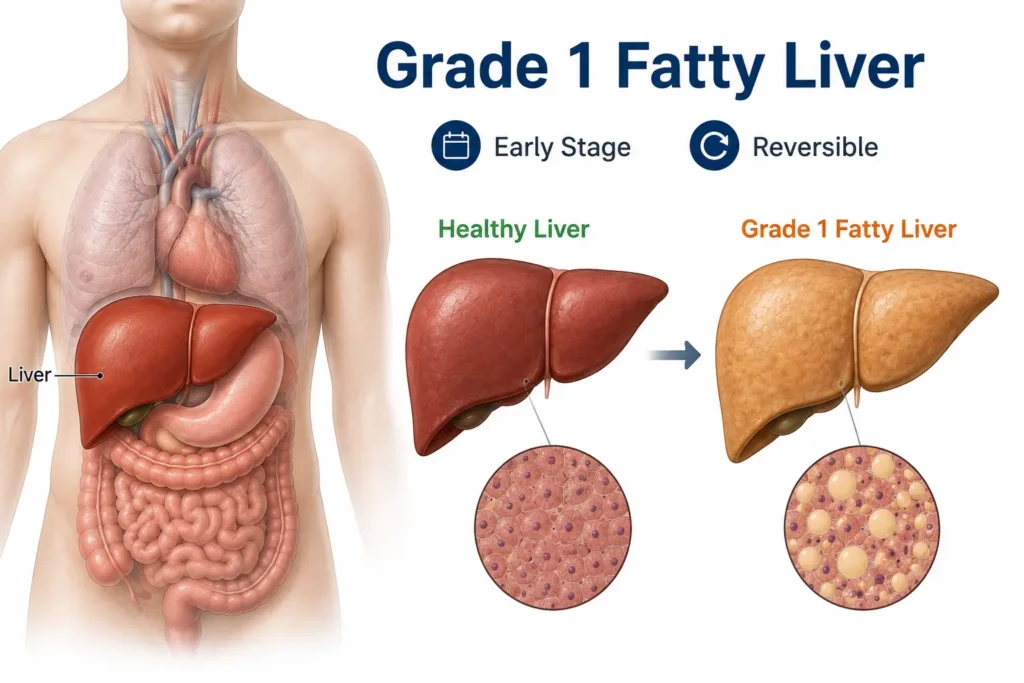
Most people meet the words grade 1 fatty liver on a scan report they were not expecting. The scan was for something else, the doctor mentioned it in passing, and now you are reading this.
It is the mildest stage and for most people it is manageable. It is also worth understanding properly, because the report tells you less than it seems to.
Quick Answer
- An ultrasound picked up a mild amount of fat in your liver. It is the lowest of three grades.
- At this stage most people have no symptoms, and the scan usually shows no damage. It measures fat only, so it cannot rule out scarring.
- Liver fat often falls with weight loss, less sugar and regular activity, though how far varies from person to person.
- Ask your doctor for blood tests and a fibrosis check rather than treating the grade as the whole picture.
What Grade 1 Fatty Liver Means
A healthy liver holds very little fat. When fat builds up inside liver cells, an ultrasound shows the liver as brighter than usual, and the radiologist grades that brightness as 1, 2 or 3. Grade 1 is the mildest.
This grading is a visual estimate, not a precise measurement. Ultrasound misses smaller amounts of fat, and two radiologists can read the same scan differently. It is a starting point, not a final verdict.
The condition is now called MASLD, short for metabolic dysfunction associated steatotic liver disease. You may still see the older name, NAFLD, on reports.
How Serious Is Grade 1 Fatty Liver
At grade 1 most people feel well and have no liver damage. It is still not a clean bill of health, for two reasons.
First, liver fat usually travels with other things, such as insulin resistance, raised blood sugar or an unfavourable lipid profile, and those carry their own risks. Second, the grade on its own cannot rule out inflammation or early scarring.
Does it always get worse? No. Most people with simple fatty liver do not develop serious liver disease, and when the liver does deteriorate it usually happens over many years. Progression is a possibility to take seriously, not a timetable you are on.
The Grade Shows Fat, Not Scarring
This is the part most reports leave out, and it changes what you should do next.
There are two separate measurements here. One is how much fat is present, which is what grade 1, 2 and 3 describe. The other is how much scarring, or fibrosis, has built up. Scarring is what determines long term outcomes, and an ordinary ultrasound does not measure it.
A low fat grade does not guarantee a low fibrosis stage. The two are measured differently and do not always move together, which is why fibrosis risk is assessed separately.
Grade 1 Compared With Grade 2 and Grade 3
| Grade | What the scan is showing |
|---|---|
| Grade 1 | Mild fat. Usually no symptoms and no damage visible.Fibrosis still needs checking separately |
| Grade 2 | Moderate fat. Some people notice tiredness or mild discomfort. |
| Grade 3 | Heavy fat load, and a stronger signal to assess for inflammation and scarring. |
Grades describe fat seen on ultrasound. They are not a staging system for liver damage.
What Causes It
Liver fat rarely has a single cause. It usually builds from several at once: extra weight around the middle, insulin resistance or type 2 diabetes, raised triglycerides, a diet heavy in sugar and refined carbohydrates, very little activity, and regular alcohol.
Alcohol matters for another reason. Above a certain regular intake the condition is classified differently, so be straightforward about how much you drink.
You do not have to look overweight to have it. In South Asians metabolic risk starts at a lower body size than international cut offs suggest, so a slim person with high blood sugar or a large waist can still have liver fat.
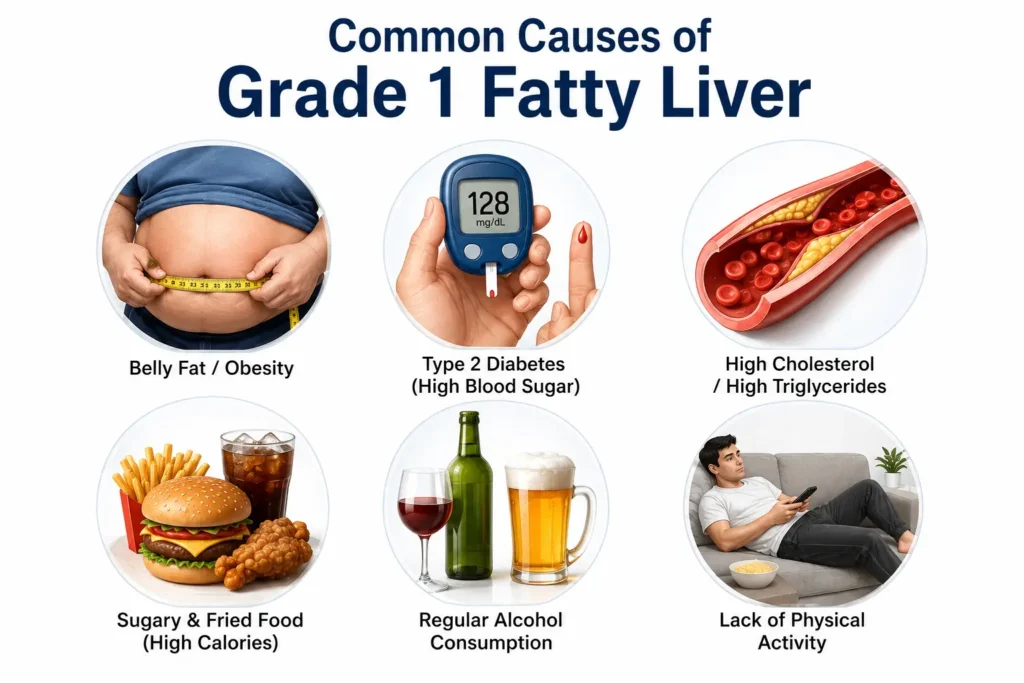
Symptoms
Grade 1 fatty liver usually causes nothing at all, which is why most cases turn up by accident. When mild signs appear they are vague: tiredness that sleep does not fix, or a dull heaviness under the right ribs.
Symptoms are a poor guide here, so your test results matter far more than how you feel.
What Your Doctor Will Check Next
The ultrasound is the start. Alongside it, expect liver enzymes called ALT and AST, a fasting sugar or HbA1c, and a lipid profile. Our liver function test guide explains those enzyme numbers. At grade 1 they are often normal, which is one reason this is easy to overlook.
To judge scarring risk, doctors often start with a score called FIB-4, calculated from your age, ALT, AST and platelet count. It costs nothing extra because those results are already on your report. It is a screen rather than a verdict, and it is less reliable at the extremes of age, including in younger adults, so your doctor reads it alongside your history. If it points that way, a FibroScan measures liver stiffness painlessly. A biopsy is rarely needed at this stage.
Treatment: What Actually Shifts Liver Fat
Treatment at this stage is lifestyle, not tablets. Weight loss has the strongest evidence behind it, and the targets below are from European guidelines for adults who are overweight or obese. If your weight is already in the normal range, how much weight change helps, if any, is a decision for your doctor.
| Weight loss | What it is linked to |
|---|---|
| 5 percent or more | Reduced liver fat, which is the target at grade 1 |
| 7 to 10 percent | Improvement in liver inflammation |
| 10 percent or more | Improvement in fibrosisFew people reach this without support |
Targets from the 2024 EASL, EASD and EASO guidelines for adults with overweight or obesity.
Alongside weight, three things do most of the work: cutting sugary drinks and refined carbohydrates, moving most days, and keeping blood sugar and lipids in range. Improvement is measured over months, not weeks.
What to Eat and What to Cut
| Eat more of | Cut down |
|---|---|
| Vegetables and leafy greens | Cold drinks and packaged juice |
| Whole grains such as oats, jowar, bajra | Maida, biscuits and sweets |
| Dal, beans, eggs, fish and other lean protein | Fried food such as samosa and pakora |
| Whole fruit such as apple, guava, papaya | Alcohol |
A simple rule covers most of it. Half the plate vegetables, a quarter protein, a quarter whole grains, and sweet drinks off the table.
Is There a Medicine for Fatty Liver in India
There has been real news here, and the details matter. On 17 July 2026 Novo Nordisk announced that India’s regulator, the CDSCO, had approved Wegovy, the semaglutide 2.4 mg injection, for adults with noncirrhotic MASH and moderate to advanced liver fibrosis, alongside diet and exercise. The same medicine is also sold in India under a second brand name, Poviztra.
Read the indication carefully. It covers a far later stage, where inflammation and significant scarring are already present, and it excludes cirrhosis. If you have grade 1 fatty liver it almost certainly does not apply to you. Never start a weight loss injection on your own.
When to See a Doctor
Book a review if your scan shows fatty liver and you have not had your liver enzymes, blood sugar and lipids checked, or if you have diabetes, drink regularly or feel persistently tired.
- Yellow skin or eyes, or dark urine
- Swelling of the abdomen or legs
- Vomiting blood, or black tarry stools
- New confusion or unusual drowsiness
These signal advanced liver disease and are not expected at grade 1, but they need same day assessment.
Key Takeaways
- Ask your doctor for a fibrosis assessment, not just a repeat scan. The grade alone does not cover it.
- Get your blood sugar and lipids checked, because they usually travel with liver fat.
- Pick one change you can hold for months rather than a strict plan you drop in three weeks.
- Agree a weight target with your doctor instead of copying a number off the internet.
Frequently Asked Questions
Is grade 1 fatty liver dangerous?
At this stage most people have no symptoms and no visible liver damage. It is not harmless either, because the scan does not show scarring and liver fat usually comes with metabolic risks that need checking.
Can grade 1 fatty liver go away?
Liver fat can fall substantially with sustained weight loss and diet change, and some scans do return to normal. How much it improves varies between people, so treat it as a realistic goal rather than a guarantee.
How long does it take to improve?
There is no fixed timeline, and published figures vary widely. Change is measured in months rather than weeks. Your doctor will decide when repeating a scan or blood test is actually useful.
Will grade 1 definitely become grade 2 or 3?
No. Most people with simple fatty liver do not progress to serious liver disease, and when the liver does worsen it usually takes many years. Risk rises with diabetes, obesity and continued alcohol use.
How common is fatty liver in India?
A meta-analysis of Indian studies put the pooled adult prevalence at 38.6 percent, roughly one in three. Higher figures circulate, including a two in three estimate from a pharmaceutical company statement, which is not peer reviewed.
Can a thin person have grade 1 fatty liver?
Yes. South Asians develop metabolic problems at a lower body size than international cut offs suggest, so a slim person with high blood sugar or a large waist can still have liver fat.
Does grade 1 fatty liver need medicine?
Usually not. Treatment at this stage is lifestyle. The Wegovy approval in India covers a far later stage, noncirrhotic MASH with moderate to advanced fibrosis, and is a specialist decision.
What should I ask my doctor?
Ask whether your fibrosis risk has been assessed, what your ALT, AST and platelet results were, whether your blood sugar and lipids are in range, and what weight target makes sense for you.
References
- EASL, EASD and EASO. Clinical Practice Guidelines on the management of metabolic dysfunction-associated steatotic liver disease. Journal of Hepatology. 2024. journal-of-hepatology.eu
- AASLD Practice Guidance on the clinical assessment and management of nonalcoholic fatty liver disease. Hepatology. 2023. pmc.ncbi.nlm.nih.gov
- Shalimar, Elhence A, Bansal B, et al. Prevalence of Non-alcoholic Fatty Liver Disease in India, a Systematic Review and Meta-analysis. Journal of Clinical and Experimental Hepatology. 2022, 12(3), 818 to 829. jcehepatology.com
- Burden of MASLD and liver fibrosis, evidence from the Phenome India cohort. Lancet Regional Health Southeast Asia. 2026. thelancet.com
- CDSCO approves Novo Nordisk’s Wegovy for fatty liver disease in India, reporting the Novo Nordisk India statement. Medical Dialogues, 19 July 2026. medicaldialogues.in
All sources checked 9 October 2026.
Iraphan Khan, BSN, RN, D.Pharm, Public Health Researcher. Founder of RealMedVision, writing from clinical guidelines, peer reviewed research and regulatory sources.
Dr Praveen Verma, MBBS, MD (Pathology)
Dr Himanshu Morya, MBBS, Medical Educator
Reviewed 9 October 2026 for accuracy against current guidelines and the Indian regulatory position.
This article is for education only. Fatty liver should be assessed and monitored by your own doctor. Never start, stop or change any medicine, including a weight loss injection, on your own.