
Why the eyes bulge, how doctors decide whether the disease is still active, and what treatment looks like at each stage.
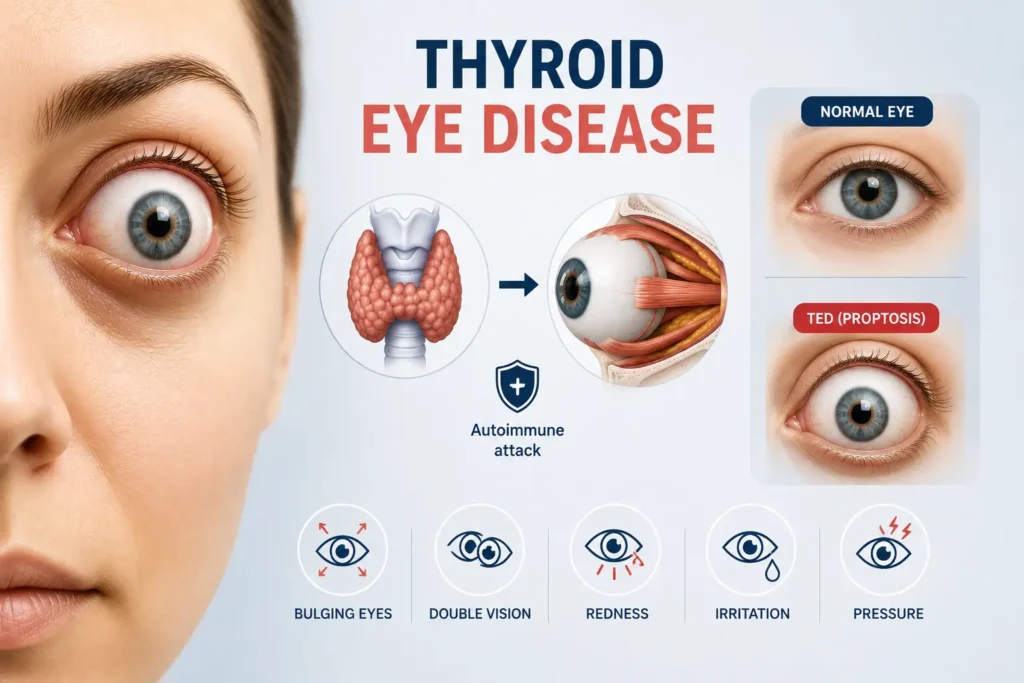
Gritty eyes that will not settle. A stare that looks different in photographs. Then one day, double vision while reading.
The condition moves slowly enough that most people explain the early signs away. Catching it matters because treatment decisions change as the disease moves from active inflammation into a more stable phase.
- Thyroid eye disease is an autoimmune condition where tissue behind the eyes swells and pushes the eyeball forward. It is closely linked to Graves disease.
- It usually moves from an active inflammatory phase, often around 18 to 24 months, through a plateau and into a stable inactive phase.
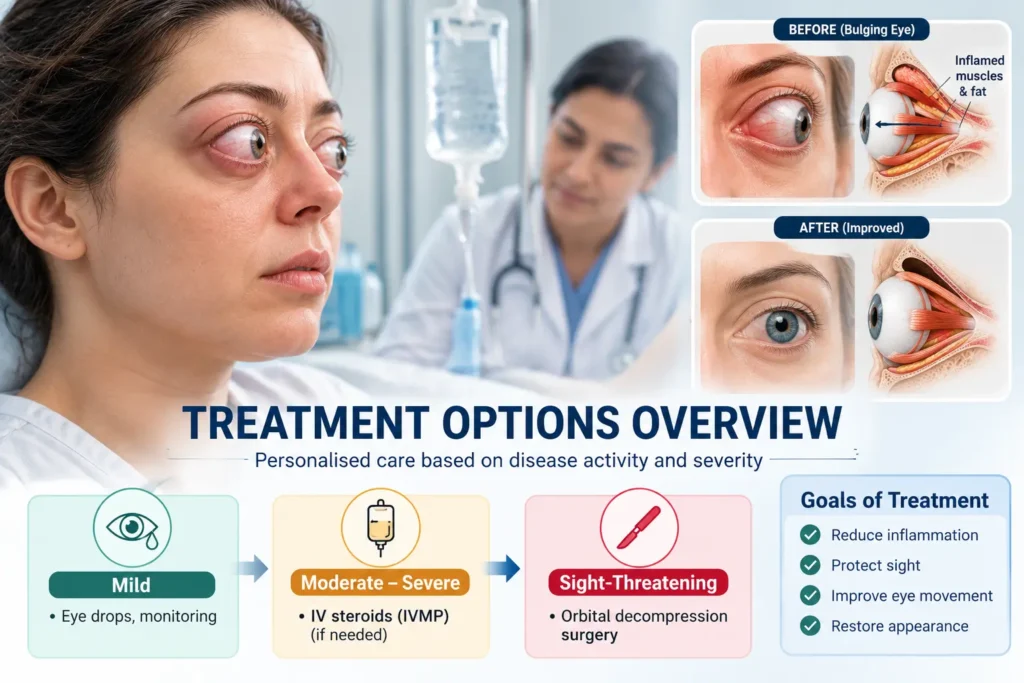
- Mild disease is often managed with supportive care. Moderate to severe active disease may need intravenous steroids or targeted therapy, with the choice depending on activity, severity and your own circumstances.
- Sudden vision loss, severe eye pain or a change in colour vision is an emergency.
What Thyroid Eye Disease Is
Also called TED or Graves orbitopathy, this is an autoimmune condition where the immune system attacks tissue and muscle in the eye socket. The tissue swells, and because the socket is fixed bone, the eyeball is pushed forward. That is proptosis.
It is tied to Graves disease, where the thyroid is overactive, though it can appear with normal or underactive thyroid too. A meta-analysis found it in roughly 40 percent of people with Graves disease. Our thyroid test normal range chart covers what each thyroid value means.
Symptoms and How Doctors Measure Activity
Early symptoms can be mild and may be mistaken for dry eye. As it progresses, people notice eye bulging, double vision, redness, swelling, pressure behind the eyes, and trouble closing the eyelids fully. In advanced disease, pressure on the optic nerve can threaten sight.
Doctors score activity using the Clinical Activity Score, or CAS. A score of 3 or more suggests the disease is still inflammatory rather than settled, and that number shapes the treatment plan.
The strongest modifiable risk factor is smoking, and risk rises with the number of cigarettes. Stopping removes an important modifiable risk factor and may reduce the risk of worsening disease. Other factors cannot be changed: being female, older age, genetic predisposition and previous radioactive iodine therapy. Whether the thyroid itself can return to normal is covered in our guide on whether thyroid disease is curable.
Why Timing Changes Everything
TED follows a recognisable shape over time, often called the Rundle curve. Severity climbs through the active phase, plateaus, then partly improves before settling at a new baseline.
Conceptual illustration, not patient data. The course varies from person to person.
Anti-inflammatory treatment has most to work with while the curve is climbing. Once the disease becomes inactive, some changes may remain even after the inflammation settles. Rehabilitative surgery may then be considered for persistent proptosis, double vision or eyelid changes.
Severity and What It Usually Means
| Severity | What it looks like | Usual approach |
|---|---|---|
| Mild | Slight eyelid retraction, minimal double vision, no threat to sightLubricating drops, stopping smoking, monitoring | Lubricating drops, stopping smoking, monitoring |
| Moderate to severe | Noticeable proptosis, persistent double vision, affects daily lifeIV steroids or an IGF-1R inhibitor, sometimes radiotherapy | IV steroids or an IGF-1R inhibitor, sometimes radiotherapy |
| Sight threatening | Dysthyroid optic neuropathy, risk of permanent vision lossUrgent specialist care, usually high dose IV steroids. Decompression if vision does not respond | Urgent specialist care, usually high dose IV steroids. Decompression if vision does not respond |
Treatment Options
Supportive Care
Mild disease is often managed without drugs: lubricating drops, cool compresses, sunglasses, and stopping smoking. Selenium may be considered in mild active disease where dietary selenium is low, though evidence is less certain where intake is adequate. General thyroid diet guidance applies alongside this.
Intravenous Steroids
Intravenous methylprednisolone remains central for moderate to severe active disease. The 2021 EUGOGO guideline recommends it combined with mycophenolate sodium as first-line, with methylprednisolone alone as an alternative. It calms inflammation but does not reliably reverse proptosis. Cumulative dosing carries liver and cardiovascular risk, so doctors monitor liver values, as our LFT guide explains. Steroids also raise blood sugar, which matters if you are managing prediabetes.
One thing runs underneath all of this. EUGOGO recommends restoring and maintaining normal thyroid hormone levels in everyone with the condition, whatever else is being treated.
Radiotherapy and Surgery
Orbital radiotherapy is sometimes used alongside steroids, particularly where eye muscle involvement drives double vision. Orbital decompression may be urgent when sight is threatened by optic nerve compression or severe corneal exposure. It is also used later to correct persistent proptosis once disease has stabilised, with squint and eyelid surgery following in that order.
IGF-1R Inhibitors: Two Approved Drugs
Two drugs target IGF-1R, a receptor involved in the biology of this disease, rather than suppressing inflammation broadly the way steroids do.
Teprotumumab, sold as Tepezza, was approved in January 2020, and in April 2023 the FDA updated its label so it is indicated regardless of disease activity or duration. Veligrotug, sold as Lumvoa, was approved on 26 June 2026 under Priority Review, with the same breadth of indication. What is new is that its FDA label includes clinical studies in both active and chronic populations, THRIVE and THRIVE-2.
THRIVE randomised 113 patients with active disease. At week 15, mean proptosis reduction was 2.90 mm with veligrotug against 0.48 mm with placebo, and 70 percent met the proptosis responder definition against 5 percent on placebo. Response was greater in the active disease study than in the chronic one. The two drugs are not interchangeable, and the choice depends on your disease and your other conditions.
| Feature | Teprotumumab (Tepezza) | Veligrotug (Lumvoa) |
|---|---|---|
| FDA approval | January 2020Veligrotug: 26 June 2026 | 26 June 2026 |
| Indication | Regardless of activity or duration, since April 2023Veligrotug: same | Regardless of activity or duration |
| Course | 8 infusions over 21 weeks, 10 mg/kg then 20 mg/kg every 3 weeksVeligrotug: 5 infusions over 12 weeks at 10 mg/kg | 5 infusions over 12 weeks at 10 mg/kg |
| Label warnings | Infusion reactions, IBD, hyperglycemia, hearing impairmentVeligrotug: the same four | The same four warnings |
| Trial data in label | Clinical studies in active diseaseVeligrotug: THRIVE active, THRIVE-2 chronic | THRIVE active, THRIVE-2 chronic |
Safety and Monitoring
Both IGF-1R inhibitors carry four label warnings, and these shape who can take them.
- Hearing impairment. The label states these drugs may cause severe hearing impairment including hearing loss, which in some cases may be permanent. It was the commonest adverse reaction with veligrotug, in 15 percent against 6 percent on placebo. Hearing is assessed before starting.
- Inflammatory bowel disease. Treatment may worsen IBD, and cases have occurred in people with no previous diagnosis. Doctors monitor for symptoms and stop the drug if IBD is suspected. People with IBD were excluded from the trials.
- Hyperglycemia. Raised blood glucose occurred in 13 percent against 5 percent on placebo. Blood glucose should be assessed before each infusion and monitored during treatment, and diabetes needs controlling first, which is where your HbA1c result comes in.
- Infusion reactions. Around 9 percent of veligrotug patients, generally mild to moderate. The infusion may be slowed or interrupted.
Veligrotug may harm a developing baby and should not be used in pregnancy. A pregnancy test is required before starting, and effective contraception is advised before, during, and for 6 months after the final dose.
What This Means for Patients in India
Approval by the FDA applies to the United States only. Every country decides separately, so an American approval does not mean a drug is approved or available in India. Do not assume either drug can be obtained locally.
Care in India still centres on supportive measures, steroids, radiotherapy where appropriate, and surgery, delivered by an endocrinologist and ophthalmologist together. For the status of a specific drug here, ask your specialist rather than an international news report. Our KFT blood test guide and ECG test guide cover baseline tests often done before infusion therapy.
When to See a Doctor
Seek care the same day for:
- Sudden vision loss or blurring
- Severe pain in or behind the eye
- A change in colour vision, which can signal optic nerve compression
Book an ordinary appointment for new or worsening eye bulging, double vision that was not there before, persistent redness or swelling, or difficulty closing your eyelids.
Key Takeaways
- Ask which phase your disease is in. It shapes whether drugs or surgery come first.
- Stopping smoking and keeping thyroid levels steady are the parts you can influence.
- If an IGF-1R inhibitor is discussed, ask about hearing, bowel symptoms, blood sugar and pregnancy.
- An FDA approval is not an availability statement for India.
Frequently Asked Questions
What is the best treatment for thyroid eye disease?
There is no single best treatment. It depends on how active and how severe the disease is, ranging from lubricating drops and monitoring in mild cases to steroids, an IGF-1R inhibitor or surgery in advanced disease.
How long does thyroid eye disease last?
The active inflammatory phase often lasts around 18 to 24 months before settling into a stable chronic phase. The course varies between people, and some changes from the active phase remain afterwards.
What is the newest drug for thyroid eye disease?
Veligrotug, sold as Lumvoa, was approved by the FDA on 26 June 2026. It is the second IGF-1R inhibitor approved for this condition, and the first whose FDA label includes clinical studies in both active and chronic disease populations.
How is veligrotug different from teprotumumab?
Both block the same receptor and both are indicated regardless of disease activity or duration. Veligrotug is 5 infusions over 12 weeks against 8 over 21 weeks for teprotumumab, and its label includes a dedicated chronic disease trial.
Is Lumvoa available in India?
FDA approval covers the United States only and does not mean the drug is approved or available in India. Status here is decided separately. Ask your endocrinologist or ophthalmologist what is actually accessible to you.
Can thyroid eye disease be cured?
No permanent cure exists. Treatment aims to control inflammation, reduce proptosis and double vision, and protect sight. Many people improve substantially once the disease leaves the active phase.
Does smoking make thyroid eye disease worse?
Smoking is the strongest modifiable risk factor, and both risk and severity rise with the number of cigarettes. Stopping removes a major driver and is one of the few parts of this disease a person directly controls.
Can thyroid eye disease be treated without surgery?
Yes. Many people are managed with supportive care, steroids or an IGF-1R inhibitor and never need an operation. Surgery is reserved for sight-threatening disease, or for correcting changes that remain once disease has stabilised.
References
- Viridian Therapeutics. LUMVOA (veligrotug-vvze) US Prescribing Information. 26 June 2026. viridiantherapeutics.com
- DailyMed. LUMVOA veligrotug injection label. 2026. dailymed.nlm.nih.gov
- US FDA. TEPEZZA (teprotumumab-trbw) Prescribing Information. 2025. accessdata.fda.gov
- Horizon Therapeutics. FDA approval of updated TEPEZZA indication language. April 2023. biospace.com
- Yen MT, Cockerham K, Saeed P, et al. THRIVE: a phase 3 study of veligrotug for active thyroid eye disease. Ophthalmology. 1 June 2026. ophthalmologytimes.com
- Bartalena L, Kahaly GJ, Baldeschi L, et al. 2021 EUGOGO clinical practice guidelines for the medical management of Graves orbitopathy. Eur J Endocrinol. 2021. academic.oup.com
- American Academy of Ophthalmology EyeNet. Expanded Treatment Options for Thyroid Eye Disease. aao.org
- Cleveland Clinic. Thyroid Eye Disease, Graves Eye Disease. my.clevelandclinic.org
All sources checked 8 October 2026.
Iraphan Khan, BSN, RN, D.Pharm, Public Health Researcher. Founder of RealMedVision, writing patient-focused health content based on clinical guidelines and peer-reviewed research.
Dr Praveen Verma, MBBS, MD (Pathology)
Dr Himanshu Morya, MBBS, Medical Educator
Reviewed 8 October 2026.
This article is general information and does not replace advice from your endocrinologist or ophthalmologist. Treatment decisions depend on your own disease and history. Always follow your doctor.