
What creatinine, urea and eGFR mean on your report, and why a normal creatinine does not always mean healthy kidneys.
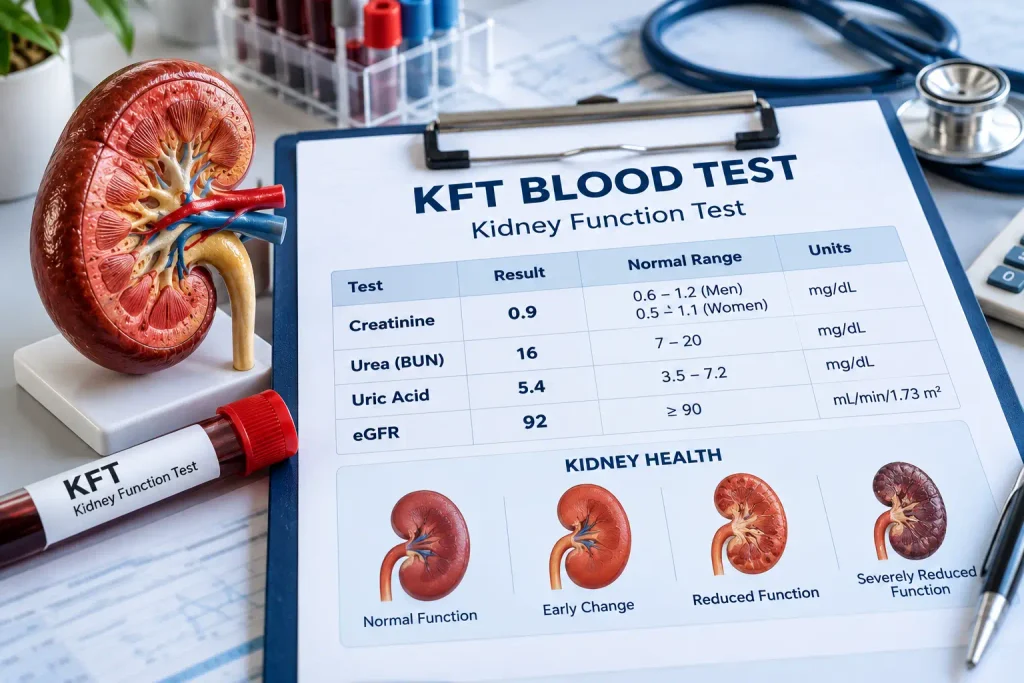
Your report comes back. Creatinine sits inside the printed range, nothing is flagged, and you move on. For most people that is right.
But the kidney is unusual. It can lose a large share of its working capacity before a routine blood value starts to move. That is why a normal creatinine on a KFT blood test does not always tell the whole story.
Quick Answer
- A KFT blood test usually shows creatinine 0.6 to 1.2 mg/dL in men and 0.5 to 1.1 mg/dL in women, and blood urea nitrogen 7 to 20 mg/dL. An eGFR of 90 or above sits in the normal or high category, though eGFR alone does not rule out kidney disease.
- eGFR gives a better estimate of filtering capacity than creatinine alone. An eGFR below 60 can indicate reduced kidney function, especially when it persists for three months or longer.
- Creatinine can stay inside the normal range until a large share of kidney function is already gone, which is why eGFR and a urine test are used alongside it.
- Very low urine output, swelling with breathlessness, or confusion need urgent medical care, whatever the report says.
What a KFT Blood Test Measures
KFT stands for kidney function test. Some laboratories call the same panel RFT, for renal function test. Both names describe the same group of values.
It measures waste products healthy kidneys clear from the blood, mainly creatinine, urea and uric acid. Most reports also calculate eGFR from your creatinine, age and sex.
KFT Test Normal Range Chart
| Marker | Reference range | What it points to |
|---|---|---|
| Serum creatinine | 0.6 to 1.2 mg/dL men, 0.5 to 1.1 womenMain waste marker, rises late | Main waste marker, rises late |
| eGFR | 90 or aboveBetter estimate of filtering than creatinine alone | Better estimate of filtering than creatinine alone |
| Blood urea nitrogen | 7 to 20 mg/dLAlso shifts with hydration and diet | Also shifts with hydration and diet |
| Blood urea | Reported on a different scale from BUNUse your own report range | Use your own report range |
| Uric acid | Varies by laboratory and sexLinked to gout and kidney stones | Linked to gout and kidney stones |
| Urine albumin ratio | Below 30 mg/gCan show damage before eGFR falls | Can show damage before eGFR falls |
Source: National Kidney Foundation and KDIGO 2024, checked 6 October 2026. Ranges differ by laboratory, age, sex and muscle mass.
Indian reports vary in how urea is presented, so compare against your own sheet. Reference ranges shift across other blood tests too, including the thyroid panel and the liver function test.
Why a Normal Creatinine Can Still Hide a Problem
Creatinine and kidney function do not move together in a straight line. Filtering capacity can fall a long way while creatinine barely shifts, and only then does it climb steeply.
Conceptual illustration, not population data. Shows the shape of the relationship, not fixed values.
That is why doctors use eGFR and a urine albumin test rather than creatinine alone. Urine can show damage while blood values still read as normal.
What Your eGFR Number Means
eGFR estimates roughly what share of filtering capacity you have. KDIGO groups it into stages, and one low reading confirms nothing on its own.
Stage boundaries from the KDIGO 2024 guideline, which also grades urine albumin separately. Two people with the same eGFR can carry different risk.
An eGFR of 60 to 89 does not by itself mean chronic kidney disease. KDIGO states that without evidence of kidney damage, neither G1 nor G2 meets the criteria. Damage means albumin in the urine or an abnormality on imaging, lasting at least three months.
What Each Value Means on Your Report
Serum Creatinine
Creatinine is waste from muscle breakdown. More muscle means more creatinine, which is why a well built young man and a slight older woman can both be healthy at very different numbers. A sudden rise matters more than a stable high-ish value.
Blood Urea and BUN
Urea comes from protein breakdown. It is a weaker marker than creatinine, because dehydration, a high protein diet and bleeding in the gut all push it up with no kidney problem present.
Uric Acid
Some KFT panels also include uric acid. A high level is linked with gout and some kidney stones. It is not a direct measure of filtering capacity, and a raised value alone does not mean kidney disease.
Urine Albumin
Not a blood value, but it belongs here. Albumin leaking into urine can be an early sign of damage, and may appear while eGFR is still normal. Ask whether it has been checked.
Reading the Pattern on Your Report
Doctors usually look at which values have changed together, not at one number on its own.
| Pattern | What the report shows | What it suggests |
|---|---|---|
| Urea up, creatinine normal | Urea raised on its ownOften dehydration, high protein or gut bleeding | Often dehydration, high protein or gut bleeding |
| Creatinine up, eGFR down | Both move togetherReduced filtering, needs assessment | Reduced filtering, needs assessment |
| Rising fast over days | A sharp jump from an earlier reportAcute injury, needs prompt review | Acute injury, needs prompt review |
| Normal blood, albumin in urine | Blood fine, urine test abnormalEarly damage blood alone would miss | Early damage blood alone would miss |
What Pushes Kidney Numbers Out of Range
Diabetes and high blood pressure are the two largest drivers worldwide. Dehydration, regular painkillers, some antibiotics, kidney stones, repeated infections and inherited conditions also appear.
Chronic kidney disease is common in India. A 2025 meta-analysis of 18 community studies put pooled prevalence at about 13 percent and found it rising. The metabolic drivers overlap, so work on blood sugar helps here too, as in our guides to reversing prediabetes and grade 1 fatty liver.
When a Kidney Result Needs a Doctor Quickly
See a doctor without waiting for your next appointment if you have:
- A sharp rise in creatinine compared with a recent report
- Passing very little urine, or none at all
- Swelling of the legs or face, especially with breathlessness
- Blood in the urine, or severe flank or lower back pain
- Confusion, unusual drowsiness or vomiting that will not settle, needing emergency care
Reading any report is easier once you know what normal looks like. Same guides exist for the ECG test, for an EF of 60 percent on an echo report and for grade 1 diastolic dysfunction.
How to Prepare for a KFT Blood Test
- Ask your laboratory whether fasting is needed, since it depends what else is bundled in.
- Drink water normally. Being dehydrated can push urea and creatinine up.
- Tell your doctor about every medicine and supplement, painkillers and protein powders included.
- Carry previous reports so values can be compared over time.
What Happens After an Abnormal KFT
What happens next depends on how abnormal the result is and whether it is new. Your doctor may repeat the test, compare it with an older report, add a urine albumin test, order an ultrasound, or investigate straight away. A sharp recent rise is treated more urgently than a stable mildly raised value.
For chronic kidney disease, KDIGO requires the abnormality to persist for at least three months before the diagnosis is made.
Where numbers are mildly off, the work is mostly controlling the drivers. Blood pressure and sugar targets, care with painkillers, and treating anything causing repeated infections.
A 52 year old man with diabetes has a routine KFT. Creatinine is 1.1, inside the range, nothing flagged. His doctor adds a urine albumin test, which comes back raised. That changes his treatment plan even though the blood report looked normal.
Composite example, not a specific patient.
Key Takeaways
- Read eGFR before creatinine. It accounts for age and sex, which creatinine alone does not.
- With diabetes or high blood pressure, ask whether a urine albumin test has been done.
- Compare today against your last report. The direction matters more than one number.
- Act at once on very low urine output, swelling with breathlessness, or confusion.
Frequently Asked Questions
What is the normal range for a KFT blood test?
Most adult reports use creatinine 0.6 to 1.2 mg/dL in men and 0.5 to 1.1 mg/dL in women, and blood urea nitrogen 7 to 20 mg/dL. An eGFR of 90 or above sits in the normal or high category. Uric acid and urea ranges differ by laboratory.
What is the difference between KFT and RFT?
There is no difference. KFT means kidney function test and RFT means renal function test. Laboratories use both names for the same panel, though the exact list of values can vary.
Is a creatinine of 1.3 dangerous?
Slightly above the usual range is a prompt to look further, not an emergency. It depends on your muscle mass, your eGFR and whether it has changed from earlier reports.
What does a low eGFR mean?
It means filtering capacity is reduced. The National Kidney Foundation treats a value below 60 as a sign the kidneys are not working well. KDIGO requires the change to last three months before it counts as chronic kidney disease.
Can a KFT be normal and the kidneys still be damaged?
Yes. A normal creatinine does not always rule out kidney damage. Albumin in the urine can sometimes show damage even when eGFR still reads as normal, which is why a urine test is advised alongside the blood panel.
Do I need to fast before a KFT blood test?
Often not for the kidney panel alone. Fasting is usually asked for when it is bundled with sugar or lipid tests. Check with your laboratory when you book, and keep drinking water unless told otherwise.
Does high urea always mean a kidney problem?
No. Urea rises with dehydration, a high protein diet and bleeding in the gut, none of which involve the kidneys. Doctors read it next to creatinine and eGFR before concluding anything.
How often should a KFT be done?
That depends on your risk. People with diabetes or high blood pressure usually need kidney testing at least once a year, using eGFR together with a urine albumin test. For everyone else, the interval depends on your own risk and what your doctor advises.
References
- KDIGO 2024 Clinical Practice Guideline for Chronic Kidney Disease. Kidney International. kidney-international.org
- National Kidney Foundation. What is the Difference Between sCr, eGFR, ACR and BUN. kidney.org
- National Kidney Foundation. Kidney Health 101: Making Sense of Lab Results. kidney.org
- National Kidney Foundation. Understanding your lab values and CKD numbers. kidney.org
- College of American Pathologists and National Kidney Foundation. CKD Testing. documents.cap.org
- Talukdar A, et al. CKD Prevalence in India: Systematic Review and Meta-Analysis. Nephrology. 2025. onlinelibrary.wiley.com
- Singh AK, et al. Epidemiology and risk factors of CKD in India, SEEK study. ncbi.nlm.nih.gov
- National Kidney Foundation. Stage G2 Chronic Kidney Disease. kidney.org
All sources checked 6 October 2026.
Iraphan Khan, BSN, RN, D.Pharm, Public Health Researcher. Writes patient facing medical content for RealMedVision, focused on test interpretation.
Dr Praveen Verma, MBBS, MD Pathology and Dr Himanshu Morya, MBBS, Medical Educator. Reviewed 6 October 2026.
This article is general information. It does not diagnose any condition and does not replace an assessment of your own results. Always follow your doctor.