
Medically Reviewed: 23 September 2026 • Last Updated: 23 September 2026 • 8 minute read
Worried about this line on your echo report? Here is what it means, how serious it usually is, and what to do next.
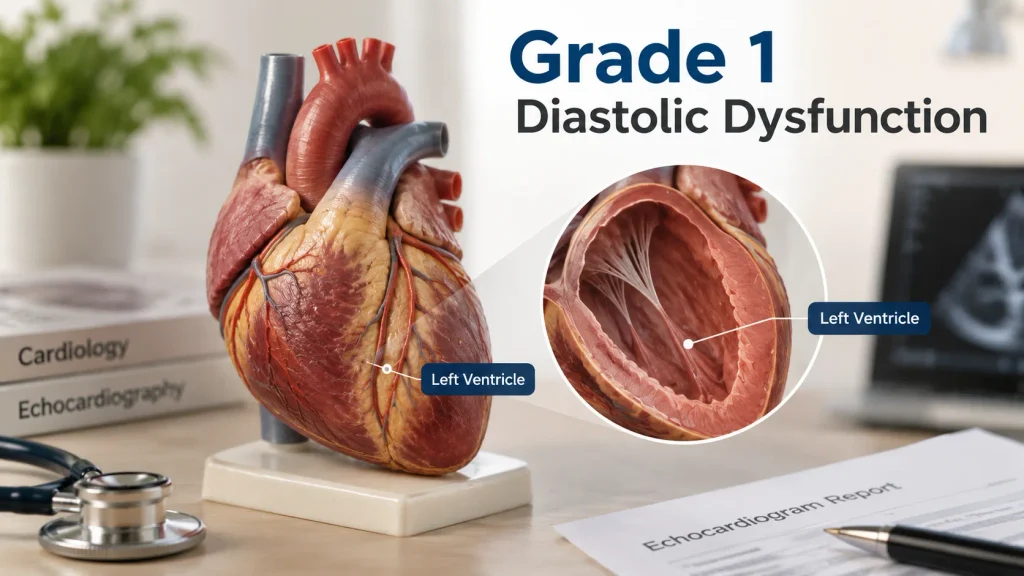
You open your 2D echo report and one line stands out: Grade 1 LV diastolic dysfunction. The word dysfunction sounds alarming, and the report rarely explains it. Feeling worried is completely understandable.
Grade 1 is the least severe category of diastolic dysfunction. It becomes more common with age and often occurs along with conditions such as high blood pressure or diabetes.
Quick Answer
- What It Means: Your heart’s main pumping chamber, the left ventricle, relaxes more slowly than usual between beats.
- How Serious: It is the least severe category, and filling pressure is usually normal at rest.
- Usual Causes: Ageing, high blood pressure, diabetes, excess weight and coronary artery disease.
- What To Do: Share the report with your doctor and work on your blood pressure, blood sugar and weight.
What Does Grade 1 Diastolic Dysfunction Mean?
Filling vs Pumping, in Simple Words
Every heartbeat has two phases. In systole, the heart squeezes blood out. In diastole, it relaxes and refills. Think of a rubber ball: a soft one springs back at once, while an older, stiffer one takes a moment longer.
Grade 1 diastolic dysfunction, also called impaired relaxation, means the left ventricle relaxes more slowly than usual. The filling pressure inside the heart is usually still normal at rest.1, 2
How It Appears on Your Echo Report
Your report may say Grade I LV diastolic dysfunction, Grade 1 LVDD (left ventricular diastolic dysfunction), or impaired LV relaxation. These terms describe the same finding. Your doctor looks at several echo measurements, such as the E/A ratio and e′ velocity, to assess how well the heart relaxes and fills.
Is Grade 1 Diastolic Dysfunction Dangerous?
On its own, grade 1 diastolic dysfunction is usually not an emergency, and many people feel perfectly well. Cleveland Clinic describes it as slightly impaired relaxation and a common finding in people over 60.3
It is still worth taking seriously. In a Mayo Clinic study from Minnesota, USA, heart failure developed over about six years in 7.8% of people whose readings stayed at, or moved to, the mild stage, compared with 2.6% of those whose relaxation stayed or became normal.4 So more than 9 in 10 people in the mild group did not develop heart failure in that time.
This older US study may not match Indian patients exactly, so treat it as a reason to act early, not to panic.
How Common Is It as You Get Older?
Very common. In a Mayo Clinic survey of 2,042 adults aged 45 or older, published in JAMA in 2003, about 1 in 5 had mild diastolic dysfunction on echo.5 Moderate and severe forms were far rarer.
Diastolic dysfunction in adults aged 45 or older
Source: Redfield MM et al, JAMA 2003. Olmsted County, Minnesota, USA, 2,042 adults.
Age alone does not explain every case of grade 1 diastolic dysfunction, so your doctor will also look for treatable causes.
What Causes Grade 1 Diastolic Dysfunction?
Often there is more than one reason. Cleveland Clinic lists these common causes and risk factors:3
- High Blood Pressure: Cleveland Clinic names uncontrolled blood pressure as the most common cause. Compare your readings with the normal blood pressure range for your age.
- Age: The risk rises with age, especially after 70.
- Diabetes and Excess Weight: Including a body mass index (BMI) of 30 or above.
- Heart Conditions: Coronary artery disease, a past heart attack or cardiomyopathy (heart muscle disease).
- Other Factors: Sleep apnoea, smoking and low physical activity.
Will You Feel Any Symptoms?
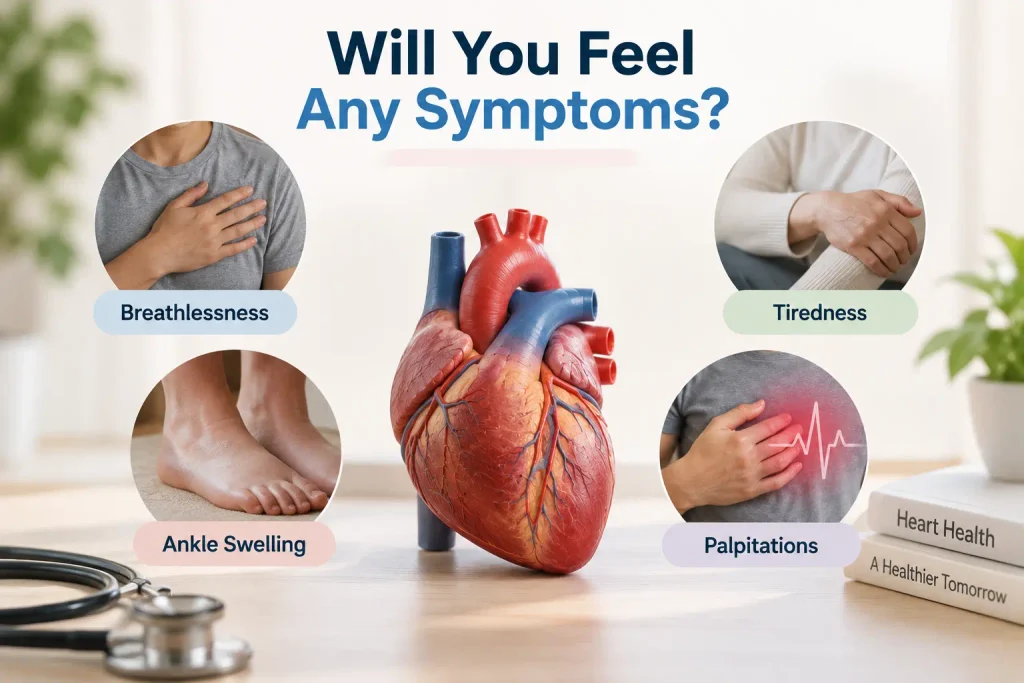
Most people with grade 1 diastolic dysfunction feel nothing unusual. Some notice breathlessness during effort, such as climbing stairs.
With more advanced diastolic dysfunction or heart failure, fluid can build up in the lungs and legs, causing breathlessness, tiredness and ankle swelling. Cleveland Clinic also notes a link with atrial fibrillation, an irregular heart rhythm.3
Keep in Mind
Seek urgent medical care for chest pain or pressure, severe breathlessness, fainting, or a racing or irregular heartbeat with dizziness. These symptoms need prompt assessment and should not be assumed to be caused by grade 1 diastolic dysfunction. Chest pain can sometimes be a sign of a heart attack.
Grade 1 vs Grade 2 vs Grade 3: What Is the Difference?
Doctors combine several echo measurements to judge how well the heart relaxes and whether filling pressure has risen. Higher grades are more serious.1, 3
| Grade | Other Name | What Is Happening | Severity |
|---|---|---|---|
| Grade 1 | Impaired relaxation | The heart relaxes more slowly than usual. Filling pressure is usually normal at rest. | Mild |
| Grade 2 | Pseudonormal filling | Relaxation is impaired, and filling pressure is usually elevated. | Moderate |
| Grade 3 | Restrictive filling | Filling pressure is usually markedly elevated, with a restrictive filling pattern. | Severe |
Grade 2 or higher may need closer review with your doctor.
Can Grade 1 Get Worse or Better?
It can change in either direction. In a 2011 JAMA study, Mayo Clinic researchers rechecked 1,402 adults after about four years. These results cover the whole group, not only those who started at grade 1.4
Change in diastolic function over about four years
Source: Kane GC et al, JAMA 2011. 1,402 adults aged 45 or older, Olmsted County, Minnesota, USA.
Worsening was more likely at age 65 or older, and results varied between individuals.
What Tests Might Your Doctor Suggest Next?
A scan finding like grade 1 diastolic dysfunction is not a full diagnosis. To find out why it is there, your doctor may suggest:
- Blood Pressure Checks: At the clinic and at home.
- Blood Sugar Tests: Such as HbA1c (glycated haemoglobin), to look for diabetes.
- ECG (Electrocardiogram): To check your heart rhythm. See our guide to ECG normal range values.
- Sleep Study: If you snore loudly or feel sleepy by day.
- Repeat Echo: Later on, to check for change. See typical costs in our echo test price guide.
When Should You See a Cardiologist?
A family physician can often manage a grade 1 finding. Your doctor may refer you to a cardiologist, a heart specialist, if you have symptoms such as breathlessness or ankle swelling, an irregular heartbeat, or other findings on the same echo, for example a low EF, thickened heart walls or a valve problem. If unsure, ask whether a cardiologist review would help.
How Is Grade 1 Diastolic Dysfunction Treated?
Treatment for grade 1 diastolic dysfunction does not target the slow relaxation directly. It focuses on the conditions behind it, usually with medicines for high blood pressure or diabetes if needed, plus lifestyle changes. If fluid builds up, doctors may prescribe water tablets (diuretics).3
Whether tight control of these conditions slows the change itself is still being studied.6 Controlling them still benefits your overall health.
Not everyone with grade 1 diastolic dysfunction needs a heart medicine. The plan depends on your blood pressure, blood sugar, symptoms and the rest of your echo report. Always follow your doctor’s advice, and never start or stop a medicine on your own.
Daily Habits That Support Your Heart
Cleveland Clinic suggests these heart-healthy habits:3
- Stay Active: Regular walking or other moderate exercise can support heart health. If you have symptoms, ask your doctor what level of exercise is right for you.
- Limit Salt: Cut back on salty foods such as pickles, papad and packaged snacks.
- Avoid Tobacco: Avoid cigarettes, bidis and chewing tobacco.
- Maintain a Healthy Weight: If you are overweight, gradual weight loss can support overall heart health. Aim for regular, good quality sleep as well.
Patient Tip
Log home blood pressure readings from a validated monitor and take them to every check-up. Ask your doctor before starting a new or intense exercise routine.
Illustrative Scenario
Composite example, not a specific patient.
Ramesh, 58, had an echo before a knee operation. His EF was normal, but the report showed Grade I LV diastolic dysfunction. His doctor asked him to monitor his blood pressure at home. When his readings remained high, the doctor started treatment and advised regular walking and less salt.
Is This the Same as a Low EF?
No. EF, or ejection fraction, measures how strongly the heart pumps. Diastolic dysfunction is about how well it relaxes and fills. So a report can show a normal EF, such as 60%, alongside grade 1 diastolic dysfunction. Our guide to EF 60% in a 2D echo report explains that number.
Key Takeaways
- Show the full report to the doctor who ordered the echo.
- Check your blood pressure regularly and treat it if it stays high.
- Make daily walking, less salt and a healthy weight part of your routine.
- Get emergency care for chest pain, fainting or severe breathlessness.
Frequently Asked Questions
Is grade 1 LV diastolic dysfunction dangerous?
Usually not on its own. It is the least severe category of diastolic dysfunction, but your doctor should consider your age, blood pressure, symptoms and other echo findings.
What is grade 1 LV diastolic dysfunction?
It means the left ventricle relaxes more slowly than usual. Filling pressure is usually normal at rest. Doctors also call this impaired relaxation.
Can grade 1 diastolic dysfunction be reversed?
It can improve in some people, but improvement cannot be guaranteed. In a Mayo Clinic study, diastolic function improved in 8.8% of adults who were rechecked after about four years.
Is grade 1 diastolic dysfunction normal for age?
It becomes more common with age, but it should not be judged by age alone. Your doctor will also consider your symptoms, blood pressure and other echo findings.
What is the treatment for grade 1 diastolic dysfunction?
There is no standard medicine for the Grade 1 finding itself. Treatment usually focuses on conditions such as high blood pressure, diabetes and excess weight, along with healthy lifestyle habits.
Which doctor should I see for diastolic dysfunction?
Start with the doctor who ordered your echo. They can review the full report and decide whether you need a cardiologist.
Can I exercise with grade 1 diastolic dysfunction?
Regular physical activity can support heart health. If you have symptoms or plan to start intense exercise, ask your doctor what level is appropriate for you.
Does grade 1 diastolic dysfunction mean heart failure?
No. Grade 1 diastolic dysfunction is an echocardiogram finding. Heart failure is diagnosed using symptoms, examination and other clinical and test findings. Having Grade 1 does not by itself mean you have heart failure.
References
- Nagueh SF, et al. Recommendations for the Evaluation of Left Ventricular Diastolic Function by Echocardiography and for Heart Failure With Preserved Ejection Fraction Diagnosis: An Update From the American Society of Echocardiography. J Am Soc Echocardiogr. 2025. onlinejase.com
- British Society of Echocardiography. The Assessment of Left Ventricular Diastolic Function: Guidance and Recommendations. Echo Res Pract. 2024. pmc.ncbi.nlm.nih.gov
- Cleveland Clinic. Diastolic Dysfunction: Causes, Symptoms and Treatment. Last updated 2022. my.clevelandclinic.org
- Kane GC, et al. Progression of Left Ventricular Diastolic Dysfunction and Risk of Heart Failure. JAMA. 2011. pubmed.ncbi.nlm.nih.gov
- Redfield MM, et al. Burden of Systolic and Diastolic Ventricular Dysfunction in the Community. JAMA. 2003. pubmed.ncbi.nlm.nih.gov
- American College of Cardiology. Journal Scan: Progression of Left Ventricular Diastolic Dysfunction and Risk of Heart Failure. 2011. acc.org
Written By
Iraphan Khan, BSN, RN, D.Pharm, Public Health Researcher. Iraphan writes evidence-based patient guides that turn medical reports and research into plain language.
Medically Reviewed By
Dr Praveen Verma, MBBS, MD Pathology
Dr Himanshu Morya, MBBS, Medical Educator
Last reviewed: 23 September 2026. Next scheduled review: March 2027.
Disclaimer: This article is for general education and is not a diagnosis or treatment plan. Your echo report should be read by a doctor who knows your full history. Always follow what your doctor tells you.
I’m now more stable and no longer warried of having to go for coronary intervention for my concentric grade 1 diastolic dysfunction. But what I don’t want is the possibility of having coronary bypass. I want to avoid surgery as much as possible
Thanks for writing in, Mohammed. Glad you’re feeling better about it.
One thing I’d clear up. Diastolic dysfunction and blocked arteries are not the same problem. Grade 1 just means your heart muscle is a bit stiff when it relaxes and fills between beats. Bypass is done for blocked arteries, and those show up on an angiogram, not on an echo. So this reading by itself doesn’t mean surgery is coming.
I can’t speak about your own case though. Only your cardiologist can. Next visit, just ask them straight: are my arteries clear, and is any procedure even being considered? Hearing the answer out loud usually settles the worry more than anything you read online.
Keep your follow-ups, and if you ever get chest pain, breathlessness or swelling in the legs, get seen the same day.