
Nipah virus can cause severe illness, but it remains rare. Knowing the early symptoms and the situations that need urgent medical care can help you respond appropriately.
This article was reviewed against World Health Organization outbreak reports available on 21 September 2026 and will be updated if the situation changes.
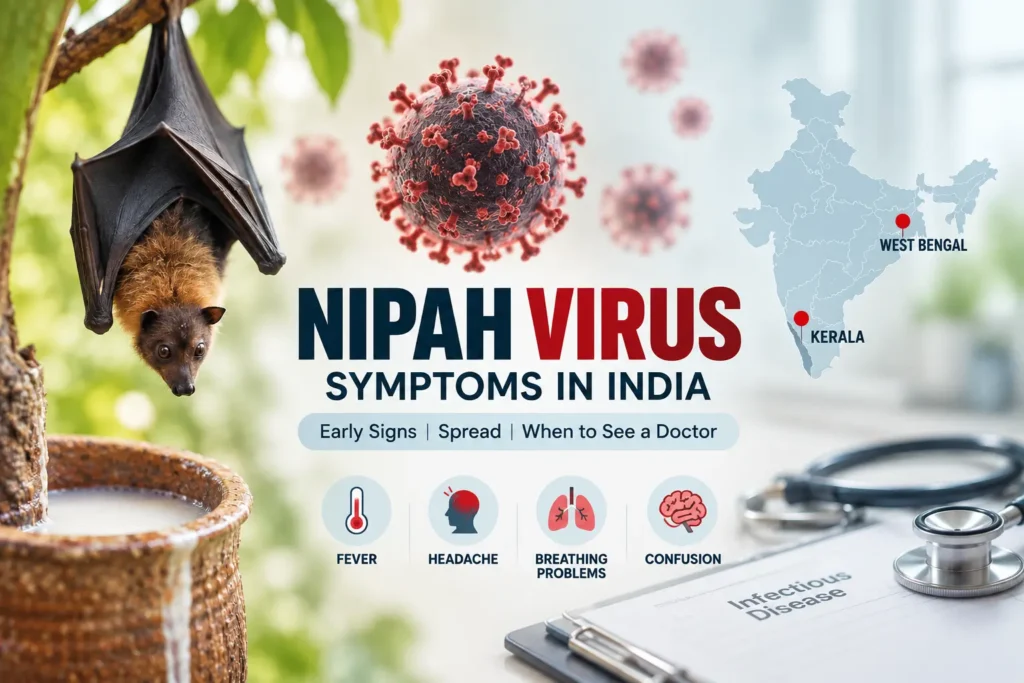
Nipah virus, or NiV, made news in India twice in 2026, in West Bengal in January and in Kerala in June, two separate states and two separate events. If you have seen the headlines and are wondering what the symptoms actually look like and whether you should be worried, this guide walks through it plainly, using WHO and CDC reporting reviewed as of 21 September 2026.
Quick Answer
- Early Nipah virus symptoms look like an ordinary bad flu: fever, headache, muscle pain, vomiting and sore throat.
- In severe cases, the illness can move to the brain within days, causing confusion, seizures or coma.
- The fatality rate among confirmed cases ranges from 40 to 75 percent, but outbreaks in India have stayed small and contained so far.
- The World Health Organization rates the current risk as moderate in the affected districts and low for the rest of India.
What Nipah Virus Actually Is
Nipah virus belongs to the same family as measles and mumps, though it behaves very differently in the body. Its natural home is fruit bats, sometimes called flying foxes, which carry the virus without getting sick themselves. People become infected through close contact with an infected bat or animal, by eating food contaminated with bat saliva or droppings, such as raw date palm sap, or through close contact with an infected person’s bodily fluids. This last route is why healthcare workers treating a Nipah patient face real risk if proper precautions are not followed.
Nipah Virus Symptoms: Early to Severe Signs
Symptoms usually start 3 to 14 days after exposure. In rare cases, symptoms have appeared as long as 45 days after infection. The illness can range from mild to severe, and not everyone follows the same path, but knowing what each stage can look like matters more than memorising a fixed symptom list.
Not everyone reaches the severe stage, and some infections stay mild throughout. But because the early symptoms are so ordinary, doctors often confirm the diagnosis only after ruling out more common causes of monsoon fever, such as dengue, which circulates far more widely at the same time of year.
Seasonal influenza, including the H1N1 strain currently circulating in parts of India, is another common look-alike doctors rule out first.
How Serious Is It, Really
The case fatality rate among confirmed cases ranges from 40 to 75 percent, according to both the WHO and CDC. That number sounds alarming, and it is one reason Nipah gets so much attention despite being rare. But it applies to people who are already confirmed infected, not to the general population, and outcomes depend heavily on how quickly a patient reaches proper hospital care. There is currently no specific antiviral treatment and no licensed vaccine. Nipah itself is confirmed only through specific laboratory testing, mainly RT-PCR on respiratory samples, blood or cerebrospinal fluid. Doctors may also use brain imaging such as MRI to evaluate neurological complications once symptoms develop, alongside supportive care such as fluids, rest and oxygen.
Good to Know
The World Health Organization has rated the risk from India’s 2026 cases as moderate within the affected districts and low at the national and global level. Outbreaks in India have historically stayed small, involving family clusters or healthcare settings rather than wide community spread.
The 2026 Outbreaks in India: Two States, Two Events
India saw two separate Nipah notifications in 2026, in two different states. The first was in West Bengal. On 26 January, health authorities confirmed two cases in Barasat, both healthcare workers at the same private hospital, in their twenties. Testing was confirmed at the National Institute of Virology in Pune, and over 190 contacts were traced and tested, all negative. This was West Bengal’s third reported Nipah outbreak, following earlier ones in Siliguri in 2001 and Nadia in 2007.
The second was in Kerala, a separate event in a different part of the country. On 11 June, Kerala’s health department confirmed one case in Kozhikode district, an adult male who developed symptoms in late May and needed intensive care with ventilator support. By 18 June, 104 contacts had been identified and monitored, including 45 healthcare workers, with no secondary cases reported. Kerala has experienced recurrent Nipah outbreaks since 2018, with confirmed events in 2018, 2019, 2021, 2023, 2025 and 2026, and Kozhikode district has been at the centre of several of them.
Who Should Be More Careful
If you live in or have recently visited an area with an active or recent outbreak, particularly parts of Kerala or West Bengal, and you develop a sudden fever with headache and confusion, mention this travel or exposure history to your doctor early. Healthcare workers and family members caring for someone hospitalised with an unexplained brain infection also carry higher risk, since close contact with bodily fluids is the main route of person-to-person spread. For most people elsewhere in India, day-to-day risk remains low, and there is no need to avoid travel or change daily routines based on the current situation.
When to See a Doctor
A fever with headache during monsoon season is common and usually not Nipah. What should prompt a same-day visit is a fever that comes with confusion, unusual drowsiness, a stiff neck, or any recent contact with someone diagnosed with Nipah or with bats or sick livestock in an affected area. Basic tests like a CBC blood count help doctors assess how the body is responding early on, though a confirmed Nipah diagnosis needs specific laboratory testing, not a routine blood panel.
Seek Emergency Care If
You or someone you are caring for has a high fever along with confusion, seizures, difficulty breathing, or a rapid decline in alertness. Go to the nearest hospital rather than waiting to see if symptoms pass.
How to Lower Your Risk
Avoid eating fruit that shows bite marks or has fallen and been left uneaten, since bats often feed on the same fruit. In regions where raw date palm sap is a local drink, boiling or avoiding it during outbreak periods removes a known risk. Wash hands regularly, especially after contact with sick animals, and if you are caring for anyone hospitalised with a suspected brain infection, follow the isolation precautions your hospital sets out rather than improvising. None of this requires special equipment, just consistent basic hygiene.
The Bottom Line
- Nipah virus symptoms start like an ordinary flu, fever, headache and body aches, before some cases progress toward the brain.
- The fatality rate is high among confirmed cases, but India’s two 2026 outbreaks, in West Bengal and Kerala, both stayed small through fast contact tracing.
- There is no vaccine or specific treatment, so early hospital care for severe symptoms matters most.
- For almost everyone in India, current risk is low. Awareness, not alarm, is the right response.
Frequently Asked Questions
What are the first symptoms of Nipah virus?
The first symptoms are fever, headache, muscle pain, sore throat and vomiting, usually appearing 3 to 14 days after exposure. These closely resemble an ordinary viral fever, which is why early cases are often missed.
How deadly is Nipah virus?
Among confirmed cases, the fatality rate ranges from 40 to 75 percent, according to the WHO and CDC. This figure applies to people already infected, not the general population, and early intensive supportive care can improve survival.
How does Nipah virus spread?
It spreads through contact with infected fruit bats or other animals, and by eating food contaminated with bat saliva or droppings. Person-to-person spread is mainly associated with close contact with an infected person’s bodily fluids, particularly in household and healthcare settings.
Is there a vaccine or cure for Nipah virus?
No. There is currently no licensed vaccine or specific antiviral treatment. Care focuses on supportive treatment such as fluids, oxygen and monitoring for brain swelling, ideally started as early as possible.
Which parts of India have had Nipah outbreaks?
Kerala has had recurrent outbreaks since 2018, including confirmed events in 2018, 2019, 2021, 2023, 2025 and 2026. West Bengal has had three, in 2001, 2007 and 2026. Outside these states, Nipah has not been confirmed in India.
Should I be worried about Nipah virus if I do not live in Kerala or West Bengal?
The World Health Organization rates the risk outside the affected districts as low. Outbreaks in India have stayed contained through fast contact tracing, so there is no need to change daily routines based on current cases.
References and Sources
- World Health Organization. Disease Outbreak News, Nipah virus infection, India, 30 January 2026.
- World Health Organization. Disease Outbreak News, Nipah virus disease, India, 25 June 2026.
- World Health Organization. Nipah virus fact sheet.
- Centers for Disease Control and Prevention. About Nipah Virus.
- World Health Organization, India Country Office. Nipah virus infection.
For more on infections circulating in India right now, see our infectious diseases guides.
Written by
Iraphan Khan, BSN, RN, D.Pharm, Public Health Researcher
Founder of RealMedVision, writing patient-focused health content based on clinical guidelines and peer-reviewed research. This article is not a substitute for consultation with a licensed physician.
Medically reviewed by
Dr Praveen Verma, MBBS, MD (Pathology), Pathologist and Clinical Laboratory Specialist
Dr Himanshu Morya, MBBS, Medical Educator
This article is for information and education only, and is not a substitute for professional medical advice. Outbreak details can change quickly. For the latest official updates, refer to the World Health Organization or India’s Ministry of Health and Family Welfare. Do not self-diagnose based on this article alone.