
Your ECG report in plain words: what every normal number means, and when a value needs a doctor.
You are holding an ECG report full of terms like PR, QRS and QT, and you just want to know one thing: is it normal? This guide explains the ECG normal range in simple language, with a full values chart, so you can understand what your heart's report is actually saying.
New to this test? Start with our simple guide on what is an ECG test, covering the procedure, types and cost.
Quick Answer
- Heart Rate: A normal resting heart rate on an ECG is usually 60 to 100 beats per minute.
- Rhythm: Normal is sinus rhythm, meaning the beat starts from the heart's natural pacemaker.
- Key Intervals: PR 0.12 to 0.20 sec, QRS under 0.12 sec. QT is judged as QTc because it changes with heart rate.
- The Full Chart: Every value is in the table just below.
- Remember: Only a doctor reads an ECG in full, alongside your symptoms.
ECG Normal Range: The Full Values Chart
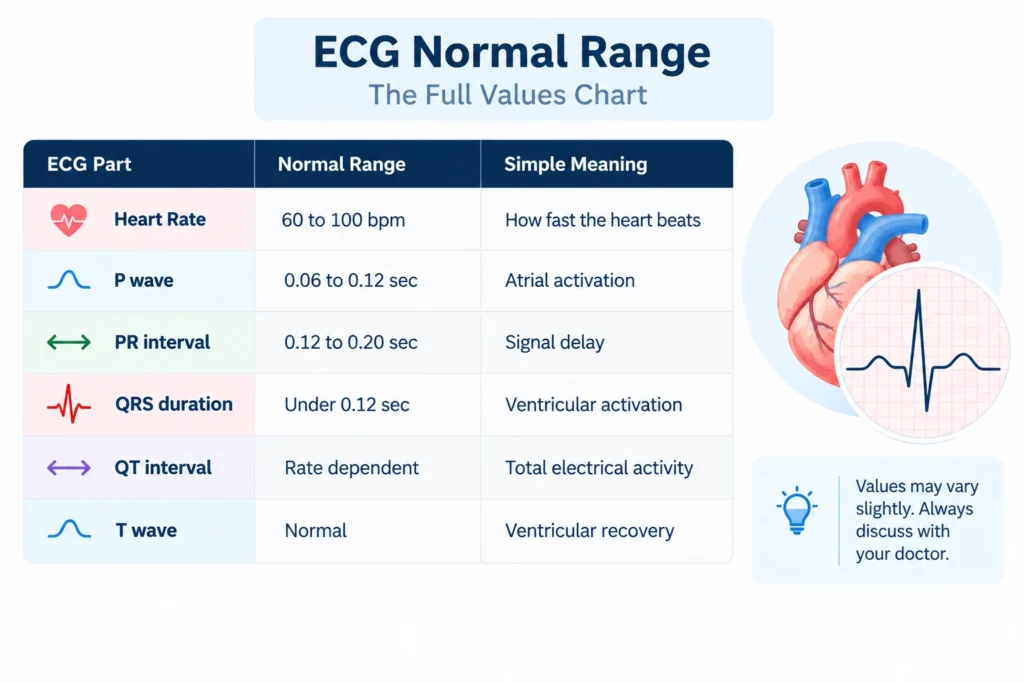
Here is the complete ECG normal range in one place. These values are the standard clinical reference used by doctors. Treat them as guides, not strict pass-or-fail lines, because a value slightly outside the range is not always a problem, and doctors read the whole report together with your symptoms.
| ECG Part | Normal Range | What It Means (Simply) |
|---|---|---|
| Heart Rate | 60 to 100 bpm | How fast the heart beats |
| Rhythm | Sinus rhythm | Beat starts from the natural pacemaker |
| P wave | 0.06 to 0.12 sec | Upper chambers activating |
| PR interval | 0.12 to 0.20 sec | Signal travel time to the bottom |
| QRS duration | Under 0.12 sec | Lower chambers activating |
| QT / QTc | Changes with heart rate, judged as QTc | Full electrical cycle length |
| ST segment | Usually near the baseline | Checked for signs of reduced blood flow |
If your heart rate reads outside this band, our guide to the normal heart rate by age explains what is expected at different ages.
What a Normal ECG Looks Like (The Waves)
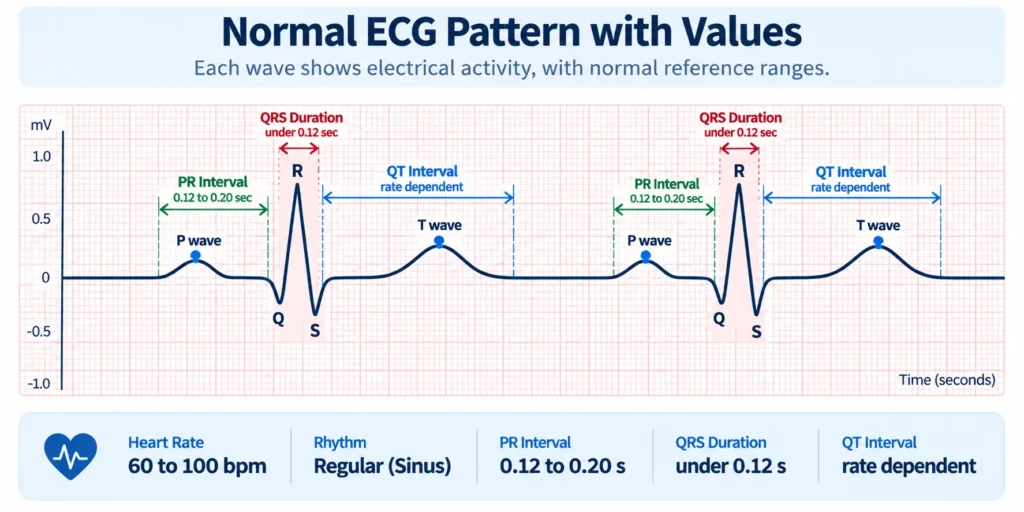
A normal ECG is just the same little shape repeating, beat after beat. Think of one heartbeat drawn as three bumps in a row: a small bump, a tall spike, then a gentle bump. Here is that single beat.
One normal heartbeat on an ECG: the P wave, the tall QRS spike, and the T wave.
- P wave (small bump): Shows the electrical activation of the upper chambers, which triggers them to contract and push blood down.
- QRS complex (tall spike): Shows the electrical activation of the lower chambers, which triggers them to contract and pump blood out. This is the strongest part.
- T wave (gentle bump): The heart's electrical system resets and recharges for the next beat.
When the rate, rhythm, intervals, waves and other features are all within expected limits, a doctor may describe the tracing as a normal ECG.
What Is an ECG Test, in Simple Words?
Your heart runs on tiny electrical signals. Every heartbeat starts with a small spark that travels through the heart in a fixed path. An ECG (electrocardiogram) is a machine that listens to those sparks through sticky pads on your skin and draws them as waves on paper. Reading those waves tells the doctor whether your heart is beating normally. Nothing goes into your body. The machine only listens.
How Is the Test Done?
You lie down. Small sticky pads go on your chest, arms and legs. Wires connect the pads to the machine. You stay still and breathe normally for a few minutes, the machine prints the waves, and you are done. The whole thing takes 5 to 10 minutes.
Good to Know: There is no pain, no injection, no current and no radiation. The pads only read signals coming out of your body.
Is the ECG Normal Range Different for Women?
ECG reference values are not always identical for men and women. The QTc limit, in particular, can differ by sex. Doctors also consider age, heart rate, symptoms and the overall ECG pattern when reading a report, so the chart above works as a general guide for everyone while the final call stays with the doctor.
ECG Test Cost in India
An ECG is generally an inexpensive heart test in India, though the price varies by city, hospital and diagnostic centre. It is usually one of the cheapest cardiac tests, far less than an echo or angiography. Check the current fee with the centre before booking, as package rates differ.
ECG vs 2D Echo: What Is the Difference?
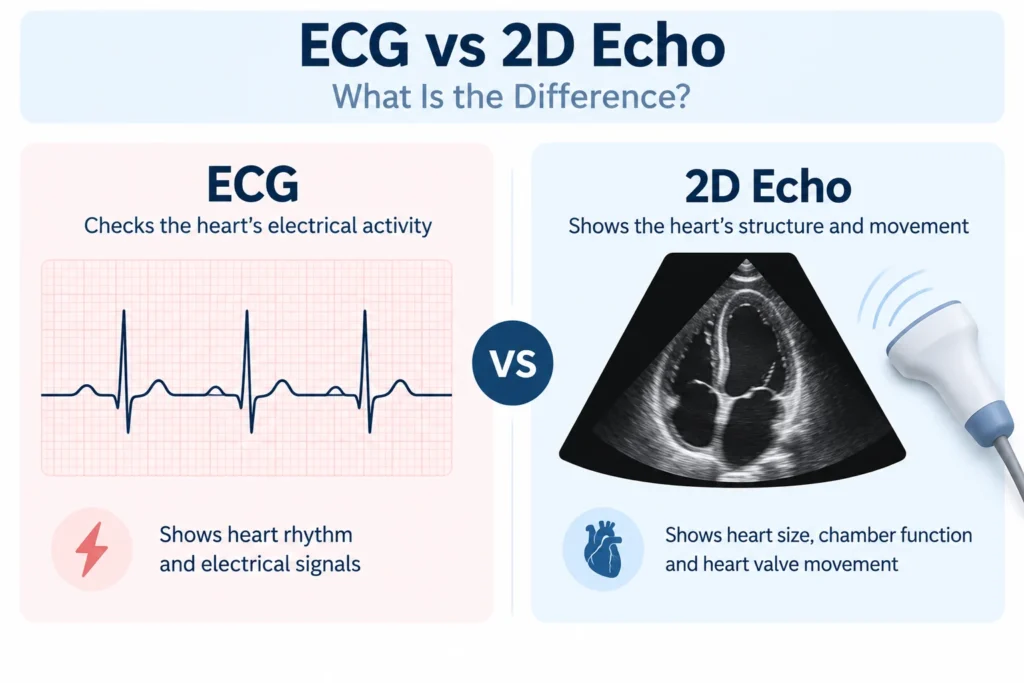
People often mix these two tests up, but they check completely different things. An ECG reads the heart's electrical signals. A 2D Echo is an ultrasound that shows the heart's structure and pumping power, including the ejection fraction, which our guide to EF in a 2D Echo report explains.
| Feature | ECG | 2D Echo |
|---|---|---|
| What It Checks | Electrical signals | Structure and pumping |
| Best At Finding | Rhythm problems, heart attack signs | Valve issues, weak pumping, EF |
| Time Taken | 5 to 10 minutes | 20 to 45 minutes |
| Reads | Electrical rhythm and timing | Moving picture of the heart |
Sometimes both are needed together, for example when someone has both a rhythm problem and suspected structural heart disease such as artery disease.
Types of ECG Tests
- Resting ECG: The standard test, done lying still. The most common type.
- Stress ECG (TMT): Recorded while you walk on a treadmill, to see how the heart handles effort. Useful for blockages that only show up during exertion, a common concern in coronary artery disease, often driven by high cholesterol.
- Holter Monitor: A small portable ECG worn for 24 to 48 hours, used when symptoms come and go and a short test may miss them.
When ECG Values Go Outside the Normal Range
A value outside the chart does not automatically mean danger. It means the doctor looks closer. A rate above 100 is tachycardia, below 60 is bradycardia, and both have harmless causes like stress or fitness. An uneven, chaotic rhythm can point to atrial fibrillation. Changes in the ST segment matter most, because they can signal reduced blood supply to the heart muscle, which over time can lead to heart failure. If your report shows abnormal findings, our guide to ECG test results explained walks through what each one means.
Get medical help immediately if chest pain or pressure comes with sweating, breathlessness, dizziness or pain spreading to the arm or jaw, whatever the ECG says. In India, call 112 or 108. ST elevation with chest pain can be a sign of an acute heart attack and needs immediate medical assessment.
Key Takeaways
- The Chart Is Your Map: Heart rate 60 to 100, PR 0.12 to 0.20 sec, QRS under 0.12 sec, and QT judged as QTc.
- Waves Tell a Story: P, QRS and T repeating evenly is what normal looks like.
- Slightly Off Is Not Always Danger: Values are guides, and doctors read them with your symptoms.
- Some Values Differ by Sex: The QTc limit can vary between men and women, and doctors adjust for it.
- Symptoms Beat Numbers: Chest pain with sweating needs emergency care, whatever the report says.
Frequently Asked Questions
What is the ECG normal range?
The full set sits in the chart above. The headline values are a heart rate of 60 to 100 bpm, PR interval 0.12 to 0.20 sec, and QRS under 0.12 sec, with the QT judged as QTc because it changes with heart rate.
What is a normal heart rate on an ECG?
Usually between 60 and 100 beats per minute at rest. Athletes often sit lower, and that is normally healthy for them.
What is the normal range of QRS in an ECG?
Under 0.12 seconds. A wider QRS means the signal is taking longer to travel through the pumping chambers, which the doctor will look into.
What is the normal QT and QTc range in an ECG?
The QT interval changes with heart rate, so doctors use the corrected value, QTc. A QTc is commonly considered prolonged above about 450 ms in men and 460 ms in women, though the exact threshold depends on the correction method, age and clinical context.
Is the ECG normal range different for women?
Some ECG reference values, especially the QTc limit, can differ by sex. Doctors adjust for this and also weigh age, heart rate and symptoms while reading a report.
Can an ECG be normal and still miss a heart problem?
Yes. Some heart problems do not show on a resting ECG, especially in early stages. If symptoms continue despite a normal report, doctors order further tests.
How much does an ECG test cost in India?
It is generally inexpensive, one of the cheapest heart tests, but the exact fee varies by city, hospital and centre, so check locally before booking.
What does sinus rhythm mean in an ECG report?
Sinus rhythm means the heartbeat is starting from the heart's natural pacemaker and travelling normally. On a report, normal sinus rhythm is good news.
References
- Normal electrocardiography (ECG) intervals. Medscape eMedicine, 2024.
- Electrocardiogram (ECG or EKG). American Heart Association, 2024.
- Electrocardiogram (ECG or EKG). Mayo Clinic, 2024.
- Characteristics of the normal ECG. ECG and Echo Learning, 2024.
- ECG intervals. Osmosis by Elsevier, 2024.
- Electrocardiogram (EKG). Cleveland Clinic, 2024.
- Electrocardiogram (ECG). National Health Service UK, 2024.
Written by
Iraphan Khan, BSN, RN, D.Pharm, Public Health Researcher
Founder of RealMedVision, writing patient-focused health content based on clinical guidelines and peer-reviewed research.
Medically reviewed by
Dr Praveen Verma, MBBS, MD (Pathology), Pathologist and Clinical Laboratory Specialist
Dr Himanshu Morya, MBBS, Medical Educator
Last medically reviewed: 8 September 2026
Medical Disclaimer
This page is published for education and awareness. It is not medical advice, a diagnosis or a treatment plan. Only a qualified doctor can interpret your ECG report fully. If you have severe chest pain, breathlessness or fainting, call 112 or 108 immediately.