
Medically reviewed: 5 September 2026 · Last updated: 5 September 2026
You watch your child more closely than anyone else does. This guide helps you tell a small worry from a sign that needs a doctor today.

Congenital heart disease in children looks different at every age. A newborn may have blue or grey lips, breathe too fast, or tire halfway through a feed. A school-going child may fall behind on the playground or feel dizzy after running. Some children show nothing at all until a doctor hears a murmur at a routine visit.
Quick Answer
- In babies, watch feeding, breathing and weight gain. Sweating during feeds, fast breathing at rest and slow weight gain are common early signs.
- In older children, look for breathlessness during play, fainting with exercise, palpitations and constant tiredness.
- Blue or grey lips or tongue at any age need urgent care. Call 112 or 108 or reach the nearest emergency room.
- Some children have no symptoms, and the defect is first picked up as a heart murmur.
- Many defects can be treated or managed, and finding a serious one early helps doctors plan care in time.
What is congenital heart disease?
A problem the heart is born with
A congenital heart defect is a structural problem in the heart that is present from birth. It may be a hole between two chambers, a valve that is too narrow, or blood vessels connected the wrong way. The heart forms in the first few weeks of pregnancy, often before a woman knows she is pregnant.
A hole between chambers
Blood leaks from one side of the heart to the other instead of moving forward.
A narrowed valve
The heart has to push harder to move blood through a tighter opening.
Vessels in the wrong place
Blood takes the wrong route, so it may travel round the body without enough oxygen.
How common is it?
Congenital heart defects are among the most common birth defects, affecting close to 1 in every 100 newborns worldwide. Severity varies enormously. Many small defects close on their own and never need treatment, while others need surgery in the first year of life. That gap between mild and serious is exactly why the early signs matter.

Congenital heart disease symptoms in children by age
Symptoms can vary with the type of heart defect and the child's age. Some signs appear soon after birth, while others become noticeable when a child becomes more active.
| Age | Signs parents may notice |
|---|---|
| Newborn 0 to 1 month | Blue or grey lips or tongue, persistently fast or laboured breathing when calm, grunting, or unusual sleepiness. |
| Infant 1 to 12 months | Sweating during feeds, tiring while feeding, poor weight gain, swelling around the eyes or legs, or repeated chest infections. |
| Toddler and young child | Breathlessness during play, squatting during activity, or less stamina than other children of the same age. |
| Older child and teenager | Fainting during exercise, palpitations, chest pain with activity, or unusual tiredness. |
Important: A baby's breathing rate should be checked when the baby is calm, not crying or feeding. One fast reading does not by itself mean the child has congenital heart disease.
Signs in newborns and infants
Colour and breathing
A bluish or grey tint on the lips or tongue is the most serious early sign. It can mean the blood is not carrying enough oxygen, and it needs urgent assessment, not an appointment next week.
Fast or laboured breathing at rest is the next clear warning. Newborns naturally breathe faster than older children, so what matters is a pattern rather than a single reading. Persistently rapid breathing while the baby is calm, especially with grunting, the ribs pulling in, poor feeding or blue lips, needs prompt medical attention.
Feeding and weight gain
Feeding trouble is the sign parents miss most often. A baby with a struggling heart tires quickly at the breast or bottle, stops repeatedly, and often sweats on the forehead while feeding. Poor weight gain usually follows, because the heart burns extra energy just to keep going.
Swelling around the eyes or legs can appear too, along with drowsiness that makes the baby hard to wake for feeds.
When to call your doctor: If your baby sweats through every feed and is slipping down the weight chart, do not wait for the next vaccination visit. Book an appointment now and describe exactly what you are seeing.
Signs in older children
Once school and sport enter the picture, milder defects that stayed silent through infancy often reveal themselves. The usual clue is breathlessness out of proportion to the effort. A child who cannot keep pace with friends during ordinary play deserves a check-up, not a scolding for being lazy.
Fainting or dizziness during exercise should be assessed promptly, because it can point to a heart problem. The same goes for palpitations, the feeling that the heart is racing, pounding or skipping beats.
Chest pain needs a calmer framing. In children it usually does not come from the heart at all. It still needs a doctor when it appears during exercise, or alongside fainting, breathlessness or palpitations. Repeated chest infections and slow growth can also point to a defect pushing extra blood into the lungs.
Blue lips and cyanosis: what blue baby syndrome means
Cyanosis is the medical word for a bluish colour of the skin, lips or tongue caused by low oxygen in the blood. Many people still call it blue baby syndrome. That older name is worth understanding properly, because it describes an appearance rather than naming a diagnosis.
Several forms of cyanotic congenital heart disease can cause it, including Tetralogy of Fallot and transposition of the great arteries. In these defects, blood reaches the body without picking up enough oxygen from the lungs. Cyanosis can also come from lung problems and other causes outside the heart, which is why every blue episode needs a doctor to find the reason behind it.
One distinction helps. Slightly bluish hands and feet are common in the first days of life and usually settle on their own. Blue or grey lips and tongue are different, and they need urgent medical assessment. If that colour appears suddenly, treat it as an emergency.
Emergency red flags
Call 112 or 108 now
Go straight to the nearest emergency department if your child has blue or grey lips, tongue or face, severe difficulty breathing, grunting, or ribs pulling in sharply with each breath. The same applies to a baby who suddenly becomes limp, unusually drowsy or refuses feeds altogether, and to any fainting, collapse, or chest pain with breathlessness.
For everything less urgent, see your paediatrician soon rather than someday. Parents almost always notice the change before anyone else does. Trust what you are seeing and act on it.
Heart murmurs: when to worry and when not to
A murmur is an extra whooshing sound the doctor hears between heartbeats. Hearing that word at a vaccination visit frightens most parents, so take a breath before you panic. Most heart murmurs in children are harmless.
These innocent murmurs come from normal blood flow through a small, healthy heart. A murmur matters more when it is loud, keeps coming back, or turns up alongside symptoms such as poor feeding, breathlessness or blue spells. In that case the doctor may refer your child to a paediatric cardiologist, who decides whether an echocardiogram or another test is needed.
Good to know: An innocent murmur needs no treatment, no activity restrictions and no special diet. One clear assessment usually closes the topic for good.
Types of congenital heart defects
Congenital heart defects are often grouped by how they affect blood flow and oxygen levels. Acyanotic defects usually do not cause low oxygen levels, while cyanotic defects can reduce the amount of oxygen reaching the body.
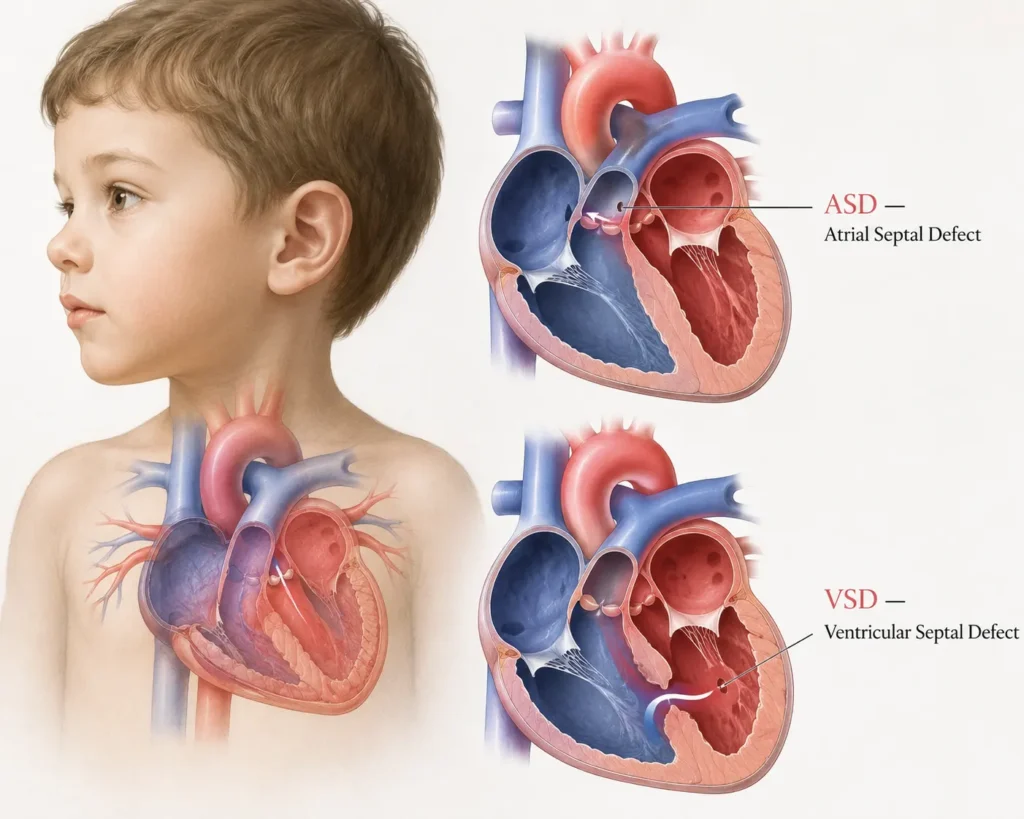
| Defect | What happens | Group |
|---|---|---|
| Ventricular septal defect VSD | A hole between the two lower chambers of the heart. | Acyanotic |
| Atrial septal defect ASD | A hole between the two upper chambers of the heart. | Acyanotic |
| Patent ductus arteriosus PDA | A blood vessel that normally closes after birth remains open. | Acyanotic |
| Pulmonary stenosis | The pulmonary valve or the path to the lungs is narrowed. | Acyanotic |
| Tetralogy of Fallot | Four heart defects occur together and can reduce oxygen reaching the body. | Cyanotic |
| Transposition of the great arteries TGA | The two main arteries leaving the heart are connected to the wrong chambers. | Cyanotic |
Ventricular septal defect is one of the most common congenital heart defects. Some small VSDs and ASDs close on their own. Patent ductus arteriosus is also more common in babies born prematurely.
What causes it, and how is it diagnosed?

What raises the risk
In most children no single cause is ever found. A heart defect is not the result of something you did or failed to do during pregnancy, and guilt has no place in this diagnosis.
Research has identified factors that raise the risk, though. Genetics carries the strongest link, and up to half of babies born with Down syndrome have a heart defect. During pregnancy, rubella infection in the first trimester, uncontrolled blood sugar, some medicines including certain seizure drugs and the acne drug isotretinoin, and any amount of alcohol all increase the risk.
Rubella vaccination before conception and good diabetes control during pregnancy reduce some of these risks. Folic acid matters in pregnancy too, mainly for preventing neural tube defects.
Before birth
The routine scan at 18 to 20 weeks includes a look at the baby's heart. If that scan raises a doubt, or the pregnancy carries risk factors, the mother is referred for a fetal echocardiogram. A normal scan cannot rule out every defect, especially small ones or those that are hard to see before birth.
Finding a defect early is not bad news arriving early. It gives the family time to plan delivery at a hospital with paediatric cardiac support, which can change the outcome completely.
After birth
The paediatrician listens to the heart, where a murmur is often the first clue. Many hospitals also run pulse oximetry screening, a sensor on the finger or toe that checks oxygen levels before discharge. It can pick up some serious defects in babies who look perfectly well, though a normal result does not rule out every heart defect.
An echocardiogram is the key test for showing the heart's structure and blood flow, and it usually confirms which defect is present. An ECG records the heart's electrical activity, while a chest X-ray and, in complex cases, a cardiac MRI complete the picture.
Clinical note: Before you take your newborn home, ask whether pulse oximetry screening was done. It is painless, takes only a few minutes, and catches some critical defects that would otherwise be missed.
Treatment and outlook
How defects are treated
Treatment depends entirely on the defect. Small holes are often simply watched with regular echocardiograms until they close on their own. Medicines such as diuretics ease the heart's workload while a child grows or waits for a procedure.
Cardiac catheterisation now repairs many ASDs and PDAs through a thin tube passed from a blood vessel, with no open surgery at all. Complex defects still need open-heart surgery. Most children with congenital heart disease now survive into adulthood, although the outlook depends on the type and severity of the defect.
Life after treatment
Follow-up matters as much as the procedure itself. The cardiologist tracks how strongly the heart pumps, often using the ejection fraction, and gives advice on sport and activity for that specific child. Many children with repaired or mild defects take part in normal physical activity, while those with complex defects may need individual limits set by their cardiologist.
The picture in India
A 2018 status report in Indian Pediatrics estimated that more than 200,000 children are born with a congenital heart defect in India each year, and that about one in five has a defect serious enough to need treatment in the first year of life.
That same report noted that advanced cardiac care was reaching only a minority of these children at the time, largely because diagnosis came late rather than because treatment did not exist. If a doctor suspects a defect, ask directly for a referral to a paediatric cardiology centre.
Key takeaways
- In babies, changes in feeding, breathing and weight gain are the signs worth watching most closely.
- Blue or grey lips or tongue needs emergency care. Call 112 or 108 without waiting to see if it settles.
- Fainting during exercise should be assessed promptly, even if it has happened only once.
- A murmur is not a diagnosis. Most are innocent, but a new or persistent one should be checked.
- A normal scan or screening test does not rule out every defect, so keep watching how your child feeds, breathes and grows.
Frequently asked questions
What are the first signs of congenital heart disease in babies?
Blue or grey lips, fast breathing at rest, sweating during feeds, tiring before a feed is finished, and poor weight gain. A sign that keeps coming back should be discussed with a paediatrician. Blue or grey lips, severe breathing difficulty or collapse needs urgent care straight away.
Can a child have congenital heart disease without symptoms?
Yes, quite often. Smaller defects can stay silent for years and are then found through a murmur or a test done for something else. This is one reason routine check-ups matter even for a healthy-looking child.
Can it be detected before birth?
Many serious defects can. The routine scan at 18 to 20 weeks examines the baby's heart, and a fetal echocardiogram follows when that scan raises doubt or the pregnancy has risk factors. A normal scan cannot rule out every defect, so the signs after birth still matter.
Does every heart murmur mean a heart defect?
No. Most murmurs in children are innocent sounds from normal blood flow and need no treatment. A murmur that is loud, persistent, or paired with symptoms such as breathlessness or poor feeding should be assessed properly.
Why do a baby's lips turn blue?
A blue or grey colour of the lips or tongue, sometimes called blue baby syndrome, suggests the blood is low on oxygen and needs urgent medical attention. Mildly bluish hands and feet alone in the first days of life are usually harmless.
What is cyanotic congenital heart disease?
It is a group of defects where blood reaches the body without enough oxygen, which gives the lips and tongue a bluish colour. Tetralogy of Fallot and transposition of the great arteries are two examples. These usually need specialist treatment.
Can children with congenital heart disease play sports?
Many children with repaired or mild defects take part in normal physical activity. Children with complex defects may need individual limits. The only safe answer comes from your child's cardiologist, who knows the exact defect and how the heart is coping.
Is congenital heart disease curable?
Full repair is possible for many defects through catheter procedures or surgery, and some small holes close on their own. Other children live well with a defect that simply needs monitoring. Outcomes today are far better than a generation ago.
Medical disclaimer
This page is published for education and awareness. It is not medical advice, a diagnosis or a treatment plan. Always speak to a qualified doctor, such as a paediatrician or paediatric cardiologist, about your child's heart health. In a medical emergency, call 112 or 108 or go to the nearest emergency department.
References
- Atrial septal defect and congenital heart defects. Centers for Disease Control and Prevention.
- Congenital disorders fact sheet. World Health Organization, 2023.
- Symptoms and diagnosis of congenital heart defects. American Heart Association, 2026.
- Saxena A. Congenital heart disease in India: a status report. Indian Pediatrics, 2018.
- Congenital heart defects in children: symptoms and causes. Mayo Clinic.
- Congenital heart disease. NHS.
- Cardiovascular complications of Down syndrome: scientific statement. Circulation, American Heart Association, 2023.
- Congenital heart disease: symptoms and treatment. Cleveland Clinic, 2026.
Written by
Iraphan Khan, BSN, RN, D.Pharm, Public Health Researcher
Founder of RealMedVision, writing patient-focused health content based on clinical guidelines and peer-reviewed research.
Medically reviewed by
Dr Praveen Verma, MBBS, MD (Pathology), Pathologist and Clinical Laboratory Specialist
Dr Himanshu Morya, MBBS, Medical Educator