
Medically reviewed: 6 September 2026 · Last updated: 6 September 2026
Stroke is not only an old person's illness. In India, one in four to five strokes happens before the age of 50.
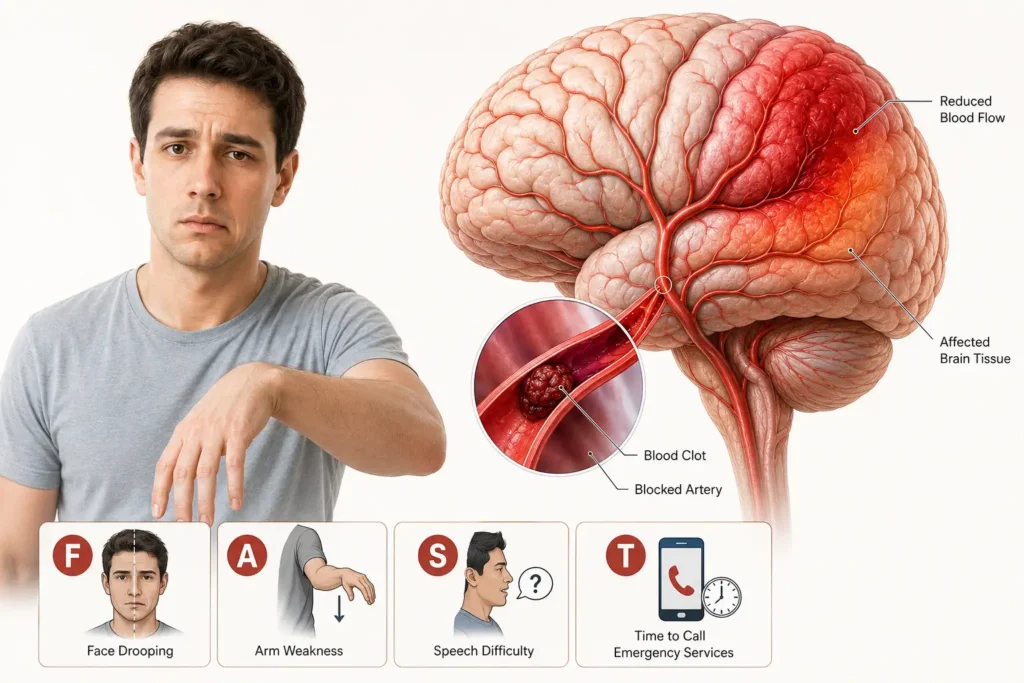
Most people picture a stroke happening to someone in their seventies. Doctors in India see them at 28, at 35, at 42. The symptoms are the same at any age, and so is the clock. Brain tissue starts dying within minutes of the blood supply being cut off, which is why recognising the signs matters more than understanding the biology.
Quick answer
- The warning signs come on suddenly: a drooping face, weakness in one arm, slurred speech, sudden vision loss, a violent headache, dizziness or confusion.
- Use the FAST rule. Face, Arms, Speech, Time to call for help.
- In India, call 108 immediately. Do not wait to see if the symptoms settle.
- High blood pressure is the single biggest cause in this age group, and most young adults who have it do not know.
Is stroke really rising in young adults?
The honest answer needs two numbers, not one. In 2021, roughly 757,000 people aged 15 to 39 had a stroke worldwide, and about 123,000 of them died. That count has climbed by around 19 percent since 1990. Adjusted for population size, though, the rate has crept down slightly. So more young people are affected in absolute terms, even though the risk per person has not exploded.
Where you live changes the picture. South Asia carries the largest number of cases in this age group, and the burden has been rising in lower-income countries while falling in wealthier ones. Globally, stroke is the second leading cause of death, and 87 percent of stroke deaths happen in low and lower-middle income countries.
The point worth taking away is simple. Being young does not protect you. High blood pressure, diabetes, smoking, obesity, clotting disorders and certain heart conditions all raise the risk well before middle age.
Early Warning Signs of Stroke
Stroke symptoms usually begin suddenly. A person may seem completely well one moment and develop a clear change in movement, speech or vision the next. Recognizing these signs quickly can help them get treatment sooner.
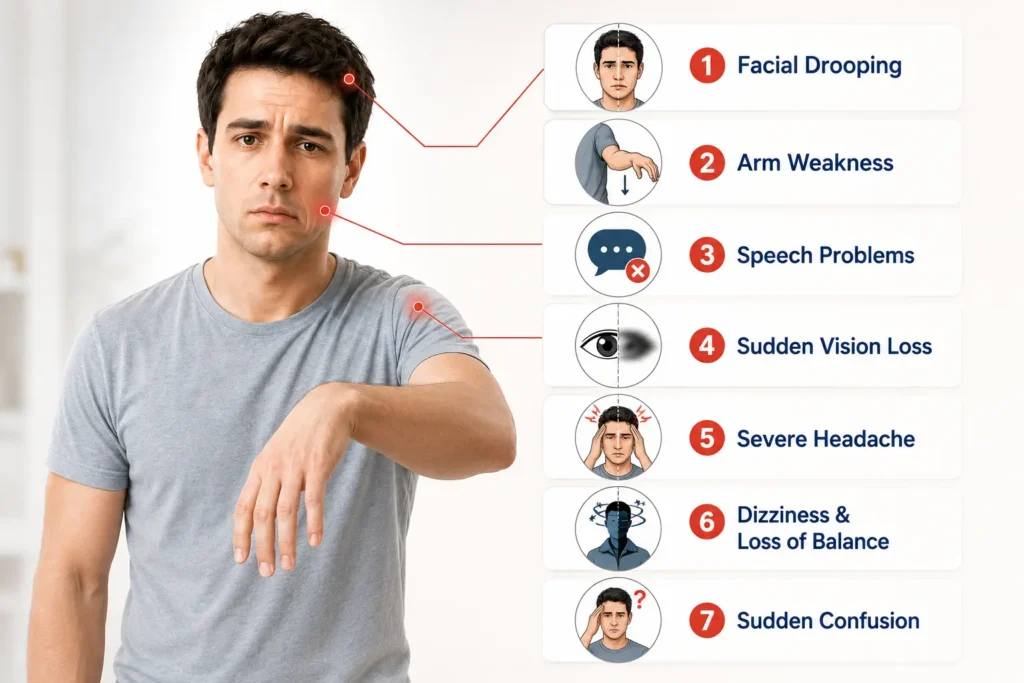
01. One Side of the Face Droops
The face may suddenly droop or feel numb on one side. Ask the person to smile. If one side of the mouth does not move normally, treat it as a possible stroke and seek emergency help.
02. Weakness or Numbness in One Arm
Sudden weakness or numbness can affect one side of the body, often the arm. Ask the person to raise both arms. If one arm drifts down or cannot be lifted normally, call emergency services.
03. Speech Suddenly Changes
Speech may become slurred, difficult to understand or hard to produce. The person may also struggle to find the right words or understand what others are saying. Sudden speech changes need urgent assessment.
04. Sudden Trouble Seeing
Stroke can cause sudden blurred or double vision, or loss of vision in one or both eyes. Do not assume a sudden change is only screen strain or tiredness. It needs urgent medical assessment.
05. Sudden, severe headache
A sudden, extremely severe headache that reaches its peak within seconds or minutes can be a warning sign of bleeding in or around the brain. It needs emergency assessment, especially alongside vomiting, weakness, confusion or loss of consciousness.
06. Sudden dizziness or loss of balance
Sudden dizziness, trouble walking or loss of coordination can occur with stroke, particularly when it starts without an obvious reason. On its own it may not seem alarming, which is exactly why it gets ignored.
07. Sudden confusion
The person may suddenly struggle to understand speech, answer a simple question, or work out where they are. Confusion that starts abruptly is never something to sleep off.
Remember BE FAST
B for Balance. Sudden loss of balance or coordination.
E for Eyes. Sudden vision changes.
F for Face. One side of the face droops.
A for Arms. One arm becomes weak or numb.
S for Speech. Speech becomes unclear or difficult.
T for Time. Call 112 or 108 immediately and note when the symptoms began.
Do not wait to see if the symptoms improve. What treatment a doctor can offer depends heavily on how much time has passed.
The Warning That Goes Away on Its Own
Stroke like symptoms that disappear after a few minutes can be a transient ischemic attack (TIA), often called a mini stroke. Sudden weakness, vision changes or speech problems may clear completely, but that does not mean the problem is harmless.
A TIA is a warning that a person may be at risk of a future stroke. Urgent medical assessment is needed even if the symptoms have completely gone away.
Why Stroke Happens in Young Adults
Stroke in a young adult can have several causes. Some are common risk factors such as high blood pressure, smoking, diabetes and obesity. Others are less obvious, including heart conditions, blood clotting disorders, migraine, autoimmune disease and pregnancy related factors.
High blood pressure is especially important because it often causes no symptoms. A person can have high readings for years without knowing it. Our blood pressure chart by age can help you understand your readings.
| Risk factor or cause | How it can increase stroke risk |
|---|---|
| High blood pressure | Damages blood vessels and is one of the most important modifiable stroke risk factors |
| Smoking | Damages blood vessels and increases the risk of blood clots |
| Diabetes | Can damage blood vessels and increase the risk of stroke over time |
| High cholesterol and obesity | Can contribute to artery disease and other cardiovascular risk factors |
| Heart conditions | Some rhythm, valve or structural problems can allow blood clots to reach the brain |
| Cocaine and amphetamines | Can cause major changes in blood pressure and increase the risk of bleeding or clot related stroke |
| Blood clotting disorders | Some inherited or acquired conditions make abnormal blood clotting more likely |
Because young stroke can have different causes, doctors may need to check blood pressure, blood sugar, cholesterol, the heart and blood clotting system. Further tests may be needed depending on the person's history and symptoms. If you have never had your blood sugar or cholesterol checked, discuss testing with your doctor.
The Main Types of Stroke and TIA
The type of stroke affects which treatment is safe. A clot blocking a blood vessel needs a different approach from bleeding in the brain. That is why doctors use brain imaging to determine the type of stroke before giving certain treatments.
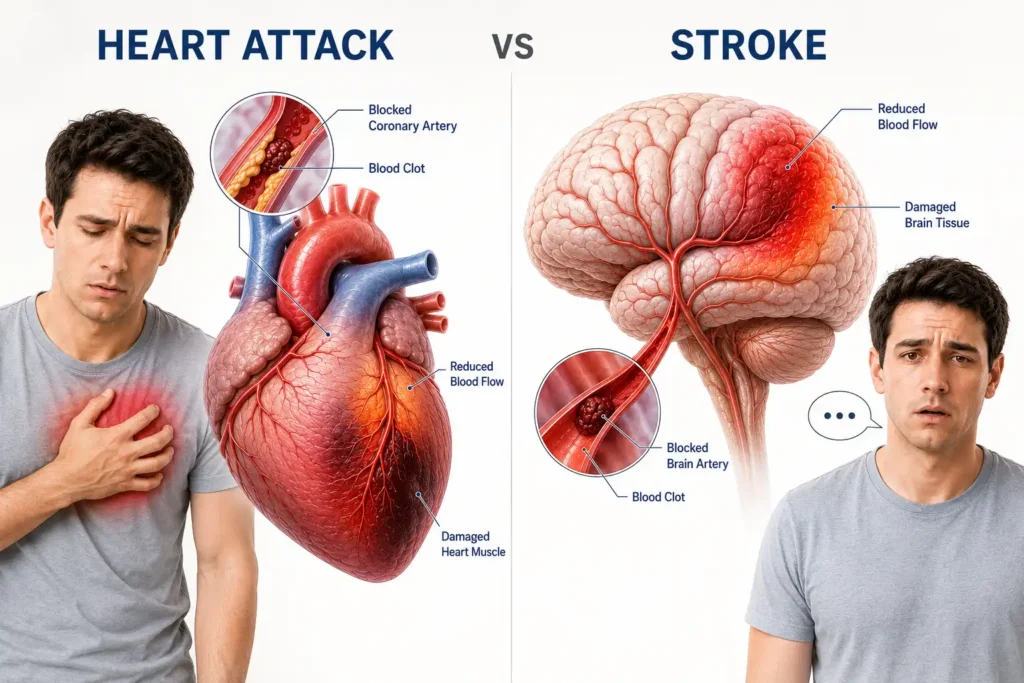
01. Ischaemic Stroke
A blood clot blocks an artery supplying the brain. This is the most common type of stroke. In young adults, doctors may look for causes such as heart conditions, blood clotting disorders, artery problems and other medical conditions.
02. Haemorrhagic Stroke
A blood vessel in the brain breaks and causes bleeding. High blood pressure is a major risk factor. This type of stroke can be severe and needs immediate medical treatment.
03. Transient Ischaemic Attack
A TIA causes stroke like symptoms that resolve because the blockage is temporary. Even when the symptoms disappear, a TIA can signal a higher risk of stroke and needs urgent medical assessment.
What Happens at the Hospital
A CT scan is often done first because it can quickly show bleeding in the brain. An MRI can provide more detailed images and may detect some early changes from an ischaemic stroke that are less clear on CT.
After the emergency treatment, doctors look for the cause of the stroke. An ECG can check for abnormal heart rhythms. A 2D echo assesses the heart's structure and function and may help identify some cardiac sources of a clot. A carotid Doppler can assess blood flow in the neck arteries, while blood tests may check glucose, cholesterol and clotting factors.
In a young adult, doctors may look for less common causes as well as the usual risk factors. The exact tests depend on the person's symptoms, medical history and initial results.
Treatment: why every minute matters
What doctors can offer depends almost entirely on how much time has passed. That is the whole reason for the T in BE FAST.
- Clot-busting medicine. For an eligible ischaemic stroke, alteplase or tenecteplase may be given within 4.5 hours of the symptoms starting.
- Mechanical thrombectomy. Where a large artery is blocked, the clot can be pulled out through a thin tube threaded up from the groin. In selected patients this is possible up to 24 hours after symptoms begin, and it is done at stroke-ready hospitals rather than every emergency room.
- Preventing the next one. Once the emergency passes, medicines are chosen based on the type and cause of the stroke.
- Stroke unit care. Treatment in a dedicated unit, with rehabilitation started early, improves recovery and reduces complications.
Someone who waits overnight to see whether the weakness passes has usually lost the chance at the first two.
Recovery and Prevention
Recovery is different for everyone. It depends on the part of the brain affected, the severity of the stroke, how quickly treatment started and the person's rehabilitation.
Recovery may include:
- Physiotherapy: helps with movement, strength and balance.
- Speech therapy: helps with speaking, communication and swallowing.
- Occupational therapy: helps with daily activities and returning to work.
- Mental health support: helps manage depression, anxiety and emotional changes after stroke.
How to Lower Your Stroke Risk
- Check your blood pressure and treat high blood pressure if needed.
- Do not smoke or use tobacco.
- Stay physically active and maintain a healthy weight.
- Keep blood sugar and cholesterol under control.
- Eat a healthy diet and get enough sleep.
The Picture in India
Stroke is an important cause of death and disability in India. Estimates suggest an annual incidence of about 119 to 145 cases per 100,000 people, with around 20% to 30% of strokes occurring in people under 50. High blood pressure, diabetes, tobacco use, obesity and physical inactivity are important risk factors.
Key Takeaways
- Stroke symptoms usually start suddenly. Do not wait to see if they improve.
- Face, arm weakness or speech problems are warning signs. Call emergency services and note when the symptoms started.
- Symptoms that disappear can still be a warning of a TIA and need urgent medical assessment.
- High blood pressure is a major modifiable risk factor for stroke, including in younger adults.
- A stroke in a young adult needs evaluation for the underlying cause, not just treatment of the stroke itself.
Call 112 or 108
If stroke symptoms start suddenly, call emergency services immediately. Note the exact time the symptoms began. Do not wait for them to settle. If the person has trouble speaking or swallowing, avoid giving food or water until they are medically assessed.
Frequently asked questions
What are the first signs of a stroke?
A drooping face, weakness in one arm, and slurred or confused speech are the three to check first. Sudden vision loss, a violent headache, dizziness and abrupt confusion are also warning signs. All of them start suddenly, which is what separates a stroke from most other problems.
Can a stroke happen at 25?
Yes. Strokes are recorded across the 15 to 39 age group, and roughly 757,000 happened worldwide in that band in a single year. Common causes at this age include uncontrolled blood pressure, clotting disorders, heart rhythm problems and stimulant drug use.
What does CVA mean?
CVA stands for cerebrovascular accident, which is the medical term for a stroke. You may see it written on a discharge summary, a scan report or a prescription. It means the same thing as stroke, and doctors use the two terms interchangeably.
Do you get warning signs days before a stroke?
Usually not. A stroke normally arrives without any build-up over days. The one real exception is a transient ischaemic attack, where stroke symptoms appear and then clear within minutes to hours. That is a genuine warning and needs urgent assessment, but most strokes give no advance notice at all.
What is a mini-stroke?
A transient ischaemic attack, where blood flow is blocked briefly and then restores itself. The symptoms match a full stroke but clear within minutes to hours. It carries a real risk of a full stroke soon after, so it needs urgent assessment even once you feel fine.
Can stress cause a stroke?
Stress on its own rarely triggers a stroke directly. Long-term stress does raise blood pressure and encourages inflammation in blood vessels, and high blood pressure is the biggest single risk factor in young adults, so it contributes indirectly.
Can a stroke happen during sleep?
Yes, and these are harder to treat because nobody knows when the symptoms began. Waking up with weakness on one side, slurred speech or confusion should be treated as an emergency straight away.
Is stroke hereditary?
Family history raises the risk, particularly when a parent or sibling had a stroke young. Inherited clotting disorders and familial high cholesterol both play a part. It raises risk rather than deciding the outcome, and that risk can be managed.
Can young adults recover fully?
Many do, especially after a mild stroke treated quickly. The younger brain adapts better than an older one. Most recovery happens in the first three to six months, with slower gains continuing for a year or more.
Can stroke be prevented?
A large share of strokes trace back to risk factors that can be changed. Controlling blood pressure, stopping smoking, managing diabetes and cholesterol, staying active and getting regular checks are the steps that make the biggest difference.
Medical disclaimer
This page is published for education and awareness. It is not medical advice, a diagnosis or a treatment plan. Always speak to a qualified doctor about your own risk and treatment. If stroke symptoms appear, call 112 or 108, or go to the nearest emergency department immediately.
References
- World Stroke Organization Global Stroke Fact Sheet 2025. International Journal of Stroke, 2025.
- Global burden of stroke in youths and young adults aged 15 to 39, 1990 to 2021. Global Burden of Disease study, 2025.
- Analyzing stroke burden and risk factors in India using Global Burden of Disease data. Scientific Reports, 2024.
- Stroke attributable to metabolic risks in young adults aged 20 to 39. Global Burden of Disease analysis, 2025.
- Stroke signs and symptoms. Centers for Disease Control and Prevention.
- Stroke symptoms and the FAST test. American Stroke Association.
- Stroke: symptoms and causes. Mayo Clinic.
- Global burden of stroke and its risk factors, 1990 to 2021. The Lancet Neurology, 2024.
Written by
Iraphan Khan, BSN, RN, D.Pharm, Public Health Researcher
Founder of RealMedVision, writing patient-focused health content based on clinical guidelines and peer-reviewed research.
Medically reviewed by
Dr Praveen Verma, MBBS, MD (Pathology), Pathologist and Clinical Laboratory Specialist
Dr Himanshu Morya, MBBS, Medical Educator