
Medically reviewed: 9 September 2026 · Last updated: 9 September 2026
A plain guide to the EF number on your 2D echo report, what it tells your doctor, and what it leaves out.
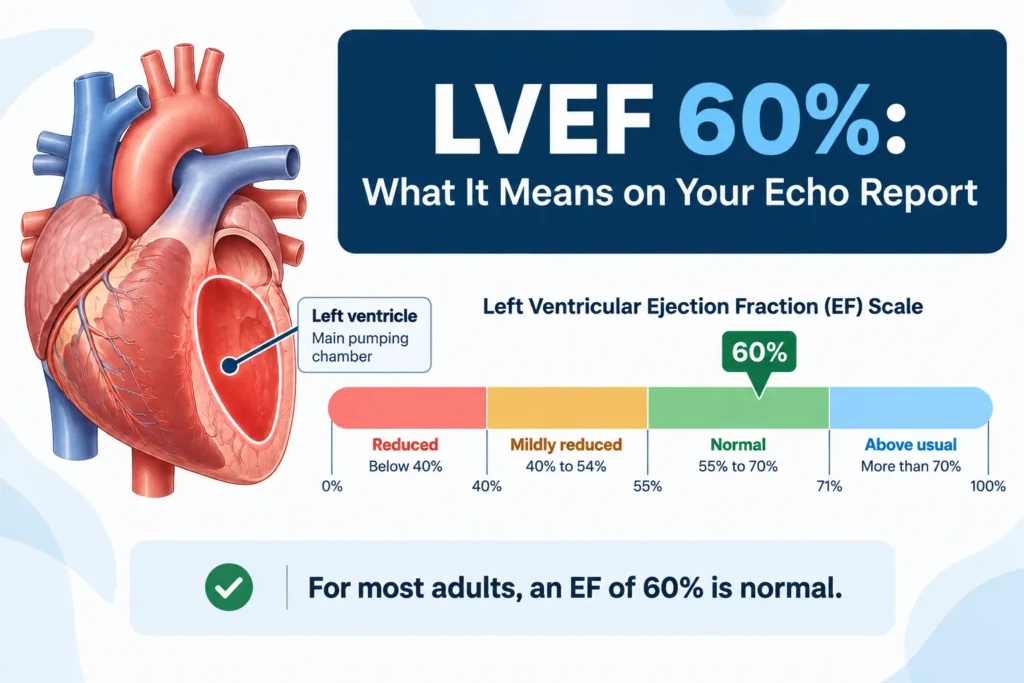
You open your echo report and one line stands out: LVEF 60%. If nobody has explained it to you yet, it is natural to wonder whether that number is good news or a warning.
For most adults, an EF of 60% is normal. Below, you will find what EF 60 means, how doctors read it, and which other lines on the same report deserve a second look.
Quick Answer
- LVEF stands for left ventricular ejection fraction. It is the share of blood the left ventricle pushes out with each heartbeat.
- The American Heart Association lists 55% to 70% as a normal EF, so 60% sits comfortably inside that range.1
- A normal EF shows good pumping. It does not rule out valve disease, narrowed arteries or rhythm problems, and heart failure is still possible with a normal EF.1
- Your doctor reads EF together with your symptoms and the rest of the echo report.
What Does EF 60 Mean on an Echo Report?
Your heart has four chambers. The left ventricle is the strongest of them. It sends oxygen-rich blood out to the rest of your body.
Each time it squeezes, it pushes out part of the blood inside it, never all of it. Ejection fraction, or EF, is that part written as a percentage. On most reports you will see it as LVEF or simply EF.1 In plain words, EF 60 means that 60% of the blood in the left ventricle leaves with each beat. The rest stays behind, and that is completely normal.
How the Number Is Worked Out
Picture the left ventricle holding 100 ml of blood just before it squeezes. If 60 ml goes out and 40 ml stays, the EF is 60%. These volumes are only an example, since heart size varies from person to person.
With one common method, the person doing your scan traces the inside of the ventricle when it is fullest and again when it is emptiest. The machine then compares the two volumes.2 The curve below shows the idea.
Is an EF of 60% Normal?
Yes. An LVEF of 60% is within the normal range for adults. The American Heart Association treats 55% to 70% as normal.1 Labs do not all use the same cut-offs, so ranges can differ slightly between reports.
Table 1. EF Ranges and What They Usually Mean
| EF on your report | What it usually means |
|---|---|
| Above 70% | Above the usual range. Values up to 72% in men and 74% in women can still be normal on echo. A high EF is read together with wall thickness and the rest of the report, not as a diagnosis on its own.2 |
| 55% to 70% | Normal. An EF of 60% sits here.1 |
| 50% to 54% | May be normal or borderline, depending on your sex and the reference range your lab uses.2 |
| 41% to 49% | Mildly reduced. Your doctor will look for a cause.1,4 |
| 40% or lower | Reduced. The left ventricle is pumping less blood with each beat. Your doctor will look for the cause and advise on treatment.1,4 |
Normal Ranges for Men and Women
The American Society of Echocardiography and its European partner society set echo reference ranges from large groups of healthy adults. On a standard 2D echo, normal LVEF is 52% to 72% for men and 54% to 74% for women.2 An EF of 60% is normal for both.
Normal values differ slightly between people and populations. A large review of healthy adults also found that EF barely changes with age.3 Whichever reference is used, 60% falls within the normal adult range. Want more detail? Read our guide on the normal ejection fraction range.
What an EF of 60% Cannot Tell You
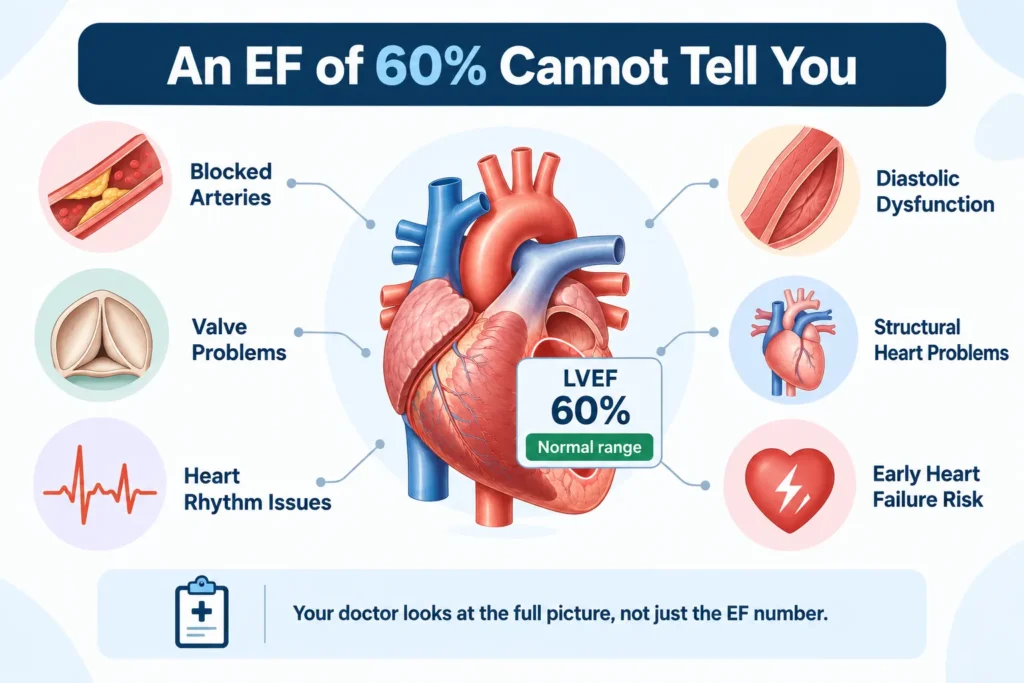
EF measures one thing: how well the left ventricle squeezes. A heart can squeeze well and still have other problems, which is why a cardiologist does not read the EF line on its own.
Heart Failure With a Normal EF
Some people have heart failure even though their EF is normal. Doctors call this heart failure with preserved ejection fraction, or HFpEF.1 The heart may be stiff or slow to relax, so it does not fill properly between beats, even though the percentage it pushes out stays normal.
HFpEF refers to heart failure in people whose LVEF is 50% or higher.4 Doctors make the diagnosis from symptoms and signs, together with evidence of raised filling pressure or other heart changes seen on the echo and other tests.6
Narrowed Arteries and Rhythm Problems
A heart can pump normally at rest while one of its arteries is narrowed. Chest tightness when you climb stairs or walk fast, known as angina, can happen with a normal EF, and a resting echo may not pick it up.
Rhythm problems sit outside what EF measures too. For those, doctors rely on an ECG and sometimes a longer recording of your heartbeat.
When a Normal EF Needs a Closer Look
For people with a severe leak in the mitral or aortic valve, an EF of 60% can be less reassuring than it sounds.
Severe Valve Leaks
A leaking valve makes the left ventricle handle extra blood with every beat. In a mitral leak, part of each squeeze flows backwards into the upper chamber instead of out to the body. This can keep EF looking normal even as the heart muscle starts to tire.
Mitral Regurgitation
In severe mitral regurgitation caused by damage to the valve itself, an EF of 60% or lower is one of the findings that can support valve surgery, along with symptoms, heart size and valve anatomy.5 So in this setting, 60% is a number doctors watch closely. One known cause of mitral valve damage is rheumatic heart disease after a throat infection.
Aortic Regurgitation
For a severe aortic leak without symptoms, the same guideline recommends valve replacement when EF is 55% or lower.5 In selected patients, a falling EF or a growing left ventricle on repeat scans may lead doctors to consider surgery earlier. Read more on early surgery for aortic regurgitation.
Patient Tip: If your report says moderate or severe next to any valve, ask your doctor how your EF should be read alongside that finding.
Other Findings on Your 2D Echo Report
Most reports list EF as one line among many. These are the phrases people ask about most. The table gives the plain meaning, but only your doctor can say what they mean for
Table 2. Common Lines on a 2D Echo Report
| Report phrase | What it usually means |
|---|---|
| Normal LV systolic function | The left ventricle squeezes normally. This usually goes with an EF in the normal range. |
| No RWMA | No regional wall motion abnormality was seen on this scan. When part of the wall does move poorly, it can be linked to past or current damage to the heart muscle, though there are other causes too.2 |
| Grade I LV diastolic dysfunction | The heart muscle relaxes a little slowly between beats. It can occur with normal ageing and is also common in people with high blood pressure. On its own it does not mean heart failure, and your doctor reads it with your symptoms and other measurements on the report.6 |
| LVH (left ventricular hypertrophy) | The heart wall is thicker than usual. Long-standing high blood pressure is a frequent reason. |
| Trivial or mild MR or TR | A small leak in the mitral or tricuspid valve. It is common and may not need treatment when nothing else of concern is found.5 |
| No pericardial effusion | There is no fluid collected in the sac around the heart. |
What Can Lower EF Over Time?
EF can fall when the heart muscle is damaged, weakened or under strain for a long time. Common reasons include:4
- a heart attack, whether a STEMI or NSTEMI, which leaves part of the muscle scarred
- years of uncontrolled high blood pressure
- serious valve disease
- diseases or inflammation of the heart muscle (cardiomyopathy and myocarditis)
- some cancer treatments, long-term heavy alcohol use, or a fast heart rhythm that continues for a long time without treatment
- a rare weakness of the heart muscle linked to pregnancy (peripartum cardiomyopathy)
Important: A low EF is not the same as heart failure. When someone has reduced heart function or another structural heart problem but no symptoms or signs of heart failure, guidelines place them in Stage B, often called pre-heart failure. Treatment then aims to stop it from getting worse.4
Can a Lower EF Improve?
Often, yes. When EF was 40% or lower and later rises above 40%, doctors call it heart failure with improved ejection fraction.4 How much it recovers depends on the cause. Treating a blocked artery, a fast heart rhythm or high blood pressure can help the muscle get stronger.
For many people with heart failure and reduced EF, guideline treatment includes four main groups of medicines. The choice and dose depend on each person's condition and other health problems.4 Never start or stop heart medicines on your own. If your EF is already 60%, there is nothing to raise. The goal is to keep it there.
Comparing Two Echo Reports
EF is an estimate, not an exact count. Image quality, the machine and the person measuring all affect it. In one study from an experienced lab using contrast dye, changes under about 4 points were hard to separate from measurement error.7 That figure applies to that study, not to every echo, but it shows why 58% after an earlier 60% often means nothing has changed.
A bigger drop, a fall below the normal range, or any drop that comes with new breathlessness is worth showing your cardiologist.
No fixed schedule exists for repeating an echo. If your report is normal and you feel well, you may not need another soon. People with valve disease or a weak heart muscle are rechecked on a plan set by their doctor.
When to Get Medical Help
When to Get Emergency Help: Call your local emergency number straight away (112 in India) if you have
- new or severe chest pain or pressure, especially with sweating, nausea, breathlessness, or pain spreading to the arm, jaw or back
- sudden, severe breathlessness
- fainting, or feeling like you are about to faint
- a racing or irregular heartbeat with dizziness
Do not wait to see whether chest pain settles on its own. Heart attack pain is not always dramatic, and some people mistake it for gas or acidity.
Book a regular cardiology appointment if you notice swelling in both ankles, breathlessness that is slowly getting worse, trouble lying flat at night, or tiredness that stops your normal routine.
Key Takeaways
- Read the whole report, not just the EF line. Watch for words like moderate, severe, RWMA and diastolic dysfunction.
- If you already know you have a valve leak, ask how your EF should be judged in that setting.
- Keep your old echo reports and compare numbers only between similar tests.
- Tell your doctor about new breathlessness, chest discomfort or ankle swelling, whatever your last EF was.
- Protect your EF over the years by keeping blood pressure, diabetes and cholesterol under control.
Frequently Asked Questions
Is LVEF 60% Good or Bad?
It is good. An LVEF of 60% falls within the normal range, which means the left ventricle is pumping well. It says nothing about your valves, arteries or heart rhythm, so your doctor still reads the full report.
What Does Normal LV Systolic Function With LVEF 60% Mean?
This line tells you the main pumping chamber squeezes normally and pushes out 60% of its blood with each beat. Other lines on the same report, such as valve or wall findings, still need to be read separately.
Can You Have Heart Failure With an Ejection Fraction of 60?
Yes. This is called heart failure with preserved ejection fraction, or HFpEF. The heart squeezes normally but may be stiff or slow to relax, so it fills poorly. Doctors diagnose it from symptoms such as breathlessness and ankle swelling plus other tests, not from EF alone.
What Is a Good Ejection Fraction by Age?
For adults, an EF of 60% is within the normal range at any age. A large review of healthy people found EF changes very little with age. Normal ranges can still vary slightly by sex and by how the test is measured.
What Does LVEF 60 to 65% Mean?
Some reports give a range rather than one number. An EF of 60% to 65% is within the normal adult range. Because EF is an estimate, small differences between measurements do not always mean the heart has changed.
How Can I Improve My Ejection Fraction?
If your EF is already normal, there is nothing to raise. The aim is to protect it. When EF is low, improvement depends on treating the cause and on the medicines your cardiologist prescribes.
At What EF Is Heart Failure Considered?
Doctors use EF to describe the type of heart failure, not to diagnose it on its own. An EF of 40% or lower is called reduced, 41% to 49% is mildly reduced, and 50% or more is preserved. Symptoms and other tests decide whether heart failure is present.
Is Grade 1 Diastolic Dysfunction With EF 60% Serious?
Not usually on its own. Grade 1 means the heart muscle relaxes a little slowly between beats. It can occur with normal ageing and is also common in people with high blood pressure. It does not by itself mean heart failure. Your doctor reads it with your symptoms and the rest of the report.
References
- Ejection fraction measurement. American Heart Association.
- Cardiac chamber quantification. American Society of Echocardiography.
- Normal LVEF in healthy adults (meta-analysis). NCBI.
- Heart failure guideline. AHA/ACC/HFSA, Circulation.
- Valvular heart disease guideline. ACC/AHA, Circulation.
- Diastolic function evaluation. American Society of Echocardiography.
- Minimum measurable EF change. Echo Research and Practice.
About this article
Last reviewed: 9 September 2026
Medical Disclaimer: This article is for general information and cannot replace a consultation. Only a doctor who knows your history can interpret your own echo report. Always follow what your cardiologist tells you.