
Medically reviewed: 09 September 2026 · Last updated: 09 September 2026
When chest burning and pressure are coming from your heart, not your stomach.
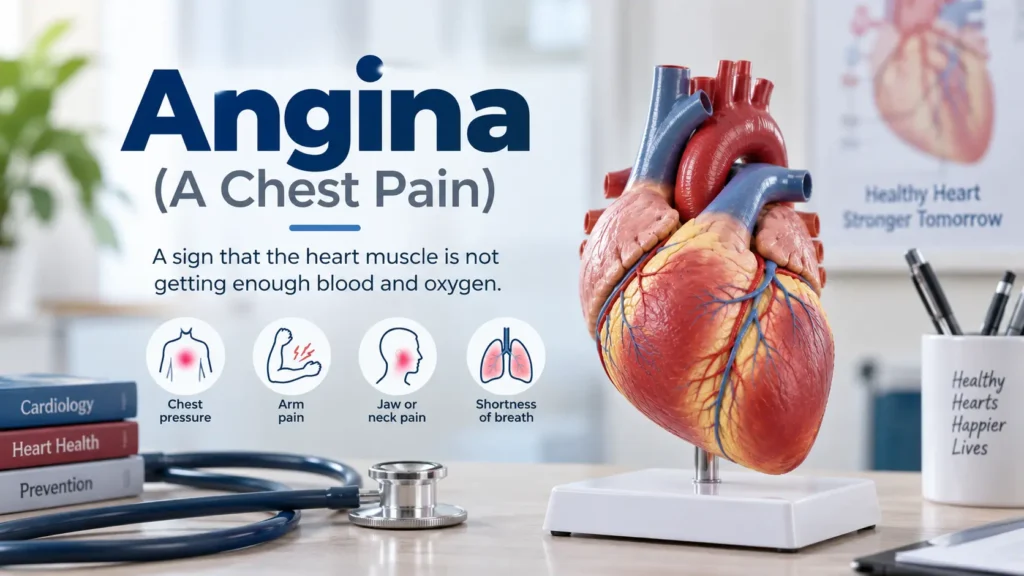
You finish a meal, a burning rises in your chest, and you reach for an antacid. It may be reflux, but chest burning can sometimes have a heart-related cause too. This guide explains the 7 angina symptoms people often mistake for gas or acidity, and how to tell them apart.
Quick Answer
- What It Is: Angina is chest pain or pressure that happens when the heart muscle does not get enough blood.
- Main Clue: Angina is often triggered by effort or stress and may ease with rest. Acidity is often linked to meals. But symptoms can overlap, so timing alone is not enough to be sure.
- 7 Signs: Chest burning, chest pressure, arm pain, jaw or neck ache, cold sweating, breathlessness, and unusual tiredness.
- What It Signals: Angina is a sign the heart muscle is not getting enough blood, and it needs medical evaluation.
- Emergency: Severe or lasting chest pain, or pain at rest, needs emergency care straight away.
What Is Angina?
Angina is chest discomfort that appears when the heart muscle does not get enough oxygen-rich blood. Your heart is fed by the coronary arteries, and when these narrow from plaque buildup, blood flow drops, especially during effort or stress. The result is pressure, heaviness or burning in the chest. Angina is not a heart attack. It is an early warning that the heart is under strain, most often from coronary artery disease, and it deserves a proper check.
Can You Have Angina Before 40?
Angina is more common with age, but younger adults can develop it too. It is more likely in people under 40 who smoke, have diabetes, high cholesterol, high blood pressure, or a strong family history of early heart disease. Some types, such as vasospastic angina, can also appear in younger people. If you also have an irregular heartbeat, it should be evaluated by a doctor.
The takeaway is simple: young age does not rule out angina. If you have these risk factors and get chest discomfort with effort or stress, it is worth a proper check rather than assuming it is only acidity or stress.
7 Angina Symptoms Often Mistaken for Acidity
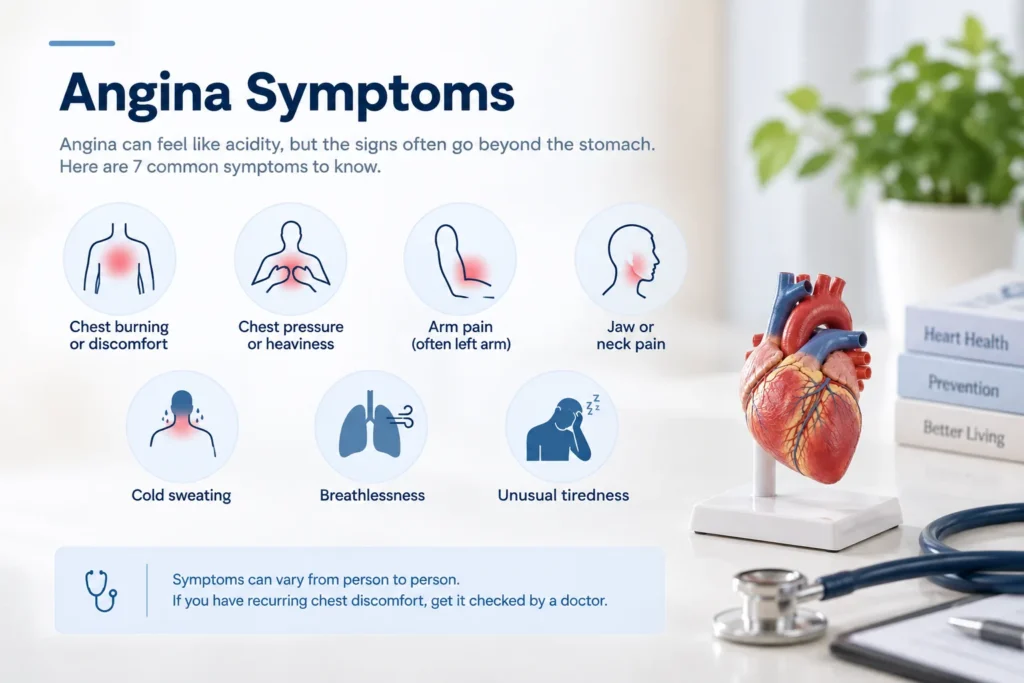
These symptoms can be easy to dismiss because they may not feel like typical heart pain. Here they are at a glance, then one by one.
The 7 Signs at a Glance
1. Chest burning, especially with effort
2. Chest pressure or heaviness, easing with rest
3. Pain in the arm or shoulder
4. Jaw or neck ache, sometimes without chest pain
5. Cold sweating during mild activity
6. Breathlessness on light exertion
7. Unusual tiredness that rest does not fix
1. Chest Burning
This can feel like acid reflux, which is why it fools people. Reflux is often tied to meals, while this burning is often tied to effort and may settle with rest. Because the two overlap, burning that comes with activity should be checked, not assumed to be acidity.
2. Chest Pressure or Heaviness
Many describe it as a weight on the chest or a tight band squeezing from outside, often as "something sitting on my chest." It usually lasts a few minutes and eases with rest. This is one of the most classic angina symptoms.
3. Arm or Shoulder Pain
Discomfort can spread from the chest to one or both arms, the shoulders, neck, jaw or back. It is often mistaken for a muscle problem, especially when it is mild or comes and goes. This spreading pattern is a well-known cardiac warning.
4. Jaw or Neck Discomfort
Angina can cause an aching or tight feeling in the jaw, neck or even the teeth, sometimes with no chest pain at all. Women may be more likely to have angina symptoms outside the chest, such as the jaw, neck, back or arms, along with breathlessness or nausea. It is easy to mistake for a dental problem or neck stiffness.
5. Sudden Sweating Without Reason
Breaking into a cold sweat during mild activity, like a slow walk or one flight of stairs, with no obvious cause, is a red flag. Cold sweating can occur with angina and other serious heart problems, especially alongside chest discomfort, breathlessness or dizziness.
6. Unexplained Breathlessness
Feeling short of breath during things that never tired you before, like walking to the kitchen, can be an early sign. It can happen when the heart cannot meet the body's demand for blood, though breathlessness has many non-cardiac causes too.
7. Extreme Tiredness or Fatigue
A deep, heavy tiredness that rest and tea do not fix, where simple tasks feel unusually hard, is one of the most ignored signs. Unusual fatigue is an under-reported early cardiac symptom, especially in women.
Acidity vs Angina: How to Tell Them Apart
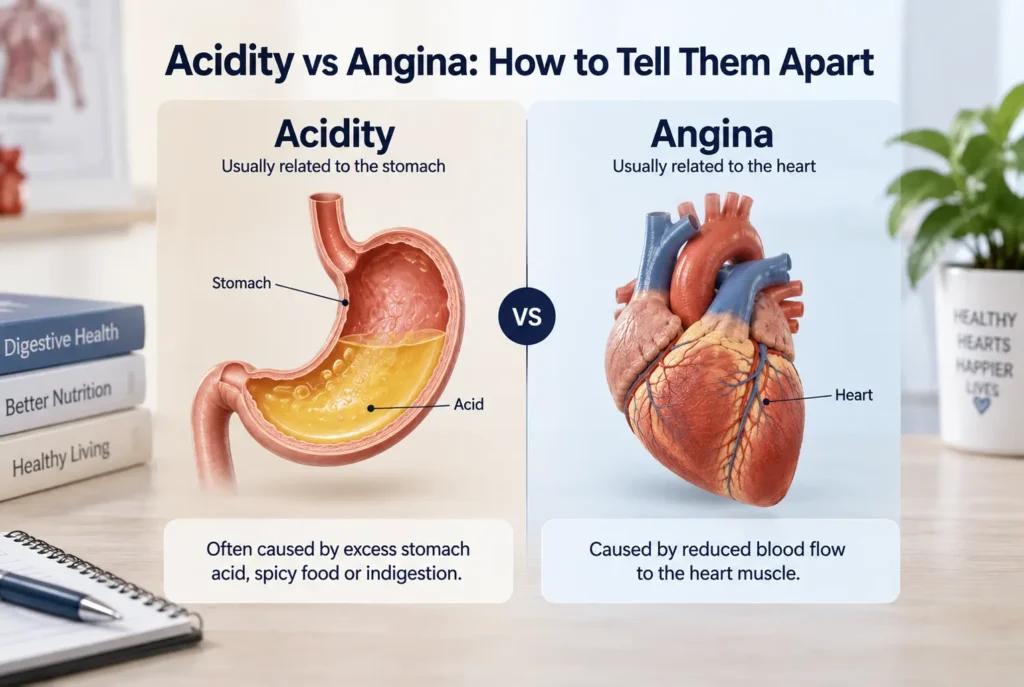
This is the difference that matters most, because getting it wrong can mean ignoring the heart. Here is a simple side-by-side.
| Feature | Reflux / Acidity | Angina |
|---|---|---|
| Often linked to | Meals or lying down | Physical effort or stress |
| Feeling | Burning | Pressure, tightness or heaviness |
| May improve with | An antacid | Rest |
| May spread to | Throat | Arm, jaw, neck or back |
These patterns can offer clues, but they cannot reliably diagnose the cause of chest discomfort. When in doubt, get it checked.
Typical Stable Angina Pattern
Classic angina follows a rhythm: discomfort rises with exertion and fades with rest. Picturing it as a curve makes the pattern easy to remember.
This pattern is typical of stable angina. Other types can occur at rest or follow a different pattern.
When this pattern breaks, and pain starts at rest or stops easing, that is the dangerous shift explained in the types below.
Types of Angina
| Type | What Happens | Key Point |
|---|---|---|
| Stable | Comes with effort, eases with rest | Predictable, still needs care |
| Unstable | Occurs at rest, lasts longer, unpredictable | Medical emergency |
| Variant (Prinzmetal) | Caused by a sudden artery spasm, often at rest | Frequently at night or early morning |
| Microvascular | Affects the heart's tiny vessels | More common in women, harder to diagnose |
Chest pain that is new, worsening, unpredictable, or occurring at rest needs urgent medical assessment rather than a wait-and-watch approach.
When to Get Help
Call emergency services straight away if chest pain or pressure is severe, lasts more than a few minutes, comes on at rest, or arrives with sweating, breathlessness, dizziness, fainting, or pain spreading to the arm or jaw. In India, call 112 or 108. Do not wait to see if it passes, and do not drive yourself.
While Waiting for Help
Stop all activity and sit down, stay calm, loosen tight clothing, and take prescribed nitroglycerin if a doctor has given it to you. Keep someone with you and open the door for responders. Quick treatment protects heart muscle.
How to Lower Your Risk
- Stop Tobacco: Quitting is the single strongest step for your arteries.
- Move Most Days: Around 30 minutes of activity, such as brisk walking, helps the heart.
- Watch the Numbers: Keep blood pressure, sugar and cholesterol in check.
- Sleep and Stress: Aim for good sleep and manage daily stress.
- Get Checked Early: If you have recurring chest symptoms or important risk factors, ask a doctor whether an ECG or other heart tests are needed.
Key Takeaways
- Timing Can Help: Angina is often triggered by effort or stress, while reflux is often linked to meals. But symptoms can overlap.
- Look Beyond the Chest: Arm, jaw, sweating and breathlessness can all be angina symptoms.
- Angina Signals a Problem: It means the heart is not getting enough blood and needs evaluation.
- Unstable Is Urgent: Pain at rest or pain that will not ease is an emergency.
- Do Not Self-Diagnose: Recurring chest discomfort deserves a proper check, not another antacid.
Frequently Asked Questions
What are the main angina symptoms?
Chest pressure or burning during effort, pain spreading to the arm, jaw or neck, cold sweating, breathlessness, and unusual tiredness. The discomfort usually eases with rest.
Can acidity really feel like angina?
Yes, and this is why angina is often missed. Both can cause chest discomfort. Reflux is often linked to meals and may improve with an antacid, while angina is often triggered by activity or stress and may improve with rest. Because symptoms overlap, timing alone cannot safely tell them apart.
Is angina dangerous?
Angina is a warning sign of reduced blood flow to the heart and needs medical attention. Unstable angina, where pain comes at rest, is a medical emergency that can lead to a heart attack.
What is the difference between stable and unstable angina?
Stable angina is predictable, comes with effort and eases with rest. Unstable angina is unpredictable, can occur at rest, lasts longer, and may not ease with rest or usual medicine. Unstable angina needs emergency care.
Can stress alone trigger angina?
Yes. Emotional stress raises heart rate and blood pressure. In someone with narrowed arteries, that extra demand can bring on an angina episode even without physical activity.
Can an ECG detect angina?
An ECG can help identify heart-related problems, but it may be normal between episodes. Depending on your symptoms and risk factors, a doctor may recommend an exercise stress test, imaging or other tests.
Can young adults get angina?
Yes. Although angina is more common with increasing age, younger adults can develop it too, particularly with risk factors such as smoking, diabetes, high cholesterol or a strong family history of heart disease.
What is the difference between angina and a heart attack?
In angina, reduced blood flow causes temporary symptoms without permanent heart muscle damage, and the pain usually eases with rest. A heart attack occurs when blood flow is severely reduced or blocked for long enough to damage heart muscle, and that pain is more severe, lasts longer and does not ease with rest.
References
- Angina. National Heart, Lung, and Blood Institute (NIH), 2024.
- Angina (chest pain). American Heart Association, 2024.
- Angina: symptoms and causes. Mayo Clinic, 2024.
- Angina. National Health Service UK, 2024.
- Angina. Cleveland Clinic, 2024.
- Cardiovascular diseases fact sheet. World Health Organization, 2024.
Written by
Iraphan Khan, BSN, RN, D.Pharm, Public Health Researcher
Founder of RealMedVision, writing patient-focused health content based on clinical guidelines and peer-reviewed research.
Medically reviewed by
Dr Praveen Verma, MBBS, MD (Pathology), Pathologist and Clinical Laboratory Specialist
Dr Himanshu Morya, MBBS, Medical Educator
Last medically reviewed: 9 September 2026
Medical Disclaimer
This page is published for education and awareness. It is not medical advice, a diagnosis or a treatment plan. Chest pain has many causes, and only a qualified doctor can evaluate yours. If you have severe or persistent chest pain, breathlessness or fainting, call 112 or 108 immediately.