Normal Heart Rate by Age: Is 60–100 BPM Normal?
What Is a Healthy Heart Rate by Age, What Is Not, and When You Should See a Doctor
A patient-friendly guide by RealMedVision
Last Update – May 2026

You glance at your smartwatch. It says 72. A few hours later, after climbing the stairs, it reads 110. The next morning, still half asleep, it shows 58. Somewhere in between all of this, a quiet question forms: is this normal?
Most people never think about their heart rate until a number on their screen makes them pause. And that pause is worth something.
Understanding normal heart rate by age can help you know whether a reading is expected or whether it deserves medical attention. For most healthy adults, a normal resting heart rate is between 60 and 100 beats per minute. But that range tells only part of the story.
Heart rate changes with age, fitness level, stress, sleep, medications, and overall health. A rate of 58 in a trained runner is often a sign of excellent cardiovascular fitness. The same number in an older adult experiencing dizziness or fatigue may need medical evaluation.
According to the American Heart Association (AHA) and the World Health Organization (WHO), resting heart rate is one of the simplest ways to understand how efficiently your heart is working, and knowing the normal heart rate by age is the first step toward interpreting your readings correctly.
What You Will Learn in This Article
- What heart rate actually means, in simple language
- Normal heart rate ranges by age, from newborns to adults
- What resting heart rate is and why it matters
- Common causes of a high heart rate (Tachycardia)
- Common causes of a low heart rate (Bradycardia)
- Warning signs that should not be ignored
- When you should see a doctor
- Simple, practical tips to keep your heart healthy
This guide will help you understand normal heart rate by age, what affects it, and when a heart rate reading may need medical attention.
What Is Heart Rate?

Heart rate is simply the number of times your heart beats in one minute. It is measured in BPM, which stands for beats per minute. If your heart beats 70 times in sixty seconds, your heart rate is 70 BPM.
Your heart is a muscle and one of the most hardworking ones in your body. With every single beat, it pumps blood through an enormous network of blood vessels, delivering oxygen and nutrients to every organ, every tissue, and every cell.
When the heart is beating at a healthy rate and rhythm, the body receives exactly what it needs to function properly. This is why understanding normal heart rate by age matters more than most people realize.
For most healthy adults, a normal resting heart rate falls between 60 and 100 BPM, though what is considered normal varies depending on your age and fitness level.
Heart rate is one of the simplest and most accessible windows into how well the cardiovascular system is working. It is not perfect on its own—a single number tells only part of the story. But tracked over time, and understood in context, it is genuinely useful information, especially when you compare it with normal heart rate by age.
What Is a Normal Heart Rate by Age?

This is the question most people actually want answered. And the answer, as with most things in medicine, is it depends on your age.
Heart rate changes significantly across the lifespan. Newborns have very fast hearts. As children grow and their cardiovascular systems become more efficient, the heart rate gradually slows. By adulthood, it stabilizes into a familiar range.
The World Health Organization, the American Heart Association, and child health organizations including UNICEF all recognize that normal heart rate by age differs across life stages — and knowing your age-appropriate range is the starting point for understanding what your readings actually mean.
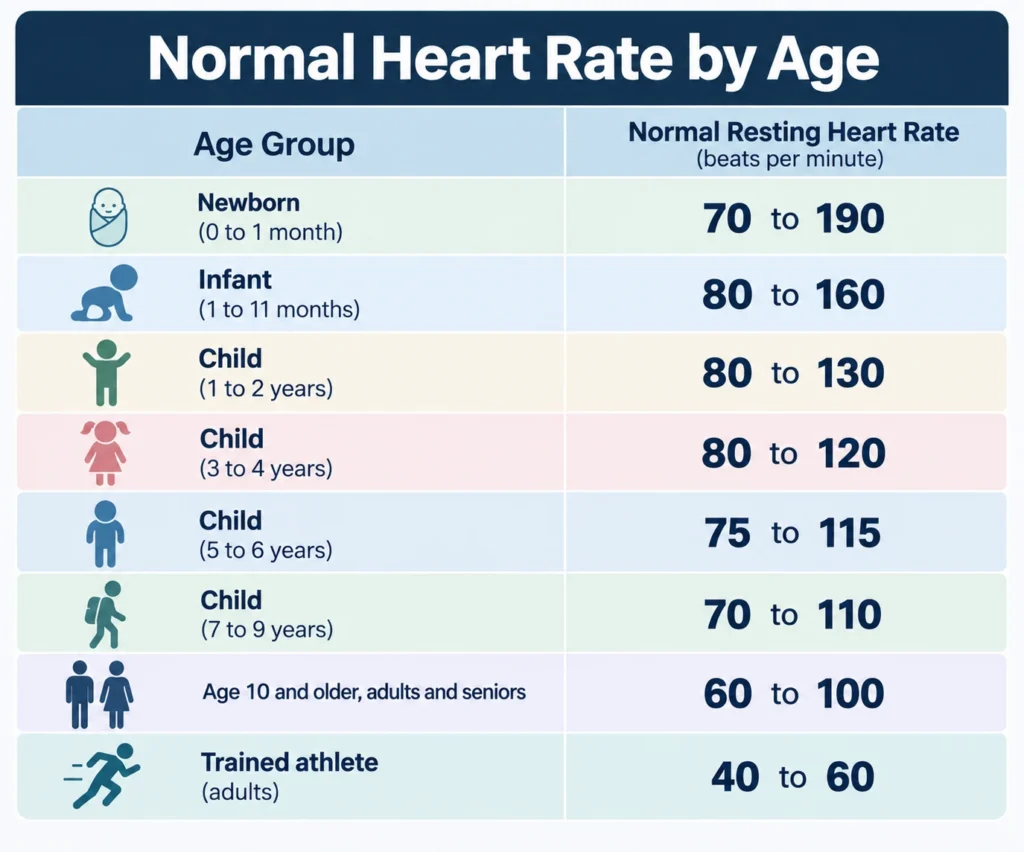
Normal Heart Rate by Age: Complete BPM Chart
Age Group | Normal Heart Rate (BPM) |
|---|---|
Newborn (0 to 1 month) | 100 to 160 BPM |
Infant (1 to 12 months) | 100 to 150 BPM |
Child (1 to 5 years) | 80 to 130 BPM |
Child (6 to 10 years) | 70 to 110 BPM |
Teen (11 to 17 years) | 60 to 100 BPM |
Adult (18 to 64 years) | 60 to 100 BPM |
Senior (65 years and above) | 60 to 90 BPM |
Trained Athletes | 40 to 60 BPM |
Newborn (0 to 1 Month)—100 to 160 BPM
A newborn’s heart beats remarkably fast, and this is entirely normal. Their bodies are tiny, their oxygen demands are proportionally high, and their hearts compensate by pumping more frequently. A rate of 140 BPM in a sleeping newborn is not a cause for alarm. It is simply how a newborn heart works.
Infant (1 to 12 Months)—100 to 150 BPM
As babies grow through their first year, the heart rate begins to settle slightly but remains fast by adult standards. The body is still growing rapidly, metabolism is high, and the cardiovascular system is working hard to keep up. A rate anywhere in this range in a calm, healthy infant is completely normal.
Child (1 to 5 Years)—80 to 130 BPM
In the early childhood years, the heart is still developing and beats faster than it will in later years. Active play, running, and physical movement are natural at this age and will temporarily push the heart rate higher. This is healthy and expected.
Child (6 to 10 Years)—70 to 110 BPM
As children grow taller and stronger, the heart grows with them. A larger, stronger heart can pump more blood per beat, which means it does not need to beat as many times per minute to do the same job. Physical activity during these years actively contributes to building a stronger, more efficient cardiovascular system.
Teen (11 to 17 Years)—60 to 100 BPM
By the teenage years, the heart rate range comes down to roughly adult levels. Adolescence brings rapid physical development, hormonal changes, and often significant increases in physical activity, all of which influence heart rate. A teenager who exercises regularly may have a resting heart rate at the lower end of this range, which is a positive sign.
Adult (18 to 64 Years)—60 to 100 BPM
For healthy adults, the standard resting heart rate is between 60 and 100 BPM. Most moderately active adults sit somewhere between 65 and 80 at rest. Fit, regularly exercising adults often have resting rates below 60, sometimes as low as 50 or even lower. This is not a problem. It is a sign that the heart has become efficient through training.
Senior (65 Years and Above)—60 to 90 BPM
Adults over 65 generally have a resting heart rate between 60 and 90 BPM. As we age, the arteries may stiffen and the heart muscle can weaken slightly, which affects how efficiently the heart pumps blood. Seniors taking multiple medications should monitor their heart rate more regularly and discuss any consistent changes with their doctor.
Trained Athletes — 40 to 60 BPM
A resting heart rate below 60 BPM in a trained athlete is not bradycardia. It is the result of years of cardiovascular conditioning. The heart becomes so efficient that it needs fewer beats per minute to deliver the same amount of oxygen. Some elite athletes have resting rates as low as 40 BPM.
Important Points to Remember:
Heart rate naturally increases during exercise, stress, fever, or strong emotions and decreases during sleep and deep relaxation. A single high or low reading is rarely meaningful on its own. What matters is your consistent resting heart rate over time, combined with how you feel.
What Is Resting Heart Rate?
Resting heart rate is your heart rate when your body is completely at rest — sitting quietly, lying down, or first thing in the morning before you get up and start moving. It is the baseline number that tells us how hard your heart is working when it does not need to do anything extra.

For a healthy adult, a normal resting heart rate is between 60 and 100 BPM. But within that range, lower is generally better — it suggests the heart is pumping efficiently and does not need to work as hard to meet the body’s baseline needs.
The best time to check your resting heart rate is in the morning, before you get out of bed. Sit quietly for a few minutes, then check your pulse or smartwatch. This gives the most accurate baseline reading and helps you better understand your normal heart rate by age.
If your resting heart rate is consistently above 100 or below 50, especially if you are not an athlete and you have no clear explanation—it is worth discussing with a doctor.
On its own, a number outside the normal range is not necessarily alarming. But combined with symptoms like dizziness, fatigue, or breathlessness, it becomes more significant.
Reasons for High Heart Rate (Tachycardia)
Tachycardia is the medical term for a heart rate above 100 BPM at rest. It sounds concerning, but the reality is that most episodes of fast heart rate have completely ordinary, non-dangerous explanations.
Common and normal reasons for a temporarily elevated heart rate include:
Exercise or physical exertion: The heart speeds up to deliver more oxygen to working muscles. This is the most common and expected cause of a temporarily high heart rate.
Stress, anxiety, or fear: Adrenaline released during emotional stress or fear triggers the body’s fight-or-flight response, which directly accelerates the heart rate.
Fever: For every one degree rise in body temperature, the heart rate increases noticeably. This is the body’s way of circulating more blood to fight infection.
Excess caffeine: Too much tea, coffee, or energy drinks directly stimulate the heart and can push the rate higher than normal, especially in people who are sensitive to caffeine.
Dehydration: When blood volume falls due to low fluid intake, the heart compensates by beating faster to maintain circulation.
Anemia: A low red blood cell count means less oxygen is carried per beat, so the heart beats more frequently to make up the difference.
Thyroid problems: An overactive thyroid gland speeds up nearly every process in the body, including heart rate. Persistent unexplained tachycardia is sometimes the first sign of hyperthyroidism.
These causes are important to recognize because they are common, they are explainable, and most of them resolve when the underlying factor is addressed. Drink water if you are dehydrated. Rest after exercise. Reduce caffeine. The heart rate comes down.
When to be concerned:
If your heart rate is consistently fast at rest without a clear reason and especially if it is accompanied by chest pain, dizziness, shortness of breath, or palpitations—please see a doctor. Persistent unexplained tachycardia can sometimes indicate an underlying heart rhythm disorder that needs evaluation.
Reasons for Low Heart Rate (Bradycardia)
Bradycardia is the medical term for a heart rate below 60 BPM. And here is something important that many people do not know: a slow heart rate is not automatically a problem. In many cases, it is actually a very good sign.
Common reasons for a lower than average heart rate include:
- Deep sleep or complete rest, your heart naturally slows down while the body recovers and conserves energy.
- Regular exercise and athletic fitness, a trained heart can pump more blood with each beat, so it does not need to beat as often. This is known as athletic bradycardia and is usually a sign of good cardiovascular fitness.
- Certain medications, including beta blockers and some heart medicines, can slow the heart rate as part of their normal effect.
- Advancing age, the heart’s electrical system may become slower over time.
- Hypothyroidism (underactive thyroid), lower thyroid hormone levels can slow many body functions, including heart rate.
- Electrical conduction problems in the heart, the signals that control the heartbeat may become delayed or blocked, causing the heart to beat more slowly.
The key difference is how you feel. A low heart rate in a healthy athlete is often normal, but a low heart rate with symptoms like dizziness or fainting needs medical attention.
When to be concerned:
If your heart rate is consistently low and you have symptoms such as dizziness, fainting, weakness, or difficulty breathing, seek medical advice. These signs may indicate that your heart is not pumping enough blood effectively.
When Should You See a Doctor
Not every unusual heart rate reading requires a doctor’s visit. But some combinations of findings should not be ignored. Based on cardiovascular research and clinical guidelines, seek medical evaluation if:
- Your resting heart rate is consistently above 100 BPM without a clear explanation
- Your resting heart rate is consistently below 50 BPM and you are not a trained athlete
- You experience chest pain or chest tightness along with an abnormal heart rate
- You feel dizzy, lightheaded, or faint, especially repeatedly
- You notice your heart beating in an irregular or skipping pattern
- You feel shortness of breath at rest or with minimal activity
Your heart rate keeps changing erratically without any obvious trigger
These signs may indicate that your readings are outside the normal heart rate by age range and need medical attention.
Simple Tips to Keep Your Heart Healthy

The research on heart health is remarkably consistent across decades of study. The habits that protect the heart are not complicated or expensive. They are consistent. Here is what the evidence actually supports:
Move your body every day. Even a 30-minute walk can make a difference. Regular physical activity strengthens the heart, improves circulation, and helps maintain a healthy resting heart rate.
Eat a balanced diet rich in fruits, vegetables, whole grains, pulses, and healthy fats. According to the WHO and AHA, long-term eating habits matter more than any single food or supplement.
Limit salt, fried foods, and excess sugar. Over time, these can increase blood pressure and cholesterol levels, which may affect heart health.
Stay well hydrated. Dehydration can cause the heart to work harder and may lead to a faster heart rate.
Get enough sleep. During sleep, the heart and blood vessels recover. Poor sleep over time can negatively affect cardiovascular health.
Avoid smoking. Tobacco damages blood vessels, increases heart rate, and significantly raises the risk of heart disease.
Schedule regular health checkups. Monitoring blood pressure, blood sugar, and cholesterol can help detect problems early, when they are often easier to manage.
You do not need to overhaul your entire life to take care of your heart. Most people who improve their heart health do it one small habit at a time.
Start with something simple. A 20 minute walk after dinner. Sleeping an hour earlier. Cutting back on salt. These things sound small but the heart responds to consistency more than intensity. Pick one change, stick with it, and add the next when the first feels natural.
Always Remember These Important Points
Key Points to Remember About Your Heart Rate:
- Heart rate increases during exercise, stress, fear, or fever—this is normal and expected
- Heart rate decreases during sleep, deep rest, and in physically fit individuals
- One unusual reading is rarely meaningful—what matters is your consistent pattern over time
- If your resting heart rate is consistently above 100 or below 50 BPM alongside symptoms like dizziness, chest pain, weakness, or breathlessness—see a doctor
- A balanced diet and regular physical activity are the two most powerful tools for long-term heart health
Regular physical activity and a balanced diet are two of the most effective ways to support long-term heart health. Good sleep and avoiding smoking matter just as much.
Frequently Asked Questions (FAQ)
What is a normal heart rate for adults?
For most healthy adults, a normal resting heart rate is between 60 and 100 BPM. Within that range, lower is generally better. It suggests the heart is pumping efficiently without working too hard. Athletes and regularly active individuals may have resting rates below 60, which is healthy and not a cause for concern.
Is 72 BPM a normal heart rate?
Yes, 72 BPM is a completely normal resting heart rate for an adult. It sits comfortably in the middle of the healthy range and suggests the heart is working efficiently at rest. Most moderately active adults will find their resting heart rate falls somewhere between 65 and 80 BPM.
What is a normal heart rate for seniors over 65?
For adults over 65, a healthy resting heart rate is generally between 60 and 90 BPM. As the body ages, the heart may become slightly less efficient, and medications can also affect heart rate. Seniors should monitor their readings regularly and report any consistent changes to their doctor.
What is a dangerous heart rate?
A resting heart rate consistently above 100 BPM or below 50 BPM in a non-athlete can be a warning sign, especially when combined with symptoms. Chest pain, dizziness, fainting, or shortness of breath alongside an abnormal heart rate always requires medical evaluation. Do not ignore these combinations.
Why does heart rate increase?
Heart rate increases whenever the body needs more oxygen. Exercise, stress, anxiety, fever, dehydration, anemia, and excess caffeine are the most common causes. Most of these are temporary and resolve once the trigger is removed. A persistently high resting heart rate without a clear reason needs medical attention.
Is a heart rate of 50 BPM too low?
Not always. In trained athletes and regularly active individuals, a resting heart rate of 50 BPM or even lower is completely normal. It simply means the heart is efficient. However, in someone who is inactive and experiencing dizziness or fatigue, a rate of 50 BPM deserves medical evaluation.
Can stress raise your heart rate?
Yes. Stress and anxiety trigger the release of adrenaline, which directly speeds up the heart. This is the body’s natural fight-or-flight response. The heart rate usually returns to normal once the stress passes. Chronic stress that keeps the heart rate consistently elevated over time can strain the cardiovascular system.
Does heart rate increase with age?
The resting heart rate itself does not necessarily increase with age, but the heart becomes less adaptable. It may not respond as quickly to physical demands, and it takes longer to return to normal after exertion. Older adults are also more likely to develop arrhythmias like atrial fibrillation, which can affect heart rate.
What is the best time to check resting heart rate?
The best time is in the morning, before getting out of bed. Sit quietly for a few minutes, then check your pulse or smartwatch. Avoid checking immediately after waking up and moving around, as activity will already have raised your rate above the true resting baseline.
Can dehydration affect heart rate?
Yes. When the body is dehydrated, blood volume drops. The heart compensates by beating faster to maintain circulation and deliver oxygen to the body’s tissues. Even mild dehydration can raise resting heart rate by 5 to 10 BPM. Staying well hydrated is one of the simplest ways to support a healthy heart rate.
What is heart rate variability and why does it matter?
Heart rate variability, or HRV, refers to the small variations in time between each heartbeat. A higher HRV generally indicates a healthier, more adaptable cardiovascular system. Low HRV has been linked to increased stress, poor recovery, and higher cardiovascular risk. Many modern smartwatches now track HRV alongside resting heart rate.
When should I see a doctor about my heart rate?
See a doctor if your resting heart rate is consistently above 100 BPM or below 50 BPM without explanation. Seek immediate attention if an abnormal heart rate is accompanied by chest pain, dizziness, fainting, palpitations, or shortness of breath. A single unusual reading after activity is rarely a concern. A persistent pattern with symptoms always is.
Conclusion
Your heart rate is not a fixed number, and it was never meant to be. It rises when you run, slows when you sleep, and shifts quietly with age, fitness, and health. A single reading on your smartwatch tells you very little. What matters is the pattern you see over weeks and months, and how you feel alongside those numbers.
Most people who maintain a healthy heart rate are not doing anything dramatic. They walk regularly, sleep enough, drink enough water, and manage their stress as best they can. These habits are not exciting, but the heart responds to them reliably over time.
If something feels off, whether your heart races without reason, beats too slowly, or skips in ways that worry you, do not wait. A doctor can evaluate what a smartwatch cannot.
Take care of your heart consistently, and it will take care of you for a long time.
Medical Disclaimer
This article is written for general educational awareness only. It does not constitute medical advice, diagnosis, or treatment recommendation. If you have any concerns about your heart rate or cardiovascular health, please consult a qualified healthcare professional.
About the Author
Iraphan Khan, BSN | D.Pharm | CMLT, is a Healthcare SEO Strategist and Medical Content Writer at RealMedVision, creating clinically accurate content optimized for Google and AI search.
Medically Reviewed By
Dr Praveen Verma MBBS MD — Diagnostic & Pathology
Dr Himanshu Morya MBBS — Clinical Accuracy & Patient Safety
Kalpna Singh Shekhawat BSN NP — Patient Care & Practical Accuracy
If type 2 diabetes remains uncontrolled for many years, it can gradually damage blood vessels, nerves, and important organs throughout the body. This is why early diagnosis and proper treatment are so important.
References:
1. American Heart Association (AHA). *All About Heart Rate*. Last reviewed May 2024.
2. American Heart Association (AHA). *Target Heart Rates Chart*. Last reviewed August 2024.
3. American Heart Association (AHA). *Abnormal Resting Heart Rate Over Long Term May Predict Future Heart Failure or Death*. November 2024.
4. National Heart, Lung, and Blood Institute (NHLBI), National Institutes of Health (NIH). *How the Heart Beats*.
5. Mayo Clinic. *Heart Rate: What Is Normal?* Last reviewed October 2025.
6. Mayo Clinic. *Exercise Intensity and Target Heart Rate*. Last reviewed 2023.
7. Cleveland Clinic. *Heart Rate: Normal Rates and What to Know*. Updated 2025.
8. Medical News Today. *What Is a Normal Resting Heart Rate?* Updated November 2024.
9. PubMed Central (PMC). *Real-World Heart Rate Norms in the Health eHeart Study*. PMC6592896.
10. PubMed Central (PMC). *Association Between Resting Heart Rate and Brain Age in Middle and Older Age*. Published April 2024.
11. American Heart Association (AHA). *Physical Activity Recommendations for Adults*. Updated 2024.
12. World Health Organization (WHO). *Cardiovascular Diseases