
What heart blockage can feel like, who is at risk, and when a symptom needs a doctor.
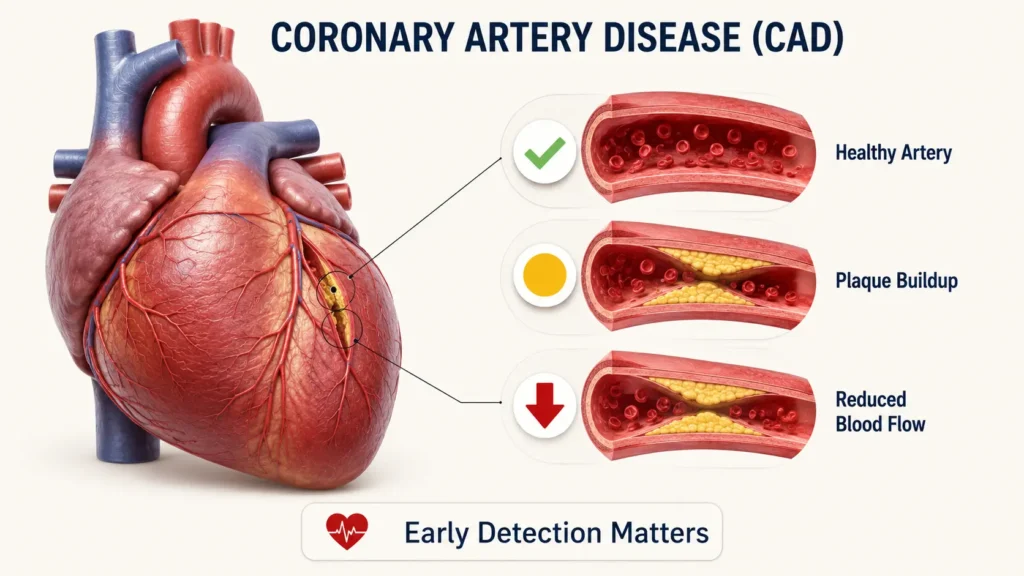
Coronary artery disease, often called heart blockage in everyday Indian language, can build up quietly for years. Some people get clear warnings. Others feel nothing until a serious event. This guide explains the 7 early signs worth taking seriously, how doctors check for it, and exactly when to seek help.
Quick Answer
- What It Is: Coronary artery disease (CAD) means the arteries feeding your heart have narrowed from plaque buildup.
- Common Name: Most people in India simply call it heart blockage.
- Early Signs: Chest pressure on exertion, breathlessness, unusual tiredness, and pain spreading to the jaw or arm.
- The Catch: Some people, especially those with diabetes, have no symptoms at all.
- Good News: Caught early, it can be managed well with medicines and lifestyle changes.
What Is Coronary Artery Disease?
Your heart is a muscle, and it needs its own blood supply to keep working. That supply comes through the coronary arteries, two main vessels that wrap around the heart and branch into smaller ones. When cholesterol, fat and inflammatory deposits build up inside these arteries, the channel narrows and less blood reaches the heart muscle. That narrowing is coronary artery disease, which many people in India commonly call heart blockage. Left unchecked, it can lead to a heart attack or gradually weaken the heart, which is how heart failure can develop.
How Does Heart Blockage Develop?
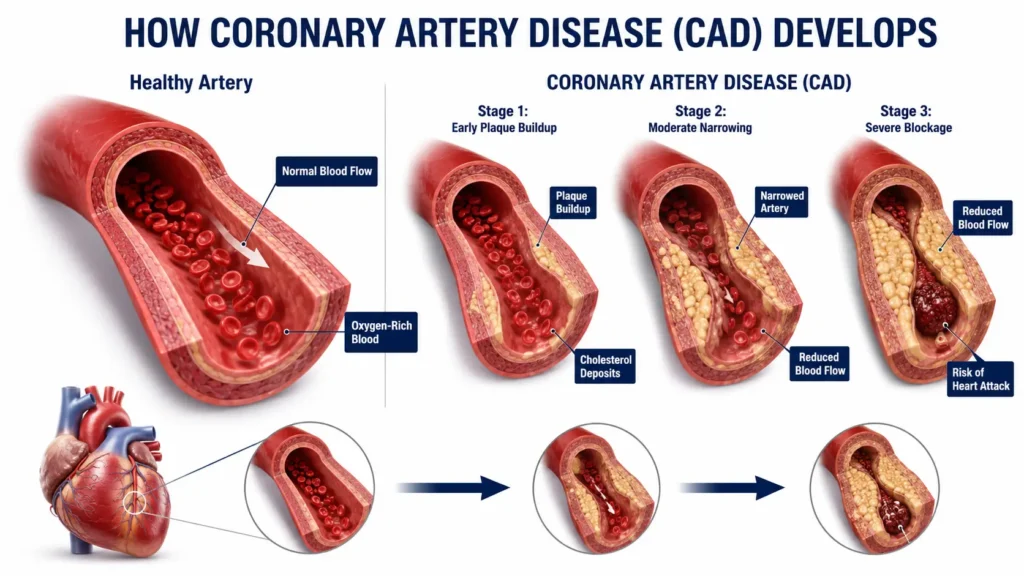
It starts small. High blood pressure, smoking, diabetes or high cholesterol damages the inner lining of an artery. Cholesterol and other substances then build up at the damaged spot and form plaque. Over years, the plaque grows and the artery narrows. This is also why cholesterol can stay high despite a healthy diet, because genetics and other factors feed the process too. Symptoms may appear once the narrowing starts limiting blood flow, often first during physical effort.
7 Early Signs of Coronary Artery Disease
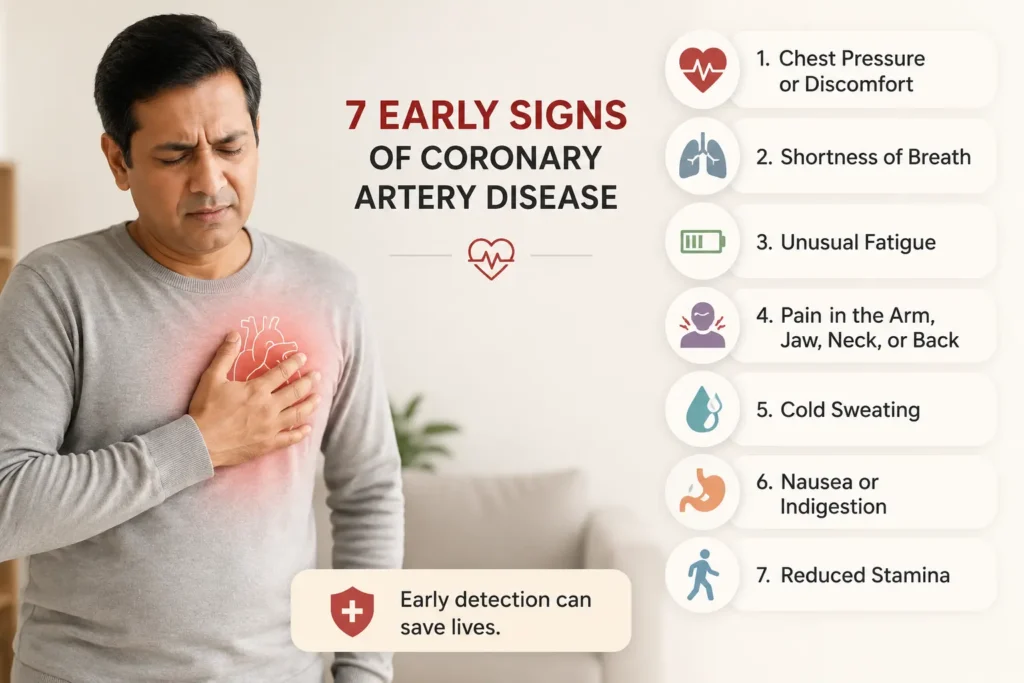
These signs are easy to blame on stress, age or a heavy meal. Here they are at a glance, then one by one.
The 7 Signs at a Glance
1. Chest pressure on exertion, eases with rest
2. Breathlessness during routine activity
3. Unusual tiredness that rest does not fix
4. Pain spreading to jaw, arm, neck or back
5. Cold sweating without heat or exercise
6. Nausea or gas-like discomfort with activity
7. Falling stamina for tasks that used to be easy
1. Chest Pressure or Discomfort (Angina)
This rarely feels like a sharp stabbing pain. People describe tightness, heaviness or squeezing in the centre of the chest, usually during walking fast, climbing stairs or carrying weight, and easing with rest. Doctors call this angina, and when it keeps returning with effort, it is the heart asking for more blood than the narrowed arteries can deliver.
2. Shortness of Breath
Getting winded on stairs you once climbed easily, or feeling breathless on a short walk, can happen when the heart is not getting enough blood and oxygen to meet the body's needs. If breathlessness is new, worsening, or arrives without a clear reason, it deserves a check rather than a shrug.
3. Unusual Fatigue
This is not the normal tiredness that sleep fixes. It is feeling drained after simple tasks or waking up already exhausted. When the heart receives less blood, the whole body works harder. Women can have less typical symptoms of heart disease, and unusual fatigue is one of them, though chest discomfort still occurs in many.
4. Pain Spreading to the Jaw, Arm, Neck or Back
Heart-related pain does not always stay in the chest. It can travel to the left arm, jaw, neck, shoulder or upper back, often during activity. Because it mimics muscle strain or a dental problem, people dismiss it. Recurring pain in these areas during effort should be evaluated.
5. Cold Sweating Without Reason
Cold, clammy sweating with no heat, fever or exertion can signal a heart under stress. When it appears together with chest discomfort, breathlessness or dizziness, treat it as urgent rather than waiting for it to pass.
6. Nausea or an Indigestion-Like Feeling
Women, older adults and people with diabetes sometimes feel stomach discomfort instead of chest pain. Some heart problems genuinely feel like gas or acidity, which is why repeated indigestion that appears with activity or stress needs a doctor, not just an antacid.
7. Reduced Stamina
A 30-minute walk that now needs two rest stops. Stairs that suddenly feel like a climb. Falling stamina is easy to blame on age, and sometimes that is all it is. But when capacity keeps dropping without a clear reason, an early heart blockage is one of the causes worth ruling out.
Coronary Artery Disease vs Heart Attack
People use these words interchangeably, but they describe different stages of the same problem. CAD is the slow narrowing. A heart attack happens when blood flow to part of the heart muscle is suddenly reduced or blocked, usually because a clot forms in a coronary artery. Its two main types are explained in our guide to STEMI and NSTEMI heart attacks.
| Feature | Coronary Artery Disease | Heart Attack |
|---|---|---|
| What Happens | Arteries narrow gradually over years | Blood flow suddenly drops, often from a clot |
| Speed | Slow and often silent | Sudden emergency |
| Typical Feel | Discomfort on effort, eases with rest | Severe, persistent pain with sweating |
| What to Do | See a doctor soon | Call emergency services now |
Who Is at Risk of Heart Blockage?
Some risks can be changed, others cannot. Knowing which side of the table you sit on tells you where your effort matters most.
| You Can Change These | You Cannot Change These |
|---|---|
| High blood pressure | Age (risk rises after 45 in men, 55 in women) |
| High cholesterol | Family history of early heart disease |
| Smoking and tobacco | Male gender at earlier ages |
| Diabetes control | South Asian ethnicity |
| Obesity and inactivity | Inherited cholesterol disorders |
Why Indians Need Extra Caution
Research consistently shows that heart blockage tends to appear at younger ages in South Asians, including Indians. Rising diabetes, blood pressure and sedentary routines are adding to the load. The landmark INTERHEART study found that a small set of largely controllable risk factors explains most heart attacks worldwide, which is why controlling the changeable factors matters so much in prevention.
How Doctors Diagnose Heart Blockage
No single symptom proves CAD, so doctors combine a few tests to see the full picture.
- ECG: Records the heart's electrical activity in minutes and can show signs of reduced blood flow or old damage. Our guide to ECG test results explains the report in simple words.
- Blood Tests: Check cholesterol, blood sugar and troponin, a protein released when heart muscle is injured.
- 2D Echo: An ultrasound that shows the heart's structure and pumping strength, including the ejection fraction. It assesses heart function when CAD is suspected.
- Stress Test: Checks how the heart responds to exercise and may show signs that it is not getting enough blood during effort.
- CT Coronary Angiogram: A detailed scan that directly shows the coronary arteries and any narrowing inside them.
How Heart Blockage Is Treated
- Medicines: Many people manage CAD with tablets that lower cholesterol, control blood pressure, prevent clots and ease the heart's workload, alongside lifestyle changes.
- Angioplasty and Stenting: For a significantly narrowed artery, a small balloon opens the channel and a stent holds it open.
- Bypass Surgery (CABG): For severe or multiple blockages, surgeons create a new route for blood to reach the heart muscle.
- Cardiac Rehabilitation: Supervised exercise, diet guidance and support after treatment, which improves recovery and lowers the chance of future problems.
Note: Which path suits you depends on how many arteries are involved, your symptoms and your overall health. That decision belongs to your cardiologist, not a website.
When to Seek Emergency Help
Seek emergency medical help immediately for chest pain or pressure that is severe or persistent, or that comes with breathlessness, cold sweating, nausea, dizziness, fainting, or pain spreading to the arm or jaw. In India, call 112 or 108. Do not wait to see if it passes, and do not drive yourself.
While Help Is on the Way
Sit down and stay as calm as possible, loosen tight clothing, open the main door for responders, and keep a family member informed. Quick treatment saves heart muscle, and minutes genuinely matter.
Prevention That Actually Works
The same plaque process that narrows heart arteries can affect brain and leg arteries too, so these habits protect far more than the heart.
- Know Your Blood Pressure: Get it checked regularly and see where you stand on the normal blood pressure range by age.
- Stop Tobacco Completely: Quitting is the single most powerful step for your arteries.
- Move Most Days: Regular physical activity, even a brisk daily walk, improves circulation and heart strength.
- Eat for Your Arteries: More vegetables, fruits, whole grains, dals and fish. Less fried, packaged and salty food.
- Manage Sugar and Stress: Keep diabetes under control, sleep enough, and get routine checkups so problems are caught early.
Key Takeaways
- Heart Blockage Builds Silently: CAD can narrow the arteries over years, sometimes without causing symptoms.
- Effort Is the Clue: Discomfort that appears with activity and eases with rest is a classic pattern of angina.
- Symptoms Can Be Different: Women, older adults and people with diabetes may have fatigue, nausea or indigestion-like discomfort instead of typical chest pain.
- Many Risk Factors Can Be Managed: Blood pressure, cholesterol, diabetes, tobacco use and physical activity all affect heart health.
- Severe Symptoms Need Immediate Help: Persistent chest pain with sweating or breathlessness is a reason to call 112 or 108, not wait at home.
Frequently Asked Questions
What is coronary artery disease in simple words?
It means the pipes supplying blood to your heart have narrowed because of plaque buildup. Less blood reaches the heart muscle, especially during effort. In India it is commonly called heart blockage.
Is heart blockage the same as a heart attack?
No. Heart blockage is the slow narrowing of the arteries. A heart attack happens when blood flow to part of the heart is suddenly reduced or blocked, usually by a clot, and it is a medical emergency.
What are the early signs of heart blockage?
Chest pressure during activity, breathlessness, unusual tiredness, pain spreading to the jaw or arm, cold sweating, gas-like discomfort with effort, and falling stamina are the seven signs to watch.
Can coronary artery disease be reversed?
Existing plaque cannot always be removed completely, but treatment and lifestyle changes can slow or stall its progression and sharply lower the risk of a heart attack.
Can young people get heart blockage?
Yes, and it is increasingly seen in Indians in their 30s and 40s, especially with smoking, diabetes, obesity or a strong family history. Young age alone is no longer full protection.
Is coronary artery disease hereditary?
Family history raises risk, particularly if a parent or sibling had heart disease young. Even then, controlling blood pressure, cholesterol, sugar and tobacco cuts a large part of that inherited risk.
Which test confirms heart blockage?
CT coronary angiography can show plaque and narrowing in the arteries. Invasive angiography gives the most detailed pictures and is used when further evaluation or treatment is needed. ECG, blood tests, echo and stress tests build the picture that leads there.
Can heart blockage be treated without surgery?
Often, yes. Many people are managed with medicines and lifestyle changes alone. Angioplasty or bypass is advised when blockages are severe, and your cardiologist decides based on your reports.
References
- Cardiovascular diseases fact sheet. World Health Organization, 2024.
- Coronary artery disease. American Heart Association, 2024.
- Coronary artery disease: symptoms and causes. Mayo Clinic, 2024.
- Coronary artery disease. Cleveland Clinic, 2024.
- Coronary heart disease. National Health Service UK, 2024.
- Effect of potentially modifiable risk factors associated with myocardial infarction (INTERHEART study). The Lancet, 2004.
Written by
Iraphan Khan, BSN, RN, D.Pharm, Public Health Researcher
Founder of RealMedVision, writing patient-focused health content based on clinical guidelines and peer-reviewed research.
Medically reviewed by
Dr Praveen Verma, MBBS, MD (Pathology), Pathologist and Clinical Laboratory Specialist
Dr Himanshu Morya, MBBS, Medical Educator
Last medically reviewed: 8 September 2026
Medical Disclaimer
This page is published for education and awareness. It is not medical advice, a diagnosis or a treatment plan. Speak to a qualified doctor about your own symptoms and reports. If you have severe chest pain, breathlessness or fainting, call 112 or 108 immediately.