
Breathlessness while walking can be one of the first symptoms of aortic stenosis.
A patient-friendly guide by RealMedVision
Medically reviewed: July 2026 · Last updated: 31 August 2026 · 10 to 12 minute read
Quick Answer
Aortic stenosis is a narrowing of the heart's aortic valve. Its main symptoms are breathlessness during activity, chest pain, and dizziness or fainting, together known as the classic triad. Fatigue and palpitations are also common. The valve can stay silent for years, so symptoms usually appear once the narrowing becomes significant and need a doctor's assessment.
Breathlessness while walking has many possible causes, from being out of shape to lung problems or anaemia. But in older adults, it can also be an early sign of aortic stenosis, a heart valve disease where the aortic valve slowly becomes narrow and stiff.
As the valve tightens, the heart has to work harder to push blood out to the body. The trouble is that many people blame the breathlessness on age or tiredness and carry on, while the valve keeps narrowing quietly in the background.
Aortic stenosis is one of the more common serious valve problems, especially after the age of 60, and untreated severe cases can lead to serious complications. This guide explains the symptoms, causes, diagnosis, and treatment in plain language.
What Is Aortic Stenosis?
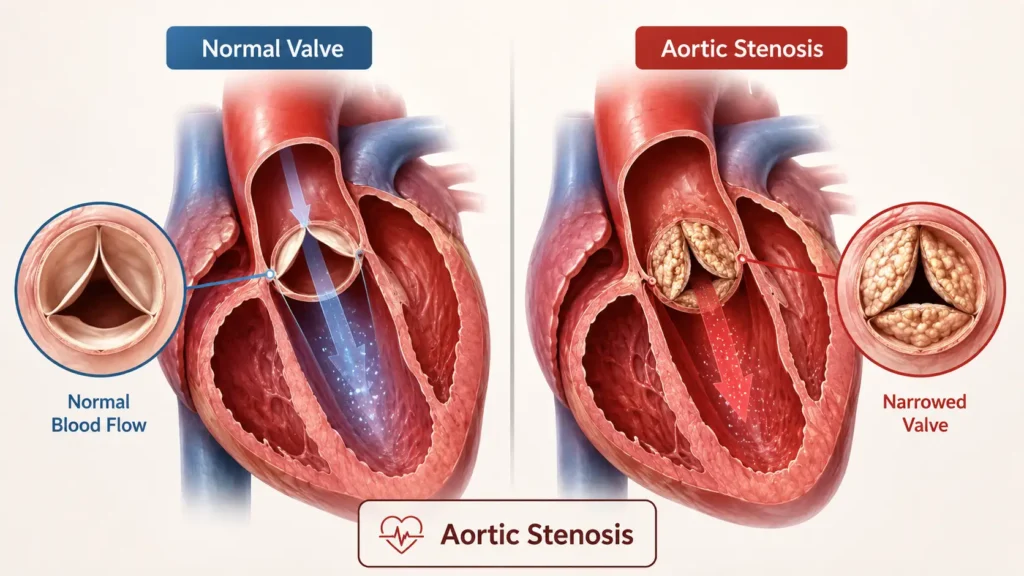
The heart has four valves that keep blood flowing in the right direction. The aortic valve is the one that controls blood leaving the heart for the rest of the body. In aortic stenosis, this valve slowly becomes narrow and stiff, usually from calcium building up on it over many years.
As the opening tightens, less blood gets through, so the heart has to pump harder to make up for it. Over time that extra strain wears on the heart muscle and, if left unchecked, can lead to heart failure.
Because it develops so slowly, many people feel fine in the early stages. Symptoms like breathlessness, chest pain, or dizziness usually show up only once the narrowing is significant, which is why severe aortic stenosis, left untreated, carries a real risk of serious complications.
7 Symptoms of Aortic Stenosis
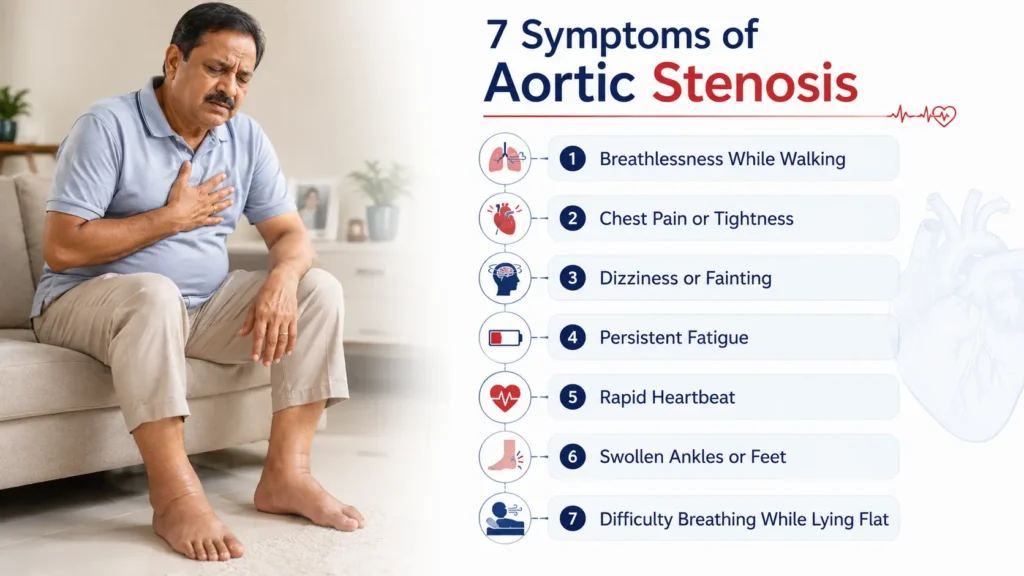
Aortic stenosis can stay silent for years. When symptoms do appear, it usually means the valve has narrowed a lot. Three of them, chest pain, fainting, and breathlessness on activity, are the classic triad and matter most.
| Common symptoms | Signs of advanced disease |
|---|---|
| Breathlessness on walking or stairs | Swelling in the ankles or feet |
| Chest pain or tightness on exertion | Breathlessness when lying flat |
| Dizziness or fainting on activity | Waking at night short of breath |
| Unusual, lasting fatigue | |
| Rapid or fluttering heartbeat |
1. Breathlessness While Walking or Climbing Stairs
Often the first thing people notice. A short walk or one flight of stairs leaves you out of breath, because the narrowed valve limits how much blood the heart can push out during activity. It is easy to blame on age, but new breathlessness on effort is worth checking.
2. Chest Pain or Tightness on Exertion
Called angina, it feels like pressure in the chest during effort and eases with rest. It is often mistaken for acidity or gas, which delays diagnosis, so get a heart check rather than assuming it is your stomach.
3. Dizziness or Fainting on Activity
Feeling faint, or fainting, during or just after activity is a serious sign. Doctors call it exertional syncope, and it often means the stenosis is already severe. Do not brush it off as low blood pressure or a missed meal.
4. Unusual, Lasting Fatigue
A deep tiredness that rest does not fix, because the body is not getting enough blood. It is easy to blame on ageing, which is why it often gets missed. If tasks that never tired you now leave you needing a rest, take it seriously.
5. Rapid or Fluttering Heartbeat
Palpitations, a racing or fluttering feeling, can happen as the strained heart's rhythm is disturbed. This needs proper checking with an ECG test and an echocardiogram, not home remedies.
Signs That Aortic Stenosis Has Progressed
Swelling in the ankles or feet, breathlessness when lying flat (called orthopnea), and waking at night short of breath are not early signs. They usually mean aortic stenosis is advanced and the heart is starting to fail, and need urgent evaluation.
Why Aortic Stenosis Symptoms Are Easy to Miss
The tricky thing about aortic stenosis is that people rarely notice the moment something changes. Instead, they quietly adjust. They start taking the lift instead of the stairs, walk a little slower, skip the evening walk, or sit down more often. Each small change feels reasonable on its own, so the real cause is easy to overlook.
This is why the condition is often caught late, especially in older adults, where slowing down gets blamed on age rather than the heart. If you find yourself avoiding effort you used to manage easily, it is worth mentioning to a doctor.
What Causes Aortic Stenosis?
Aortic stenosis usually develops slowly, and it comes down to a few main causes:
| Cause | Who it affects |
|---|---|
| Calcium build-up on the valve | Older adults; the most common cause |
| Bicuspid aortic valve (born with two flaps instead of three) | Younger adults; a common cause before 60 |
| Rheumatic fever (after untreated strep throat) | More common where strep goes untreated |
In older adults, the most common cause is calcium building up on the valve over many years, which makes it stiff and slower to open. Some people are born with a bicuspid valve, with two flaps instead of the usual three, which puts extra strain on it and often leads to stenosis earlier in life. This falls under congenital heart disease. Less often, rheumatic fever after an untreated strep throat scars the valve over time, which is why it
Who Is at Higher Risk?
Two things raise the risk most: being older, as calcium builds up on the valve with age, and being born with a bicuspid valve, which wears out sooner. Beyond these, several conditions that affect the heart and blood vessels can speed up valve damage:
- High blood pressure
- High cholesterol
- Smoking
- Diabetes and obesity
- Chronic kidney disease
- A family history of heart valve disease
There is also some evidence that obesity and insulin resistance may speed up how quickly the valve deteriorates, though age and valve structure remain the biggest factors.
Good to Know: Types of Aortic Stenosis
Doctors name the condition by its cause:
- Calcific: from calcium build-up, the most common type in older adults.
- Congenital: from a bicuspid valve a person is born with, often showing up earlier in life.
- Rheumatic: from valve scarring after rheumatic fever.
How Aortic Stenosis Progresses
The narrowing happens in a chain. As calcium stiffens the valve, its opening shrinks and less blood gets through with each beat. To keep up, the heart muscle thickens and works harder, but over time that overworked muscle starts to weaken. If it is not treated, this is the path that leads towards heart failure, and in severe cases the ejection fraction can fall too. This is exactly why catching it early matters: it lets doctors step in before the heart muscle is damaged.
Mild, Moderate or Severe: How Doctors Assess It
Aortic stenosis is usually graded as mild, moderate, or severe. But the grade is not decided by a single number. On an echocardiogram, doctors look at several things together, how narrow the valve opening is, how fast blood is flowing through it, the pressure difference across it, and how well the heart is pumping.
- Mild: the valve is only slightly narrowed. Most people have no symptoms and are simply monitored over time.
- Moderate: the narrowing is more noticeable. Some people start to feel breathless or tired on effort, and follow-up becomes more regular.
- Severe: the valve is significantly narrowed. Symptoms like chest pain, fainting, or breathlessness often appear, and this is when treatment is seriously considered.
Keep in mind: severe does not automatically mean surgery for everyone. The decision depends on symptoms, heart function, age, and overall health, and is made by a specialist heart team, not by valve measurements alone.
How Is Aortic Stenosis Diagnosed?
The main test is an echocardiogram (2D echo), an ultrasound of the heart. It confirms the diagnosis, shows how narrow the valve is, and checks how well the heart is pumping. Most of the answer comes from this one test.
Other tests fill in the picture: a doctor may first hear a heart murmur through a stethoscope, an ECG checks the heart's rhythm, and a CT, MRI, or chest X-ray can be added when more detail is needed.
How Is Aortic Stenosis Treated?
No medicine can open a narrowed valve. Mild cases with no symptoms are simply monitored, but when the stenosis is severe and causing symptoms, the valve usually needs replacing. This is done either by open-heart surgery (SAVR), generally preferred in younger, low-risk patients, or by TAVI, a less invasive catheter procedure that guidelines now favour for suitable patients aged 70 and older.
Keep in mind: the choice is not automatic. A specialist heart team decides based on age, anatomy, and overall health. Medicines can help manage blood pressure or rhythm alongside, but they do not fix the valve itself.
What You Can Do While Waiting for Assessment
Home care cannot open a narrowed valve, but a few sensible steps can keep you safer until you are seen:
| Do | Avoid |
|---|---|
| Take any prescribed medicines as directed | Pushing through symptoms during exercise |
| Note when breathlessness or dizziness happens | Heavy exertion or straining |
| Seek urgent care for chest pain or fainting | Starting new blood pressure drugs on your own |
Can Aortic Stenosis Be Prevented?
Age-related aortic stenosis cannot always be prevented, and lifestyle changes cannot open a narrowed valve. But keeping the rest of your heart healthy helps, and it lowers the chance of other problems that add strain:
- Keep blood pressure, cholesterol, and diabetes under control.
- Maintain a healthy weight and a heart-friendly diet with less salt and saturated fat.
- If you smoke, quitting lowers your overall heart risk.
- Stay active within limits your doctor has cleared, and treat strep throat properly in children to prevent rheumatic valve damage.
What Happens if Aortic Stenosis Is Left Untreated?
When severe aortic stenosis with symptoms is not treated, the strain on the heart builds and can lead to serious problems:
- Heart failure, as the overworked muscle weakens.
- Abnormal heart rhythms, which can cause palpitations or dizziness.
- Sudden cardiac death, a real risk in severe, symptomatic disease left untreated.
The valve cannot heal on its own, but treatment can step in before these develop. This is exactly why symptoms like fainting, chest pain, or worsening breathlessness should be assessed promptly.
When to See a Doctor
See a doctor if you get breathless on light activity, chest tightness on effort, unusual fatigue, a fluttering heartbeat, or any fainting, especially if these are new or getting worse.
Go straight to emergency care for sudden fainting, severe chest pain, sudden breathlessness, or palpitations with dizziness. Call your local emergency number (108/112 in India, 999 UK, 911 US) and do not drive yourself.
What Is the Outlook?
Untreated severe aortic stenosis is serious, but the outlook today is good. Replacing the valve, by surgery or TAVI, greatly improves survival and quality of life. An echocardiogram shows how severe it is and guides whether to monitor or treat.
Frequently Asked Questions
What are the 3 classic symptoms of aortic stenosis?
The classic triad is chest pain on exertion, fainting or dizziness, and breathlessness during activity. When these appear, it usually means the valve is significantly narrowed and needs a doctor's assessment.
Can aortic stenosis cause breathlessness while walking?
Yes. A narrowed valve limits how much blood the heart can push out during activity, so walking or climbing stairs can leave you short of breath. But breathlessness has many causes, so it does not automatically mean aortic stenosis.
Is breathlessness always aortic stenosis?
No. It can come from being out of shape, anaemia, asthma or lung problems, heart failure, or other heart conditions. That is why it needs proper assessment rather than assuming the cause.
Can aortic stenosis cause sudden death?
Severe, symptomatic aortic stenosis can lead to serious complications, including sudden cardiac death, if left untreated. New fainting, chest pain, or severe breathlessness should be checked promptly, as these are the warning signs that matter most.
What is the difference between aortic stenosis and aortic regurgitation?
In stenosis, the valve is too tight and blood cannot flow forward properly. In regurgitation, the valve does not close fully and blood leaks backward. One is a blocked door, the other is a door that will not shut. Both are valve problems but are treated differently.
When does aortic stenosis need surgery?
While there are no symptoms, doctors usually just monitor with echo scans. Once chest pain, fainting, or breathlessness begins, valve replacement is seriously considered. A specialist heart team decides, based on symptoms, heart function, age, and overall health.
Can young people get aortic stenosis?
Yes. People born with a bicuspid valve, with two flaps instead of three, can develop it in their 30s or 40s. A family history of valve disease is worth mentioning to a doctor so it can be followed up appropriately.
How is aortic stenosis different from a heart attack?
A heart attack is a sudden blockage of blood supply to the heart muscle, usually from a clot. Aortic stenosis is a valve that narrows slowly over years. Both are serious and both can cause chest pain, so any chest pain needs urgent assessment to tell them apart.
Medical Disclaimer
This article is for general education only. It is not medical advice, diagnosis, or treatment. If you have breathlessness, chest pain, dizziness, or any symptom described here, please see a doctor. For sudden fainting, severe chest pain, or sudden breathlessness, seek emergency care immediately by calling your local emergency number (108 or 112 in India, 999 in the UK, 911 in the US). Always follow the advice of a qualified doctor.
References and Sources
- Mayo Clinic. Aortic Stenosis: Symptoms and Causes.
- Cleveland Clinic. Aortic Stenosis: Symptoms and Treatment.
- 2025 ESC/EACTS Guidelines for the Management of Valvular Heart Disease. European Heart Journal.
- American Heart Association (AHA). Problem: Aortic Valve Stenosis.
- American College of Cardiology (ACC). ACC/AHA Valvular Heart Disease Guidelines.
- National Heart, Lung, and Blood Institute (NHLBI), NIH. Heart Valve Diseases.
- World Health Organization (WHO). Cardiovascular Diseases.
- NHS UK. Aortic Valve Replacement.
Written by
Iraphan Khan, BSN, RN, D.Pharm
Founder of RealMedVision and Public Health Researcher. Registered nurse who writes evidence based health explainers using trusted medical and public health sources.
Medically reviewed by
Dr Praveen Verma, MBBS, MD (Pathology)
Dr Himanshu Morya, MBBS, Medical Educator
Last medically reviewed: 31 August 2026