
Medically Reviewed: 28 September 2026 • Last Updated: 28 September 2026 • Originally Published: 13 April 2026 • 8 minute read
What STEMI and NSTEMI mean, how doctors tell them apart, and why both need urgent care.
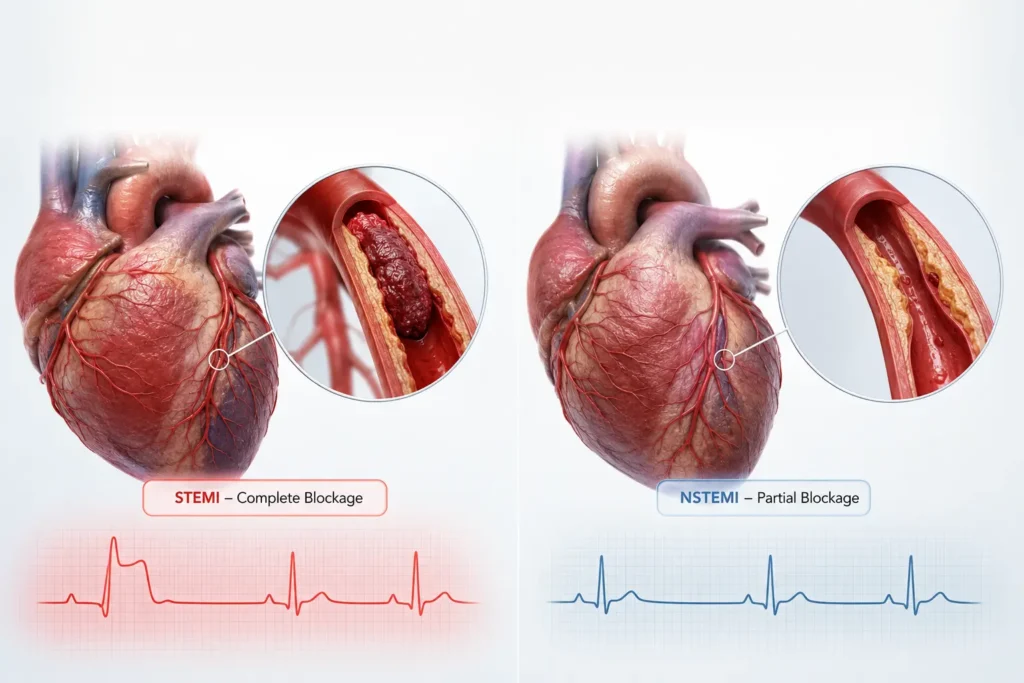
STEMI stands for ST-elevation myocardial infarction, and NSTEMI stands for non-ST-elevation myocardial infarction. Both are heart attacks. The difference in STEMI vs NSTEMI lies in the ECG: a STEMI shows persistent ST elevation, meaning a rise in part of the heart's electrical tracing that continues on the ECG, while an NSTEMI does not.
That one difference changes how fast and how doctors treat you. But both damage heart muscle, both raise a blood marker called troponin, and both are medical emergencies. Neither is a "mild" heart attack.
Quick Answer
- STEMI: Persistent ST elevation on the ECG, usually a suddenly blocked artery. Needs treatment to restore blood flow at once.
- NSTEMI: No persistent ST elevation. Diagnosed using troponin results together with symptoms and ECG findings. Treatment depends on risk.
- Symptoms: Can be the same. Doctors use the ECG, troponin and the overall clinical picture to tell them apart.
- Suspect a heart attack? Call 112 or 108 for an ambulance. Do not drive yourself.
STEMI and NSTEMI Full Form
Myocardial infarction is the medical term for a heart attack. The ST segment is one part of the wave pattern on an ECG.
- STEMI: ST-Elevation Myocardial Infarction.
- NSTEMI: Non-ST-Elevation Myocardial Infarction.
The names describe what doctors see on the ECG. They do not, on their own, tell you how blocked an artery is or how much heart muscle has been damaged.
STEMI vs NSTEMI: The Key Differences
| Feature | STEMI | NSTEMI |
|---|---|---|
| ECG | Persistent ST elevation | No persistent ST elevation |
| Troponin | Raised | Raised |
| Usual artery problem | Sudden blockage, usually from a blood clot | Varies: plaque rupture, narrowing, a temporary blockage or other causes |
| First step in hospital | Restore blood flow at once | Blood-thinning medicines and risk assessment |
| Timing of angiography | Immediately | Immediate or early, depending on risk |
| How serious | Emergency | Emergency |
Based on the 2025 ACC/AHA and 2023 ESC acute coronary syndrome guidelines.
The table shows typical patterns. Your doctor looks at the whole picture, and some heart attacks do not fit neatly into one box.
What Causes a Heart Attack?
Most heart attacks start with a slow process called atherosclerosis. Over years, fatty deposits called plaque build up inside the coronary arteries, the vessels that feed the heart muscle. This is coronary artery disease.
A heart attack usually happens when a plaque cracks and a blood clot forms on it. Blood flow to part of the heart muscle drops sharply or stops, and that muscle starts to get injured. The sooner blood flow is restored, the more muscle can be saved.
What Is STEMI?
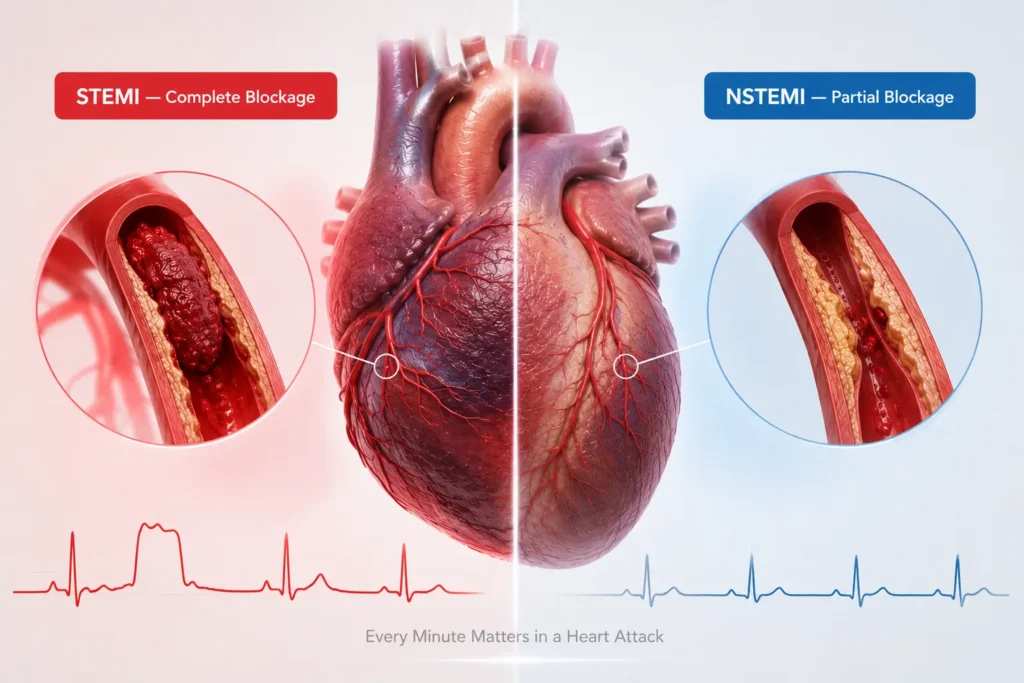
In a STEMI, the ECG shows persistent ST elevation. This usually means a coronary artery has suddenly become blocked, so blood flow to part of the heart has stopped or nearly stopped. It is treated as an emergency from the moment the ECG is seen, without waiting for blood test results.
The goal is to reopen the artery as quickly as possible, usually with emergency angioplasty (also called primary PCI), where a thin tube opens the artery and a stent keeps it open. Current guidelines use a 90-minute target for people who arrive directly at a hospital that can do angioplasty, and a 120-minute target when transfer to such a hospital is needed. If angioplasty cannot be done in time, clot-busting medicine may be given instead.
Every minute matters. In a large US study of 29,222 STEMI patients, hospital deaths rose steadily the longer people waited for angioplasty after arriving.
Faster Treatment, Better Survival in STEMI
Hospital deaths by time from arrival to angioplasty
Source: US registry study of 29,222 STEMI patients (McNamara et al., Journal of the American College of Cardiology, 2006).
What Is NSTEMI?
In an NSTEMI, heart muscle is injured but the ECG does not show persistent ST elevation. The ECG may be normal, or show other changes such as ST depression or T-wave inversion. The underlying artery problem varies. It may be a severe narrowing, a clot that blocks and unblocks, or sometimes something else.
An NSTEMI is not a mild heart attack. People with NSTEMI remain at serious risk of another heart attack, heart failure and other problems, especially without treatment. Doctors start blood-thinning medicines, such as antiplatelets and anticoagulants, and assess your risk. Very high-risk patients may need immediate angiography. Other high-risk patients usually have it during the hospital stay, often within 24 hours, depending on their condition. Depending on what the angiogram shows, the next step may be a stent, bypass surgery or medicines alone.
How Doctors Tell STEMI vs NSTEMI Apart
Diagnosis follows a clear sequence:
- Symptoms and history: what you feel, when it started and your risk factors.
- ECG within minutes: persistent ST elevation points to STEMI. Our guide to ECG test results explains what the tracing shows.
- Repeat ECGs: a normal first ECG does not rule out a heart attack, so it is often repeated.
- Troponin blood tests: a rise or fall above the test's normal range, together with signs of reduced blood flow to the heart, supports the diagnosis of a heart attack.
- Angiography when needed: dye and X-rays show where the arteries are narrowed or blocked.
Troponin is a marker of heart muscle injury. It can also rise in other conditions, which is why doctors read it together with your symptoms and ECG.
NSTEMI, Unstable Angina and the ACS Family
STEMI, NSTEMI and unstable angina together make up acute coronary syndrome (ACS). When there is no persistent ST elevation, doctors call it non-ST-elevation ACS (NSTE-ACS), which covers both NSTEMI and unstable angina.
| Condition | ECG | Troponin |
|---|---|---|
| STEMI | Persistent ST elevation | Raised |
| NSTEMI | No persistent ST elevation | Raised in a heart attack pattern |
| Unstable angina | No persistent ST elevation | No heart attack pattern |
Source: 2025 ACC/AHA acute coronary syndrome guideline.
Unstable angina is still serious. It means reduced blood flow without evidence of heart muscle death, and it can lead to a heart attack.
Symptoms: Why You Cannot Tell Them Apart
When it comes to STEMI vs NSTEMI, the symptoms can feel exactly the same. Symptoms can be mild or severe, and they may come and go. Common signs include:
- Chest pain, pressure, tightness or heaviness.
- Pain spreading to the arm, shoulder, neck, jaw or upper back.
- Breathlessness, with or without chest pain.
- Cold sweat, nausea or light-headedness.
- Sudden, unusual tiredness.
Chest discomfort is also the most common symptom in women, who more often have breathlessness, nausea or back and jaw pain as well. People with diabetes may have less obvious symptoms. Many people mistake a heart attack for gas or acidity, which costs precious time.
Get Emergency Help Now
Call 112 or 108 for an ambulance if you suspect a heart attack. Do not drive yourself. If the person becomes unresponsive and is not breathing normally, start CPR and use an AED if one is available. The emergency operator may advise aspirin, but it is not right for everyone.
Other Ways a Heart Attack Can Happen or Show Up
Silent heart attack: some heart attacks cause few or no noticeable symptoms. The American Heart Association notes they may make up as many as 45% of heart attacks. They can be dangerous because they go unnoticed, and are often found later on an ECG or other heart test.
Coronary artery spasm: a coronary artery can suddenly tighten. A short spasm causes chest pain, but a long one can injure heart muscle and cause a heart attack, even without major plaque. Smoking, stimulant drugs and severe stress can trigger it.
Type 2 heart attack: this happens when the heart's need for oxygen outstrips its supply, for example with severe anaemia, very low blood pressure or a very fast heart rate, rather than from a new clot. Treatment focuses on the underlying cause. Our guide to types of heart attack explains these in more detail.
Treatment After the Emergency
After a STEMI or NSTEMI, most people need long-term treatment to prevent another heart attack. This usually includes antiplatelet medicines, a high-intensity statin to lower cholesterol, and other heart medicines chosen for each person. Some people need a stent or bypass surgery.
Before you go home, doctors usually check how well your heart is pumping with an echocardiogram. Our ejection fraction normal range guide explains that number. A cardiac rehabilitation programme then helps you return to activity safely.
Why Speed Matters: Possible Complications
A heart attack can cause dangerous heart rhythm problems, heart failure, a sudden drop in blood pressure called cardiogenic shock, another heart attack, or cardiac arrest. Quick treatment lowers these risks, which is why a suspected heart attack always needs emergency care.
STEMI and NSTEMI in India
In the older CREATE registry of more than 20,000 patients with acute coronary syndrome in India, about 6 in 10 had a STEMI. Many patients also reached hospital late, often after first trying home remedies or waiting for the pain to settle. Knowing the warning signs, calling 112 or the 108 ambulance service early and going to a hospital that can do angioplasty can make a real difference to survival.
Can Heart Attacks Be Prevented?
Many can. The main risk factors are ones you can work on:
- Blood pressure: an important risk factor. Our age wise BP chart shows the healthy range.
- Cholesterol: high LDL cholesterol contributes to plaque buildup.
- Blood sugar: diabetes speeds up artery damage.
- Smoking: stopping lowers risk quickly.
- Weight and diet: a healthy weight and less salt, sugar and fried food all help your arteries.
- Activity: regular exercise helps, at a level that suits your health.
Ask your doctor how often to check your blood pressure, cholesterol and sugar based on your age and risk. An ECG is done when your doctor thinks it is needed, not as a routine test for everyone.
Key Takeaways
- Remember that STEMI and NSTEMI are both heart attacks and both are emergencies.
- In STEMI vs NSTEMI, remember that the ECG separates them, not the type or strength of pain.
- Call an ambulance early, because faster treatment saves heart muscle and lives.
- Keep up long-term treatment after a heart attack to prevent another.
Frequently Asked Questions
What is the full form of STEMI and NSTEMI?
STEMI stands for ST-elevation myocardial infarction, and NSTEMI stands for non-ST-elevation myocardial infarction. Both are types of heart attack.
What is the main difference in STEMI vs NSTEMI?
A STEMI shows persistent ST elevation on the ECG and usually means a suddenly blocked artery. An NSTEMI does not. Doctors use troponin results together with symptoms and ECG findings to diagnose it.
Which is more dangerous, STEMI or NSTEMI?
Both are emergencies. STEMI usually needs immediate treatment to reopen a blocked artery. NSTEMI also carries serious short and long-term risks and needs urgent hospital care.
Is troponin high in both STEMI and NSTEMI?
Yes. Troponin rises in both because heart muscle is injured. It does not rise in a heart attack pattern in unstable angina.
Can symptoms tell me if it is STEMI or NSTEMI?
No. Symptoms can be very similar, from mild pressure to severe pain. Doctors use the ECG, troponin and the overall clinical picture to tell them apart.
Can a heart attack happen without chest pain?
Yes. Some heart attacks cause only breathlessness, tiredness or no clear symptoms. These silent heart attacks are more common in older adults and people with diabetes.
Can young people have a STEMI or NSTEMI?
Yes. Heart attacks can happen at a young age, from causes such as smoking, inherited high cholesterol, stimulant drugs or coronary artery spasm.
What should I do if I think someone is having a heart attack?
Call 112 or 108 for an ambulance straight away and do not drive them yourself. If they stop responding and are not breathing normally, start CPR and use an AED if available.
References
- Rao SV, et al. 2025 ACC/AHA/ACEP/NAEMSP/SCAI guideline for the management of patients with acute coronary syndromes. Circulation, 2025.
- Byrne RA, et al. 2023 ESC guidelines for the management of acute coronary syndromes. Eur Heart J, 2023.
- Thygesen K, et al. Fourth universal definition of myocardial infarction. Circulation, 2018.
- McNamara RL, et al. Effect of door-to-balloon time on mortality in patients with STEMI. J Am Coll Cardiol, 2006.
- Xavier D, et al. Treatment and outcomes of acute coronary syndromes in India (CREATE). Lancet, 2008.
- American Heart Association. Warning signs of a heart attack.
- American Heart Association. Heart attack symptoms in women.
- American Heart Association. Silent heart attack.
Written By
Iraphan Khan, BSN, RN, D.Pharm, Public Health Researcher. Iraphan writes evidence-based patient guides that turn medical reports and research into plain language.
Medically Reviewed By
Dr Praveen Verma, MBBS, MD Pathology
Dr Himanshu Morya, MBBS, Medical Educator
First published: 13 April 2026. Updated and reviewed: 28 September 2026. Next scheduled review: March 2027.
Disclaimer: This article is for general education and does not replace advice from your own doctor, nurse or pharmacist. If you have heart attack symptoms, call emergency services immediately. Always consult a qualified doctor about your heart health.