
Gas and a heart attack can feel almost the same. The difference is in how the pain behaves.
A patient-friendly guide by RealMedVision
Medically reviewed: 31 August 2026 | Last updated: 31 August 2026 | 10 to 12 minute read
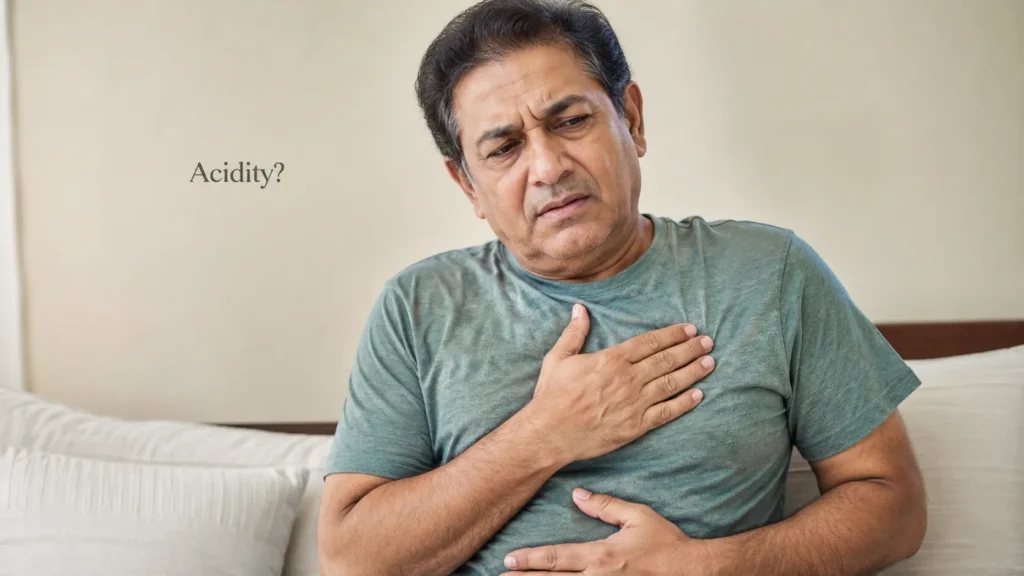
Gas Pain vs Heart Attack, Side by Side
One quick glance can help you read your own symptoms. Keep this table somewhere you can find it.
| Sign | Gas or acidity | Heart attack |
|---|---|---|
| Eases after burping or passing wind | Often yes | No |
| Improves with an antacid | Usually yes | Usually no |
| Spreads to arm, jaw, neck, or back | Rare | Common |
| Cold sweating | Rare | Common |
| Breathlessness | Rare | Common |
| Nausea with chest discomfort | Sometimes | Common |
| Lasts more than 15 minutes | Rarely | Often |
| Changes with body position or movement | Often | Usually not |
If most of your answers fall in the red column, treat it as an emergency. Call 112 or 108 straight away. Do not wait to see if it passes.
Why Gas Pain and a Heart Attack Feel So Alike
Most people picture a heart attack as something loud. Someone grabs their chest and drops to the floor. That happens, but it is only one version.
Very often it starts quietly instead. A burning feeling in the chest. A heavy, full stomach. A little nausea after a meal. It feels like something you ate, so you reach for an antacid, lie down, and wait.
There is a real reason for the mix-up. The heart, the stomach, the chest wall, the jaw, and the arms all send their pain signals along shared nerve pathways to the same part of the spinal cord. When the heart is starved of blood, the brain cannot always tell exactly where the alarm is coming from. So a blocked artery can genuinely feel like trapped gas, a burning that seems like acidity, or an upset stomach after dinner. Doctors call this referred pain.
This is not in your head. It is simple anatomy, and it is exactly why gas pain vs heart attack is one of the most dangerous mix-ups in everyday life.
The Clearest Way to Tell Them Apart
You do not need a medical degree to spot the difference. You just need to watch how the pain behaves.
Gas and acidity tend to shift around. The discomfort moves, it often eases after you burp or pass wind, and it is usually tied to what and when you ate. An antacid helps. Changing position helps. Walking it off helps.
Heart pain behaves differently. It tends to sit in the centre or left of the chest as pressure, tightness, or heaviness, rather than a sharp point. It rarely settles with an antacid or a change of position. It may ease for a moment and then return, or slowly build. And it rarely comes alone. There is usually a second clue riding along with it, such as a cold sweat, breathlessness, or pain creeping into the arm or jaw.
Here is the simplest rule to remember. Acidity gets better when you treat it like acidity. If chest discomfort ignores an antacid and rest for 15 minutes, stop assuming it is your stomach. A heart attack sits at the most serious end of a group of problems that also includes different types of heart attack, and none of them should be managed at home.
Six Signs That Point to the Heart, Not the Stomach
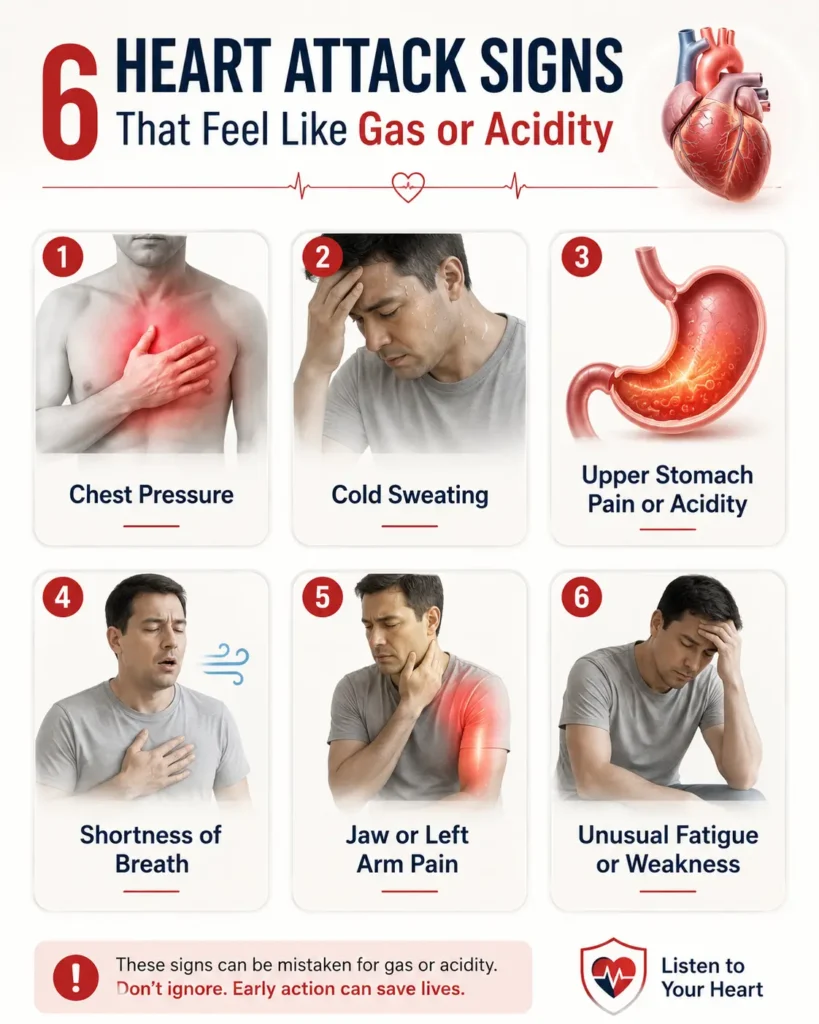
These are the exact symptoms people talk themselves out of. Learn them, because spotting even one alongside chest discomfort can change what you do next.
1. Chest pressure or burning that antacids do not fix
This is the big one. Heart discomfort often feels like pressure, heaviness, or burning rather than a sharp, stabbing pain. It can feel almost identical to heartburn, so the real tell is how it behaves.
Real acidity eases with an antacid and is clearly tied to food. Cardiac chest discomfort keeps going, comes back after a short break, or slowly worsens no matter what you take or how you sit.
2. Pain that spreads to the arm, jaw, neck, or back
Pain moving into the left arm, jaw, neck, upper back, or both shoulders is a classic heart warning. People miss it because they cannot see why an arm or jaw would hurt when the trouble is in the chest. The reason is referred pain.
The heart shares nerve pathways with those areas, so the signal shows up in the wrong place. Left arm heaviness that comes on with effort and eases with rest deserves attention. So does chest pain before 40, which is far too often waved away as gas.
3. Cold sweat with no reason
Sudden cold, clammy, damp skin when there is no heat, no fever, and no exercise is a recognised warning sign. This is not normal sweating. Normal sweat is warm, tied to heat or effort, and it stops when you cool down.
The cold sweat linked to a heart problem comes on fast, often with chest discomfort or nausea, and does not settle with rest.
4. Breathlessness during easy tasks
Feeling winded while talking, resting, or doing something that never troubled you before is a serious sign. It can show up with no chest pain at all. When the heart cannot pump well because an artery is blocked, fluid backs up into the lungs and you feel short of breath.
In cities with heavy pollution, people often blame the air or their fitness instead of their heart. New breathlessness that keeps returning can also be one of the early warning signs of heart failure, so it should never be brushed aside.
5. Nausea along with chest discomfort
The stomach and heart are close neighbours and share nerve signals. When the heart muscle is starved of oxygen, that distress can show up as nausea rather than chest pain. Feeling sick with no clear food reason, especially alongside any chest pressure or sweating, should not be brushed off as a simple stomach upset.
6. Sudden, deep tiredness
A heavy, unexplained tiredness that sleep does not fix is one of the most missed warning signs, and it can appear days or even weeks before a major event. People feel drained doing simple things. One flight of stairs leaves them puffing. Carrying groceries feels harder than it should.
Because it builds slowly and does not match what a heart attack is supposed to feel like, it often gets blamed on stress, age, or weakness, especially in women. This kind of discomfort can also overlap with early cardiomyopathy symptoms in adults, where the heart muscle weakens quietly over time.
Who Is Most Likely to Mistake It
Some people are far more likely to read these signs wrong, and that is exactly what makes the mix-up dangerous for them.
People with diabetes
Long-term diabetes can damage the nerves that carry pain, so a heart attack may feel like nothing more than mild gas-like pressure or plain tiredness. If you have diabetes, treat even small unexplained chest discomfort or new fatigue as a reason to get checked, not a reason to lie down.
Women
Instead of crushing chest pain, many women feel jaw pain, upper back discomfort, nausea, dizziness, or just a vague sense that something is badly wrong. These get labelled as anxiety or a gastric problem, and the real cause is missed. Any woman over 40 with unexplained fatigue, jaw discomfort, or ongoing nausea, especially with high blood pressure or a family history of heart disease, deserves a heart check, not just a stomach one.
Indian and South Asian adults
Acidity here is genuinely everyday. Spicy food, late dinners, skipped meals, and stress mean most adults know chest burning well, so a cardiac signal that mimics it gets waved away. On top of that, heart disease tends to strike South Asians earlier, with coronary artery disease often appearing roughly a decade sooner than in Western populations. Uncontrolled high blood pressure, diabetes, and high cholesterol that stays high despite a healthy diet are three of the biggest reasons why.
Why the First Hour Decides Everything
In heart care, the first hour or so after a heart attack begins is often called the golden hour. Treatment given early in this window can save most of the heart muscle before the damage turns permanent.
The logic is simple: the longer an artery stays blocked, the more heart muscle dies, and that muscle does not grow back. Reopen it quickly and you save the heart. Wait, and you lose more of it with every passing hour.
The two main treatments, clot-dissolving medicine and a procedure that physically reopens the blocked artery, both work best when given early, and their benefit drops sharply with delay. So acting fast on chest discomfort is not an overreaction. It is the single most useful thing a patient or a bystander can do.
And here is what cardiologists keep pointing out: the biggest delay is rarely the ambulance or the hospital. It is the time people spend at home, telling themselves it is only acidity.
When to Stop Waiting and Call for Help
Get emergency help right away if:
- ❌Chest pressure or burning lasts more than 15 minutes and does not ease with rest or an antacid.
- ❌Pain spreads to the jaw, arm, neck, shoulder, or upper back.
- ❌A cold sweat starts with no heat, exercise, or fever.
- ❌Breathlessness comes with chest discomfort, nausea, or weakness.
- ❌You feel sudden dizziness, confusion, or faintness.
- ❌The symptoms keep coming back or slowly get worse.
Call 112 or 108 in India
999 in the UK • 911 in the USA
Do not drive yourself. Do not wait to see if it passes.
Simple Habits That Lower Your Risk
Most early heart attacks can be prevented. The World Health Organization estimates that the large majority of premature heart disease comes down to risk factors you can actually manage. None of these steps are complicated. They just need consistency.
- ✓Walk for thirty minutes on most days.
- ✓Eat less salt, fried food, and packaged snacks.
- ✓Stop smoking completely. There is no safe amount for your heart.
- ✓Keep your blood pressure in a healthy range and your blood sugar under control.
- ✓Protect your sleep and find real ways to unwind.
- ✓Get regular checkups. High blood pressure and high cholesterol show no symptoms at all.
Plaque quietly building inside the arteries is the slow start of most heart attacks, so catching the numbers early is how you stay ahead of coronary artery disease.
Frequently Asked Questions
Can gas pain actually feel like a heart attack?
Yes, and it is well documented. Trapped gas in the stomach or upper gut can cause chest pressure that is genuinely hard to tell apart from heart pain. The difference is that gas pain tends to shift around, eases after burping or passing wind, and does not usually bring sweating, breathlessness, or arm pain with it.
Where is gas chest pain usually felt?
Gas pain is most often felt in the upper belly or lower chest, just below the breastbone, and it can move around as the gas shifts. Some people feel it under the ribs or even towards the back. Heart pain sits more in the centre or left of the chest as steady pressure or heaviness, and it does not travel around the way gas does. If the discomfort is fixed, heavy, and comes with sweating or breathlessness, treat it as a heart problem until a doctor says otherwise.
If an antacid helps, does that rule out a heart attack?
Not completely. Antacids usually settle true acidity, so clear relief points towards the stomach. But relief can sometimes be partial or coincidental, and a few people feel briefly better even during a heart attack. If the discomfort returns, does not fully clear, or comes with sweating, breathlessness, or arm and jaw pain, do not rely on the antacid. Get help.
How long should I wait before going to the hospital?
Do not wait longer than about 15 minutes if chest discomfort will not ease. If sweating, breathlessness, or arm or jaw pain is also there, do not wait at all. Call for help straight away, because early treatment saves far more of the heart.
How long does gas pain in the chest usually last?
Gas pain often comes and goes in short waves and usually eases within a few minutes to a couple of hours, especially after burping, passing wind, or moving about. Pain that sits steadily for more than 15 minutes, or keeps building, is less likely to be gas and should be checked, particularly if anything else feels wrong.
Is a heart attack more likely to feel like gas in people with diabetes?
Yes. Diabetes can dull the nerves that carry pain, so a heart attack may feel like only mild gas-like pressure or plain tiredness. Anyone with diabetes should treat unexplained chest discomfort or new fatigue as a reason to get checked, not something to wait out at home.
Can a young person in their 30s have a heart attack with only mild signs?
Yes. Heart attacks are being seen more often in people aged 30 to 45, especially with risk factors like high blood pressure, diabetes, smoking, or a strong family history. Being young does not protect the heart, and mild signs in a young person still need urgent checking rather than waiting.
What is a silent heart attack?
It is a heart attack that causes no clear symptoms, or signs so mild they get blamed on indigestion or fatigue. The damage to the heart is just as real. Silent heart attacks are more common in people with diabetes and in women, and are often picked up later on a routine ECG.
Related Reading
Medical Disclaimer
This article is for general education only. It is not medical advice, diagnosis, or treatment. If you or someone near you has chest pain, breathlessness, or any symptom described here, get emergency care immediately by calling 112 or 108. Do not rely on this or any online content in place of prompt professional care.
References and Sources
- American Heart Association (AHA). Heartburn or Heart Attack: When to Worry.
- World Health Organization (WHO). Cardiovascular Diseases Fact Sheet, 2021.
- ACC/AHA. Guideline for the Management of Patients With Acute Coronary Syndromes, Circulation.
- American Heart Association (AHA). Acute Myocardial Infarction in Women: A Scientific Statement, Circulation, 2016.
- Mayo Clinic. Heart Attack: Symptoms and Causes.
- Cleveland Clinic. Heart Attack (Myocardial Infarction): Symptoms and Emergency Care.
- National Heart, Lung, and Blood Institute (NHLBI), NIH. What Is a Heart Attack?
- Johns Hopkins Medicine. Heart Attack: Symptoms, Causes and Diagnosis.
- British Heart Foundation (UK). Heart Attack: Symptoms and Treatment.
- Harrison's Principles of Internal Medicine. Cardiology Sections.
Written by
Iraphan Khan, BSN, RN, D.Pharm
Founder of RealMedVision and Public Health Researcher. Registered nurse who writes evidence based health explainers using trusted medical and public health sources.
Medically reviewed by
Dr Praveen Verma, MBBS, MD (Pathology)
Dr Himanshu Morya, MBBS, Medical Educator
Last medically reviewed: 31 August 2026