
How throat infections can lead to rheumatic heart disease in children
A patient-friendly guide by RealMedVision
Medically reviewed: July 2026 · Last updated: 31 August 2026 · 10 to 12 minute read

Quick Answer
Rheumatic heart disease is permanent damage to the heart valves that can develop after rheumatic fever. Rheumatic fever is an immune reaction that can occur after a Group A strep throat infection. In children, early symptoms may include fever and joint pain, while signs of heart valve damage such as breathlessness and unusual tiredness may appear later. Prompt treatment of a confirmed Group A strep infection can help prevent rheumatic fever and rheumatic heart disease.
Most sore throats in children are harmless. But a Group A strep throat infection can sometimes trigger rheumatic fever, an immune reaction that may damage the heart valves.
The important thing for parents is knowing what to watch for after a throat infection. Fever and joint pain can be signs of rheumatic fever, while breathlessness, unusual tiredness, or a fast heartbeat can occur when the heart is affected. Early treatment of Group A strep infection can help prevent rheumatic fever and rheumatic heart disease.
What Is Rheumatic Heart Disease?
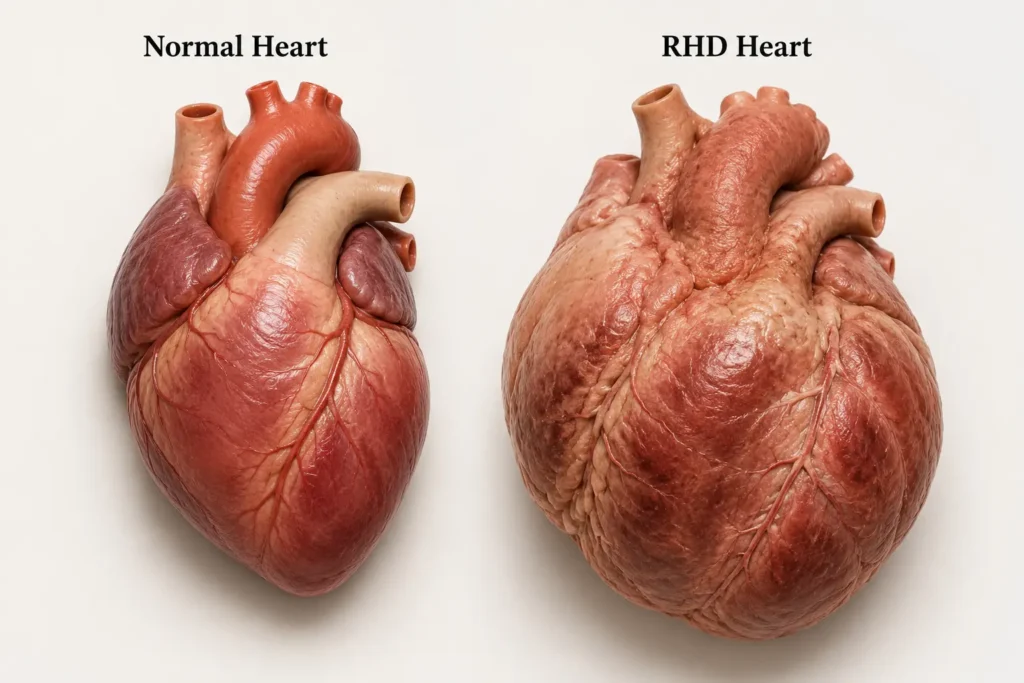
Rheumatic heart disease is permanent damage to the heart valves that can happen after rheumatic fever. Rheumatic fever can develop after a Group A strep throat infection.
Most sore throats are caused by viruses and get better on their own. But in some children, a strep infection can trigger an immune reaction that affects the heart.
Damaged valves may become stiff, narrow, or leaky. The mitral valve is affected most often. Repeated episodes of rheumatic fever can cause more damage over time.
Early treatment of a Group A strep infection can help prevent rheumatic fever and reduce the risk of rheumatic heart disease.
Why Is the Risk Higher in Children?
Rheumatic fever, the reaction that leads to rheumatic heart disease, mostly affects children and teenagers. Most cases begin between the ages of 5 and 15. A few things put this age group at higher risk:
- Frequent throat infections: school-age children are in close contact all day, so strep spreads easily.
- Crowded living conditions: tight spaces and poor hygiene help the bacteria pass from child to child.
- Incomplete treatment: a doctor may not be seen, or the antibiotic course is stopped early once the child feels better.
- Low awareness: a sore throat is often treated as trivial, so the warning window is missed.
- Limited healthcare access: in many rural areas, infections simply go untreated.
In many parts of rural India, a child's sore throat is managed with home remedies and expected to pass. Often it does. But when it is bacterial and left untreated, the damage it starts can quietly follow that child into adulthood.
Early Warning Signs After a Throat Infection
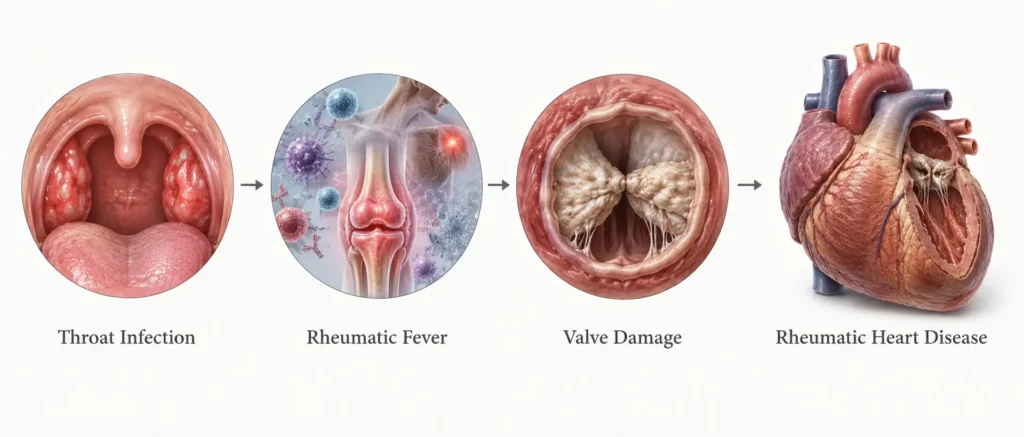
These are the signs of rheumatic fever, the reaction that can follow an untreated strep throat. They usually appear one to six weeks after the infection, and they are not always dramatic, so they are easy to miss.
- Fever that returns after the sore throat seems to have settled.
- Joint pain and swelling, often in the knees and ankles, that moves from one joint to another.
- A skin rash, flat and faint, with a wavy border.
- Unusual jerky movements (Sydenham's chorea). This one often comes later, weeks to months on, sometimes after the other signs have gone.
For parents: if your child had a sore throat in the past few weeks and now has a returning fever, joint pain, or unusual movements, see a doctor without delay. Together, these point to rheumatic fever, which needs prompt treatment.
Signs the Heart May Be Affected

If rheumatic fever goes untreated, or keeps coming back, the heart valves can start to take damage. This is the shift from rheumatic fever to rheumatic heart disease. The heart signs often show up gradually, sometimes long after the original illness, and in some children they are so mild they only appear on a scan.
- Breathlessness, especially during play or activity.
- Tiring very easily, when a child who once ran around now gets worn out quickly.
- Chest pain or discomfort.
- Swelling in the legs or ankles.
- A fast or irregular heartbeat the child or parent can feel.
If you notice these, have your child seen by a doctor. A pediatrician can assess the symptoms and refer to a heart specialist if needed. An echocardiogram, a simple ultrasound of the heart, shows how much the valves are affected and helps guide treatment. Even when damage has begun, catching it early still makes a real difference to the long-term outcome.
Rheumatic Fever vs Rheumatic Heart Disease
These two are often mixed up. One is the early reaction, the other is the long-term result.
| Rheumatic Fever | Rheumatic Heart Disease | |
|---|---|---|
| What it is | Early immune reaction after strep throat | Lasting damage to the heart valves |
| When it appears | 1 to 6 weeks after the infection | Months to years later |
| Main signs | Fever, joint pain, rash, jerky movements | Breathlessness, tiredness, heart murmur |
| Is it reversible? | Often settles with treatment | Valve damage is usually permanent |
| The goal | Treat early, prevent repeat episodes | Detect early, protect remaining valve function |
Note: Why Awareness Matters
Prevention is easier when people know the link between a strep throat and the heart. WHO supports health education, in schools, communities, and clinics, so that a bacterial sore throat is recognised and treated in time. Simple habits taught early, like handwashing and not sharing water bottles, also cut down how easily strep spreads between children.
Prevention, Complications and Outlook
Prevention works at two stages. Treating a strep throat properly stops rheumatic fever before it starts, while the heart is still healthy. If fever has already happened, regular penicillin, often a monthly injection, protects the valves from further damage.
Left untreated, scarred valves can lead to narrowing, an irregular heartbeat, or clots that travel to the brain, one reason stroke can appear in young adults. In severe cases, valve surgery may be needed.
Damage already done cannot be reversed, but it can be managed well. Caught early and kept on penicillin, most children live full, active lives. The whole point of treating early is making sure it never gets that far.
At What Age Does Rheumatic Heart Disease Occur?
Rheumatic fever usually begins between ages 5 and 15. But the heart damage it leaves behind can stay silent for years. The child feels fine, the family suspects nothing, and with each untreated infection the valve damage quietly grows. By the time signs like breathlessness or an irregular heartbeat appear, the child is often already a teenager or young adult, and the damage started long before.
Is Rheumatic Heart Disease Common in India?
Yes, more than most people realise. India carries one of the highest burdens of rheumatic heart disease in the world. The reasons are not mysterious: throat infections that go untreated, limited healthcare in rural areas, and overcrowded living conditions. The encouraging part is that awareness is growing, and ICMR and WHO-supported programmes are making a difference in high-burden districts. There is still a long way to go, but the direction is right.
When Should Parents See a Doctor?
If your child had a sore throat in the past few weeks and you now notice any of these, see a doctor the same day rather than waiting it out:
- A fever that returns after the sore throat seemed to settle.
- Joint pain or swelling, especially in the knees, ankles, or wrists.
- Unusual jerky or involuntary movements.
- Chest pain, or a heartbeat that feels fast or irregular.
- Getting breathless during play or light activity.
On their own these can seem minor, but together, soon after a throat infection, they point to rheumatic fever, which needs prompt treatment. Catching it early can still prevent lasting heart damage.
Go straight to emergency care if your child faints, struggles to breathe, or has severe chest pain. These need urgent attention, not a wait-and-watch approach.
Key Takeaways
- Rheumatic heart disease usually follows one or more episodes of rheumatic fever, which can come from an untreated strep throat.
- Treating a strep throat properly, and finishing the antibiotics, can prevent it from ever starting.
- Stopping the medicine early, once the child feels better, is a common and risky mistake.
- A child who has had rheumatic fever usually needs long-term penicillin and regular heart checks.
Frequently Asked Questions
Can a sore throat really damage a child's heart?
Yes, but not every sore throat. The risk is an untreated Group A strep infection, which can trigger rheumatic fever and, over time, damage the heart valves. Treating strep throat properly usually stops this.
What causes rheumatic heart disease?
It follows rheumatic fever, an immune reaction to an untreated strep throat. The immune system attacks the body's own tissues, including the heart valves, and repeated episodes leave lasting damage.
How long after a throat infection can rheumatic fever start?
Usually one to six weeks later. The jerky movements called Sydenham's chorea can appear even later, sometimes after other symptoms have gone. This delay is why the link is often missed.
Can rheumatic heart disease be prevented?
Largely, yes. Treating a strep throat early and finishing the antibiotics can stop rheumatic fever before it starts. If a child has already had it, regular penicillin protects the valves.
Does every child with rheumatic fever get heart disease?
No. Not every episode affects the heart. But repeated or untreated episodes make heart damage more likely, so prompt treatment and follow-up matter.
Is rheumatic heart disease curable?
Damage already done cannot be reversed, but it can be managed well. Caught early, many children live full, active lives. Severe cases may need valve surgery, but that is a last resort.
Is rheumatic heart disease contagious?
The heart disease is not. But the strep throat that can start it spreads through coughs and close contact, so handwashing and not sharing utensils help.
Is surgery always needed?
No. Most children never need it when the condition is caught early and managed with medicines. Surgery is only for severe valve damage that cannot be controlled otherwise.
Medical Disclaimer
This article is for general education only. It is not medical advice, diagnosis, or treatment. If your child has had a sore throat and now shows any warning signs described here, please see a doctor. If a child faints, struggles to breathe, or has severe chest pain, seek emergency care immediately by calling 112 or 108. Always follow the advice of a qualified doctor.
References and Sources
- World Health Organization (WHO). Rheumatic Heart Disease Fact Sheet, 2025.
- Centers for Disease Control and Prevention (CDC). Rheumatic Fever and Group A Streptococcus.
- StatPearls (NCBI). Rheumatic Heart Disease: Clinical Review.
- Indian Council of Medical Research (ICMR). Acute Rheumatic Fever: Standard Treatment Workflow.
- Jones Criteria. Guidelines for the Diagnosis of Rheumatic Fever.
- World Heart Federation. Rheumatic Heart Disease Overview.
- American College of Cardiology (ACC). Contemporary Diagnosis and Management of Rheumatic Heart Disease.
- UNICEF. Combating Rheumatic Heart Disease in Children.
- Pan American Health Organization (PAHO). Echocardiographic Screening for Rheumatic Heart Disease.
- The Lancet. Global Burden of Rheumatic Heart Disease.
Written by
Iraphan Khan, BSN, RN, D.Pharm
Founder of RealMedVision and Public Health Researcher. Registered nurse who writes evidence based health explainers using trusted medical and public health sources.
Medically reviewed by
Dr Praveen Verma, MBBS, MD (Pathology)
Dr Himanshu Morya, MBBS, Medical Educator
Last medically reviewed: 31 August 2026