
A patient-friendly guide by RealMedVision
Medically reviewed: 1 September 2026 · Last updated: 1 September 2026 · 9 to 11 minute read
Sharp chest pain that eases when you lean forward is the classic clue. Here are the early signs, and how to tell it apart from a heart attack.

In This Article
What is pericarditis · 7 symptoms · Vs heart attack · Causes · Diagnosis · Treatment · When it's an emergency · FAQs
Quick Answer
Pericarditis is inflammation of the thin sac around the heart. Its main symptom is a sharp chest pain that gets worse lying down and eases when you sit up and lean forward. It can also bring a low fever, tiredness, and breathlessness. Most cases settle with the right treatment, but chest pain always needs urgent checking to rule out a heart attack.
Most people have never heard of pericarditis until they land in an emergency room with sharp chest pain, unsure whether they are having a heart attack. It is more common than people realise, and it often follows an ordinary viral illness.
The frustrating part is that many people notice the signs days before it becomes serious, but do not know what they are looking at. Learning the pattern early can mean getting treated before complications set in.
What Is Pericarditis?
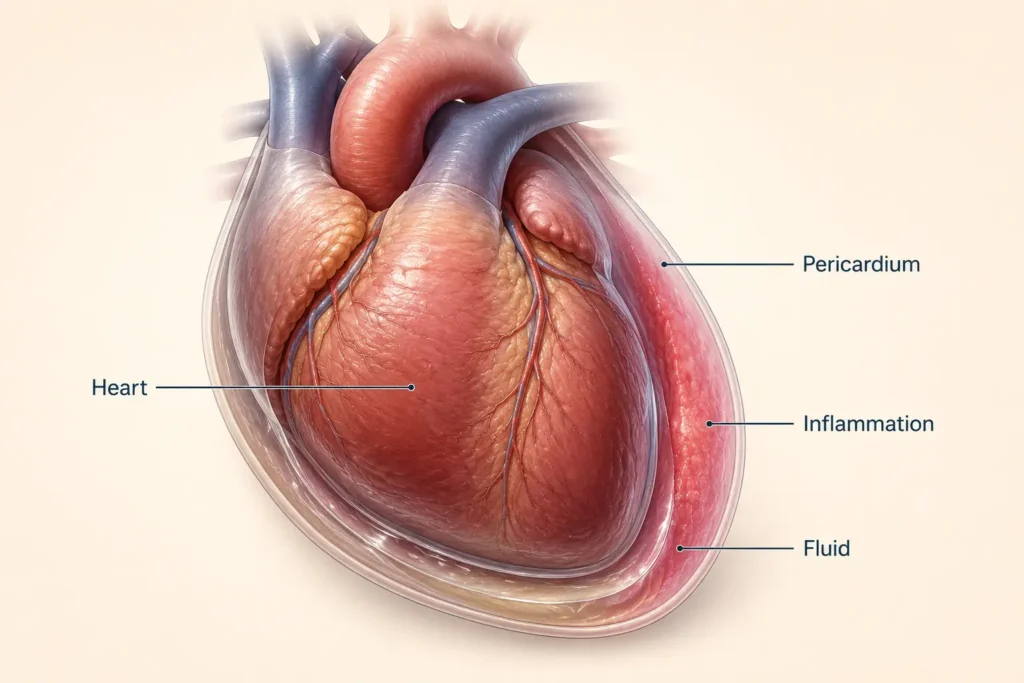
The heart sits inside a thin, two-layered sac called the pericardium, with a little fluid in between to let everything move smoothly. When that sac becomes inflamed, it is called pericarditis. When it comes on suddenly and lasts under six weeks, doctors call it acute pericarditis.
Pericarditis is a common cause of sharp chest pain, especially in younger adults. Most uncomplicated cases respond well to appropriate treatment. Getting the right diagnosis matters because untreated or recurrent pericarditis can lead to complications. If you have symptoms that fit this pattern, it is better to get checked than to wait for them to pass.
7 Symptoms of Pericarditis
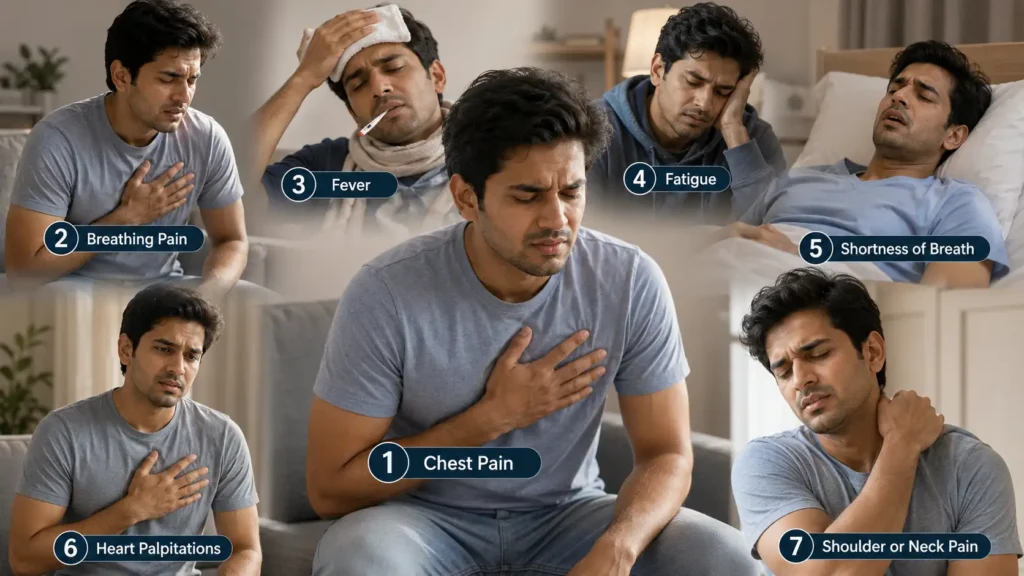
The signs often appear together, and the chest pain has a very particular pattern that sets it apart. Here is what to watch for.
1. Sharp chest pain that changes with position
This is the classic sign. The pain is sharp, usually in the centre or left of the chest, and it behaves in a telling way: it gets worse when you lie flat and eases when you sit up and lean forward. Many people notice it most at night. This positional pattern is the strongest clue that it is pericarditis rather than ordinary muscle pain or reflux.
2. Pain that worsens when you breathe in deeply
Chest pain that sharpens with a deep breath or a cough is called pleuritic pain. It is easy to blame on a pulled muscle, but when it turns up alongside tiredness and a recent cold or flu, pericarditis is worth considering.
3. A low-grade fever
A mild fever is common in the early stage and often gets blamed on a lingering cold. On its own it means little, but a low fever together with any chest discomfort is a combination worth taking seriously.
4. Unusual tiredness and weakness
A deep tiredness that does not lift with rest is something many people recall afterwards. At the time, it is easy to write off as normal recovery from a viral illness. If you still feel drained weeks later, especially with any chest discomfort, it is worth getting checked.
5. Breathlessness, often worse lying down
Some people feel short of breath, particularly when lying flat, and find themselves reaching for an extra pillow. It is often mistaken for anxiety or reflux, but breathlessness that is clearly worse lying down deserves attention.
6. Heart palpitations
A racing, skipping, or fluttering heartbeat can occur, and is often dismissed as stress or too much caffeine. Because it is a change in the heart's rhythm, an ECG is often used to check it. If it comes with chest pain or fever, it should be looked at rather than ignored.
7. Pain spreading to the shoulder or neck
The pain can travel up to the left shoulder or neck, which is exactly why it is so often mistaken for a heart attack, and why it needs to be ruled out urgently. Chest pain that spreads to the shoulder or neck should always be assessed straight away.
Pericarditis vs Heart Attack
The symptoms overlap enough that even doctors do not tell them apart on story alone. The pattern below can offer clues, but it cannot safely diagnose the cause at home, which is why any serious chest pain needs urgent, in-person assessment.
| Pericarditis | Heart attack | |
|---|---|---|
| Type of pain | Sharp, stabbing | Often heavy pressure or tightness |
| Changes with position | Yes, worse lying down, better leaning forward | Usually not |
| Changes with breathing | Often worse with a deep breath | Usually not |
| Other signs | Low fever, recent viral illness | Sweating, nausea, arm pain |
Doctors sort it out quickly with tests. An ECG and blood tests together, along with the clinical picture, usually point to the answer. Never try to make this call yourself. If in doubt, treat it as an emergency.
What Causes Pericarditis, and Who Is at Risk?
Most often a viral infection is behind it, the same kind of bug that causes a bad cold or flu can inflame the sac around the heart. Other causes include autoimmune conditions such as lupus and rheumatoid arthritis, bacterial infections including tuberculosis, recent heart surgery or a heart attack, some medicines, kidney failure, and COVID-19. In a large share of cases no specific cause is ever found, which doctors call idiopathic pericarditis.
It affects younger adults most, and men slightly more than women. Anyone who has recently had a viral illness, a chest injury, or a heart procedure is more likely to develop it, and should pay attention to any chest pain or breathlessness that follows.
How Is Pericarditis Diagnosed?
No single test confirms pericarditis on its own. Doctors put together the history, an examination, and a few tests to reach the diagnosis, and to rule out other causes of chest pain.
An ECG is usually first, and can show a characteristic pattern of widespread changes. It also helps compare against a heart attack, though on its own it cannot completely rule one out. Blood tests check inflammation markers such as CRP, and troponin to see whether the heart muscle is involved. An echocardiogram looks for fluid around the heart, and a chest X-ray helps rule out other problems. For complex or unclear cases, current 2025 ACC and ESC guidance supports cardiac MRI, which can show active inflammation directly.
How Is Pericarditis Treated?

For most people the treatment is straightforward, and the 2025 ACC and ESC guidelines broadly agree on it. The usual approach combines an anti-inflammatory medicine (such as ibuprofen or aspirin) with a second medicine called colchicine, which lowers the chance of it coming back. Most people start feeling better within days. Colchicine is usually continued for a few months even after symptoms settle, because stopping too early is a common reason pericarditis returns.
Rest matters too. Doctors generally advise avoiding intense exercise for at least a month, since exertion too soon can restart the inflammation. When standard treatment does not work and the problem keeps returning, newer medicines that target the specific protein driving the inflammation, called anti-IL-1 agents (such as rilonacept and anakinra), are now recommended for these harder, recurrent cases, and are often preferred over steroids.
Note: the exact medicines, doses, and stomach-protecting steps are decisions for your own doctor, based on your health and other conditions. Never start, stop, or change these medicines on your own.
Complications and When It's an Emergency
Most cases settle without trouble, but leaving it untreated, or stopping treatment early, raises the risk of it returning or of fluid building up around the heart. Rarely, that fluid can build up fast enough to squeeze the heart, an emergency called cardiac tamponade. Over the long term, ongoing scarring can occasionally lead to constrictive pericarditis, which is more likely after bacterial or TB-related cases.
Go to emergency care immediately if chest pain comes with severe breathlessness, fainting or dizziness, a very fast or irregular heartbeat, or swelling in the neck veins. Call your local emergency number (108 or 112 in India, 999 in the UK, 911 in the US). Any severe or new chest pain should be treated as a possible heart attack until a doctor says otherwise.
Key Takeaways
- Pericarditis is inflammation of the sac around the heart, most often after a viral illness.
- Its hallmark is sharp chest pain that worsens lying down and eases leaning forward.
- It can mimic a heart attack, so chest pain always needs urgent, in-person checking.
- Most people recover fully; finishing the full course of treatment prevents it returning.
Frequently Asked Questions
What are the first signs of pericarditis?
Usually a sharp chest pain that worsens lying down and eases when you sit forward, often with a low fever and tiredness after a recent cold or flu. The positional pain is the strongest early clue.
Does pericarditis chest pain get worse lying down?
Yes, that is one of its most typical features. The pain often worsens when you lie flat and eases when you sit up and lean forward. This pattern helps tell it apart from many other causes of chest pain.
How is pericarditis different from a heart attack?
Pericarditis pain is usually sharp and changes with position and breathing, while heart attack pain is more often heavy pressure that does not change with position. But the two can overlap, so only tests can safely tell them apart. Treat any serious chest pain as an emergency.
Can pericarditis go away on its own?
Mild cases sometimes settle, but pericarditis should still be assessed and treated, because proper treatment eases symptoms and lowers the chance of it returning or of complications. It is not something to simply wait out.
Can you have pericarditis without chest pain?
Yes, though it is less common. In some cases, especially chronic or autoimmune-related ones, the main signs may be tiredness, mild breathlessness, or a low fever rather than clear chest pain. This is part of why it can be missed.
Is pericarditis linked to COVID-19?
A COVID-19 infection can occasionally trigger pericarditis, and in rare cases it has been reported after COVID-19 vaccination, where the overall benefit of vaccination still outweighs this small risk. If you have had either recently and now have chest pain or fever, mention it to your doctor.
How long does pericarditis take to heal?
Many people improve within a few weeks with treatment, though the medicines are often continued longer to prevent it returning. Recovery is usually fullest when the whole course is completed rather than stopped early.
Medical Disclaimer
This article is for general education only. It is not medical advice, diagnosis, or treatment. If you have chest pain, breathlessness, or any symptom described here, please see a doctor. For severe chest pain, fainting, or sudden breathlessness, seek emergency care immediately by calling your local emergency number (108 or 112 in India, 999 in the UK, 911 in the US). Never start, stop, or change any medicine without your doctor's advice.
References and Sources
- American College of Cardiology. 2025 Concise Clinical Guidance on the Diagnosis and Management of Pericarditis, JACC.
- Cleveland Clinic. Pericarditis: Symptoms, Causes and Treatment.
- Mayo Clinic. Pericarditis: Symptoms and Causes.
- American Heart Association (AHA). Symptoms and Diagnosis of Pericarditis.
- StatPearls (NCBI). Acute Pericarditis.
- NHS UK. Pericarditis.
- Johns Hopkins Medicine. Pericarditis.
Written by
Iraphan Khan, BSN, RN, D.Pharm
Founder of RealMedVision and a Public Health Researcher who creates evidence-based health content from trusted medical sources.
Medically reviewed by
Dr Praveen Verma, MBBS, MD (Pathology)
Dr Himanshu Morya, MBBS, Medical Educator
Last medically reviewed: 1 September 2026