
A patient-friendly guide by RealMedVision
Medically reviewed: 1 September 2026 · Last updated: 1 September 2026 · 10 to 12 minute read
Breathless on stairs for weeks with no clear reason? It can start quietly, and normal arm blood pressure does not rule it out.
In This Article
What is it · 7 early signs · Why it's missed in India · WHO groups · Diagnosis · Treatment · When it's urgent · FAQs
Quick Answer
The earliest sign of pulmonary hypertension is usually breathlessness on activity that slowly gets worse over weeks, with no clear reason. Other early signs are unusual tiredness, dizziness on exertion, and swelling in the legs. Importantly, arm blood pressure can be completely normal, because this is high pressure inside the lung arteries, not the body's main arteries. An echocardiogram is the key first test.
Consider a common scenario: someone in their late thirties gets breathless on stairs for months. One doctor suspects anaemia, another suggests anxiety, someone says they just need more exercise. The blood tests are normal, the thyroid is normal, even the arm blood pressure looks fine. But nobody has done an echocardiogram.
This pattern is common with pulmonary hypertension. Because the early signs are vague and overlap with everyday problems, many people move between explanations for months before the heart and lungs are properly checked. Knowing what to look for, and what test to ask for, can save a lot of that lost time.
What Is Pulmonary Hypertension?
Most people think of blood pressure as the reading taken on the arm. But there is a second pressure system inside the lungs. The pulmonary arteries carry blood from the right side of the heart into the lungs to pick up oxygen. When the pressure inside these vessels becomes too high, it is called pulmonary hypertension.
Here is the part that surprises people most: you can have a perfectly normal arm blood pressure and still have dangerously high pressure inside the lungs. They are two separate systems, and a normal arm reading does not rule this out. Over time the raised pressure strains the right side of the heart, which has to push harder and harder, and can slowly weaken. This is why catching it early, before the right heart is damaged, matters so much.
7 Early Signs of Pulmonary Hypertension
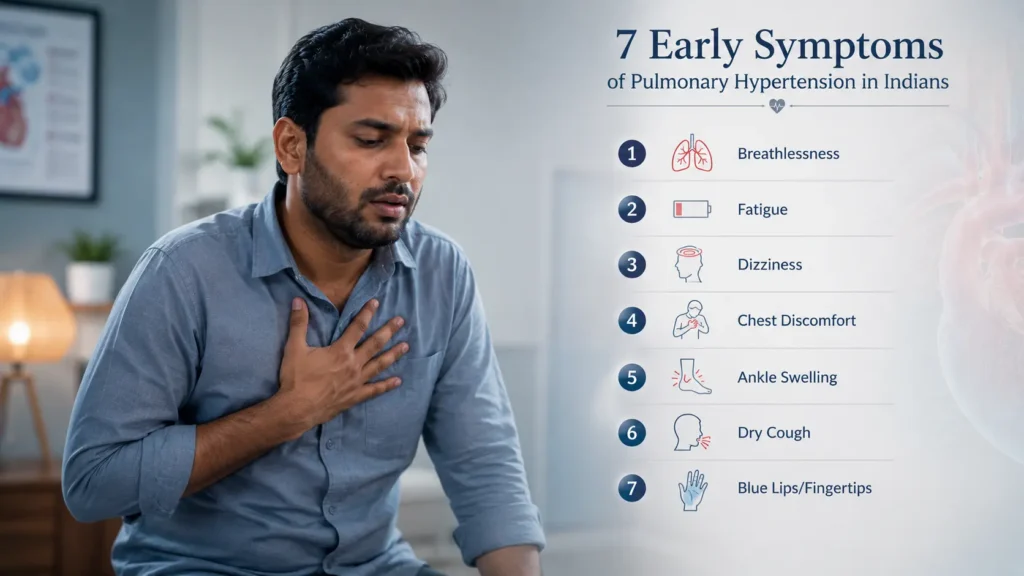
The signs build slowly, which is exactly why they get brushed aside. Here is what to watch for.
1. Breathlessness that keeps getting worse
Usually the first sign. Not dramatic, just more winded than before on stairs, walking quickly, or carrying something. It is easy to blame on being out of shape. The difference is that this breathlessness does not improve with gentle activity, it slowly keeps worsening over weeks with no clear reason. Breathlessness that steadily builds over four to eight weeks deserves an echocardiogram, not reassurance.
2. Deep tiredness that rest does not fix
Not the tiredness of a long day, something heavier that is there in the morning and still there after a weekend of sleep. When the body's tissues run short of oxygen, everything feels like more effort. In women especially, this often gets blamed on anaemia, thyroid, or stress, and the search stops at a normal blood count instead of looking at the heart and lungs.
3. Dizziness during activity
Lightheadedness while climbing stairs or walking, and sometimes actual fainting. When the heart cannot raise its output enough to meet the body's demand during effort, the brain briefly gets less blood. One episode of unexplained fainting during activity is a reason to see a cardiologist within days, not weeks.
4. Chest discomfort on exertion
Often not obvious pain, more a dull tightness or heaviness during activity that eases with rest. Because it is not crushing or sudden, it gets written off as gas or muscle tension, sometimes for years. Any chest discomfort that reliably comes with activity and settles with rest needs a heart check.
5. Swelling in the ankles and legs
Puffiness in the lower legs and ankles, usually worse by evening, that leaves a small dent when pressed. When the right heart cannot push blood forward well, fluid backs up into the lowest parts of the body first. Heat and long standing cause this too, so the real concern is swelling that keeps returning, especially with breathlessness or fatigue.
6. A dry cough with no obvious cause
No fever, no cold, no allergy, just a persistent dry cough that has lasted weeks and does not respond to the usual treatments. Raised lung pressure can cause mild congestion in the lung tissue that triggers a cough. Many people spend months on cough syrups before anyone looks at the heart and lungs.
7. Bluish lips or fingertips
A bluish or greyish tinge to the lips, fingernails, or fingertips means the blood is carrying less oxygen than it should. This one usually appears later than the others, but even when mild, it is a reason for same-day medical attention, not next week.
Why It Is Often Missed, Especially in India
Several things line up to delay the diagnosis. The early signs look just like far more common problems, so those get investigated first:
- It mimics asthma, anaemia, and anxiety, which are checked first. When those come back normal, many people are not investigated further.
- Air pollution is a real factor. Long-term exposure to fine particulate pollution can damage the lung's blood vessels over time.
- Untreated sleep apnoea, where oxygen drops repeatedly during sleep, slowly raises lung pressure.
- Rheumatic heart disease is still common in India and can damage heart valves, raising lung pressure over time.
- Unrepaired congenital heart disease is a leading cause in younger patients where early heart care was limited.
The single most useful thing you can do is ask directly: "Can I have an echocardiogram to check my pulmonary artery pressure?" It is the test that most often gets skipped.
The Five Types (WHO Groups)
Pulmonary hypertension is not one disease. It develops for different reasons, and the World Health Organization sorts it into five groups. Getting the group right matters, because the treatment for one can be wrong, even harmful, for another.
| Group | Main cause | Notes |
|---|---|---|
| Group 1 (PAH) | Lung artery wall disease | Rarer; has the most targeted drugs |
| Group 2 | Left heart or valve disease | Very common |
| Group 3 | COPD, lung disease, sleep apnoea | Very common |
| Group 4 (CTEPH) | Old blood clots in the lungs | Surgery can sometimes cure it |
| Group 5 | Kidney disease, sarcoidosis, others | Mixed or unclear mechanisms |
Why this matters: Groups 2 and 3 are the most common. Group 4 is the one where surgery can sometimes fully cure it. The targeted drugs used in Group 1 can be harmful if given for the wrong group, which is why getting the diagnosis exact is not just a formality.
How Is It Diagnosed?
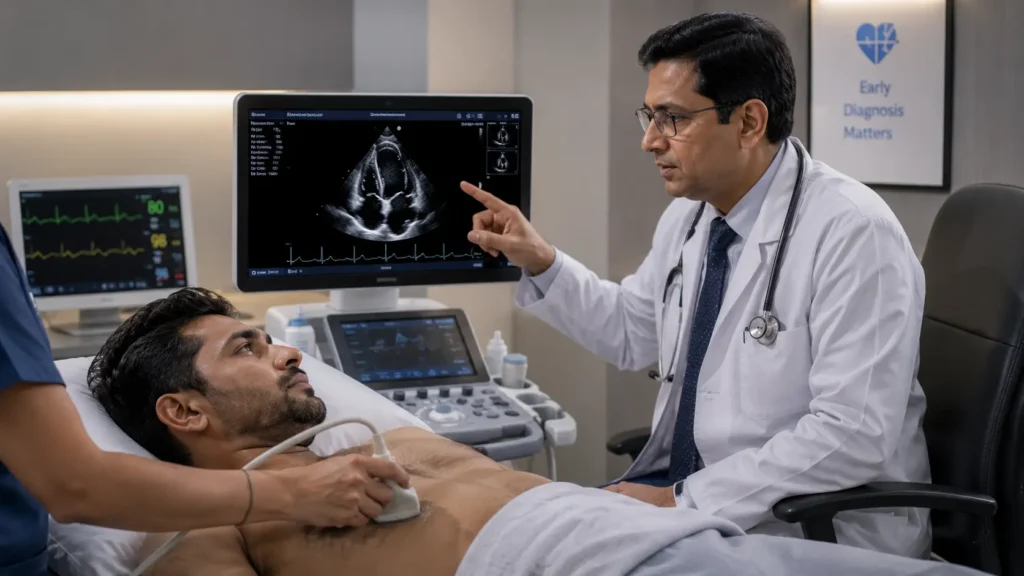
An echocardiogram (2D echo) is the essential first step. It estimates the pressure in the lung arteries and shows the size and function of the right side of the heart. It is painless, uses no radiation, and takes under 30 minutes. This is the test everyone with unexplained breathlessness should have.
If the echo suggests raised pressure, right heart catheterisation is the gold standard, a thin tube guided through a vein to measure the lung artery pressure directly. It is needed before starting targeted treatment. An ECG can show right heart strain but may look normal early on. A CT scan of the lung arteries is used when old blood clots are suspected, and tests like a six-minute walk, blood tests, and lung function tests help judge severity and find the cause.
How Is It Treated?
Treatment depends entirely on the group and the severity, which is why the diagnosis has to be exact first. Group 1 has the most specific medicines, drugs that relax and widen the lung arteries, and doctors often combine more than one. For Groups 2 and 3, the focus is on treating the underlying cause, such as heart failure care, valve repair, CPAP for sleep apnoea, or oxygen for lung disease. Group 4, caused by old clots, is the one where surgery to remove the clots can sometimes dramatically improve things or even cure it.
Important: the specific medicines for pulmonary hypertension are powerful and are chosen by a specialist for your exact type. They can cause harm if used for the wrong group. Never start, stop, or source these medicines on your own; they must be prescribed and monitored by a doctor.
Alongside medicines, a few everyday steps genuinely help: keeping salt low to reduce fluid buildup, gentle walking within comfortable limits, stopping all tobacco, using CPAP every night if sleep apnoea is diagnosed, and avoiding high altitude without medical clearance. Weighing yourself daily is useful too, since a gain of a kilo or more in a day often means fluid is building up and the doctor should be told.
When to See a Doctor, and When It's Urgent
See a doctor if breathlessness has been worsening for more than a few weeks, tiredness does not lift with rest, leg swelling keeps returning, or you feel dizzy during activity. A family history of pulmonary hypertension is also worth mentioning, as some forms can run in families.
Go to emergency care immediately if you have:
- Severe breathlessness, especially at rest
- Fainting, or feeling close to it, during activity
- Chest pain that does not settle with rest
- Bluish lips or fingertips
- Rapid swelling of the legs or belly over a few days
Call your local emergency number (108 or 112 in India, 999 in the UK, 911 in the US).
Key Takeaways
- The earliest sign is usually breathlessness on activity that slowly worsens over weeks.
- Normal arm blood pressure does not rule it out; the lungs are a separate pressure system.
- It is often mistaken for asthma, anaemia, or anxiety, which delays the diagnosis.
- An echocardiogram is the key first test; ask for it if breathlessness is unexplained.
Frequently Asked Questions
What are the first signs of pulmonary hypertension?
Usually breathlessness on activity that slowly gets worse over weeks, along with unusual tiredness. Dizziness on exertion and leg swelling can follow. The signs are vague early on, which is why the condition is often missed at first.
Can you have pulmonary hypertension with normal blood pressure?
Yes. Arm blood pressure and lung artery pressure are two separate systems. You can have a completely normal arm reading and still have high pressure in the lungs, which is why it needs a specific test, an echocardiogram, to detect.
Is pulmonary hypertension the same as high blood pressure?
No. Ordinary high blood pressure affects the body's main arteries. Pulmonary hypertension affects only the arteries in the lungs. They have different causes, different tests, and different treatments.
Is pulmonary hypertension often mistaken for asthma?
Frequently, because both cause breathlessness and a dry cough. The difference is that asthma usually improves with inhalers and has clear triggers, while pulmonary hypertension tends to keep worsening despite treatment. If breathlessness is not fully explained by asthma, the heart and lungs should be checked.
Can young adults get pulmonary hypertension?
Yes. One type, pulmonary arterial hypertension, most often affects women between about 20 and 50. Unrepaired congenital heart disease is another cause in younger people. Being young does not rule it out, and in a young adult with unexplained breathlessness it can actually be missed for longer.
Is pulmonary hypertension curable?
One type, Group 4 caused by old blood clots, can sometimes be cured with surgery. Sometimes treating an underlying cause like sleep apnoea also helps greatly. Most other types are not cured but are managed long-term, and many people live active lives for years with the right treatment.
Which test confirms pulmonary hypertension?
An echocardiogram is the key first screening test. Right heart catheterisation, which measures the pressure directly, is the gold standard and is needed before treatment decisions are made. Both are usually done before starting targeted therapy.
Does air pollution cause pulmonary hypertension?
Long-term exposure to high particulate pollution, common in many Indian cities, can damage the lung's blood vessels over time and add to the risk. It is not the only cause, but it is a real contributing factor for people in polluted urban areas.
Medical Disclaimer
This article is for general education only. It is not medical advice, diagnosis, or treatment. If you have worsening breathlessness, swelling, or any symptom described here, please see a doctor. For severe breathlessness, fainting, chest pain, or bluish lips, seek emergency care immediately by calling your local emergency number (108 or 112 in India, 999 in the UK, 911 in the US). Never start, stop, or change any medicine without your doctor's advice.
References and Sources
- Cleveland Clinic. Pulmonary Hypertension: Symptoms and Treatment.
- Mayo Clinic. Pulmonary Hypertension: Symptoms and Causes.
- Centers for Disease Control and Prevention (CDC). About Pulmonary Hypertension.
- ESC/ERS. 2022 Guidelines for the Diagnosis and Treatment of Pulmonary Hypertension.
- American Lung Association. Pulmonary Arterial Hypertension Symptoms and Diagnosis.
- NIH MedlinePlus. Pulmonary Hypertension.
- NHS UK. Pulmonary Hypertension.
Written by
Iraphan Khan, BSN, RN, D.Pharm
Founder of RealMedVision and a Public Health Researcher who creates evidence-based health content from trusted medical sources.
Medically reviewed by
Dr Praveen Verma, MBBS, MD (Pathology)
Dr Himanshu Morya, MBBS, Medical Educator
Last medically reviewed: 1 September 2026