
Medically reviewed: 10 September 2026 · Last updated: 10 September 2026
The first signs of heart failure are easy to miss. Here is what to watch for, and when to see a doctor.
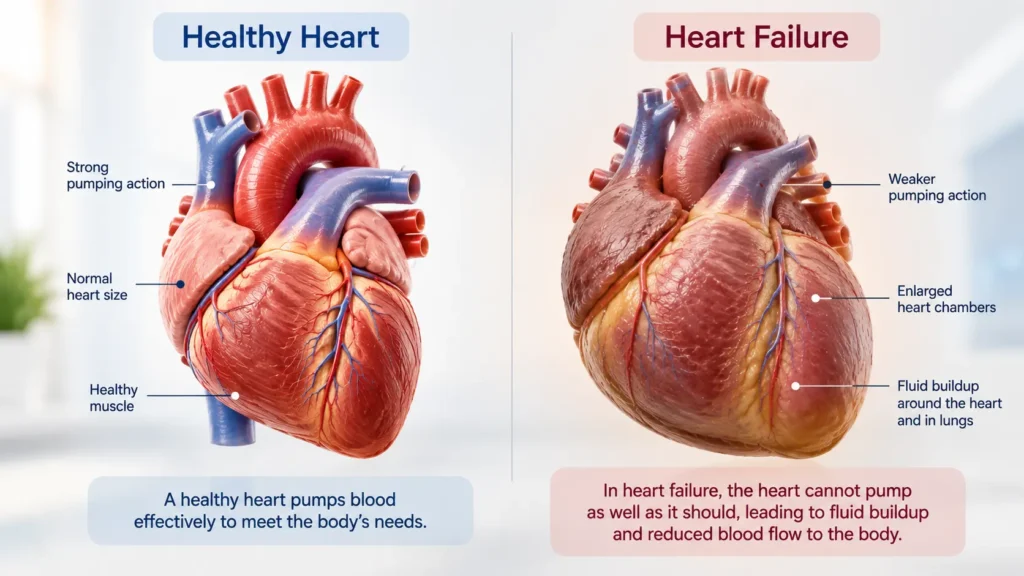
Heart failure rarely starts with one dramatic moment. More often, the stairs get harder, your shoes feel tight by evening, or a cough keeps coming back at night.
This guide explains the early signs of heart failure in adults, which symptoms need prompt attention, and how doctors confirm what is going on.
Quick Answer
- Heart failure means the heart cannot pump or fill with blood as well as it should. It does not mean the heart has stopped.1
- Common early symptoms include breathlessness during everyday activity, tiredness that does not improve with rest, and swelling in the ankles or legs.2
- Breathlessness when lying flat, or waking up gasping for air, can occur with heart failure and should be discussed with a doctor.2
- Blood tests, an ECG and an echocardiogram help doctors judge whether heart failure is likely and work out its type and possible cause.1
How quickly to act
Book a check-up
New breathlessness with daily tasks, tiredness that lingers, or mild ankle swelling.
Call your doctor today
Weight up by about 1 kg in a day or more than 2 kg in a week, swelling getting worse, or needing extra pillows to breathe.
Call emergency help now
Chest pain, severe breathlessness at rest, fainting, or sudden confusion. Call your local emergency number.
Based on the American Heart Association symptom tracker.3 Your doctor may give you different limits.
What Is Heart Failure?
In simple terms, heart failure means the heart muscle cannot pump or fill with blood as well as the body needs. You may also hear it called congestive heart failure, because fluid can back up into the lungs and legs.1
It can happen in two main ways. Sometimes the muscle is weak and pumps out less blood with each beat. Other times the heart pumps normally but is stiff and does not fill well.1 Doctors measure this with a number called the ejection fraction. Our guide to the normal ejection fraction range explains what those figures mean.
Early Signs of Heart Failure in Adults
These are the symptoms doctors see most often in the early stages. Each one can have many other causes. What matters is a new pattern, or several of them appearing together.2
Breathlessness During Everyday Activity
Stairs, a short walk to the market or carrying shopping start to leave you out of breath, when they did not before. This happens because fluid backs up into the lungs when the heart cannot keep up.2 It is easy to blame new breathlessness on age, weight or being out of shape.
Tiredness That Does Not Improve With Rest
Everyday tasks feel heavier, and you take longer to recover after any effort. Doctors call this reduced exercise tolerance.2 Tiredness has many causes, so it matters most when it comes with breathlessness or swelling.
Swelling in the Ankles, Legs or Belly
Fluid collects in the lower body, so the ankles and legs look puffy, often worse by evening. If you press the swollen skin and a dent stays for a few seconds, mention it to your doctor. Some people notice a bloated belly or tighter clothes instead.2
Quick Weight Gain From Fluid
A quick rise in weight can be a sign that the body is holding fluid. Weighing yourself each morning, after using the toilet and before breakfast, makes this easy to spot. Some heart failure care plans treat a gain of about 1 kg in a day or more than 2 kg in a week as a trigger to call the clinic, but your doctor may set a personal limit for you.3
A Cough or Wheeze That Keeps Coming Back
A dry cough or wheeze that is worse at night, with no cold or infection behind it, can come from fluid in the lungs.2
Symptoms That Need Prompt Attention
Some symptoms point more strongly to heart failure than others. These deserve a call to your doctor soon, rather than waiting for a routine visit.2
Breathlessness When Lying Flat
You need two or three pillows to breathe comfortably, or you end up sleeping in a chair. Lying down sends more blood back towards the heart and lungs, and a struggling heart cannot handle the extra load.
Waking Up Gasping for Air
Waking an hour or two after falling asleep, short of breath and needing to sit up or stand, is called paroxysmal nocturnal dyspnoea. It can occur with heart failure, especially when it keeps happening.2
A Fast or Irregular Heartbeat
A heart that races or flutters at rest can be a sign of atrial fibrillation, an irregular rhythm that often occurs alongside heart failure.1 An ECG can show what the rhythm is doing.
Heart Failure Symptoms in Women and Younger Adults
Women usually notice the same main symptoms as men: breathlessness, tiredness and swelling. Heart failure with preserved ejection fraction, where the heart pumps normally but is stiff, is also common among women.1 Vaguer symptoms such as tiredness or a poor appetite are easy to put down to a busy life.
Younger adults can get heart failure too. Common reasons include inherited heart muscle disease, viral inflammation of the heart (myocarditis), heart problems present from birth, heavy alcohol use or certain drugs that can harm the heart, and a rare weakness of the heart linked to pregnancy.1 Unexplained breathlessness and swelling in a young person deserve a proper heart check, not just rest.
Normal Tiredness vs Heart Failure Warning Signs
The early signs of heart failure in adults often look like everyday tiredness. The difference usually lies in the pattern, and the table below shows what to look for.
Table 1. Common Symptom Patterns and When to Get Checked
| Symptom | Common pattern | When to get it checked |
|---|---|---|
| Breathlessness | After hard exercise, settles quickly | With light activity, or when lying flat |
| Tiredness | Improves after rest or a good night's sleep | Lasts for weeks and limits daily tasks |
| Ankle swelling | After a long trip or standing, often improves with rest | Both ankles, most days, slowly getting worse |
| Cough | With a cold, clears within two or three weeks | Dry, worse at night, no infection behind it |
| Weight | Changes slowly over months | Rises by about 1 kg in a day or more than 2 kg in a week |
What Causes Heart Failure?
Heart and blood vessel diseases remain the leading cause of death worldwide, with an estimated 19.8 million deaths in 2022.7 Many of these conditions strain or damage the heart over years and can lead to heart failure.1
In India's national registry of 10,851 patients, coronary artery disease was behind about 72% of heart failure cases, followed by dilated cardiomyopathy at 18%. Patients were on average about 60 years old, younger than in most Western studies.4
Table 2. Common Causes of Heart Failure
| Cause | How it affects the heart |
|---|---|
| Coronary artery disease or a past heart attack | Narrowed arteries or scar tissue weaken the heart muscle. Learn how the two main types of heart attack differ. |
| Long-standing high blood pressure | The heart works harder for years and becomes thick or stiff. Aim to keep your blood pressure in a healthy range. |
| Diabetes | Raises the risk of artery disease and can affect the heart muscle directly. |
| Cardiomyopathy or myocarditis | The heart muscle itself is weakened, sometimes from an inherited cause or a viral infection. |
| Heart valve disease | A narrow or leaking valve makes the heart work harder. One cause is rheumatic heart disease after a throat infection. |
| Heavy alcohol use, some cancer treatments, or a fast rhythm left untreated | Each can weaken the heart muscle over time. |
High cholesterol, smoking, obesity, older age and a family history of heart disease raise the risk further.1
How Doctors Check for Heart Failure
Diagnosis starts with your symptoms and an examination. The doctor listens to your lungs, checks for swelling and looks at the veins in your neck.2 Doctors commonly use these tests as part of the assessment:1,2
- A blood test for BNP or NT-proBNP, proteins the heart releases when it is under strain. A normal result can make heart failure less likely, while a raised result needs to be read alongside your symptoms and other conditions, because kidney disease, atrial fibrillation and older age can also push it up.2
- An ECG, to look at the heart's rhythm and signs of past damage.
- An echocardiogram (2D echo), which shows how well the heart pumps and fills and measures the ejection fraction. Our guide on what an EF of 60% means explains how to read the report.
A chest X-ray may also be done to look for fluid in the lungs.
What Happens After Diagnosis
Treatment depends on the type of heart failure and its cause. For reduced EF, current guidelines use four main groups of medicines, often with water tablets (diuretics) to clear extra fluid. Your cardiologist chooses the medicines and doses.1
For preserved EF, treatment focuses on controlling fluid, blood pressure and other conditions such as diabetes, and some of the same newer medicines may be used.1
Outlook differs a lot from one person to another. A large UK study found that roughly one in two people were still alive five years after diagnosis, and age, the cause and other illnesses made a big difference.5
Daily habits help too. Weigh yourself each morning, stay as active as your doctor advises, and avoid smoking and heavy drinking. Doctors often suggest cutting down on salt, although a large trial found that a very strict low-salt diet did not reduce hospital visits or deaths.6 Ask how much is right for you.
Keep in Mind: Some heart failure medicines raise potassium levels. Check with your doctor before using potassium-rich drinks such as coconut water, or salt substitutes.
When to Get Emergency Help
Call your local emergency number straight away if you have
- chest pain or pressure, especially with sweating, nausea, or pain spreading to the arm, jaw or back
- severe breathlessness at rest, or breathlessness that is getting worse quickly
- fainting, sudden confusion or severe dizziness
- a racing or irregular heartbeat with dizziness or chest discomfort
Do not wait to see whether these settle on their own. Heart attack pain is not always dramatic, and some people mistake it for gas or acidity.
Key Takeaways
- Breathlessness with light activity, lasting tiredness and ankle swelling are common early signs.
- Needing extra pillows to breathe, or waking up gasping, calls for a doctor soon.
- If you are at risk, weigh yourself every morning and report quick gains.
- Blood tests, an ECG and an echocardiogram help doctors judge whether heart failure is likely and find its type and cause.
- Keeping blood pressure, diabetes and cholesterol under control lowers your risk over time, so review these with your doctor.
Frequently Asked Questions
What Does the Beginning of Heart Failure Feel Like?
For many people it starts as breathlessness or tiredness during tasks that used to be easy, such as climbing stairs. Some notice puffy ankles by evening or a cough at night. These changes often build slowly over weeks or months.
Can Early Signs of Heart Failure Come and Go?
Yes. Early on, symptoms may appear only during activity and settle with rest. They can also flare up and ease again. A pattern that keeps returning, or slowly gets worse, should be checked by a doctor.
Is Heart Failure the Same as a Heart Attack?
No. A heart attack happens suddenly when an artery supplying the heart is blocked. Heart failure usually develops over time. A heart attack can damage the heart muscle and later lead to heart failure, which is why the two are often confused.
What Are the Symptoms of Heart Failure in Women?
The main symptoms are the same as in men: breathlessness, tiredness and swelling. Women are more likely to have heart failure with preserved ejection fraction, where the heart pumps normally but is stiff and fills poorly.
Can Young Adults Get Heart Failure?
Yes, though it is less common. In younger adults it is often linked to inherited heart muscle disease, inflammation of the heart after a viral infection, heart problems present from birth, heavy alcohol or drug use, or pregnancy.
What Stage of Heart Failure Causes Swollen Legs?
Swelling is a symptom, not a stage. Doctors describe heart failure in stages A to D. Symptoms such as leg swelling usually appear in stage C, but swelling on its own cannot decide the stage, and only a doctor can work that out.
Can You Live a Normal Life With Heart Failure?
Many people manage daily life well with treatment, but heart failure is a serious long-term condition. In a large UK study, about half of people were alive five years after diagnosis. Outlook varies widely with age, the cause and other health problems.
Can Heart Failure Get Better With Treatment?
Sometimes. When an underlying cause can be treated, heart function may improve in some people. When EF rises from 40% or lower to above 40%, doctors call it heart failure with improved ejection fraction.
References
- 2022 AHA/ACC/HFSA Heart Failure Guideline. Circulation. 2022. https://doi.org/10.1161/CIR.0000000000001063
- 2021 ESC Heart Failure Guidelines. Eur Heart J. 2021. https://doi.org/10.1093/eurheartj/ehab368
- American Heart Association. Heart Failure Symptom Tracker. https://cpr.heart.org/-/media/files/health-topics/heart-failure/hf-symptom-tracker.pdf
- National Heart Failure Registry, India. ESC Heart Failure. 2022. https://doi.org/10.1002/ehf2.14096
- Taylor CJ, et al. Heart Failure Survival in the UK 2000-2017. BMJ. 2019. https://www.bmj.com/content/364/bmj.l223
- SODIUM-HF Trial. Lancet. 2022. https://doi.org/10.1016/S0140-6736(22)00369-5
- WHO. Cardiovascular Diseases Fact Sheet. 2025. https://www.who.int/news-room/fact-sheets/detail/cardiovascular-diseases-(cvds)
About this article
Last reviewed: 10 September 2026
Medical Disclaimer: This article is for general information and cannot replace a consultation. Only a doctor who knows your history can say what your symptoms mean. Always follow what your doctor tells you.