
Medically Reviewed: 24 September 2026 • Last Updated: 24 September 2026 • 8 minute read
The usual ranges for TSH, T3 and T4, and how to make sense of the numbers on your own report.
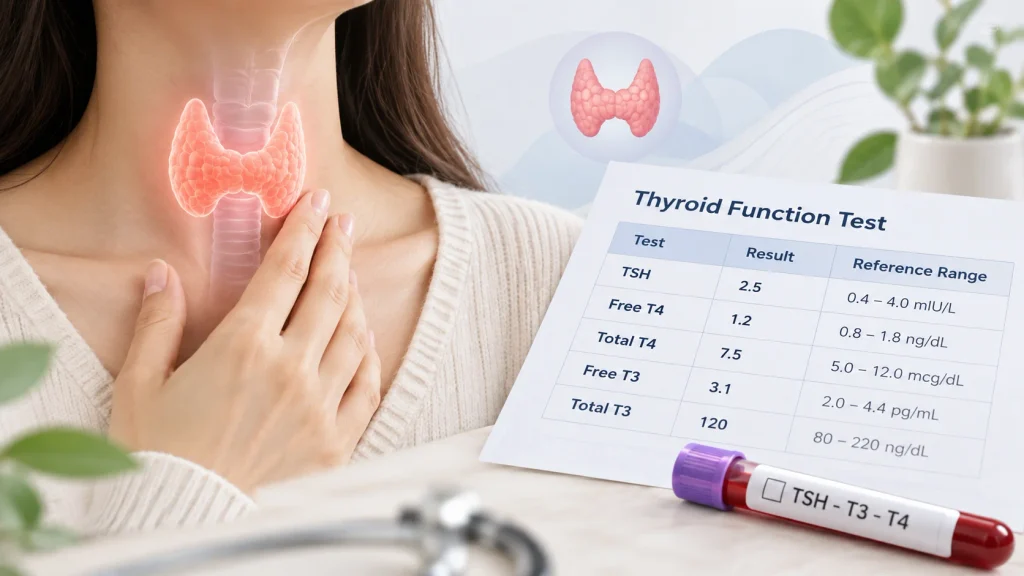
The TSH normal range in female adults is about 0.4 to 4.0 mIU/L in many labs, and up to 4.5 or 5.0 in others. It is the same range used for men. Pregnancy is the main exception, and your own lab’s printed range always comes first.
Thyroid problems are far more common in women, so it helps to know what your numbers mean. Below you will find the usual TSH, T3 and T4 ranges, what a high or low result suggests, and how things change with pregnancy and age.
Quick Answer
- Women: About 0.4 to 4.0 mIU/L in many labs, the same as men.
- Pregnancy: About 0.1 to 4.0 mIU/L in the first two trimesters if your lab has no pregnancy range.
- High TSH: Usually points to an underactive thyroid. Low TSH points to an overactive one.
- Your Report Decides: Compare with the range printed by your own lab.
TSH Normal Range in Female: Thyroid Test Chart
These typical adult ranges apply to women and men alike. Your lab may use slightly different numbers.
Some reports print TSH as uIU/mL instead of mIU/L. The two mean exactly the same thing.
Why Your Lab’s Range May Be Different
Laboratories may use different reference ranges based on their testing methods and reference populations. One lab may flag a TSH of 4.6 while another calls it normal. That is why the range printed on your own report matters most.
Why Women Should Watch Their TSH
The printed range is the same for both sexes, but women are more likely to develop thyroid disorders. In a study of 5,360 adults across eight Indian cities, hypothyroidism was found in 15.9% of women compared with 5.0% of men. About 1 in 10 adults overall had it.
Thyroid levels can affect periods, fertility and pregnancy, and thyroid problems can appear for the first time in the months after childbirth. Doctors may check TSH when periods become irregular, because thyroid problems and PCOS can cause similar symptoms.
What a Thyroid Test Checks
Your thyroid is a small, butterfly-shaped gland in the front of your neck. It makes two hormones, T4 and T3, which set the pace of your body: your energy, heart rate, weight and how warm or cold you feel. T4 is the main hormone it releases, and much of it is later turned into T3, the more active form.
TSH comes from the pituitary gland under your brain and works like a thermostat. When thyroid hormone runs low, TSH rises to push the thyroid harder. When there is too much, TSH falls. That is why doctors usually look at TSH first.
How to Read Your TSH Result
Doctors read TSH together with free T4 and your symptoms, not on its own. This guide shows what each band usually means.
What Your TSH Number Means
Find your TSH result (mIU/L) in the bands below
Low: below 0.4
Thyroid may be overactive, or a thyroid tablet dose may be too high.
Example: 0.2
Normal: 0.4 to 4.0 (up to 4.5 or 5.0 in some labs)
Usually a normal thyroid, if free T4 is also normal.
Example: 2.5
Mildly high: above your lab's limit, up to 10
Often rechecked in 2 to 3 months, especially when free T4 is normal. If free T4 is low, it usually needs treatment.
Examples: 5.5, or 8 with low free T4
High: above 10
Treatment may be considered, depending on age, symptoms and other findings.
Example: 12
Bands use a common adult range. Always read TSH with free T4 and the range printed on your own report.
A mildly high TSH can return to the normal range in some people. That is why doctors may repeat the test before deciding on treatment, especially when free T4 is normal.
Other Results on Your Thyroid Report
Free vs total: first check whether your report shows free or total T4 and T3, because each has its own range. Total tests count all the hormone in your blood, while free tests count only the part your body can use. Pregnancy and some hormone pills raise the proteins that carry thyroid hormone, so total T4 can look high while the thyroid is fine. Free T4 avoids that problem.
Anti-TPO antibodies: a positive result can support an autoimmune thyroid condition such as Hashimoto’s thyroiditis, a common cause of an underactive thyroid. It was found in about 1 in 5 Indian adults in one large study. A positive result alone does not mean you need treatment.
TSH Normal Range in Pregnancy
Pregnancy hormones push TSH down, so the usual TSH normal range in female adults does not fit. The American Thyroid Association’s 2026 guideline prefers lab and trimester-specific ranges. When a lab does not have them, a TSH of about 0.1 to 4.0 mIU/L can be used in the first and second trimesters.
The older fixed TSH cutoffs of 2.5 and 3.0 mIU/L are no longer used as universal pregnancy limits. A mildly abnormal result is usually repeated within a few weeks before any treatment, and it should always be reviewed by your obstetrician or an endocrinologist.
Does TSH Change With Age in Women?
TSH tends to rise slowly with age in both women and men, even when the thyroid is healthy. One study of 1,200 carefully screened adults found these ranges:
These are research figures, not the ranges your lab prints. Most labs still use one adult range for everyone, so do not decide on your own that a high reading is “normal for your age”. Your doctor will weigh your age when reading the result.
Tips Before Your Thyroid Test
- Test at the same time: TSH changes through the day, so repeat tests are best done at a similar hour, ideally in the morning.
- Fasting is usually not required: TSH can dip slightly after a meal, so if you are tracking TSH over time, test under similar conditions each time.
- Ask about your tablet: if you already take a thyroid tablet, ask your doctor whether to take it before or after the blood sample, and keep it the same each time.
- Mention biotin: hair and nail supplements with biotin can distort some thyroid results. Tell the lab if you take them.
Symptoms That Go With High or Low TSH
A high TSH with an underactive thyroid can bring tiredness, weight gain, feeling cold, constipation, dry skin and sometimes a slow heartbeat. A low TSH with an overactive thyroid can cause weight loss, shaky hands, poor sleep and a fast or irregular heartbeat. Many women with mild changes feel nothing at all.
If you are diagnosed with a thyroid problem, medicine does most of the work, but food and tablet timing matter too. Our thyroid diet chart explains what to eat and when to take your tablet.
When to See a Doctor
Book an appointment if any value on your report is outside the range, if you are pregnant or planning pregnancy, if your periods have changed, if you notice a lump or swelling in your neck, or if you take a thyroid tablet and your symptoms have changed.
Keep in Mind
Get emergency help for chest pain, fainting, severe breathlessness, sudden confusion, or a very fast and irregular heartbeat. These need urgent care, whatever your thyroid report says.
Illustrative Scenario
Composite example, not a specific patient.
Sunita, 38, saw TSH 5.8 flagged in red on her report and worried she needed tablets for life. Her free T4 was normal and she felt well. Her doctor asked her to repeat the test after three months at the same time of day. The second result was 3.9, well inside her lab’s range.
Key Takeaways
- Use the range printed on your own report, not a chart online.
- Read TSH together with free T4, not on its own.
- Expect a mildly high TSH to be rechecked before any treatment.
- Tell your doctor if you are pregnant or planning pregnancy, as the limits change.
Frequently Asked Questions
What is the TSH normal range in female adults?
It is about 0.4 to 4.0 mIU/L in many labs, and up to 4.5 or 5.0 in some. It is the same range used for men, except during pregnancy.
Is the TSH range different for women and men?
No. Both use the same printed range. Women are simply more likely to develop thyroid problems.
What is the normal TSH in pregnancy?
Lab and trimester-specific ranges are preferred. If they are not available, about 0.1 to 4.0 mIU/L is used in the first and second trimesters.
Is TSH 5.5 normal for a woman?
Not quite. It is mildly above most lab ranges. If free T4 is normal, doctors usually repeat the test in 2 to 3 months, as mild rises often settle.
Can thyroid problems affect periods?
Yes. Both an underactive and an overactive thyroid can change your periods, which is why TSH is often checked when periods become irregular.
Does TSH go up with age in women?
It tends to rise slowly with age in both sexes. Your doctor will consider this, but your lab’s range still decides what is flagged.
Do I need to fast for a thyroid test?
Usually no. TSH can dip slightly after a meal, so if you are comparing results, test under similar conditions each time.
What are normal T3 and T4 levels in women?
Typical adult ranges are free T4 0.8 to 1.8 ng/dL, total T4 5.0 to 12.0 mcg/dL, free T3 2.0 to 4.4 pg/mL and total T3 80 to 220 ng/dL.
References
- Lab Tests Online. Thyroid test results and reference ranges.
- UCLA Health. Normal thyroid hormone levels.
- Cleveland Clinic Journal of Medicine. Subclinical hypothyroidism in older patients, 2025.
- Cleveland Clinic Journal of Medicine. Subclinical hypothyroidism: when to treat, 2019.
- Unnikrishnan AG, et al. Hypothyroidism in adults in eight Indian cities. Indian J Endocrinol Metab, 2013.
- Fontes R, et al. TSH reference intervals in adults over 60 and over 80. Thyroid Res, 2013.
- American Thyroid Association 2026 pregnancy guideline: summary and full text.
- Nair R, et al. Does fasting affect thyroid function testing? Indian J Endocrinol Metab, 2014.
Written By
Iraphan Khan, BSN, RN, D.Pharm, Public Health Researcher. Iraphan writes evidence-based patient guides that turn medical reports and research into plain language.
Medically Reviewed By
Dr Praveen Verma, MBBS, MD Pathology
Dr Himanshu Morya, MBBS, Medical Educator
First published: 9 July 2026. Updated and reviewed: 24 September 2026. Next scheduled review: March 2027.
Disclaimer: This article is for general education and is not a diagnosis. Thyroid ranges differ between labs and people, so always have your report reviewed by your own doctor.