
For most healthy people, normal blood sugar ranges stay similar from childhood to old age. Age changes diabetes treatment targets, not the normal range.
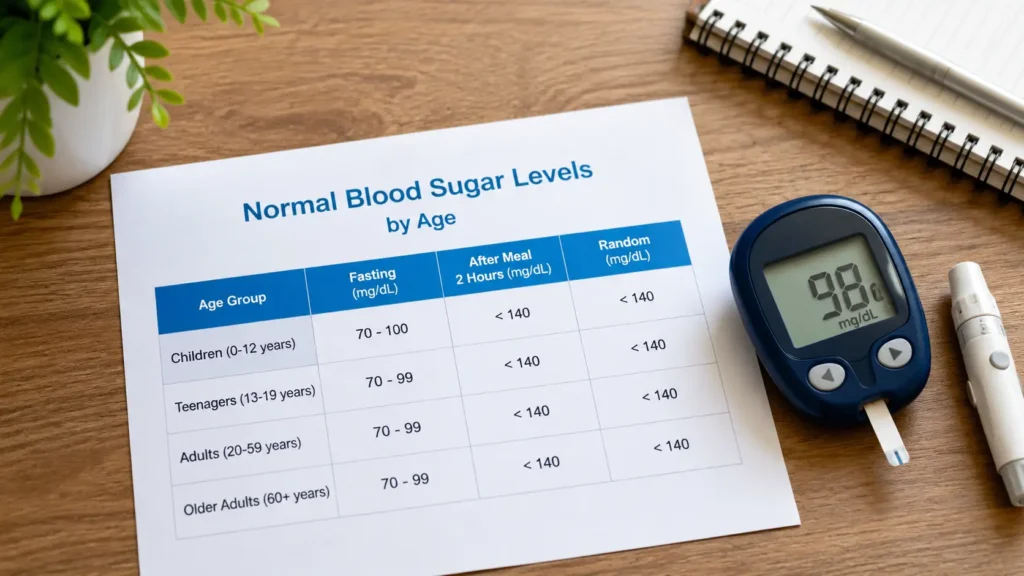
If a lab report just landed in your hands with a number that looks off, it is easy to feel a jolt of worry. Take a breath first. A single reading rarely tells the whole story. This guide walks through what counts as normal, why the range stays steady across ages, and what actually changes as you get older.
Quick Answer
- A fasting blood sugar under 100 mg/dL is normal. From 100 to 125 suggests prediabetes. 126 or higher is in the diabetes range, usually confirmed with a repeat test when there are no clear symptoms.
- On the two-hour glucose tolerance test, under 140 mg/dL is normal, 140 to 199 is prediabetes, and 200 or higher is diabetes.
- An HbA1c under 5.7 percent is normal, 5.7 to 6.4 is prediabetes, and 6.5 or higher usually confirms diabetes.
- For healthy people, these numbers stay almost the same at every age. What changes with age is the target a doctor sets once someone already has diabetes.
The Normal Blood Sugar Levels Chart, Test by Test
There is no separate normal blood sugar levels chart for every decade of life. One set of cutoffs applies the same way to a healthy 20 year old and a healthy 70 year old. Doctors use three main tests, each with its own cutoffs.
| Test | Normal | Prediabetes | Diabetes |
|---|---|---|---|
| Fasting glucose | Under 100 mg/dL | 100 to 125 mg/dL | 126 mg/dL or more |
| 2-hour, 75g OGTT | Under 140 mg/dL | 140 to 199 mg/dL | 200 mg/dL or more |
| HbA1c | Under 5.7 percent | 5.7 to 6.4 percent | 6.5 percent or more |
These numbers come from the American Diabetes Association’s 2026 Standards of Care. One clarification: the 140 to 199 range applies to the formal 75g oral glucose tolerance test, where you drink a measured sugar solution and get tested exactly two hours later. This is not the same as a reading taken two hours after an ordinary meal. Blood sugar can rise above 140 mg/dL soon after eating a normal meal, and this alone does not diagnose diabetes.
A random test, taken any time without planning around meals, works differently from the numbers on a normal blood sugar levels chart. A random glucose result below 200 mg/dL does not by itself establish a diagnosis of diabetes. It points strongly toward diabetes only at 200 mg/dL or higher, together with symptoms like heavy thirst or frequent urination, and your doctor will usually confirm it with a fasting test or HbA1c.
Good to Know
A single high number rarely settles anything on its own. When there are no obvious symptoms, doctors usually confirm an abnormal result with a second test on another day before calling it diabetes.
Why Age Barely Changes the Normal Range
In people without diabetes, the body’s ability to keep blood sugar steady does not really weaken with age in a way that shifts what counts as normal. A healthy 25 year old and a healthy 70 year old are judged by the same cutoffs. Age matters differently: it shapes the treatment target once someone already has diabetes, not the definition of healthy.
For many otherwise healthy older adults with diabetes, an HbA1c target around 7 percent may still be appropriate. For those with frailty, multiple health conditions, or a high risk of hypoglycemia, 2026 ADA guidance allows a less strict target, up to 8 percent. In very complex cases, the focus may shift away from a specific HbA1c number toward avoiding hypoglycemia and symptomatic high sugar. This is a personal decision made with your doctor, not a fixed rule by age.
What HbA1c Actually Tells You
A fasting or random test shows a single moment. HbA1c reflects your average glucose over roughly three months, so a single meal does not meaningfully change it, and you need not fast beforehand. It is not flawless though. Some conditions affecting red blood cells or haemoglobin, such as anaemia or pregnancy, can make it less reliable, so mention it to your doctor if it disagrees with your fasting result. Read a full breakdown in our HbA1c normal range guide.
Signs Worth Paying Attention To
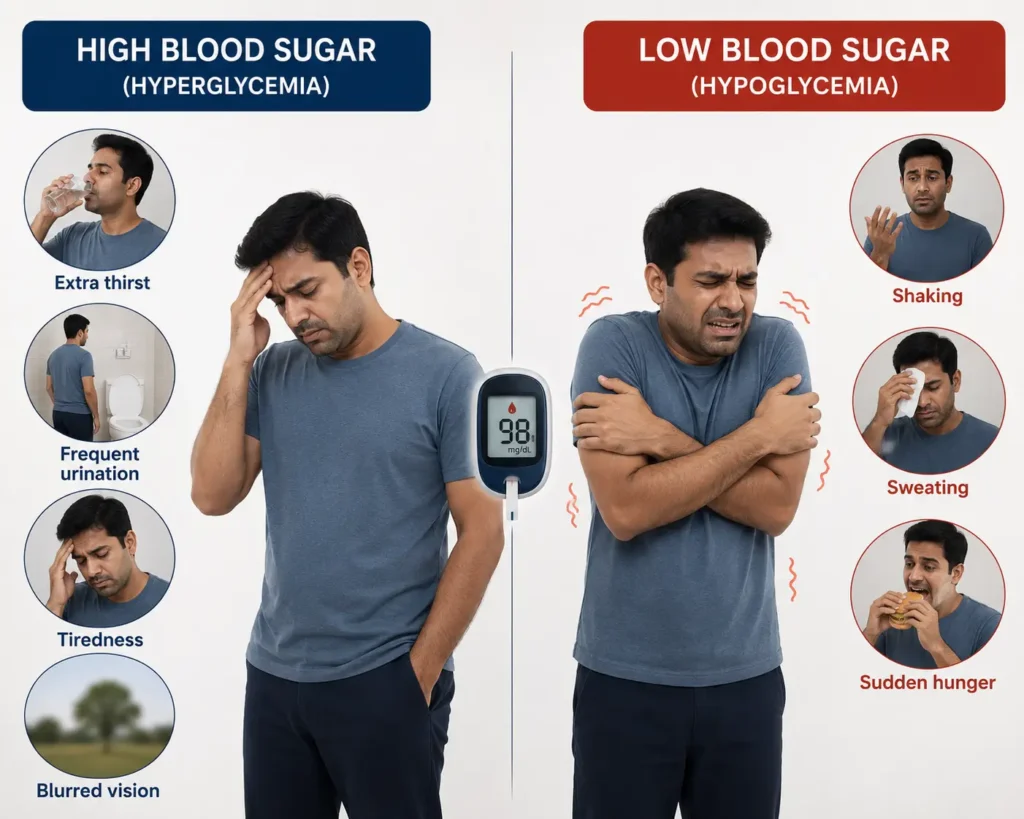
Numbers on a page are one thing, what your body feels is another. High blood sugar creeps up slowly, showing as thirst, frequent urination, tiredness, blurred vision, or slow-healing cuts. Many people feel fine for years despite it, which is why testing matters even without symptoms. Low blood sugar comes on fast, mostly in people taking insulin or diabetes tablets, with shakiness, sweating, a racing heart, hunger, or confusion. Low blood sugar needs prompt treatment rather than waiting for symptoms to pass.
If those high blood sugar signs sound familiar, or diabetes runs in your family, a simple test is worth asking for. Our guide to the early warning signs of type 2 diabetes goes into more detail on what to watch for before a diagnosis.
A Word for Indian and South Asian Readers
The diagnostic numbers do not change based on your ethnicity. What changes is how early doctors start looking, because South Asian people tend to develop type 2 diabetes younger and at a lower body weight. They may also carry more visceral fat, fat stored around internal organs, at a lower BMI. This is part of why prediabetes in normal-weight Indians is more common than people expect.
Because of this, Indian health guidelines set the overweight threshold at a BMI of 23 rather than 25, and watch waist size closely, above 90 cm for men and 80 cm for women. Because South Asian people can develop diabetes at a younger age, doctors may recommend screening earlier than the usual 40 to 45 when risk factors like family history or a raised waist size are present. Our piece on type 2 diabetes in young Indians explains why the numbers are shifting earlier for this generation. A normal result today is genuinely reassuring, but your waist size and family history still count for something.
If Your Number Sits in the Prediabetes Range
Most people with prediabetes feel completely fine, which is why it gets missed so often. Catching it here is genuinely good news, since blood sugar at this stage can often be brought back into the normal range with sustained lifestyle changes, rather than medication. Losing a modest amount of weight, moving more, and cutting sugary drinks carry the strongest evidence. For realistic timelines, our guide on how long it takes to reverse prediabetes walks through what to actually expect.
One habit with strong research behind it: a short walk after meals. A 2016 Diabetologia trial found a 10-minute walk after each main meal controlled blood sugar better over 24 hours than one longer walk done at any other time of day. It costs nothing. If lifestyle changes are not enough, your doctor may discuss medication too, but that comes after these basics.
When to Get Help Fast
Most blood sugar problems build up slowly, but a few situations need quick action. Vomiting, stomach pain, fast or deep breathing, confusion, severe weakness, or ketones, along with a very high reading, often 300 mg/dL or higher, need emergency care. The symptoms matter as much as the number. For a low below 70 mg/dL, if the person is awake and can swallow safely, give about fifteen grams of fast-acting sugar, such as juice or glucose tablets, then recheck in fifteen minutes. If they cannot swallow safely or lose consciousness, call for emergency help immediately.
Outside an emergency, book an appointment within the week for ongoing thirst, frequent urination, weight loss, blurred vision, or slow-healing wounds. None confirm diabetes alone, but together they warrant a proper check.
The Bottom Line
- For most healthy people, the normal blood sugar range looks similar at 25 or 75.
- Fasting under 100 mg/dL, under 140 two hours into a glucose tolerance test, and HbA1c under 5.7 percent are the numbers to know.
- If your number sits outside these ranges, it is not a verdict. It is a prompt to test again.
- Talk to a doctor who can see your full picture. A single result rarely tells the whole story.
Frequently Asked Questions
What is a normal blood sugar level by age?
For healthy people, the normal range is nearly identical at every age: under 100 mg/dL fasting and under 140 mg/dL two hours into a glucose tolerance test. Age mainly changes the treatment goals for someone who already has diabetes, not the healthy range itself.
Is 140 blood sugar normal two hours after eating?
The 140 mg/dL cutoff applies specifically to the formal glucose tolerance test, not to an ordinary meal. There is no single universal number your sugar must hit two hours after a normal plate of food, though a repeated pattern of readings well above 140 is worth mentioning to your doctor.
What counts as a normal random blood sugar reading?
A random reading only points strongly to diabetes when it is 200 mg/dL or higher and comes with symptoms like heavy thirst or frequent urination. On its own, a random reading is a snapshot rather than a diagnosis.
What is a normal HbA1c level?
Below 5.7 percent is normal, 5.7 to 6.4 percent is prediabetes, and 6.5 percent or higher usually confirms diabetes. Once someone is diagnosed, their doctor sets a personal treatment target, which is a separate number from these diagnostic cutoffs.
Does blood sugar naturally rise with age?
Glucose regulation can change a little with age, but this does not change the standard diagnostic cutoffs for diabetes. A number that keeps climbing over time should still be checked rather than dismissed as ageing.
Can a slim or normal-weight person have high blood sugar?
Yes. Being slim does not guarantee healthy blood sugar. Fat carried deep around the organs can affect how the body uses insulin even at a normal weight on the scale, a pattern seen often in South Asian people, which is why testing matters even for those who feel and look fit.
Can prediabetes be brought back to normal?
For many people, yes. Losing a modest amount of weight, staying active, and cutting back on sugary drinks can bring blood sugar back into the normal range. Acting earlier tends to improve the odds, so a prediabetes result is a chance to change course, not a fixed outcome.
How often should a healthy person check their blood sugar?
Healthy adults do not necessarily need yearly glucose testing. How often you need it depends on your age, risk factors, family history, and local guidelines, so it is worth asking your doctor what is right for you.
References and Sources
- American Diabetes Association. Diagnosis and Classification of Diabetes, Standards of Care in Diabetes, 2026.
- American Diabetes Association. Older Adults, Standards of Care in Diabetes, 2026.
- Reynolds AN, et al. Advice to walk after meals is more effective for lowering postprandial glycaemia in type 2 diabetes than advice that does not specify timing. Diabetologia, 2016.
- Anjana RM, et al. Metabolic non-communicable disease health report of India, the ICMR-INDIAB study. The Lancet Diabetes and Endocrinology, 2023.
- Centers for Disease Control and Prevention. National Diabetes Statistics Report, 2026.
- Diabetes UK. Diabetes prevalence statistics, 2025.
- WHO Expert Consultation. Appropriate body-mass index for Asian populations and its implications for policy and intervention strategies. The Lancet, 2004, volume 363, pages 157 to 163.
Written by
Iraphan Khan, BSN, RN, D.Pharm, Public Health Researcher
Founder of RealMedVision, writing patient-focused health content based on clinical guidelines and peer-reviewed research. This article is not a substitute for consultation with a licensed physician.
Medically reviewed by
Dr Praveen Verma, MBBS, MD (Pathology), Pathologist and Clinical Laboratory Specialist
Dr Himanshu Morya, MBBS, Medical Educator
This article is for information and education only, and is not a substitute for professional medical advice. Blood sugar targets can differ from person to person, and only a qualified healthcare professional who knows your full history can tell you what is right for you. Do not start, stop, or change any treatment based on this article alone.