
Medically Reviewed: 23 September 2026 • Last Updated: 23 September 2026 • 8 minute read
What the two names really mean, how doctors diagnose the condition, and what to ask if your report says PCOD.
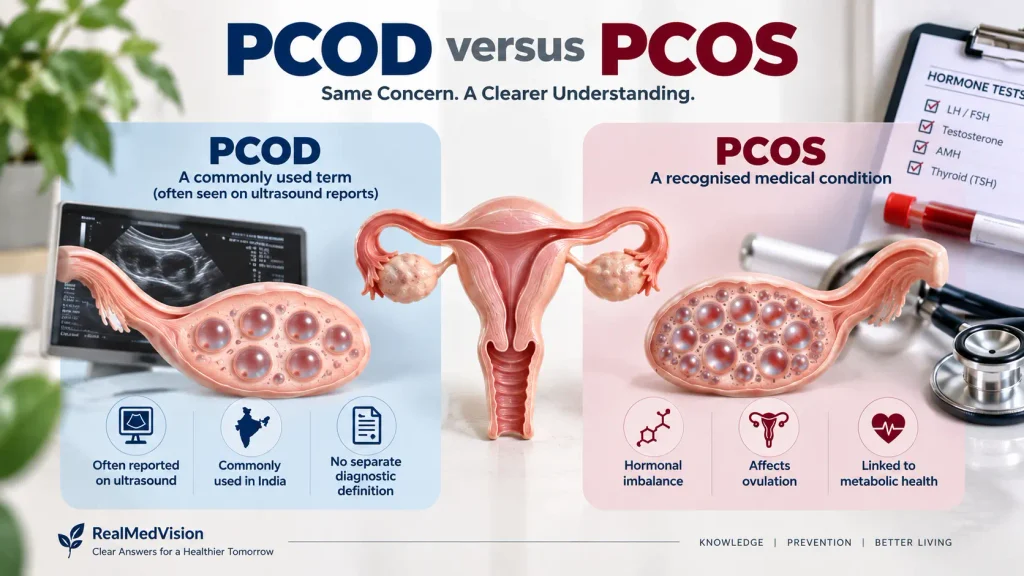
Search for PCOD vs PCOS and most websites will tell you they are two different diseases, one mild and one serious. International guidelines recognise one condition, polycystic ovary syndrome (PCOS). PCOD, or polycystic ovarian disease, is an older name that is still widely used in India, but it has no separate diagnostic definition.
In May 2026, an international consensus gave PCOS a new name, polyendocrine metabolic ovarian syndrome (PMOS), though most doctors and patients still say PCOS.1 So when you compare PCOD vs PCOS, the real question is not which of the two you have. It is whether you meet the criteria for PCOS, and what your hormones, periods and blood sugar show.
Quick Answer
- Same Condition: PCOD is a common Indian term. Guidelines diagnose only PCOS, now also called PMOS.
- Ultrasound Alone Is Not Enough: Polycystic-looking ovaries on a scan do not by themselves mean PCOS.
- Diagnosis: Doctors look for two of three features after ruling out other causes.
- Metabolic Health: Ask whether you also need blood sugar and cholesterol tests.
Is PCOD the Same as PCOS?
The two names are often used interchangeably in India, but PCOD has no separate standardized definition in current international guidelines. Many hospital and clinic websites describe PCOD as a milder ovarian problem and PCOS as a whole-body disorder, and you may hear the same from a doctor. But that split does not appear in the international guideline used by gynaecologists and endocrinologists worldwide. The symptoms described under both names overlap, and the guideline uses PCOS as the established diagnosis. The guideline describes a single condition whose features vary a great deal from woman to woman. Its authors have long argued that the old name was a distraction, which is part of why it has now changed.2
Why the Name Changed to PMOS
The new name puts less focus on the ovaries alone and more on the wider hormonal and metabolic features of the condition, such as its effects on insulin, weight and cholesterol, alongside periods and fertility. The old name wrongly suggested ovarian cysts, when the small circles seen on scans are immature follicles.1 Nothing about diagnosis or treatment has changed, and it will take time for reports and prescriptions to switch to the new term.
My Ultrasound Says PCOD. Do I Have PCOS?
Not necessarily. Many small follicles on an ultrasound may be described in a report as a polycystic ovarian pattern. This finding is only one of three possible features, and on its own it does not confirm PCOS. Plenty of women with regular periods and no hormone symptoms have ovaries that look like this.
Age matters too. In teenagers, polycystic-looking ovaries are common and usually normal, which is why the guideline does not recommend ultrasound for diagnosing PCOS in adolescents.3 If your report mentions PCOD, ask your doctor three things: do my periods count as irregular, are my androgen hormones high, and have other causes been ruled out? Those other causes are checked with blood tests for thyroid, prolactin and a few other hormones, and our thyroid test normal range chart explains the thyroid part of that report.
Good to Know
Questions worth taking to your appointment: Do my periods count as irregular? Are my testosterone levels raised? Have thyroid and prolactin problems been ruled out? Do I need blood sugar and cholesterol tests? If the answer to the first two is no, a PCOD line on a scan may simply be a finding to keep an eye on.
How Doctors Diagnose PCOS
Under the 2023 international guideline, adults are diagnosed with PCOS when two of three key features are present, after other causes have been excluded:3
- Irregular or absent ovulation: in adults, for example, cycles shorter than 21 days, longer than 35 days, or fewer than 8 periods a year.
- High androgens: signs such as excess facial or body hair and acne, or raised testosterone on a blood test.
- Polycystic ovaries: seen on ultrasound or, in adults, suggested by a raised AMH blood test.
Can You Have PCOS Without Cysts?
It is possible. If your periods are irregular and your androgens are high, you meet the criteria even if your ovaries look normal. In that situation the guideline says neither an ultrasound nor an AMH test is needed.3 This is one reason the name “polycystic” was felt to mislead so many women.
Common Symptoms
The symptoms can look very similar, which is one reason the difference between PCOD and PCOS confuses so many people. The signs vary a lot between women:
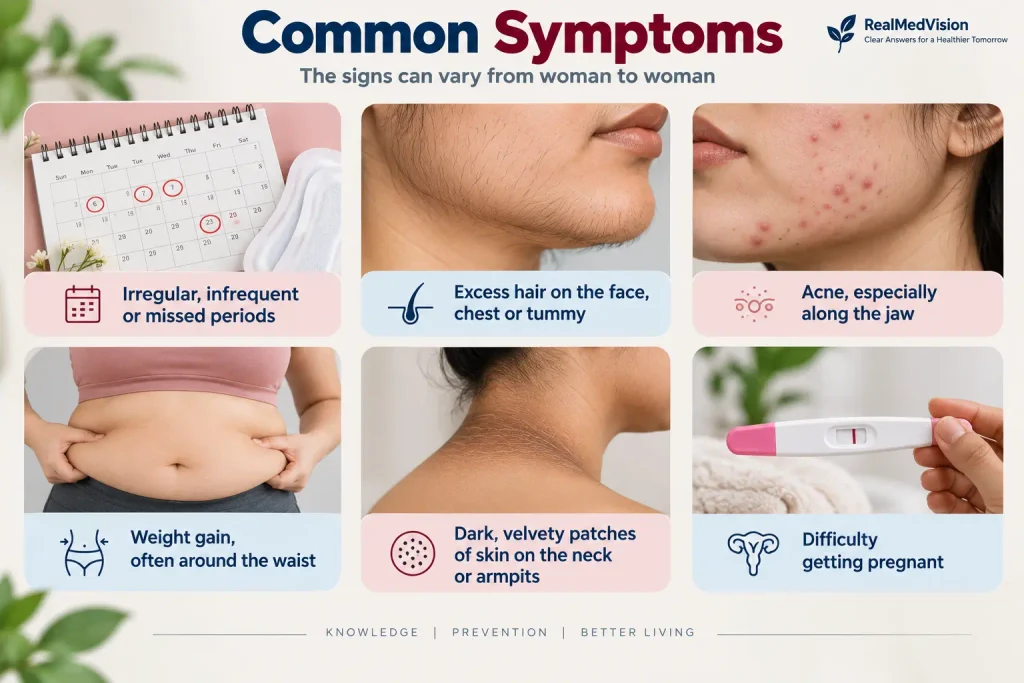
- Irregular, infrequent or missed periods
- Excess hair on the face, chest or tummy
- Acne, especially along the jaw, and thinning scalp hair
- Weight gain, often around the waist, though many women with PCOS are not overweight
- Dark, velvety patches of skin on the neck or armpits
- Difficulty getting pregnant
Why Blood Sugar Checks Matter
Insulin resistance is common in PCOS, and it is not limited to women who carry extra weight. The CDC notes that more than half of women with PCOS develop type 2 diabetes by the age of 40.4
A large national study led by the Indian Council of Medical Research found that PCOS prevalence among women aged 18 to 40 ranged from 7% to 20%, depending on the diagnostic criteria used. The same study reported high rates of metabolic problems in women with PCOS: 43.2% had obesity, 91.9% had abnormal cholesterol and 3.4% already had diabetes.5 That is why a “mild PCOD” label should never mean skipping these tests. Our blood sugar chart by age shows the ranges to discuss with your doctor.
PCOD, PCOS and Pregnancy
If you ovulate irregularly, pregnancy can take longer, whatever name is on your report. It is still very possible. Many women with PCOS conceive naturally, and others need medicines that help the ovaries release an egg. If your periods are irregular and you are trying to conceive, see a doctor early rather than waiting a year.
PCOD vs PCOS: Is One More Serious?
The two cannot really be compared. PCOD has no separate definition, so there is no way to rank it against PCOS. What does vary is how PCOS affects each woman. Some have mild, occasional symptoms. Others have raised blood sugar, cholesterol problems or fertility difficulties. Your own risk depends on your test results, not the label.
Treatment and Diet
Treatment is shaped around your main concern. Doctors may suggest combined oral contraceptive pills for irregular periods and excess hair, metformin when there are metabolic risk factors, laser treatment for unwanted hair, or ovulation medicines when you want to conceive.2, 6
Healthy eating and regular activity help at every body size. The guideline found no single diet better than others, so you do not need to give up rice or roti.7 Our PCOS diet chart has a 7 day Indian meal plan with simple portions.
Illustrative Scenario
Composite example, not a specific patient.
Neha, 23, had an ultrasound for stomach pain, and the report mentioned a PCOD pattern. She panicked and started a strict diet. Her gynaecologist asked about her periods, which were regular, and checked her hormones, which were normal. The doctor explained that the scan finding alone did not mean PCOS, and suggested a review if her periods or skin changed.
Key Takeaways
- Remember that PCOD and PCOS are often used interchangeably in India, but PCOS is the established diagnosis in current international guidelines.
- Do not accept a diagnosis based on an ultrasound alone. Ask about your periods and hormones too.
- Get blood sugar and cholesterol checked, whatever label your report uses.
- Choose treatment based on your own symptoms and goals, with your doctor.
Frequently Asked Questions
Is PCOD and PCOS the same?
The terms are used interchangeably in India, but only PCOS is a recognised diagnosis in international guidelines. It is now also called PMOS.
Which tests are used to diagnose PCOS?
Doctors review your periods and check for excess hair or acne, then use blood tests for testosterone, thyroid and prolactin. An ultrasound or AMH test is added only when needed.
Does a PCOD pattern on ultrasound mean I have PCOS?
Not by itself. PCOS needs two of three features, such as irregular periods and high androgens, after other causes are ruled out.
Can I have PCOS without cysts?
Yes. If your periods are irregular and your androgens are high, you can be diagnosed with PCOS even if your ovaries look normal.
What is PMOS?
PMOS, or polyendocrine metabolic ovarian syndrome, is the new name for PCOS adopted in a 2026 international consensus. PCOS is still widely used, and diagnosis and treatment stay the same.
Can PCOS happen at a normal weight?
Yes. PCOS occurs at every body size, and insulin resistance can be present even without excess weight.
Can teenagers be diagnosed with PCOS?
Yes, but both irregular periods and signs of high androgens are needed. Ultrasound is not recommended for diagnosis in teenagers, as polycystic-looking ovaries are common at that age.
Can I get pregnant with PCOD or PCOS?
Yes. Irregular ovulation can make it slower, but many women conceive naturally or with medicines that help ovulation.
References
- Teede HJ, et al. Polyendocrine Metabolic Ovarian Syndrome, the New Name for Polycystic Ovary Syndrome. Lancet. 2026. thelancet.com
- Monash University. International Evidence-Based Guideline for PCOS 2023: Summary. 2023. monash.edu
- Teede HJ, et al. Recommendations From the 2023 International Evidence-Based Guideline for the Assessment and Management of PCOS. J Clin Endocrinol Metab. 2023. academic.oup.com
- Centers for Disease Control and Prevention. PCOS (Polycystic Ovary Syndrome) and Diabetes. 2025. cdc.gov
- Ganie MA, et al. Prevalence, Phenotypes, and Comorbidities of Polycystic Ovary Syndrome Among Indian Women. JAMA Netw Open. 2024. pubmed.ncbi.nlm.nih.gov
- American Academy of Family Physicians. Polycystic Ovary Syndrome: Assessment and Management Guidelines. Am Fam Physician. 2024. aafp.org
- Summary of the 2023 International Evidence-Based Guideline for the Assessment and Management of PCOS. Med J Aust. 2024. mja.com.au
Written By
Iraphan Khan, BSN, RN, D.Pharm, Public Health Researcher. Iraphan writes evidence-based patient guides that turn medical reports and research into plain language.
Medically Reviewed By
Dr Praveen Verma, MBBS, MD Pathology
Dr Himanshu Morya, MBBS, Medical Educator
First published: 8 July 2026. Updated and reviewed: 23 September 2026. Next scheduled review: September 2027.
Disclaimer: This article is for general education and is not a diagnosis. Only a doctor who knows your history, examination and test results can tell you whether you have PCOS and which treatment suits you.