
Medically Reviewed: 23 September 2026 • Last Updated: 23 September 2026 • 8 minute read
A practical 7 day Indian meal plan, simple portions, and what to eat or limit with PCOS, also called PCOD.
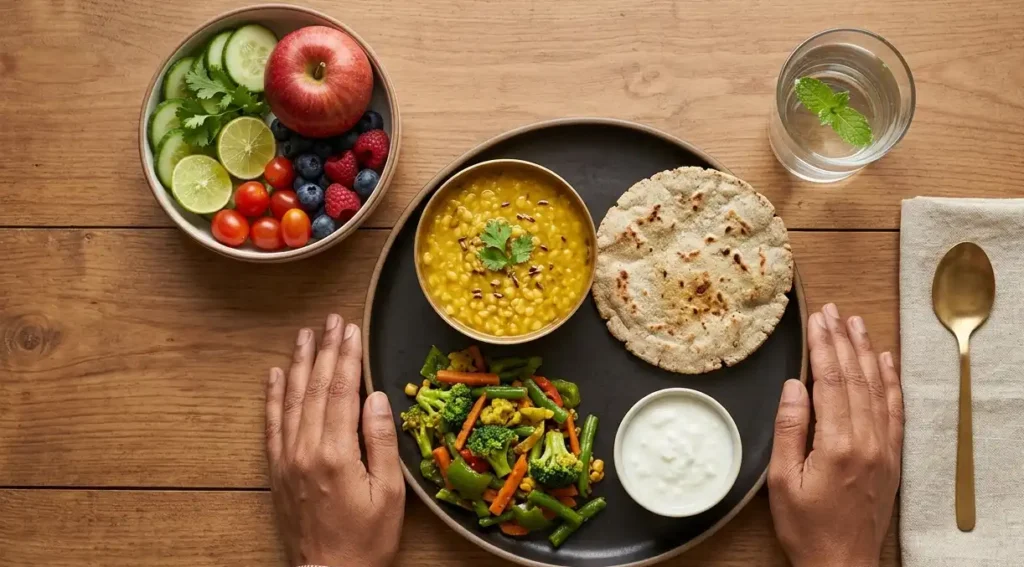
A PCOS diet does not mean giving up rice, roti or fruit. The aim is a balanced way of eating that keeps blood sugar steadier, supports your metabolic health and fits your family’s kitchen. This PCOS diet chart gives you a 7 day Indian plan, simple portions and the foods worth limiting.
PCOS is common in India. A national study led by the Indian Council of Medical Research found it in 7% to 20% of women aged 18 to 40, depending on the diagnostic criteria used.1 In India many people call it PCOD. In May 2026, an international consensus adopted polyendocrine metabolic ovarian syndrome (PMOS) as its new name, though PCOS is still the term most patients and many doctors use.2 The food advice stays the same whatever name is on your report.
Quick Answer
- Build Meals On: Dal, eggs, paneer, curd, vegetables, millets and whole grains.
- Limit: Sugary drinks, sweets, maida, fried snacks and large portions of white rice on its own.
- No Perfect Diet: International guidance finds no single diet better than others for PCOS.
- Any Body Size: Healthy eating helps even when weight loss is not the goal.
Who This PCOS Diet Chart Is For
This guide is for adult women with PCOS or PCOD who want everyday Indian meals that support steadier blood sugar, in either a vegetarian or non-vegetarian home. If you are pregnant, have diabetes or kidney disease, have a history of an eating disorder, or are under 18, ask your doctor or a dietitian to adapt it, because your needs can be quite different.
A 7 Day Indian PCOS Diet Chart
Each day pairs grains with protein and vegetables. Use it as a template and swap in the dals and seasonal sabzis your family already eats.
Non-vegetarian swap: on any day, replace paneer, tofu or rajma with two eggs, fish or chicken.
Simple Indian Portion Guide
The portions below are general examples for this PCOS diet chart, not individual nutrition prescriptions. Your needs depend on age, activity, body size, medical conditions and personal goals, so a dietitian can tailor them.
Why Blood Sugar Matters in PCOS
Insulin resistance is common in PCOS, and it is not limited to women with extra weight. When the body struggles to use insulin, blood sugar and insulin stay higher, which raises the risk of type 2 diabetes. The CDC states that more than half of women with PCOS develop type 2 diabetes by age 40.3
Indian data paints its own picture. Among women with PCOS in the ICMR study, 43.2% had obesity, 91.9% had abnormal cholesterol and 3.4% already had diabetes.1 That is why the meals above pair grains with fibre and protein, which gives a slower, lower rise than refined carbs eaten on their own.4
Illustrative Example: Why Meal Composition Can Affect Blood Sugar
Maida, sugary drink or white rice on its own
Millet roti with dal, sabzi and curd
This is a conceptual illustration, not measured patient data. Actual blood sugar responses vary by person, food quantity and meal composition. Glycaemic index is measured from the area under a 2-hour blood sugar curve.
In daily life, the easiest ways to get the flatter blue curve are to eat rice or roti with dal and sabzi rather than on their own, choose whole fruit over juice, and cut back on sweet drinks.
Foods to Eat With PCOS
Foods to Limit With PCOS
Nothing here is banned forever. These foods simply raise blood sugar fast or add a lot of sugar and oil, so keep them small and occasional.
Can You Eat Rice and Roti With PCOS?
Yes. The 2023 international PCOS guideline found no single diet that works better than others, and advises following healthy eating guidance for the general population.5 So rice and roti can stay. What matters is the portion and what you eat with them. A small katori of rice with dal, sabzi and curd is a very different meal from a large plate of rice with little else. Whole wheat, bajra or jowar rotis add more fibre than maida.
PCOS Diet Chart for Weight Loss
PCOS can occur at any body size, and healthy eating and activity bring benefits even without weight loss.5 If you do carry extra weight, the guideline says losing 5% to 10% of body weight can bring meaningful clinical improvements.6 For a woman weighing 70 kg, that is 3.5 to 7 kg, reached slowly.
Keep the same 7 day chart with slightly smaller grain portions and more vegetables, and add regular movement such as brisk walking, plus some muscle-strengthening exercise at home. Crash diets are hard to keep up and usually do not last, so slow, steady change is the safer path.
Medicines and Supplements
Diet is one part of care, not the whole of it. Depending on your symptoms and goals, doctors may use combined oral contraceptive pills for irregular periods and excess hair, metformin for metabolic problems, or laser treatment for unwanted hair.7 Supplements such as inositol are widely sold. Ask your doctor before starting one, as doses and product quality vary, and no supplement cures PCOS.
Good to Know
A simple PCOS grocery list: moong, masoor and chana dal, rajma, besan, oats, bajra or jowar atta, brown rice, eggs or paneer, curd, seasonal vegetables and greens, guava, apples, roasted chana, makhana, peanuts and pumpkin seeds.
When to See a Doctor
See a doctor if your periods are very irregular or stop, you have troubling acne or hair growth, or you are struggling to get pregnant. Ask about regular checks of blood sugar, HbA1c and cholesterol, and compare results with our blood sugar chart by age. Doctors also check thyroid levels to rule out other causes, and our thyroid test normal range chart explains that report. If you are treated for a thyroid problem as well, our thyroid diet chart fits alongside this plan.
Keep in Mind
Get urgent care or call 112 for very heavy bleeding, severe belly pain, chest pain or fainting.
Illustrative Scenario
Composite example, not a specific patient.
Priya, 26, was told she had PCOD and assumed she had to stop eating rice. Her doctor explained that she could keep it in smaller portions with dal and sabzi, swap her sweet chai for less sugar, and walk after dinner. She also had her blood sugar and cholesterol checked, and planned a review in a few months.
Key Takeaways
- Pair rice or roti with dal, sabzi or curd at most meals.
- Cut down on sugary drinks and frequent fried snacks.
- Use this PCOS diet chart as a flexible template and choose habits you can maintain at any weight.
- Get blood sugar and cholesterol checked regularly, not just your hormone levels.
Frequently Asked Questions
Is PCOS the same as PCOD?
In everyday use in India, both names describe the same condition. PCOS is the familiar medical term, and PMOS is the new name adopted in 2026 that is still being rolled out.
Can I eat rice with PCOS?
Yes. Keep the portion small and eat it with dal, vegetables or curd. No single diet has been shown to work better than others for PCOS.
Is curd good for PCOS?
Plain curd is a good source of protein and fits well in a PCOS diet chart. Choose unsweetened curd over flavoured versions.
Which fruits are good for PCOS?
Whole fruits such as guava, apple, pear, orange and papaya are good choices. Eat the fruit rather than drinking packaged juice.
Can you have PCOS at a normal weight?
Yes. PCOS occurs at every body size, and insulin resistance can be present even without excess weight.
How much weight should I lose with PCOS?
If you carry extra weight, losing 5% to 10% can bring meaningful improvements. Healthy eating still helps if weight loss is not your goal.
Can diet cure PCOS?
No. Diet cannot cure PCOS, but it supports your metabolic health and works alongside any treatment your doctor advises.
Does a PCOS diet help with getting pregnant?
It can support overall health, but it is not a fertility treatment. If you are trying to conceive, plan it with your doctor.
References
- Ganie MA, et al. Prevalence, Phenotypes, and Comorbidities of Polycystic Ovary Syndrome Among Indian Women. JAMA Netw Open. 2024. pubmed.ncbi.nlm.nih.gov
- Teede HJ, et al. Polyendocrine Metabolic Ovarian Syndrome, the New Name for Polycystic Ovary Syndrome. Lancet. 2026. thelancet.com
- Centers for Disease Control and Prevention. PCOS (Polycystic Ovary Syndrome) and Diabetes. 2025. cdc.gov
- FAO and WHO. Carbohydrates in Human Nutrition: The Glycaemic Index. 1998. fao.org
- Summary of the 2023 International Evidence-Based Guideline for the Assessment and Management of PCOS. Med J Aust. 2024. mja.com.au
- Teede HJ, et al. Recommendations From the 2023 International Evidence-Based Guideline for PCOS. 2023. pmc.ncbi.nlm.nih.gov
- Monash University. International Evidence-Based Guideline for PCOS 2023: Summary. 2023. monash.edu
Written By
Iraphan Khan, BSN, RN, D.Pharm, Public Health Researcher. Iraphan writes evidence-based patient guides that turn medical reports and research into plain language.
Medically Reviewed By
Dr Praveen Verma, MBBS, MD Pathology
Dr Himanshu Morya, MBBS, Medical Educator
First published: 7 July 2026. Updated and reviewed: 23 September 2026. Next scheduled review: September 2027.
Disclaimer: This article is for general education and is not a diagnosis or treatment plan. PCOS care differs from person to person, so always follow your own doctor’s advice before changing your diet, medicines or supplements.