
Medically Reviewed: 14 September 2026 • Last Updated: 14 September 2026 • 8 minute read
Which thyroid problems go away for good, which need lifelong treatment, and what that means for your daily life.
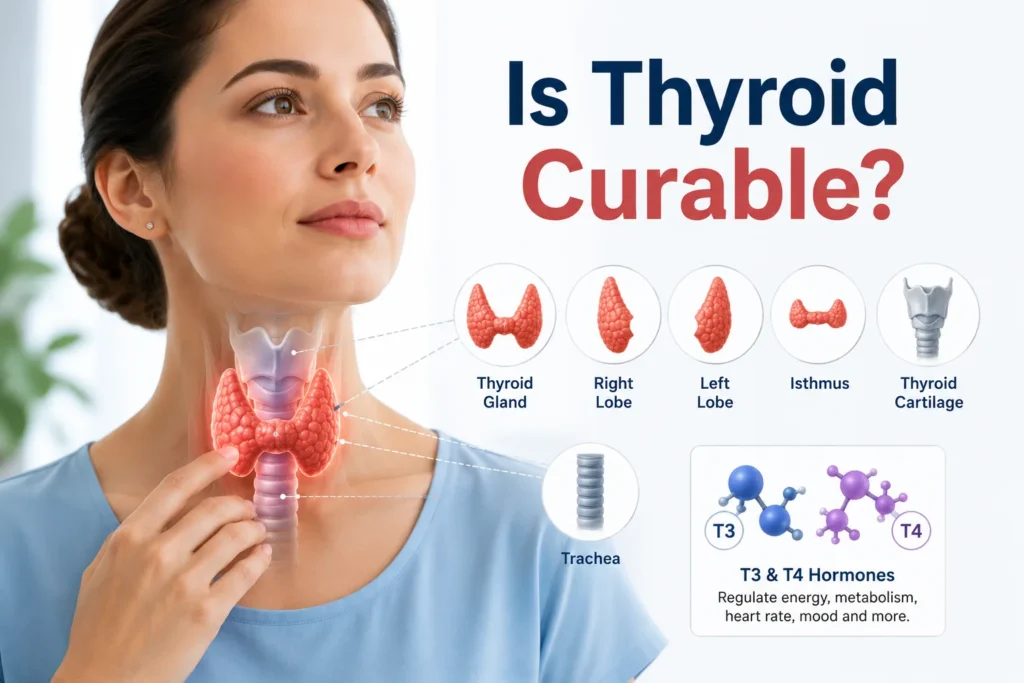
Is thyroid curable? It depends on the type. Some thyroid problems can be cured or settle on their own, such as some cases of thyroid inflammation after pregnancy and many thyroid cancers, and a mildly raised TSH may return to normal. Others, especially the common underactive thyroid caused by Hashimoto’s disease, stay for life but can be controlled so well that you feel completely normal.
Thyroid problems are common in India. A study across eight Indian cities found an underactive thyroid in about 1 in 10 adults, and in 15.9% of women compared with 5.0% of men. Here is what cure and control really mean for each type.
Quick Answer
- Can go away: Some thyroid inflammation and many thyroid cancers. A mildly high TSH may return to normal.
- Can be stopped for good: An overactive thyroid, with radioactive iodine or surgery.
- Lifelong but controlled: An underactive thyroid from Hashimoto’s disease, with one daily tablet.
- No natural cure: No diet, yoga or supplement cures thyroid disease.
What Does the Thyroid Do?
The thyroid is a small, butterfly-shaped gland at the front of your neck. It makes hormones that set the speed of your body, including your heart rate, energy, weight, body temperature and mood. When it makes too little, you slow down. When it makes too much, everything speeds up. Most thyroid problems fall into one of these two groups, or involve a lump in the gland.
Cure vs Control: What the Words Mean
A cure means the problem is gone and you no longer need treatment. Control means the problem is still there, but treatment keeps it quiet so it cannot harm you.
Think of glasses. They do not fix weak eyesight, but while you wear them you see perfectly. A thyroid tablet works the same way for an underactive thyroid. Take it every day and your body works normally, even though the gland has not healed.
Which Thyroid Problems Can Be Cured?
The answer changes with the cause, so it helps to see the common types side by side.
Is Hypothyroidism Curable?
For most people, no. The commonest cause of an underactive thyroid is Hashimoto’s disease, where the immune system slowly damages the gland. Once the gland cannot make enough hormone, it rarely recovers.
The good news is that the treatment is simple. A daily levothyroxine tablet replaces the missing hormone. Because it is the same hormone your body makes, problems usually come only from a dose that is too high or too low. Most people need it for life, and on the right dose they live a completely normal, active life. Your doctor adjusts the dose using TSH blood tests, and our TSH normal range guide explains those numbers.
When a Mildly High TSH Settles on Its Own
A single TSH of 5 or 6 does not decide thyroid disease on its own. Doctors also look at free T4, symptoms, age and pregnancy. When only TSH is mildly raised, it is called subclinical hypothyroidism, and in some people it may return to normal without treatment. That is why your doctor may repeat the thyroid tests before deciding whether treatment is needed.
Is Hyperthyroidism Curable?
Often, yes, in the sense that the overactivity can be stopped. The commonest cause is Graves’ disease, where the immune system pushes the thyroid to make too much hormone. There are three treatments:
- Antithyroid tablets: usually taken for 12 to 18 months. Some people stay well after stopping them, but relapse is common.
- Radioactive iodine: a capsule or drink that shrinks the overactive gland for good.
- Surgery: removes all or part of the gland.
There is a catch. Radioactive iodine and surgery usually leave the thyroid underactive, so most people then need a daily hormone tablet for life. The overactivity is cured, but control continues in a different form. Which option suits you depends on your age, pregnancy plans, the size of the gland and your own preference.
The Thyroid Problems Most Likely to Go Away
Thyroid Inflammation After Pregnancy or a Virus
Inflammation of the thyroid, called thyroiditis, can follow childbirth or a viral infection. It may cause a short overactive phase, then a short underactive phase, before the gland recovers, often within about a year. Some women later develop a lasting underactive thyroid, so doctors keep checking TSH for a while afterwards.
Thyroid Lumps and Cancer
Most thyroid lumps are harmless and only need regular checks. When a lump does turn out to be cancer, many thyroid cancers are highly treatable. Papillary and follicular thyroid cancers, the most common types, are usually curable with surgery, sometimes followed by radioactive iodine. After the gland is removed, a daily hormone tablet takes over its work.
Can Thyroid Be Cured Permanently?
So, is thyroid curable permanently? Some thyroid problems are. Many cases of thyroiditis improve over time, although some people develop lasting hypothyroidism. Many thyroid cancers are highly treatable, and papillary and follicular thyroid cancers are usually curable. An overactive thyroid can be stopped for good, and a mildly high TSH may return to normal.
What cannot be permanently cured is an underactive thyroid from Hashimoto’s disease. But with the right dose and regular TSH checks as advised by your doctor, it becomes a small part of life rather than the centre of it.
Can Diet, Yoga or Home Remedies Cure Thyroid?
No. No diet, herb, yoga routine or detox can cure thyroid disease, whatever social media promises. Healthy habits help you feel better and support your treatment, but they cannot replace the hormone your body is missing.
Some remedies can even harm. Too much iodine, for example from kelp or seaweed supplements, can upset the thyroid and make an overactive thyroid worse. For everyday food choices that work alongside treatment, see our thyroid diet chart.
Can Thyroid Medicine Ever Be Stopped?
Sometimes, but only with your doctor. If the problem was temporary, such as inflammation after pregnancy, blood tests may show that your gland has recovered and the tablet can be stopped. Antithyroid tablets for Graves’ disease are often stopped after 12 to 18 months to see if the disease stays calm.
For Hashimoto’s disease, the tablet is usually needed for good. Never stop it on your own, because symptoms return slowly and you may not notice until you feel very unwell.
Living Well With a Lifelong Thyroid Condition
- Take your tablet the same way every day: usually on an empty stomach, with water, at the same time.
- Keep your blood tests: more often while the dose is being set, then as often as your doctor advises once you are stable.
- Tell your doctor early if you are pregnant: the dose often needs to change during pregnancy.
- Mention new symptoms: tiredness, weight change or a racing heart can mean the dose needs adjusting.
What Happens If Thyroid Disease Is Not Treated?
An untreated underactive thyroid can raise LDL cholesterol, cause a slow heartbeat and create problems in pregnancy. An untreated overactive thyroid can cause a fast or irregular heartbeat and weaken bones over time. This is why control matters, even when a cure is not possible.
When to See a Doctor
See a doctor for ongoing tiredness, unexplained weight change, feeling too hot or cold, a swelling in the neck, irregular periods or trouble getting pregnant. A simple TSH blood test is the first step.
Keep in Mind
Get emergency help for a very fast or irregular heartbeat with fever and confusion, or for extreme drowsiness, confusion and feeling very cold. These rare signs can mean a thyroid emergency.
Illustrative Scenario
Composite example, not a specific patient.
Anita, 34, was told she had thyroid after a TSH of 5.6 and asked if it was curable. Her free T4 was normal, so her doctor repeated the test after three months. It came back at 3.2, and she needed no tablet, only follow-up checks.
This is only an example. A different TSH result or medical history may need a different approach.
Key Takeaways
- Ask your doctor what is causing your thyroid problem, because the cause decides whether it can be cured.
- If your TSH is mildly high, ask your doctor whether repeat testing is needed before starting long-term treatment.
- Take your tablet daily if you have Hashimoto’s disease, and never stop it on your own.
- Ignore anyone selling a natural cure for thyroid.
Key Takeaways
- Ask your doctor what is causing your thyroid problem, because the cause decides whether it can be cured.
- If your TSH is mildly high, ask your doctor whether repeat testing is needed before starting long-term treatment.
- Take your tablet daily if you have Hashimoto’s disease, and never stop it on your own.
- Ignore anyone selling a natural cure for thyroid.
Frequently Asked Questions
Is thyroid curable?
It depends on the type. Some thyroid inflammation and many thyroid cancers can go away, a mildly high TSH may return to normal, and an overactive thyroid can be stopped. An underactive thyroid from Hashimoto’s disease is lifelong but well controlled.
Can thyroid be cured permanently?
Some types can, such as some cases of thyroid inflammation, papillary and follicular thyroid cancers, and an overactive thyroid treated with radioactive iodine or surgery. An underactive thyroid from Hashimoto’s disease usually needs a tablet for life.
Is hypothyroidism curable?
Usually not, because the commonest cause, Hashimoto’s disease, damages the gland for good. A daily levothyroxine tablet keeps it fully controlled.
Can a TSH of 5 or 6 go back to normal?
It may. A mildly raised TSH can return to normal in some people, so your doctor may repeat the thyroid tests, along with free T4, before deciding on treatment.
Can hyperthyroidism come back after treatment?
Yes. Many people relapse after stopping antithyroid tablets. Radioactive iodine and surgery are more lasting but often lead to an underactive thyroid.
Can thyroid be cured naturally?
Not by any diet, yoga, herb or detox. Healthy habits support treatment but cannot replace it.
Can I stop my thyroid tablet?
Only if your doctor advises it after blood tests, usually when the problem was temporary. Stopping on your own can make symptoms return.
Is thyroid a lifelong disease?
It depends. Hashimoto’s disease usually is. Others, like thyroid inflammation after pregnancy, are temporary. Even lifelong types can be fully controlled.
References
- Cleveland Clinic. Hypothyroidism (underactive thyroid).
- Cleveland Clinic. Thyroid disease.
- Cleveland Clinic Journal of Medicine. Subclinical hypothyroidism: when to treat, 2019.
- American Thyroid Association. Remission of Graves’ disease with antithyroid medication.
- American Thyroid Association. Long-term remission after medical treatment of Graves’ disease.
- Unnikrishnan AG, et al. Hypothyroidism in adults in eight Indian cities. Indian J Endocrinol Metab, 2013.
Written By
Iraphan Khan, BSN, RN, D.Pharm, Public Health Researcher. Iraphan writes evidence-based patient guides that turn medical reports and research into plain language.
Medically Reviewed By
Dr Praveen Verma, MBBS, MD Pathology
Dr Himanshu Morya, MBBS, Medical Educator
First published: 11 July 2026. Updated and reviewed: 25 September 2026. Next scheduled review: March 2027.
Disclaimer: This article is for general education and cannot replace an examination by your own doctor. Never start, stop or change thyroid medicine on your own.