
Medically reviewed: 4 September 2026 · Last updated: 4 September 2026
One injection a week instead of 365 a year, at about Rs 261 a week. Here is what that really buys you.
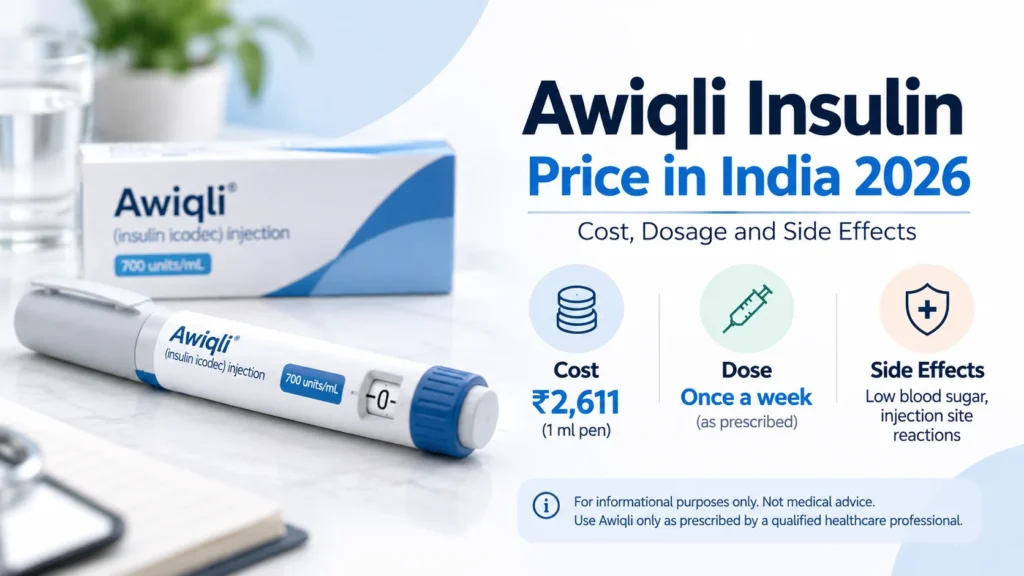
The Awiqli insulin price in India is Rs 2,611 for a 1 ml pen of 700 units and Rs 7,833 for a 3 ml pen of 2,100 units, or Rs 3.73 per unit. At a starting dose of 70 units a week, that is about Rs 261 a week. Awiqli is insulin icodec, a basal insulin taken once a week instead of daily.
Quick answer
What you actually pay depends on your dose, not on which pen you buy. Both pen sizes cost the same Rs 3.73 per unit, so there is no bulk saving in the larger one.
At a typical starting dose of 70 units a week, Awiqli works out to about Rs 261 a week, or roughly Rs 1,045 a month. Novo Nordisk says that makes it 30 to 40 percent cheaper per unit than the daily basal insulins already sold in India, where 70 units cost between Rs 345 and Rs 453.
Awiqli insulin price in India
The Awiqli insulin price in India runs from Rs 2,611 to Rs 7,833, depending on which of the two pen sizes you buy. Both work out to the same Rs 3.73 per unit, so the larger pen holds three times the insulin at exactly three times the price. There is no bulk saving in choosing it. Insulin icodec is the medicine inside the pen, so the insulin icodec price in India is the same figure, just listed under the brand name.
| Pen | Insulin units | Price | Per unit |
|---|---|---|---|
| Awiqli FlexTouch 1 ml | 700 units | Rs 2,611 | Rs 3.73 |
| Awiqli FlexTouch 3 ml | 2,100 units | Rs 7,833 | Rs 3.73 |
Prices announced by Novo Nordisk India at the New Delhi launch, July 2026. Confirm the current price with a licensed pharmacy before buying.
What Awiqli costs at different doses
Your real cost is set by your weekly dose, not by the pen. Someone on 140 units a week pays double what someone on 70 units pays. Our Awiqli dosage guide explains how that weekly dose is worked out.
| Weekly dose | Weekly cost | Monthly cost |
|---|---|---|
| 70 units | About Rs 261 | About Rs 1,045 |
| 100 units | About Rs 373 | About Rs 1,492 |
| 140 units | About Rs 522 | About Rs 2,089 |
| 210 units | About Rs 783 | About Rs 3,133 |
What Awiqli is and how it works
Awiqli is a basal insulin, meaning it covers the slow, steady background insulin your body needs between meals and through the night. The medicine inside is insulin icodec, which binds to albumin, a protein circulating in your blood. While it is bound it cannot act, so it sits there as a reserve and releases slowly across seven days. That is why one injection covers the week.
You inject it on the same day each week into the abdomen, thigh or upper arm. In type 2 diabetes it can be used on its own or alongside your other diabetes medicines. In type 1 diabetes it replaces only the background insulin, so you still take rapid-acting insulin before meals. Our Awiqli dosage guide covers how to use the pen and how the weekly dose is set.
Awiqli compared with daily insulin
The comparison shown here is against insulin glargine U100, a daily basal insulin widely available in India.
| Awiqli (insulin icodec) | Insulin glargine U100 | |
|---|---|---|
| Injection | Once a week | Once a day |
| Injections a year | 52 | 365 |
| Cost for 70 units | About Rs 261 | Rs 345 to Rs 453 |
| Concentration | 700 units per ml | 100 units per ml |
| HbA1c in Indian participants | Comparable | Comparable |
| Approved in India | Type 1 and type 2 | Type 1 and type 2 |
| Approved in the US for type 1 | No | Yes |
Cost comparison as stated by Novo Nordisk India at the launch, July 2026.
The last row is the one worth pausing on. Awiqli is approved in India for both types of diabetes, but the United States approved it for type 2 only, and the reason is covered in the next section.
What the trials actually found
Awiqli was tested in six phase 3a trials called ONWARDS. Five of them studied type 2 diabetes across 3,765 adults, and ONWARDS 6 studied type 1. Across the type 2 trials, weekly icodec either beat daily insulin on HbA1c or matched it, and ONWARDS 1 was published in the New England Journal of Medicine in 2023. That is the headline every news report ran with. Here is the part they left out.
Indian results were different
Mohan and colleagues looked at the 217 Indian participants inside ONWARDS 1, 4 and 6 and published their analysis in Diabetes Therapy in 2025. In these Indian participants, icodec did not show a meaningful HbA1c advantage over daily insulin.
| Trial | Who | HbA1c difference vs daily insulin |
|---|---|---|
| ONWARDS 1 | Type 2, new to insulin | 0.04% (95% CI -0.46 to 0.54) |
| ONWARDS 4 | Type 2, on basal bolus | -0.04% (95% CI -0.41 to 0.32) |
| ONWARDS 6 | Type 1, on basal bolus | 0.08% (95% CI -0.67 to 0.82) |
Indian subgroup analysis. Mohan V, Kesavadev J, Murthy LS and others. Diabetes Therapy, 2025.
Every one of those confidence intervals crosses zero, which means the difference could just as easily have been chance. The authors say as much themselves, and they note the trials were never designed to answer questions about one country’s participants. What Awiqli offers is the same job done once a week instead of seven times.
Type 1 diabetes, read this part twice
Awiqli is approved in India for both type 1 and type 2 diabetes. In the United States it is approved only for type 2. That gap comes from one trial, and if you have type 1 diabetes you should know what it found.
ONWARDS 6 compared weekly icodec against daily degludec in 582 adults with type 1 diabetes. Blood sugar control was equal. Low blood sugar was not.
| ONWARDS 6 result | Weekly icodec | Daily degludec |
|---|---|---|
| HbA1c at 26 weeks | Non-inferior | Comparator |
| Serious low blood sugar | 19.9 events per patient-year | 10.4 events per patient-year |
ONWARDS 6, a phase 3a trial in adults with type 1 diabetes. The Lancet, 2023.
That is roughly twice the rate, and the difference was statistically significant. In the type 2 trials the picture reversed, with fewer such episodes on icodec than on insulin glargine. In May 2024 a United States FDA advisory committee voted 7 to 4 against its use in type 1 diabetes, and the FDA approved Awiqli on 26 March 2026 for type 2 only. The European Union, Canada, Australia and Japan approved it for both.
If you have type 1 diabetes
These results do not rule Awiqli out in type 1 diabetes, but they do show a higher rate of serious low blood sugar in ONWARDS 6. The decision needs an endocrinologist who knows your hypoglycaemia history. Ask how your low blood sugar will be monitored in the first few months.
Awiqli side effects and three risks worth knowing
Low blood sugar is the main side effect, as with any insulin. The warning signs are sweating, shaking, a racing heart, sudden hunger and confusion. Keep glucose tablets or sugar within reach. Beyond that, a weekly insulin brings three risks that a daily one does not.
1. Hypoglycaemia clusters on days two to four
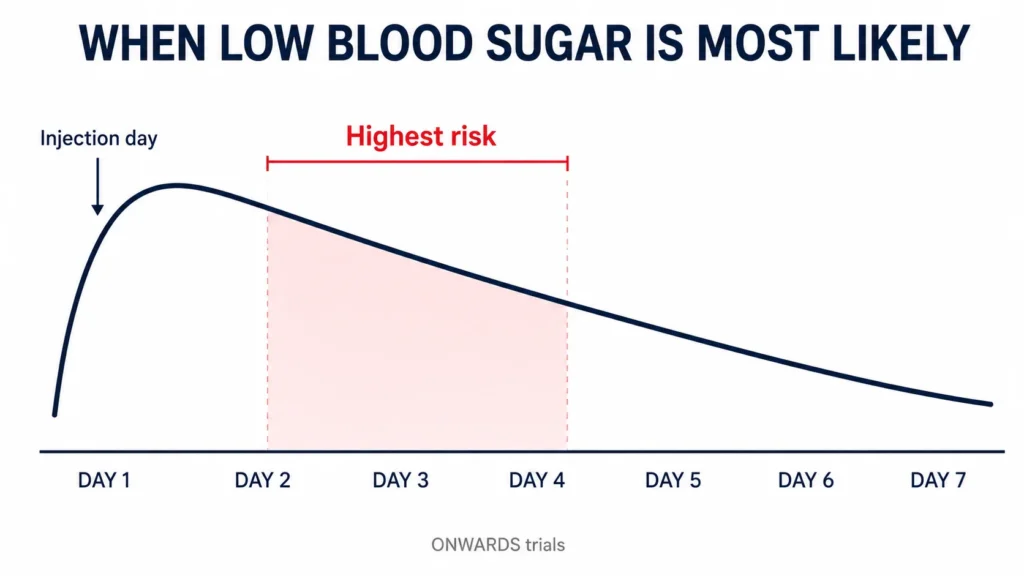
Icodec levels are highest early in the dosing week, and across the ONWARDS trials hypoglycaemic episodes clustered around days two to four after the injection. Watch those days more closely in the first few weeks and after any dose change.
2. The pen is seven times more concentrated
Awiqli holds 700 units per millilitre while most insulins in India hold 100. Serious low blood sugar needing hospital care has been reported when this pen was mixed up with another insulin, when the wrong dose was selected, or when it was taken more often than once a week.
Keep in mind: Store the Awiqli pen apart from any daily insulin pen, and check the label every single time before you inject. Never draw insulin out of the pen with a syringe.
3. You cannot adjust for one active day
With daily insulin you can lower tomorrow’s dose before a long walk or a wedding. With a week’s insulin already in your body, you cannot. A post hoc analysis of ONWARDS 1 to 5 found no significant rise in exercise-related hypoglycaemia, so this is lost flexibility rather than proven harm.
Other reported effects include injection site reactions, thickening of the skin where you inject, swelling in the legs and feet, and weight gain. Rotating the injection site each week helps. Tell your doctor if you take pioglitazone or another glitazone tablet, because taking one alongside insulin can cause fluid retention and worsen heart failure in some people.
Is Awiqli worth the price?
It depends on what you are buying. Fewer injections at a lower cost per unit, yes. Better blood sugar control, no. Novo Nordisk says Indians delay starting insulin by seven to nine years, held back by fear of the needle and the burden of a daily routine. If that sounds like you, one injection a week may be the change that gets you started, or keeps you going.
The clearest fit is someone with type 2 diabetes starting basal insulin for the first time, or someone already on a daily basal insulin who wants the same control with fewer needles. A careful conversation is needed if your activity swings hard from day to day, or if your kidneys are struggling, since ONWARDS 1 to 4 excluded people with severe kidney impairment.
Among the 217 Indian participants studied, Awiqli did not show a meaningful HbA1c advantage over daily insulin. So you are paying for fewer injections, not for better numbers.
Key takeaways
- Awiqli costs Rs 2,611 for the 1 ml pen of 700 units and Rs 7,833 for the 3 ml pen of 2,100 units, which works out to Rs 3.73 per unit.
- A starting dose of 70 units a week costs about Rs 261, roughly 30 to 40 percent cheaper per unit than daily basal insulin.
- Among the 217 Indian trial participants studied, it matched daily insulin rather than beating it.
- The pen holds 700 units per millilitre instead of the usual 100, so never mix it up with a daily insulin pen.
- The United States FDA approved it for type 2 diabetes only, after an advisory committee voted 7 to 4 against its use in type 1.
When to talk to your doctor
Do not switch on your own. Awiqli is not a like-for-like swap for your current pen, and the weekly dose has to be calculated from your daily one. Book an appointment before you change anything if you use basal insulin now, if you have type 1 diabetes, if your kidneys are not working well, or if your readings swing a lot from day to day. Our blood sugar chart by age shows the usual target ranges.
Get emergency help now
Call emergency services or go to the nearest emergency room if low blood sugar brings confusion, seizures or loss of consciousness. This is severe hypoglycaemia and it needs medical treatment. Do not try to give food or a sugary drink to someone who is unconscious or unable to swallow safely.
Frequently asked questions
What is the Awiqli insulin price in India?
Awiqli costs Rs 2,611 for the 1 ml pen holding 700 units and Rs 7,833 for the 3 ml pen holding 2,100 units, which works out to Rs 3.73 per unit. At a starting dose of 70 units a week, that is about Rs 261 a week. These are the launch prices announced by Novo Nordisk India in July 2026 and can vary by pharmacy.
How much does a weekly insulin injection cost in India?
Awiqli is the once-weekly basal insulin sold in India, and it costs about Rs 261 a week at a 70 unit dose. Someone on 140 units a week pays around Rs 522. Because the price works out to Rs 3.73 per unit, your weekly cost depends entirely on the dose your doctor prescribes.
What is the price of insulin icodec in India?
Insulin icodec is the medicine inside the Awiqli pen, so the price is the same: Rs 2,611 for 700 units and Rs 7,833 for 2,100 units. Icodec is the drug name and Awiqli is the brand Novo Nordisk sells it under in India. You will not find icodec listed separately at a different price.
Who makes Awiqli?
Novo Nordisk, the Danish company that also makes Ozempic. The medicine inside the pen is insulin icodec, and Novo Nordisk launched it in India in July 2026. Pharmacy sites sometimes list it as Awiqli insulin Novo Nordisk, which is the same product.
Where can I buy Awiqli in India?
Awiqli is sold through licensed pharmacies and major online pharmacy platforms, and it needs a valid prescription. Insulin has to stay cold between 2 and 8 degrees Celsius, so buy only from a seller that ships refrigerated. Check that the pack is sealed and within its expiry date, and avoid heavily discounted pens from unverified sellers.
Is Awiqli cheaper than daily insulin?
Per unit, yes. Novo Nordisk puts it at 30 to 40 percent cheaper than the daily basal insulins already sold here, where 70 units cost Rs 345 to Rs 453. Your actual monthly cost still depends on the dose you end up on, so a higher dose can cancel out the per unit saving.
How do you use the Awiqli pen?
You inject it under the skin of the abdomen, thigh or upper arm, once a week on the same day, at any time of day. Use a fresh needle each time and rotate the site rather than using the same spot. Our Awiqli dosage guide walks through the steps and the switching chart.
How many units of Awiqli are given each week?
Your doctor sets the dose. For an adult new to insulin the usual starting point is 70 units once a week. For someone moving across from a daily basal insulin, the weekly dose is worked out from the previous daily dose multiplied by seven, with a one-time higher first dose in some cases.
What should I do if I miss a dose of Awiqli?
If you remember within four days, take the missed dose as soon as you can, then continue once weekly from that day. If more than four days have passed, skip it and take your next dose on the usual day. Check your blood sugar more often than normal after a missed dose, and never take two doses close together to catch up.
Can people with type 1 diabetes use Awiqli?
In India, yes. It is approved for adults with both types. In the United States it is approved only for type 2 diabetes, after an FDA advisory committee voted 7 to 4 against its use in type 1, citing the risk of low blood sugar. If you have type 1 diabetes, this is a decision to make with your specialist.
What are the main side effects of Awiqli?
Low blood sugar is the main one, along with injection site reactions, swelling in the legs and feet, and weight gain. In the trials, hypoglycaemic episodes clustered on days two to four of the weekly dose, when icodec levels are highest, so those days are worth watching more closely at the start.
Does Awiqli help with weight loss?
No. Awiqli is an insulin, not a GLP-1 medicine like Ozempic or Mounjaro. Insulin can cause weight gain rather than weight loss, which is one reason the two are not interchangeable even though both are weekly injections.
Medical disclaimer
This page is published for education and awareness. It explains how Awiqli is used in general, not what is right for any one person, and it is not a diagnosis, a treatment plan or a prescription. Awiqli is a prescription medicine, so never start, stop or adjust an insulin dose on your own.
Prices, stock and product details can change after publication, so confirm the current price with a licensed pharmacy before buying. In a medical emergency, seek immediate care rather than searching online.
References
- Awiqli (insulin icodec-abae) prescribing information. DailyMed, US National Library of Medicine, 2026.
- Complete Response Letter for insulin icodec. Novo Nordisk, 2024.
- Insulin icodec in Indian participants: ONWARDS 1, 4 and 6. Diabetes Therapy, 2025.
- Weekly icodec versus daily glargine U100 (ONWARDS 1). New England Journal of Medicine, 2023.
- Weekly icodec versus daily degludec in type 1 diabetes (ONWARDS 6). The Lancet, 2023.
- Meta-analysis of ONWARDS 1 to 5. Diabetes, Obesity and Metabolism, 2024.
- Physical activity and hypoglycaemia with icodec. Diabetologia, 2025.
- Icodec outcomes by kidney function. ONWARDS post hoc analysis, 2025.
- Awiqli product information. Therapeutic Goods Administration, Australia.
- Novo Nordisk brings Awiqli to India. Medical Dialogues, 2026.
Written by
Iraphan Khan, BSN, RN, D.Pharm
Founder of RealMedVision, writing patient-focused health content based on clinical guidelines, regulatory records and peer-reviewed research.
Medically reviewed by
Dr Praveen Verma, MBBS, MD (Pathology), Pathologist and Clinical Laboratory Specialist
Dr Himanshu Morya, MBBS, Medical Educator
Last medically reviewed: 4 September 2026