
Medically reviewed: 6 September 2026 · Last updated: 6 September 2026
Seventy units a week if you are new to insulin. Your daily dose multiplied by seven if you are switching. The rest is detail, and the detail is what keeps you safe.
Awiqli dosage works differently from daily insulin because one injection has to cover seven full days. That changes how the dose is calculated, why the very first dose is often larger, and what you should do when a week goes wrong. This guide walks through each situation with the actual numbers, so you can check your prescription and understand the reason behind it.
Quick Answer
- New to insulin: the usual starting dose is 70 units once a week.
- Switching from daily insulin: your daily basal dose multiplied by seven becomes your weekly dose.
- First week only: doctors often raise that first dose by half, one time, to build the level faster.
- Injection day: once a week, same day, any time, with or without food.
- Never guess a dose. Every number here is for understanding your prescription, not for setting your own.
How One Injection Lasts a Week
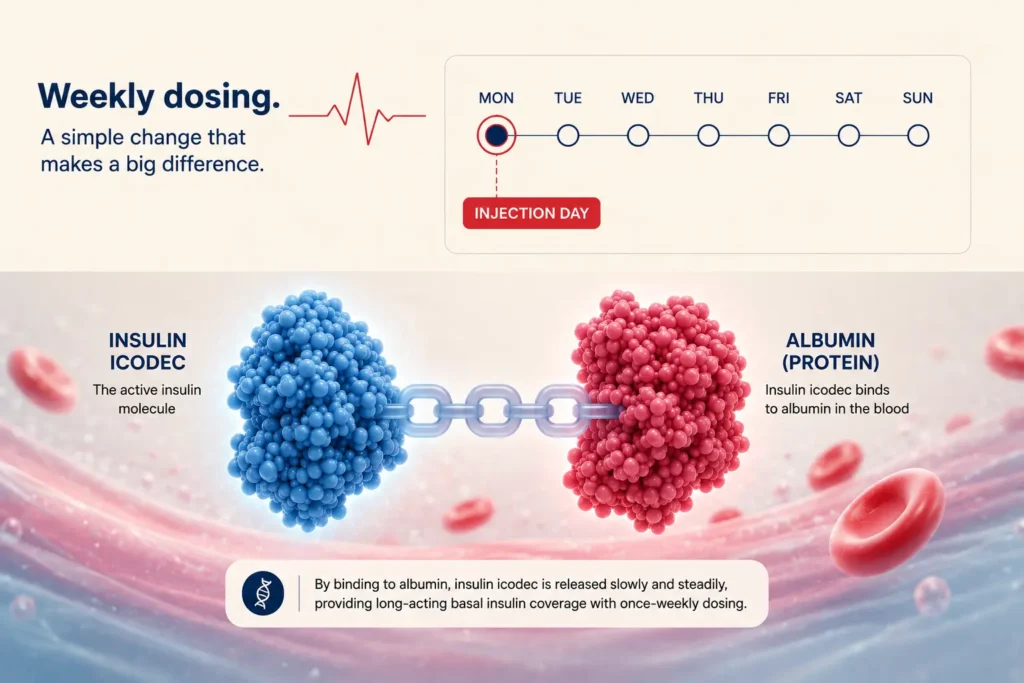
Awiqli contains insulin icodec, which binds tightly to albumin, a protein in your blood. That bond works like a slow release store, letting a little insulin unhook every hour until the next injection tops it up. This is why the dose is written in weekly units, seven times the daily number you may be used to.
In India it is approved for adults with type 2 and type 1 diabetes, while the United States has cleared it for type 2 only. It replaces basal insulins such as glargine or degludec, not mealtime insulin. If you are still deciding between the two styles, our Awiqli vs daily insulin comparison covers who benefits from switching and who should stay put.
Starting Dose If You Are New to Insulin
The label sets the starting point at 70 units once a week for an adult with type 2 diabetes who has never used insulin. That equals a modest 10 units a day, spread across the week. Your doctor then adjusts the dose in steps, usually weekly, guided by your morning readings, until the numbers settle where they should.
Switching From Daily Insulin: The Conversion
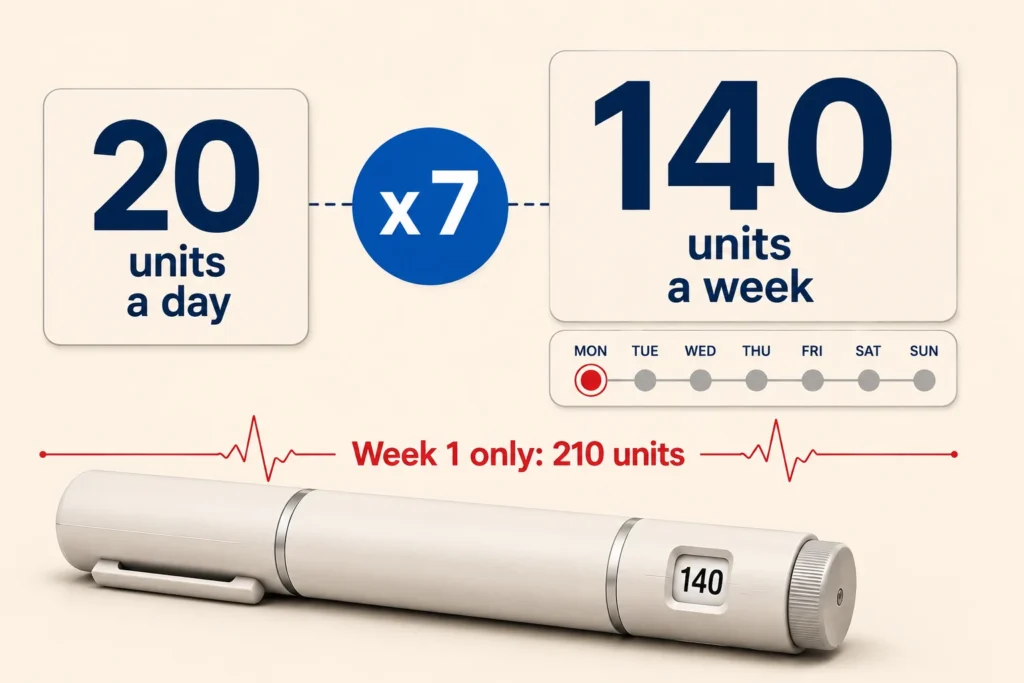
The base rule is simple multiplication. Take your total daily basal dose and multiply it by seven. Someone on 20 units of glargine a day moves to 140 units of Awiqli a week. For the first injection only, doctors often add half as much again, a one time loading dose that fills the albumin store quickly instead of waiting weeks for it to build.
| Daily basal dose | Week 1 with loading dose | Week 2 onwards |
|---|---|---|
| 10 units | 110 units | 70 units |
| 20 units | 210 units | 140 units |
| 30 units | 320 units | 210 units |
| 40 units | 420 units | 280 units |
| 60 units | 630 units | 420 units |
| 100 units | 1,050 units, as two injections | 700 units |
Worked examples using the label formula: daily dose times seven, with a one time 50 percent addition in week one, rounded to the nearest 10 units. Your prescription may differ, and that is normal.
The week one bar is taller on purpose. It is a single event, not the ongoing dose.
The American label recommends the higher first dose when switching. The European label treats it as optional in type 2 diabetes and required in type 1. Your doctor follows the instructions approved for the product supplied in your country.
The First Month: Why Patience Wins
With the one time higher first dose, icodec reaches its steady working level in about two to three weeks. Without it, allow three to four. Judging the dose after one injection is like judging a kettle before it boils. Readings can wobble while the level builds, so keep checking on the plan your doctor set, and report low sugar straight away instead of waiting for things to settle.
The level climbs with each injection and settles in about two to four weeks, sooner with the higher first dose. Dose reviews usually wait for this.
From there, adjustments come weekly at most, guided by fasting readings and, over the longer term, by your HbA1c level. Small steps beat big corrections every time.
When the Dose May Need Changing
A weekly insulin does not mean a fixed insulin. These are the common situations where doctors review the number.
| Situation | What usually happens |
|---|---|
| Fasting sugar staying above target | Dose moves up in small weekly steps |
| Low sugar episodes, or readings running low | Dose comes down, and the cause is checked |
| Illness or short term changes in food or activity | Closer sugar checks. Do not change the weekly dose yourself |
| Kidney or liver problems | More caution and more frequent review |
| Other diabetes medicines added or stopped | Dose rechecked against the new combination |
The combination that deserves the most respect is Awiqli with a sulfonylurea tablet such as glimepiride, because both push sugar down and the tablet dose often needs lowering when the insulin starts.
If You Miss a Dose
The window is four days. Remember within that time, inject as soon as you can, and that day becomes your new weekly injection day. Past four days, skip the missed one and take the next dose on your usual day. Check your sugar more often either way, and never take two doses close together to make up for one.
The Pen, the Units and the Storage
Awiqli is far more concentrated than daily insulin, at 700 units per millilitre. The pen does the conversion for you, so you simply dial the units your doctor prescribed. What you must never do is draw it out with a syringe, because a syringe marked for standard 100 unit insulin would deliver seven times the intended amount.
Inject under the skin of the abdomen, thigh or upper arm, rotating the exact spot each week. Unopened pens live in the fridge at 2 to 8 degrees Celsius. Once a pen is in use, it can stay at room temperature below 30 degrees and remains good for 12 weeks. Never freeze it, and never use a pen that has been frozen.
What a Weekly Dose Costs in India
| Your weekly dose | Approximate cost |
|---|---|
| 70 units | About Rs 261 a week, near Rs 1,045 a month |
| 140 units | About Rs 522 a week |
| 280 units | About Rs 1,045 a week |
Every pen works out to Rs 3.73 per unit, so your cost simply follows your dose. Pen prices, pack sizes and pharmacy discounts are covered in our Awiqli price in India guide. And Awiqli is no longer the only weekly option on the horizon, a second once weekly insulin called efsitora alfa has finished its major trials.
The Mistakes People Actually Make
- Judging the dose in week one. The level has not built yet. Give it three to four weeks unless readings are dangerously off.
- Doubling up after a missed week. The four day rule exists so you never stack two doses.
- Comparing weekly units with daily units. A neighbour on 20 daily units and you on 140 weekly units are on the same amount of insulin.
- Ignoring mild lows in the first weeks. Shakiness, sweating or sudden hunger are worth reporting early, not after they get worse. Our guide to Awiqli side effects explains what low sugar feels like and who runs the highest risk.
From a clinic visit: I sat with a relative during his switch from 24 daily units. The prescription read 250 units for week one, then 170. He was convinced the pharmacist had made a mistake, and only relaxed when the doctor wrote the multiplication out on paper. If a weekly number shocks you, ask for exactly that. Details changed for privacy, shared as an illustration.
When to Call Your Doctor
Call if fasting readings stay above target after three to four weeks, if low sugar keeps returning, or if illness stops you eating normally. Do not change the weekly dose on your own between visits.
Emergency
Severe low sugar with confusion, fits or unconsciousness needs emergency help now. Give sugar if the person can swallow safely, and call 112 or 108.
The Bottom Line
Two numbers carry this whole guide. Seventy units to start fresh, and daily dose times seven to switch. Everything else, the loading dose, the four day window, the three week wait, exists to make those two numbers work safely. Keep your injection day, keep your readings, and let your doctor drive the changes.
Frequently Asked Questions
What is the usual Awiqli dose to start with?
For an adult with type 2 diabetes who is new to insulin, the label starts at 70 units once a week. Your doctor then adjusts it in steps based on your fasting sugar readings.
How do I convert my daily insulin dose to Awiqli?
Multiply your total daily basal dose by seven. Twenty units a day becomes 140 units a week. Only your doctor should confirm the final number and decide about the higher first dose.
Why is my first Awiqli dose bigger than the rest?
The first injection is often raised by half, one time only, so the insulin level builds in days instead of weeks. From the second week you drop to your regular weekly dose.
What happens if I miss my injection day?
Take it as soon as you remember within four days, and that day becomes your new injection day. After four days, skip it and continue on your usual day. Never take two doses together.
How long does Awiqli take to work properly?
The full effect takes about two to three weeks with the higher first dose, and three to four without it. Doctors wait until then before judging the dose.
Is there a maximum Awiqli dose?
The pen delivers up to 700 units in one injection, so a weekly dose above 700 units is given as two injections. Your doctor sets and reviews the weekly number.
Can I change my injection day?
Yes. Keep at least four days between the old dose and the new one, then stay on the new day every week.
Where should I inject Awiqli?
Under the skin of the abdomen, thigh or upper arm, at any time of day, with or without food. Use a fresh needle each week and rotate the exact spot.
What should I do if my sugar goes low on Awiqli?
Take fast acting sugar straight away, such as glucose tablets or juice, then recheck after 15 minutes. Tell your doctor about any low, because repeated lows usually mean the dose needs lowering.
Is Awiqli dosing different for type 1 diabetes?
Yes in two ways. It is used with mealtime insulin, and the higher first dose is treated as required rather than optional. Type 1 dosing needs closer specialist supervision throughout.
References
- Awiqli (insulin icodec-abae) prescribing information. DailyMed, US National Library of Medicine, 2026.
- Awiqli (insulin icodec) medicine overview. European Medicines Agency, 2024.
- Awiqli, European public assessment report. European Medicines Agency.
- FDA approves Awiqli, the first and only once-weekly basal insulin treatment for adults with type 2 diabetes. Novo Nordisk, 26 March 2026.
- Awiqli biologics license approval letter. US Food and Drug Administration, 2026.
- Diabetes care gets easier: Novo Nordisk launches once-weekly insulin at Rs 261 a week. Business Today, 9 July 2026.
- Novo Nordisk launches world’s first once-weekly basal insulin Awiqli in India. Indian Pharma Post, 9 July 2026.
Written by
Iraphan Khan, BSN, RN, D.Pharm, Public Health Researcher
Founder of RealMedVision, writing patient-focused health content based on clinical guidelines and peer-reviewed research.
Medically reviewed by
Dr Praveen Verma, MBBS, MD (Pathology), Pathologist and Clinical Laboratory Specialist
Dr Himanshu Morya, MBBS, Medical Educator
Medical Disclaimer
This guide is for education and awareness. It is not medical advice and it cannot replace your own doctor. Never start, stop, or change an insulin dose on your own. If severe low blood sugar brings confusion, seizures or fainting, treat it at once and call 112 or 108.