
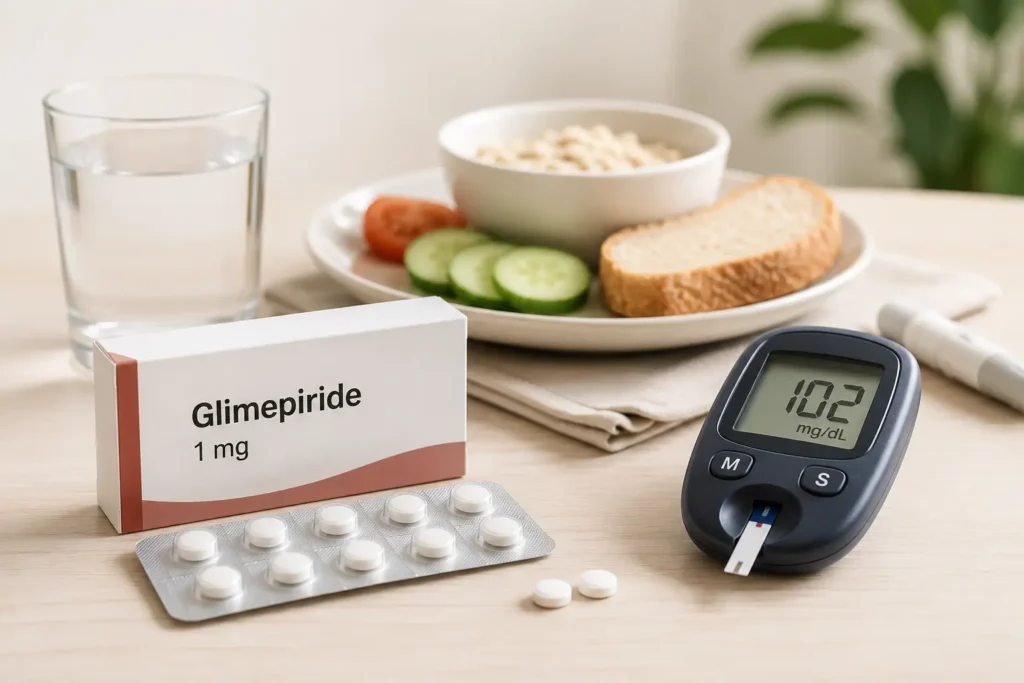
A once daily sulfonylurea tablet, taken with breakfast, that tells the pancreas to release more insulin.
Getting the dose right is the easy part. Skipping a meal after taking it is what sends people to hospital.
A patient-friendly guide by RealMedVision.
Medically reviewed: July 2026 | Last updated: July 2026 | 8 to 10 minute read
Key Takeaways
- Glimepiride treats type 2 diabetes in adults, not type 1 (FDA, 2025).
- Usual start is 1 mg or 2 mg once daily. The maximum on the United States label is 8 mg (FDA, 2025).
- Take it with breakfast, never on an empty stomach (FDA, 2025).
- Low blood sugar is the main risk. Treat 70 mg/dL (3.9 mmol/L) or below at once (ADA, 2026).
- Older adults and people with reduced kidney function start on 1 mg (FDA, 2025).
Introduction
If your doctor has just added glimepiride, the first worry is usually the same. Will this tablet make my sugar crash? It can, and that is worth saying plainly rather than glossing over. It is also a medicine that millions of people in India take safely once they understand two things: when to take it and what to do when a reading drops.
Quick Answer
Glimepiride is a sulfonylurea tablet that lowers blood sugar in adults with type 2 diabetes by prompting the pancreas to release more insulin. It is taken once daily with breakfast. Most people start on 1 mg or 2 mg, and the maximum recommended dose is 8 mg a day (FDA, 2025).
Glimepiride tablet uses in adults with type 2 diabetes
Glimepiride is used to lower blood sugar in adults with type 2 diabetes, alongside a proper diet and regular activity (FDA, 2025). It is not a stand alone treatment. It works with food and movement, not instead of them.
Doctors usually prescribe it as a second medicine when metformin alone stops holding blood sugar at target. It is also used first when metformin cannot be taken or when someone has clear symptoms of high sugar such as heavy thirst and frequent urination, because it lowers glucose quickly (NICE, 2026).
An Indian expert consensus in 2023 placed modern sulfonylureas like glimepiride as a practical second line option after metformin because they work well and cost little (Indian Journal of Diabetes in Developing Countries, 2023).
Glimepiride does not work in type 1 diabetes or diabetic ketoacidosis (FDA, 2025). It is also not recommended for children. If you have rising readings but no diagnosis yet, the [type 2 diabetes in adults over 40] warning signs are worth reading first.
How does glimepiride work in the body?
Glimepiride tells the beta cells in your pancreas to release more insulin. It attaches to a receptor on those cells, which closes a potassium channel and triggers insulin to be let out (FDA, 2025).
Picture the beta cell as a room with a door held shut. Glimepiride is the hand that pushes that door open.
This one fact explains almost everything else about the medicine. It pushes insulin out whether or not you have eaten. So if food does not arrive, blood sugar can fall too far. That is the opposite of how metformin behaves.
Blood sugar starts falling about 2 to 3 hours after a dose. The medicine stays active for roughly 5 to 8 hours (FDA, 2025). One dose covers the day for most people.
Glimepiride dose chart from 1 mg to 8 mg
The recommended starting dose is 1 mg or 2 mg once daily. It is then raised in steps of 1 mg or 2 mg, no more often than every 1 to 2 weeks, up to a maximum of 8 mg once daily (FDA, 2025). In India, most brands are sold from 1 mg to 4 mg.
| Daily dose | Who this usually applies to | What to know |
|---|---|---|
| 1 mg once daily | Older adults, reduced kidney function, anyone at higher risk of a low | Also the standard first step on the United Kingdom label |
| 2 mg once daily | Common starting dose for other adults | Increases are made from this point onward |
| 3 mg to 4 mg once daily | Usual maintenance range once readings settle | Above 4 mg helps only a minority of people (UK SmPC, 2020) |
| 6 mg once daily | Higher maintenance dose | The maximum on United Kingdom and European labels |
| 8 mg once daily | Maximum on the United States label | Not routine, and low sugar risk rises with dose |
The two labels genuinely differ. The United States prescribing information allows up to 8 mg a day (FDA, 2025). United Kingdom and European product information caps it at 6 mg and notes that more than 4 mg gives better results only in exceptional cases (UK SmPC, 2020).
Dose changes are guided by your fasting readings and your [HbA1c target], not by how you feel on a given day. Never raise or lower the dose yourself.
Should glimepiride be taken before or after food?
Take glimepiride with breakfast or shortly before it. The United States label says to give it with breakfast or the first main meal of the day (FDA, 2025). The United Kingdom label says shortly before or during a substantial breakfast (UK SmPC, 2020).
If you skip breakfast, take it with your first proper meal instead. Do not take it and then wait hours to eat.
You may have read that glimepiride must be taken 30 minutes before breakfast. That instruction belongs to some other diabetes tablets, not this one. Product information reports no meaningful difference between giving it 30 minutes before a meal and giving it immediately before (UK SmPC, 2020). What matters is the meal, not the countdown.
Swallow the tablet whole with water, at roughly the same time each morning.
The riskiest habit is taking the tablet and then missing the meal. Irregular meal times, skipped meals and fasting all push people into low blood sugar on this medicine (UK SmPC, 2020). If you plan to fast for a festival or a medical test, ask your doctor first about adjusting the dose.
Low blood sugar on glimepiride, and how to treat it
Low blood sugar, called hypoglycaemia, means a reading of 70 mg/dL (3.9 mmol/L) or below. It is the most common serious side effect of glimepiride (ADA, 2026). In one 14 week trial, symptoms suggesting a low were reported by 4 in 100 people on 1 mg. That rose to about 17 in 100 on 4 mg (FDA, 2025).
Higher dose means higher risk. This is why doctors move up slowly.
| Level | Reading | What it usually feels like |
|---|---|---|
| Level 1, alert value | Below 70 mg/dL (3.9 mmol/L) | Shakiness, sweating, fast heartbeat, hunger, irritability |
| Level 2, serious | Below 54 mg/dL (3.0 mmol/L) | Confusion, blurred vision, slurred speech, poor coordination |
| Level 3, severe | Any reading with severe symptoms | The person cannot help themselves and needs another person to act |
Source: American Diabetes Association Standards of Care in Diabetes, 2026.
What to do when your reading drops
Treat a reading of 70 mg/dL (3.9 mmol/L) or below straight away, using what is known as the rule of 15 (ADA, 2026).
Take 15 grams of fast acting sugar. That is about four teaspoons of sugar or glucose powder stirred into water, or half a cup of regular fruit juice. Wait 15 minutes, then check again. If the reading is still at or below 70 mg/dL, repeat the same amount. Once it comes back up, eat a meal or a snack, because a low caused by a sulfonylurea can return hours later (UK SmPC, 2020).
Call emergency services immediately if the person is drowsy, confused, having a fit, or cannot swallow safely. Do not put food or drink into the mouth of someone who is not fully awake.
Two things blunt your early warning. Beta blocker tablets used for blood pressure can mute the shakiness and sweating, and so can long standing nerve damage from diabetes (FDA, 2025). Alcohol raises the risk unpredictably, especially on an empty stomach.
Knowing your own [normal blood sugar range] makes it easier to spot a reading that is genuinely off.
Side effects of glimepiride
The most common side effects are low blood sugar, dizziness, weakness, headache and nausea (FDA, 2025). In pooled placebo controlled trials, headache affected about 8 in 100 people. Nausea and dizziness affected about 5 in 100 each (FDA, 2025).
Weight gain is common and it is dose related. Over 22 weeks, people on glimepiride gained an average of 1.8 kg, while the placebo group lost 0.9 kg (FDA, 2025). For someone already carrying extra weight, that is a real trade off to discuss.
Serious reactions are less common but do happen. They include severe allergic reactions, blistering skin rashes, liver problems such as jaundice and hepatitis, breakdown of red blood cells, low blood cell counts and low blood sodium (FDA, 2025).
Sulfonylureas are also linked with a higher fracture risk, and the American Diabetes Association advises avoiding them where bone health is already a concern (ADA, 2026).
Stop the tablet and call your doctor the same day if you notice yellowing of the eyes or skin, dark urine, severe stomach pain, unusual bruising, a spreading or blistering rash, or swelling of the lips and tongue.
Who should not take glimepiride?

Glimepiride must not be taken by anyone who has had an allergic reaction to glimepiride, to other sulfonylureas, or to sulfonamide medicines (FDA, 2025).
These groups should avoid it or use it only under close medical supervision:
- People with type 1 diabetes, diabetic ketoacidosis or diabetic coma. The tablet cannot work without functioning beta cells (FDA, 2025).
- People with severe kidney or liver disease. European product information calls for a switch to insulin (UK SmPC, 2020).
- People with G6PD deficiency, an inherited condition seen in parts of India. Sulfonylureas can break down red blood cells, so another class is preferred (FDA, 2025).
- Women who are pregnant or planning pregnancy. Treatment is usually switched to insulin (UK SmPC, 2020).
- Women who are breastfeeding, because of the risk of low blood sugar in the baby (UK SmPC, 2020).
- Children and teenagers, in whom benefit and safety are not established (FDA, 2025).
- Older adults and people with reduced kidney function. They start at 1 mg and move up slowly (FDA, 2025).
Some medicines change how glimepiride behaves. Fluconazole roughly doubles the amount in your blood, and miconazole taken by mouth has caused severe lows (UK SmPC, 2020, and FDA, 2025). Tell your doctor about every tablet, syrup and supplement you take, including anything bought over-the-counter.
Glimepiride and metformin compared
Metformin and glimepiride lower blood sugar in completely different ways. Metformin reduces the glucose your liver releases and improves how your body responds to insulin. Glimepiride makes your pancreas release more insulin. That is why they are so often combined.
| Feature | Metformin | Glimepiride |
|---|---|---|
| How it works | Lowers glucose made by the liver, improves insulin sensitivity | Prompts the pancreas to release more insulin |
| Risk of low blood sugar | Very low on its own | Common, and rises with dose |
| Effect on weight | Broadly weight neutral | Weight gain of around 2 kg is typical |
| Usual position | First choice for most adults | Added second, or used first if metformin is unsuitable |
| Kidney limits | Not started below eGFR 45, stopped below 30 | Started at 1 mg and raised slowly |
Source: American Diabetes Association Standards of Care in Diabetes, 2026.
Can they be taken together? Yes, and combination tablets are widely sold in India for exactly this reason. Metformin still comes first for most people because it is weight neutral, does not cause low blood sugar, and reduces deaths from heart disease (ADA, 2026).
Sulfonylureas also lose ground over time. The GRADE trial followed 5,047 adults already on metformin for an average of 5 years. Adding insulin glargine or liraglutide held people at target slightly better than adding glimepiride or sitagliptin, and severe lows were more common in the glimepiride group (NEJM, 2022).
For people who need stronger options later, [semaglutide options in India] have widened a great deal. Several [newer diabetes injections] also act on appetite and weight, not just glucose.
When glimepiride and metformin together stop holding blood sugar steady, the usual next step is adding a basal insulin. A [weekly basal insulin] is one of the newer ways of doing that.
Common glimepiride brands in India
Glimepiride is sold in India under many brand names, all containing the same active medicine. Combination tablets with metformin are especially common in general practice.
| Brand | Company | Type |
|---|---|---|
| Amaryl | Sanofi | Glimepiride alone |
| Glimestar | Mankind | Glimepiride alone |
| Glimy | Dr. Reddy’s | Glimepiride alone |
| Glimulin | Glenmark | Glimepiride alone |
| Glycomet-GP | USV | With metformin |
| Gluconorm-G | Lupin | With metformin |
Glimepiride is under price control in India. In 2021 the National Pharmaceutical Pricing Authority set a ceiling price of Rs 3.60 for a 1 mg tablet and Rs 5.72 for a 2 mg tablet (NPPA, 2021). These ceilings are revised each year, so check the Pharma Sahi Daam portal for the current figure.
What patients often get wrong
Many people reach for a sugar free biscuit or a diet soft drink when a low starts. This does not work. Artificial sweeteners have no effect on a hypoglycaemic episode, because they contain no glucose to raise your blood sugar (UK SmPC, 2020).
A low needs real sugar. Keep glucose powder, sugar sachets or regular fruit juice in your bag, at your bedside and in your car. Tell one person at home and one at work where it is kept.
If you miss a dose
Take the missed dose with your next main meal and carry on as normal. Do not take two tablets together to make up for it. Product information is explicit that a forgotten dose must not be corrected by increasing the next one (UK SmPC, 2020).
If the meal has passed and several hours have gone by, skip that day’s dose. Doubling up is what causes lows.
When to see a doctor
Book an appointment within the week if any of these apply:
- Lows are happening more than once a week or waking you at night.
- You have started a new medicine.
- Your kidney function has changed.
- You are planning a pregnancy or a period of fasting.
Treat it as an emergency and call for help if someone taking glimepiride becomes confused, cannot be woken, has a seizure, or does not improve after two rounds of sugar.
An overdose can cause low blood sugar lasting 12 to 72 hours. It can also return after an apparent recovery, so hospital observation is often needed (UK SmPC, 2020).
[CLINICAL NOTE: In my clinical experience, swallowing the tablet is not usually the difficult part. The real challenge is timing it around meals. Patients who work different shifts, older adults who eat small meals, and people who fast often need more guidance. When they understand when to take the medicine, how to recognise the early signs of low blood sugar, and what to do if it happens, they feel more confident using glimepiride safely.]
Frequently Asked Questions
What is the maximum dose of glimepiride per day?
The maximum recommended dose is 8 mg once daily on the United States label (FDA, 2025). United Kingdom and European product information sets a lower ceiling of 6 mg a day and notes that going above 4 mg helps only in exceptional cases (UK SmPC, 2020).
Can glimepiride cause low blood sugar?
Yes. Low blood sugar is the most common serious side effect, and the risk climbs with the dose. In trials, symptoms suggesting a low affected about 4 in 100 people on 1 mg and about 17 in 100 on 4 mg (FDA, 2025). Older adults are most at risk.
What are the warning signs of low blood sugar?
Early signs are shakiness, sweating, a fast heartbeat, sudden hunger, dizziness and irritability. As the reading falls further, confusion, blurred vision and slurred speech appear (ADA, 2026). Treat any reading of 70 mg/dL (3.9 mmol/L) or below at once. Beta blockers can mute these signs.
What happens if you skip a meal after taking glimepiride?
Your blood sugar can fall too low. Glimepiride keeps pushing insulin out whether or not food arrives. Missed meals, irregular meal times and fasting all bring on hypoglycaemia on this medicine (UK SmPC, 2020). If a meal will be delayed, keep fast acting sugar within reach.
What should you do if you miss a dose of glimepiride?
Take it with your next main meal and continue as usual. Never double the next dose to make up for a missed one, because product information is explicit that a forgotten dose must not be corrected that way (UK SmPC, 2020). If most of the day has passed, skip it.
Is glimepiride better than metformin?
Metformin is generally preferred first. Against sulfonylureas, it is weight neutral, does not cause low blood sugar on its own, and reduces deaths from heart disease (ADA, 2026). Glimepiride works well and costs very little, so it is usually added second.
Can glimepiride and metformin be taken together?
Yes. The two work on different problems, so they are commonly combined, and fixed dose tablets are widely sold in India. European product information supports adding glimepiride when the highest tolerated metformin dose is not enough (UK SmPC, 2020). The low sugar risk comes from the glimepiride part.
Does glimepiride cause weight gain?
Yes, modest weight gain is expected. In a 22 week trial, people on glimepiride gained an average of 1.8 kg while those on placebo lost 0.9 kg (FDA, 2025). The gain happens because more insulin is circulating. Raise it with your doctor rather than stopping the tablet.
Bottom Line
Glimepiride is an effective, inexpensive tablet for type 2 diabetes. Its safety comes down to one habit: take it with a real meal every time. Learn your numbers, keep fast acting sugar nearby, and review the dose with your doctor at least once a year. If you are not on medication yet, the evidence on how far diet and activity can [reverse prediabetes] is worth reading first.
References
- FDA Prescribing Information for glimepiride tablets, DailyMed, 2025
- Glimepiride 4 mg tablets Summary of Product Characteristics, electronic medicines compendium, 2020
- American Diabetes Association, Glycemic Goals, Hypoglycemia and Hyperglycemic Crises, Standards of Care in Diabetes 2026
- American Diabetes Association, Pharmacologic Approaches to Glycemic Treatment, Standards of Care in Diabetes 2026
- American Diabetes Association, Older Adults, Standards of Care in Diabetes 2026
- NICE guideline NG28, Type 2 diabetes in adults, management, initial medicines
- GRADE Study Research Group, Glycemia Reduction in Type 2 Diabetes, New England Journal of Medicine, 2022
- GRADE Study Research Group, Hypoglycemia outcomes, PLOS One, 2024
- Time to reposition sulfonylureas in type 2 diabetes management in the Indian context, PubMed, 2023
- Position of Sulfonylureas in the Current Era, review of national and international guidelines, 2022
- AMARYL glimepiride tablets, FDA approved label, accessdata.fda.gov
- ICMR Guidelines for Management of Type 2 Diabetes, Indian Council of Medical Research
Medical Disclaimer
This article is for general education only and does not replace advice from your own doctor. Do not start, stop or change the dose of glimepiride on the basis of what you read here. Always speak to a qualified healthcare professional about diagnosis, treatment and any medical emergency.
Medically reviewed by
This guide was checked for medical accuracy by our review board before publishing.
Dr. Praveen Verma, MBBS, MD (Pathology), Pathologist and Clinical Laboratory Specialist.
Dr. Himanshu Morya, MBBS, Medical Educator.
Kalpna Singh Shekhawat, BSN, RN, NP
About the author
Iraphan Khan, BSN, RN, D.Pharm, is the founder of RealMedVision and a Public Health Researcher who creates evidence-based health content from trusted medical sources.
This article is for education and does not replace advice from your own doctor.