
A clear, doctor-reviewed guide to what your PP sugar reading actually means, why labs disagree on the exact number, and when a high result needs attention.
If your lab report shows a PP sugar number and you are not sure whether it is good or worrying, you are not alone. Many people managing type 2 diabetes get confused here, because different labs and doctors quote slightly different cutoffs for the same test.
This guide explains the PP sugar range in plain terms, why the normal number depends on whether you already have diabetes, and what a high or low reading actually means for you.
Quick Answer
- For a healthy adult, the normal PP sugar range is below 140 mg/dL, measured 2 hours after starting a meal.
- For someone already diagnosed with diabetes, the treatment target is usually below 180 mg/dL at 1 to 2 hours after eating.
- A 2 hour glucose level of 200 mg/dL or higher during a 75 g oral glucose tolerance test (OGTT) meets the diabetes diagnostic threshold. Confirmatory testing is generally needed when there are no clear symptoms of hyperglycemia.
- PP stands for postprandial, meaning after a meal. It is different from a fasting or random sugar test.
What Does PP Sugar Actually Mean?
PP stands for postprandial, a medical term that simply means after eating. A PP sugar test measures how much glucose is in your blood after a meal, showing how well your body handles the sugar and carbohydrates you just consumed.
This is different from a fasting test, which is taken after 8 hours without food, and a random test, which can be taken at any time. PP testing specifically shows how your pancreas and insulin respond once food enters your system, which is often where early problems with blood sugar control first show up.
The PP Sugar Range: Why the Number Depends on Who You Are
Below 140 mg/dL at 2 hours is commonly used as a reference for normal post-meal glucose after an ordinary meal. The 140 to 199 mg/dL and 200 mg/dL or above categories, however, are diagnostic thresholds that specifically apply when the reading comes from a standardized 75 g oral glucose tolerance test (OGTT), not an everyday meal.
| Group | PP Sugar Target | Test Context |
|---|---|---|
| Healthy adult, no diabetes | Below 140 mg/dL | 2 hours after an ordinary meal |
| Diagnosed diabetes, ADA target | Below 180 mg/dL | 1 to 2 hours after an ordinary meal |
| Prediabetes (impaired glucose tolerance) | 140 to 199 mg/dL | 2 hour glucose during a 75 g OGTT |
| Diabetes diagnosis threshold | 200 mg/dL or above | 2 hour glucose during a 75 g OGTT |
The below 180 mg/dL figure is a treatment target set by the American Diabetes Association for people already managing diabetes after an ordinary meal, not a diagnostic cutoff. The 140 to 199 and 200 mg/dL figures come from a specific, standardized test rather than whatever you happened to eat for lunch. This single distinction explains why two different sources can quote different numbers and both be correct.
1 Hour vs 2 Hour PP Test: What Is the Difference?
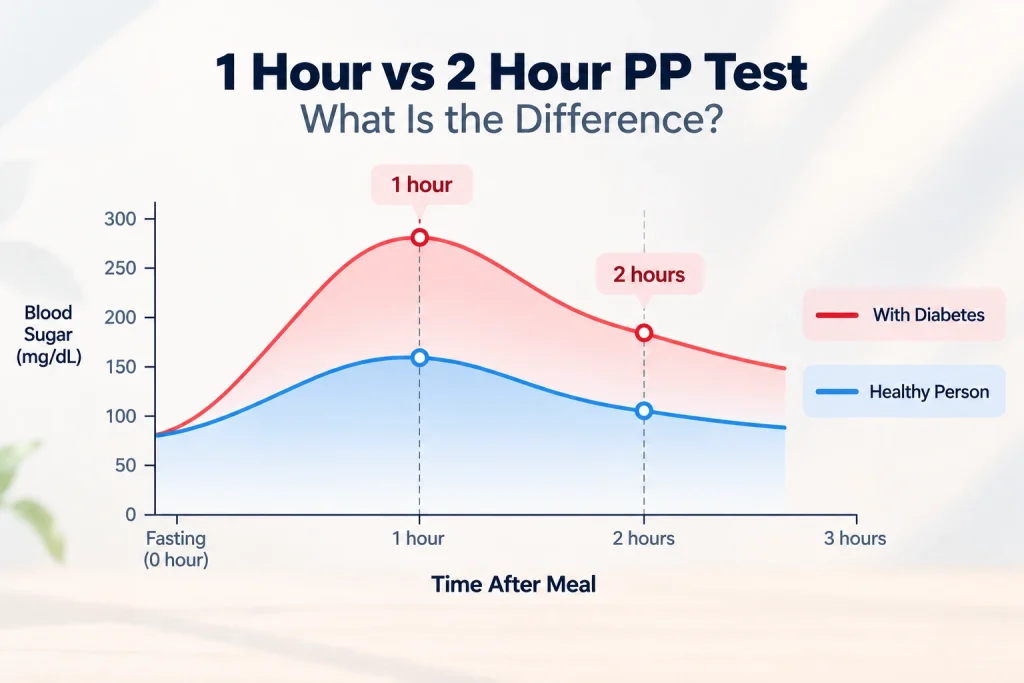
A PP sugar test is commonly measured 2 hours after the start of a meal, although the exact timing can vary depending on why the test was ordered. A 1 hour reading is sometimes used as well, mainly to catch an early or sharper spike that a 2 hour test might miss.
A 1 hour reading can be higher than a 2 hour reading, since glucose often peaks earlier after eating. The target that applies to your result depends on why the test was ordered and whether you have diabetes or are pregnant. For diagnosed diabetes, the American Diabetes Association generally has postprandial measurements taken 1 to 2 hours after the start of a meal, with a peak target below 180 mg/dL for many non-pregnant adults. If your doctor has specifically ordered a 1 hour test, do not assume the 2 hour cutoffs above apply, ask which timing and target they are using.
How Is a PP Sugar Test Done?
You do not need to fast before this test. Eat a normal meal, the same size and content you would usually eat, and note the time you take your first bite. A blood sample is then taken exactly 2 hours later, either at a lab or with a home glucometer.
Timing matters more than most people realise. Testing too early can show a false spike, while testing late can miss the peak entirely. If your doctor has also ordered a HbA1c test, that result reflects your average sugar over the past 2 to 3 months and works alongside your PP reading, not in place of it.
What Can Push Your PP Sugar Higher?
Meal composition matters a great deal. Refined carbohydrates like white rice, white bread, and sugary drinks raise glucose faster and higher than meals with more fibre, protein, and complex carbohydrates.
Portion size, physical activity before and after eating, sleep quality, and stress all influence the reading too. Acute stress and poor sleep can raise blood glucose in some people, so an unusual reading should be interpreted in context rather than by itself. Repeated high readings on different days are what matter clinically, alongside your prediabetes risk profile.
| Factor | Effect on PP Reading |
|---|---|
| Refined carbohydrates (white rice, sweets) | Raises reading faster and higher |
| Fibre and protein in the meal | Slows the rise, lowers peak |
| Large portion size | Higher peak, longer time to settle |
| Short walk after eating | Light activity may help reduce the rise |
| Acute stress or poor sleep | Can raise the reading in some people |
None of these factors alone means something is wrong. They explain why the same person can get two different PP readings on two different days without any real change in their underlying health.
PP Sugar in Pregnancy: Targets vs Diagnostic Criteria
Pregnancy uses its own numbers, and here it helps to separate two different things. Everyday glucose targets are what you aim for once gestational diabetes has already been diagnosed and you are monitoring day to day. Diagnostic criteria are the specific cutoffs from a standardized test used to diagnose it in the first place. These are not the same numbers.
For diagnosis, the American Diabetes Association one-step approach uses a 75 g OGTT, with gestational diabetes confirmed if any one of these values is met or exceeded, fasting 92 mg/dL, 1 hour 180 mg/dL, or 2 hour 153 mg/dL. Only one abnormal value is needed for diagnosis, unlike the two values usually required in general adult diabetes testing.
If you are pregnant and have received a specific glucose reading, do not compare it directly to the general adult chart above. Your obstetrician or diabetes specialist will interpret it against pregnancy-specific criteria, and will set separate day to day targets once a diagnosis is made.
Doctor’s Tip
Write down what you ate before a PP test, not just the number afterward. A high reading after a festival meal tells a very different story than a high reading after your usual lunch.
What If Your PP Sugar Is Low Instead of High?
A PP sugar reading below 70 mg/dL is considered low, most often in people already on insulin or certain diabetes medicines. This is a form of hypoglycemia that needs prompt action rather than waiting.
The usual first step is 15 grams of a fast-acting carbohydrate, followed by a recheck 15 minutes later. If the level is still low, this is repeated. Once it normalises, a small snack with protein and complex carbohydrate can help prevent another drop. If you often feel shaky, dizzy, or unusually hungry after meals, mention this to your doctor even if a single reading looked fine.
When Should You See a Doctor About a PP Sugar Result?
A single high reading after an ordinary meal is worth mentioning to your doctor, but is not an emergency on its own. If your doctor orders a formal 75 g OGTT and the 2 hour result reaches 200 mg/dL or higher, especially if confirmed on a repeat test, this crosses the diagnostic threshold used by both the American Diabetes Association and Indian guidelines, alongside any other early diabetes symptoms you may have noticed.
When to Get Medical Help Quickly
- A PP reading above 250 mg/dL along with excessive thirst, frequent urination, or blurred vision
- A low reading below 70 mg/dL that does not improve after fast-acting carbohydrate
- Confusion, sweating, or fainting alongside an unusually high or low reading
- Any reading you cannot explain, paired with feeling generally unwell
Key Takeaways
- Ask whether your doctor is using the healthy-adult target or the diabetes-treatment target before comparing your number to any chart.
- Note what you ate and when, since meal timing and content change the result more than most people expect.
- Treat one unusual reading as a signal to retest, not as a diagnosis on its own.
- If pregnant, use pregnancy-specific targets rather than the general adult range.
- A reading of 200 mg/dL or above on a formal OGTT, confirmed with a second test, needs a prompt conversation with your doctor.
Frequently Asked Questions
What is the normal PP sugar range?
Below 140 mg/dL, 2 hours after an ordinary meal, is commonly used as a reference for a healthy adult. For someone with diagnosed diabetes, the treatment target is usually below 180 mg/dL.
What does PP mean in a sugar test?
PP stands for postprandial, meaning after a meal. A PP sugar test measures glucose after eating, rather than after fasting.
Is PP sugar of 140 normal?
A 2 hour PP reading of 140 mg/dL is at the upper boundary of the commonly used reference for normal post-meal glucose. It should not be interpreted as a diabetes diagnosis by itself, though your doctor may suggest a repeat test.
Why do different websites give different PP sugar numbers?
Most disagreements come from mixing up the healthy-adult range with the diabetes-treatment target, which are genuinely two different numbers set for two different groups.
Should PP sugar be tested 1 hour or 2 hours after eating?
The 2 hour test is standard for most people. A 1 hour test is sometimes added to catch an early spike, particularly during pregnancy or specific risk screening.
Do I need to fast before a PP sugar test?
No. Eat your usual meal and note the start time. The blood sample is taken 2 hours later, not before eating.
What PP sugar level indicates diabetes?
A 2 hour glucose level of 200 mg/dL or higher during a formal 75 g OGTT meets the diagnostic threshold used by both the American Diabetes Association and Indian guidelines. Confirmatory testing is generally needed unless there are clear symptoms of hyperglycemia. An ordinary after-meal reading is not the same as this standardized test.
Is the PP sugar range different during pregnancy?
Yes, pregnancy uses its own diagnostic criteria. For gestational diabetes, a 75 g OGTT is considered abnormal if fasting reaches 92 mg/dL, 1 hour reaches 180 mg/dL, or 2 hour reaches 153 mg/dL, with only one abnormal value needed.
Can stress raise a PP sugar reading?
Yes. Acute stress releases cortisol and adrenaline, which can raise blood glucose in some people. A calm retest helps confirm whether an unusual reading was a one-off or a genuine pattern.
What should I do if my PP sugar is low?
Take 15 grams of fast-acting carbohydrate, wait 15 minutes, then recheck. Repeat if still low, and follow up with a small protein and complex-carbohydrate snack once it normalises.
References and Sources
- American Diabetes Association. Diagnosis and Classification of Diabetes: Standards of Care in Diabetes, 2026.
- American Diabetes Association. Check Your Blood Glucose.
- Optimizing Nutrition Strategies for Diabetes Management in India, PMC, 2026.
- Medscape. Glucose: Reference Range, Interpretation, Collection and Panels.
- Lal PathLabs. Postprandial Blood Sugar Test (PPBS Test), patient explanatory reference.
- Correlation Between First Trimester Two-Hour Postprandial Blood Glucose and GDM Prediction, Cureus, 2024.
Written by
Iraphan Khan, BSN, RN, D.Pharm, Public Health Researcher
Founder of RealMedVision, writing patient-focused health content based on clinical guidelines and peer-reviewed research.
Medically reviewed by
Dr Praveen Verma, MBBS, MD (Pathology), Pathologist and Clinical Laboratory Specialist
Dr Himanshu Morya, MBBS, Medical Educator
This article is for information and education only, and is not a substitute for professional medical advice. Individual targets vary by age, health condition, and pregnancy status. Always talk to your doctor before interpreting a lab result or changing any treatment.