
A patient-friendly guide by RealMedVision.
Medically reviewed: July 2026 | Last updated: July 2026 | 8 to 10 minute read
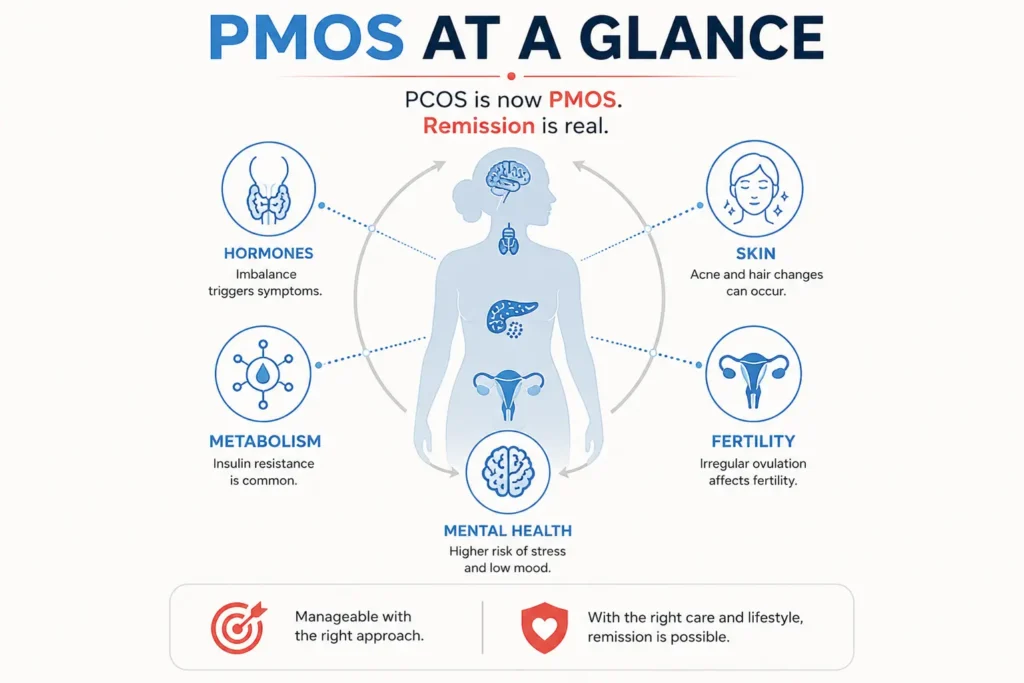
No. PCOS has no permanent cure. Now officially renamed PMOS, it is a lifelong multisystem hormonal condition, not a simple ovary problem. But symptoms can improve or disappear with the right treatment, and many people reach long stretches with regular cycles, clearer skin and restored fertility.
Key takeaways
People searching how to cure PCOS permanently often meet a second surprise. In May 2026, a global consensus published in The Lancet renamed polycystic ovary syndrome to polyendocrine metabolic ovarian syndrome (PMOS). The condition affects about 1 in 8 women. The old name was inaccurate, because many patients never have ovarian cysts.
- There is no cure. The World Health Organization fact sheet updated in January 2026 says so plainly while confirming that treatment reduces symptoms and protects long-term health.
- The name changed in May 2026. A global consensus in The Lancet replaced polycystic ovary syndrome with polyendocrine metabolic ovarian syndrome (PMOS).
- About 10 to 13 percent of women of reproductive age are affected, and up to 70 percent do not know they have it (WHO, 2026).
- Losing 5 to 10 percent of body weight can bring back ovulation in people carrying extra weight (Cleveland Clinic Journal of Medicine, 2026).
- Treatment follows your goal. The 2023 International Guideline puts combined pills first for cycles and skin, letrozole first for fertility, and rated metformin more effective than inositol.
Why is PCOS now called PMOS?
The name changed because the old one described the wrong organ. In May 2026, an international consensus published in The Lancet replaced polycystic ovary syndrome with polyendocrine metabolic ovarian syndrome, shortened to PMOS.
The process was led from Monash University by Professor Helena Teede and drew more than 14,000 survey responses. About 86 percent of patients and 71 percent of health professionals wanted a new name (The Lancet, 2026).
The reason is simple. Cysts are not required for the diagnosis, and many people who have the condition never have them. Leading with the word polycystic sent patients towards gynaecology when the problem also sits in hormones, metabolism, skin, and mental health.
Here is the part most articles skip. Your diagnosis has not changed, and you do not need a new test. Records and prescriptions will keep saying PCOS for years because coding systems update slowly. For older terms people still mix up, read [PCOD vs. PCOS].
How to cure PCOS permanently: Is there any proven method?
There is no proven method. No medicine, diet, supplement, herbal course or surgery has been shown to remove this condition from the body for good. The WHO fact sheet updated in January 2026 states it directly.
That is a hard sentence to read if you have spent months searching for the opposite. So let us be precise. The absence of a cure is not the absence of good treatment. It means the underlying tendency stays with you, even during years when you have almost no symptoms.
Doctors treat it the way they treat high blood pressure. Nobody promises a cure. Everyone agrees it can be controlled well enough to stop causing damage.
What is the difference between a cure and remission in PCOS?
A cure means the disease is gone. Remission means the symptoms are gone while the underlying condition remains. In PMOS, remission is realistic and a cure is not.
| Cure | Remission | Long term management | |
|---|---|---|---|
| Meaning | Disease completely gone | Symptoms improve or disappear | Ongoing lifestyle and medical care |
| Possible in PCOS | Not currently possible | Possible in many people | Most common outcome |
| Used in guidelines | Not used | Used, but not the standard term | Standard approach |
This is not word games. It changes what you buy and what you expect. A product sold as a permanent cure makes a claim no guideline supports. A plan aimed at remission makes a claim the evidence does support. The same question comes up with other long-term hormone conditions. See [Is Thyroid Curable].
Why can PCOS not be permanently cured?
Because it sits in how your body handles hormones and fuel, not in one organ that can be removed or repaired. Four processes drive it, and they feed each other.
Insulin resistance. The body still makes insulin, but cells respond poorly, so the pancreas makes more. High insulin pushes the ovaries to produce extra androgens. It affects most people with PMOS, including many who are not overweight.
Hyperandrogenism means higher than usual levels of male-type hormones such as testosterone. That is what produces acne, unwanted facial or body hair, and scalp thinning.
Anovulation means the ovary does not release an egg in a given cycle, which causes late or missing periods and most of the fertility trouble. Chronic low-grade inflammation runs quietly alongside and appears to make insulin resistance worse.
It also runs in families (WHO, 2026), which is why treatment quietens symptoms but cannot rewrite the tendency. Because insulin sits at the centre, blood sugar screening is routine. See [Normal Blood Sugar Levels Chart by Age] and [HbA1c Normal Range Chart by Age].
What are the 4 types of PCOS?
The four types you see online are not an official medical classification.
Some healthcare professionals and online resources describe four PCOS patterns: insulin resistant, adrenal, inflammatory, and post pill. These categories are not part of internationally accepted diagnostic guidelines. The 2023 international guideline classifies PCOS using the Rotterdam criteria and recognised phenotypes instead.
What doctors actually use is the Rotterdam criteria. You need two of these three features, once other causes have been ruled out: signs or blood tests showing high androgens, irregular or absent ovulation, and polycystic ovaries on ultrasound.
Because any two of three qualify, people fall into different phenotypes. One has high androgens and irregular cycles with normal-looking ovaries. Another has irregular cycles and polycystic ovaries with normal testosterone. Their risks and treatment priorities differ, which is why two people with the same diagnosis get different advice.
What can actually be improved?
Many people use the term reverse PCOS. Doctors usually describe this as symptom remission or metabolic improvement rather than a permanent cure.
With that framing in place, quite a lot improves. Cycles become regular. Ovulation returns. Acne and excess hair growth settle. Insulin sensitivity, cholesterol and blood pressure improve, which lowers the long-term risk of type 2 diabetes. Regular bleeds also protect the uterine lining from endometrial hyperplasia, an overgrowth that can turn cancerous if ignored for years.
What does not change is the underlying tendency. Stop the treatment and symptoms usually drift back over months. That is not failure. That is how a chronic condition behaves.
How do doctors treat PCOS?
Treatment is chosen by what is bothering you, not by the diagnosis itself. Someone who wants regular periods gets a different plan from someone trying to conceive.
| Treatment | Main purpose | What the evidence says |
|---|---|---|
| Combined oral contraceptive pill | Regular bleeds, acne, unwanted hair | First-line for cycle and skin problems (2023 International Guideline) |
| Metformin | Insulin resistance, blood sugar, weight | Recommended mainly for metabolic features, often alongside the pill |
| Letrozole | Ovulation induction for fertility | Preferred first-line fertility medicine, ahead of clomiphene citrate |
| Spironolactone | Hirsutism and stubborn acne | Anti-androgen with a limited role, used with reliable contraception |
| Myo-inositol and D-chiro-inositol | Insulin sensitivity | Low risk of harm, but limited benefit for ovulation, hair or weight |
| Laser and cosmetic hair reduction | Facial and body hair | Effective for hair reduction in some groups |
Two points deserve honesty. Metformin has been the default for two decades, but newer trials have not always matched the early enthusiasm, and it is no longer treated as a first choice for weight loss or ovulation. Inositol is sold aggressively in India, yet the 2023 guideline placed it below metformin because the clinical gains are small.
Can GLP-1 medicines help with PCOS?
GLP-1 receptor agonists are not currently approved specifically for PCOS. Doctors may prescribe them in selected patients, particularly those with obesity or insulin resistance.
The early data is encouraging. A proof-of-concept study from the University of Colorado Anschutz, published in Fertility and Sterility in 2026, found that injectable semaglutide improved signs of ovulation and reproductive function in women with PMOS, sooner than weight loss alone would predict. The researchers called for larger trials, so this is emerging research, not settled practice.
Three cautions matter. These are not fertility drugs, and they are stopped well before trying to conceive. Benefits fade when the medicine stops. And cost is a real barrier in India. If you are comparing options, see [Semaglutide Brands in India].
What does the evidence say about lifestyle change?
Lifestyle change helps almost everyone, and it is also the most oversold part of the plan. For people carrying extra weight, losing 5 to 10 percent of body weight can restore ovulation and regularise cycles (Cleveland Clinic Journal of Medicine, 2026).
The 2023 International Guideline adds two findings that rarely reach diet posts. No single eating pattern beats the others, so keto, low carb and fasting have no proven edge here. And eating well and moving help even when the scale does not move, which matters at any weight. For a starting structure built around Indian meals, see [PCOS Diet Chart].
How long does it take to see improvement?
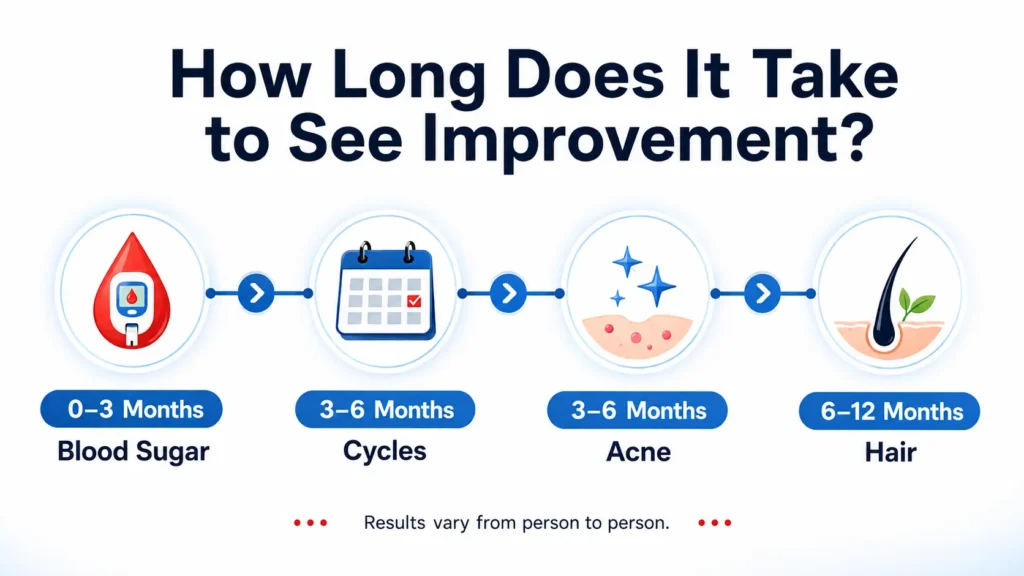
Plan in months, not weeks. Different symptoms run on different clocks, which is why people give up too early.
Blood sugar and insulin markers usually shift first, often within about three months. Cycles need three to six months to settle. Acne improves over a similar period. Unwanted hair is slowest, because follicles work on their own cycle, so six to twelve months is a fair wait.
These are typical ranges, not guarantees. Some people respond faster and some do not respond to the first plan at all, which is a reason to review with your doctor rather than quit.
Is lean PCOS different?
Yes, in what drives it and what treats it. Lean PCOS describes people who meet the diagnostic criteria while sitting in the normal weight range.
Insulin resistance can still be present, which surprises anyone told this is a weight problem. Because weight loss is not available as a lever, treatment leans on the pill for cycles and skin, letrozole when fertility is the goal, and metabolic screening that is often skipped in slim patients. Everyone with the diagnosis needs blood sugar and cardiovascular risk checked, whatever the scale says.
Can you get pregnant with PCOS?
Yes. Most people with PMOS who want a pregnancy can achieve one, often with straightforward treatment. The problem is usually irregular ovulation, not an inability to conceive.
Letrozole is the preferred first-line medicine to trigger ovulation, ahead of clomiphene citrate, under the 2023 International Guideline. If tablets fail, injections or ovarian surgery come next, and IVF sits at the third line. Pregnancy here carries a higher risk of gestational diabetes and raised blood pressure, so extra monitoring is normal rather than alarming.
What does PCOS treatment cost and involve in India?
Most of the core medicines are inexpensive generics in India, and the costly options are the newest ones.
Metformin, combined oral contraceptive pills, spironolactone and letrozole are all widely stocked generics, and letrozole is a short course of a few days per cycle rather than a daily expense. Inositol supplements sell at premium prices for a benefit the guideline rates as small. GLP-1 medicines sit far above everything else.
Insurance is the weak point. This condition is managed almost entirely in outpatient care, and most Indian health policies exclude outpatient consultations, tests and medicines unless an outpatient rider has been added. CGHS and ESI beneficiaries can use their own facilities and dispensaries. Prices change often, so confirm current cost with your pharmacy.
What do patients often get wrong about PCOS?
The most common mistake is chasing an insulin resistance test. Patients arrive asking for fasting insulin or HOMA-IR, sure that the number will settle the plan.
The 2023 International Guideline treats insulin resistance as a central feature, yet does not recommend measuring it in routine care, because the available tests are not standardised enough to guide treatment. What your doctor does check is fasting glucose or HbA1c, lipids and blood pressure, because those results change management.
The second mistake is waiting for ovarian cysts to appear before accepting the diagnosis. Cysts are one of three criteria, and you only need two.
Which PCOS cure claims do not hold up?
Anything sold as a permanent cure is making a promise no guideline supports. That rules out most of what circulates on social media.
Detox drinks and cleanse teas do not remove hormones or reset metabolism, and no clinical evidence shows they change ovulation. Seed cycling has no trial evidence for regulating cycles. Herbal reversal kits and 90 day cure programmes are unregulated products making regulated claims.
Ovarian drilling is a real surgical procedure, not a scam, but it is a second-line fertility option, not a cure. If a seller uses the words permanent, guaranteed or root cause reversal, close the page.
When should you see a doctor?
Book an appointment within the next few weeks if you have periods that are consistently late, unpredictable or absent, new or worsening facial and body hair, acne that resists usual treatment, scalp thinning, or difficulty conceiving after a year of trying, or after six months if you are over 35.
Go sooner if you have gone more than three months without a period, or if you have unexplained weight gain, constant thirst or repeated infections, which can point towards raised blood sugar.
Seek emergency care if you have heavy vaginal bleeding that soaks a pad every hour for more than two hours, bleeding with dizziness or fainting, severe one-sided pelvic pain with nausea or vomiting, or chest pain and breathlessness while taking a combined oral contraceptive pill.
Bottom line
PMOS, the condition you have known as PCOS, cannot be cured permanently, and any product promising otherwise is selling something. What can happen is remission lasting years: regular cycles, calmer skin, better metabolic numbers and, for most people who want it, pregnancy. The plan that gets you there depends on what you want fixed first. That is a conversation with a doctor, not a purchase.
Frequently asked questions
Can PCOS be cured permanently?
No. There is no cure for PCOS, now renamed PMOS, according to the WHO fact sheet updated in January 2026. It is a lifelong hormonal and metabolic condition. Treatment can bring symptoms into remission for years and restore regular cycles, but the underlying tendency remains.
What are the 4 types of PCOS?
The four types described online, insulin resistant, adrenal, inflammatory and post pill, are not an official classification. Doctors use the Rotterdam criteria, which require two of three features: high androgens, irregular ovulation, or polycystic ovaries on scan. Different combinations create different phenotypes and different priorities.
What helps PCOS go away faster?
Nothing makes it go away, but symptoms improve fastest when treatment matches the main complaint. For people with extra weight, a 5 to 10 percent weight loss can restore ovulation. Combined pills act on cycles and skin within a few months, and letrozole works within a cycle or two.
What to drink to reduce PCOS?
No drink treats this condition. Detox teas, apple cider vinegar and cleanse juices have no clinical evidence for regulating ovulation or lowering androgens. Water is the sensible default, and cutting sugary drinks helps insulin resistance by reducing the sugar load, not because any drink is therapeutic.
Can people with PCOS get pregnant?
Yes. Most people with PMOS who want a pregnancy can have one. The usual barrier is irregular ovulation, which is treatable. Letrozole is the preferred first-line medicine for ovulation induction under the 2023 International Guideline, with injections and IVF available as further steps.
How long does it take to improve PCOS symptoms?
Expect months rather than weeks. Insulin and blood sugar markers often shift within about three months. Cycles usually take three to six months to settle, and acne follows a similar timeline. Unwanted hair takes longest, around six to twelve months, because follicles grow on their own slow cycle.
Does PCOS hair loss grow back?
Often, partly. Scalp thinning from high androgens can improve once androgen levels are controlled with a combined pill or an anti-androgen such as spironolactone. Regrowth is slow and rarely complete, and results are better when treatment starts early. Long-standing thinning responds less well.
Can PCOS be treated at home?
Partly. Eating well, moving regularly and sleeping properly do improve insulin resistance and cycles, and you can start today without a prescription. But diagnosis, blood sugar screening, endometrial protection and fertility treatment need a doctor. Home care supports medical treatment rather than replacing it.
References
- Polyendocrine metabolic ovarian syndrome, the new name for polycystic ovary syndrome: a multistep global consensus process. The Lancet, 2026.
- Recommendations from the 2023 International Evidence-based Guideline for the Assessment and Management of PMOS. American Society for Reproductive Medicine, 2023.
- Polycystic ovary syndrome fact sheet. World Health Organization, updated January 2026.
- Polyendocrine Metabolic Ovarian Syndrome: new name to improve diagnosis and care. Endocrine Society, 2026.
- Polycystic ovary syndrome: an update on diagnosis and management. Cleveland Clinic Journal of Medicine, 2026.
- Injectable semaglutide shows early promise to improve fertility in women with PMOS. University of Colorado Anschutz, 2026, reporting a study in Fertility and Sterility.
Medical disclaimer
This article is for general education and does not replace advice from your own doctor. It should not be used to diagnose a condition or to start, stop or change any medicine. Treatment for PMOS depends on your symptoms, test results, medical history and personal goals, so speak with a qualified healthcare professional before making decisions about your care.
Medically reviewed by
This guide was checked for medical accuracy by our review board before publishing.
Dr Praveen Verma, MBBS, MD (Pathology), Pathologist and Clinical Laboratory Specialist.
Dr Himanshu Morya, MBBS, Medical Educator.
Kalpna Singh Shekhawat, BSN, RN, NP
About the author
Iraphan Khan, BSN, RN, D.Pharm is the founder of RealMedVision and a Public Health Researcher who creates evidence-based health content from trusted medical sources.
This article is for education and does not replace advice from your own doctor.