
52 injections a year instead of 365. In head to head trials, blood sugar control came out almost level.
Many put insulin off for years because of the daily needle. Fewer needles is real, and so is the trade.
Evidence based patient guide by RealMedVision | 12 to 14 minute read
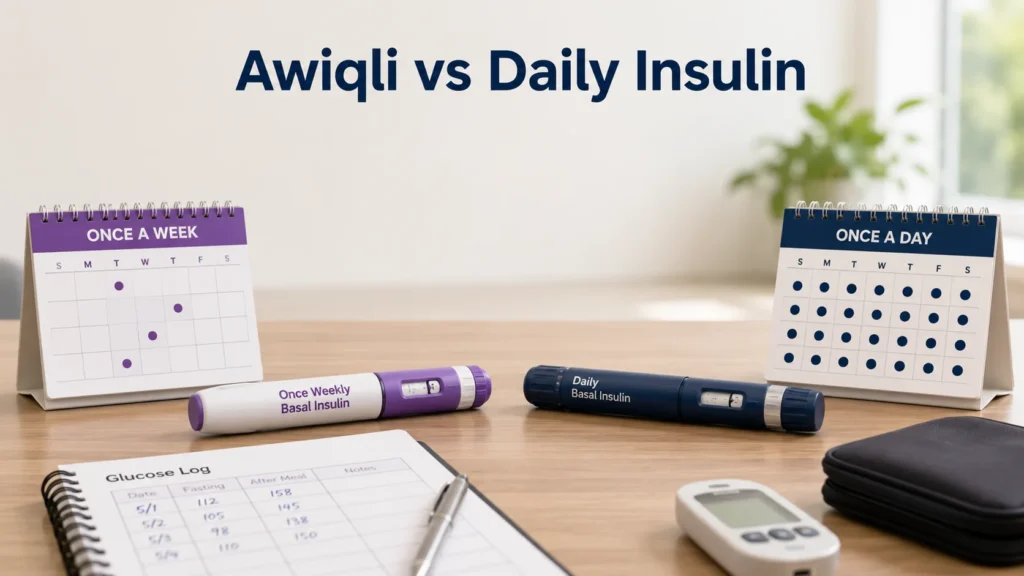
Awiqli vs daily insulin comes down to one trade. Awiqli (insulin icodec) is a background insulin injected once a week. Daily basal insulin, like glargine or degludec, goes in every day. In large trials both lowered blood sugar by a similar amount, so the choice is less about control and more about convenience, safety, and cost.
This guide is for adults with type 2 or type 1 diabetes who use basal insulin or are about to start. New to the basics? Our guide to [diabetes symptoms] is a good first stop.
Quick answer
Awiqli and daily basal insulin lower blood sugar by a similar amount in type 2 diabetes, so the main gain from Awiqli is fewer injections, 52 a year instead of 365. Daily insulin lets you change the dose faster and has stronger evidence in type 1 diabetes, where the United States FDA has not approved Awiqli.
Key takeaways
Across five trials in 3,764 adults with type 2 diabetes, once-weekly Awiqli lowered HbA1c by a similar or slightly greater amount than daily basal insulin (ONWARDS programme, 2023).
Awiqli cuts basal injections from 365 a year to 52, and treatment satisfaction scores improved more with Awiqli than degludec (ONWARDS 2, Lancet Diabetes and Endocrinology, 2023).
In type 1 diabetes, Awiqli caused nearly twice the rate of serious low blood sugar as daily degludec, 19.9 against 10.4 events per patient year (ONWARDS 6, Lancet, 2023).
A United States FDA advisory committee voted 7 to 4 against Awiqli for type 1 diabetes (FDA, 2024).
The FDA approved Awiqli for type 2 diabetes only on 26 March 2026. India approved it for both types (Novo Nordisk, 2026).
Among 217 Indian trial participants, Awiqli matched daily insulin rather than beating it (Diabetes Therapy, 2025).
What Awiqli and daily insulin are
Both are basal insulin, and basal just means background: the slow, steady insulin your body needs between meals and overnight. The difference is how long a dose lasts.
Glargine or degludec (Tresiba) works for about a day, so you inject daily. Awiqli holds on far longer, and one injection covers a full week.
Awiqli is the brand, insulin icodec is the drug inside the pen. In the United States it is written as insulin icodec-abae, the same medicine. Our guide to [Awiqli insulin] covers it in detail.
The reason it lasts a week is chemistry. Insulin icodec sticks to albumin, a protein in your blood, and while stuck it cannot act. It waits in reserve, then releases slowly across seven days.
For type 2 diabetes, either insulin can be used alone or with tablets or a weekly GLP-1 medicine. For type 1 diabetes, both cover only the background need, so you still take rapid-acting insulin before meals. That part does not change.
Awiqli vs daily insulin at a glance
The biggest difference is how the low blood sugar risk splits by diabetes type, which is why it appears on two rows.
| Feature | Awiqli (insulin icodec) | Daily basal insulin |
|---|---|---|
| Injection schedule | Once a week | Once a day |
| Injections per year | 52 | 365 |
| Blood sugar control in type 2 | Similar, sometimes slightly better | Similar |
| Low blood sugar in type 2 | Low with both, clusters on days two to four | Low, spread evenly |
| Low blood sugar in type 1 | Nearly double the rate of degludec | Lower |
| Changing the dose day to day | Not possible once given | Possible before exercise or illness |
| Cost per unit in India | About Rs 3.73 | About Rs 4.90 to Rs 6.50 |
| Approved for type 1, United States | No | Yes |
| Approved for type 1, India | Yes | Yes |
| Best for | Type 2 diabetes, when the daily needle is the barrier | Type 1 diabetes, pregnancy, or when doses need changing |
Does Awiqli control blood sugar better than daily insulin?
In type 2 diabetes, Awiqli controls blood sugar about as well as daily basal insulin and in some studies, slightly better. The evidence comes from the ONWARDS trials, testing insulin icodec against daily glargine and degludec. The measure was HbA1c, showing your average sugar over the past two to three months. Our [HbA1c normal range chart] lays out the targets.
| Trial (2023) | Who took part | Compared with | HbA1c result |
|---|---|---|---|
| ONWARDS 1 | Type 2, new to insulin | Daily glargine | Awiqli better, fell 1.55 vs 1.35 points |
| ONWARDS 2 | Type 2, switching basal | Daily degludec (Tresiba) | Awiqli better, 7.20 vs 7.42 percent |
| ONWARDS 3 | Type 2, new to insulin | Daily degludec (Tresiba) | Awiqli better, fell 1.57 vs 1.36 points |
| ONWARDS 4 | Type 2, on basal-bolus | Daily glargine | Equal, fell 1.16 vs 1.18 points |
| ONWARDS 6 | Type 1, on basal-bolus | Daily degludec (Tresiba) | Equal sugar, more lows with Awiqli |
Look closely at those gaps. They run between 0.2 and 0.4 percentage points: real in statistics, modest in a clinic.
Now the part most headlines skipped. Three Indian specialists looked only at the 217 Indian people in ONWARDS 1, 4 and 6, publishing in Diabetes Therapy in 2025. There, Awiqli did not beat daily insulin. It matched it, every difference small enough to be chance.
So Awiqli lowers blood sugar as well as daily insulin, now and then a little better. Not a stronger insulin, just an equally good one taken far less often. For how these targets fit daily monitoring, see our [blood sugar levels chart].
Low blood sugar risk: where the two really differ
Low blood sugar, or hypoglycaemia, is the main risk with any insulin, and here the two differ sharply by diabetes type. It means a reading under about 70 mg/dL (3.9 mmol/L), and it can bring sweating, shaking, a racing heart, sudden hunger, or confusion.
In type 2 diabetes, serious low sugar was uncommon with both. In ONWARDS 2, rates ran at 0.73 events per patient year with Awiqli against 0.27 with degludec, a numerical gap that did not reach statistical significance.
Type 1 diabetes is where the picture shifts. In ONWARDS 6, published in the Lancet in 2023, clinically significant or severe low blood sugar ran at 19.9 events per patient year with Awiqli against 10.4 with degludec. That is roughly double, and it was statistically significant.
| Diabetes type | What the trials found | What it means for you |
|---|---|---|
| Type 2 | Serious lows uncommon with both, 0.73 vs 0.27 events per patient year, not significant | A small difference. Watch days two to four. |
| Type 1 | 19.9 vs 10.4 events per patient year with Awiqli, significant | Weaker safety case. The FDA did not approve Awiqli for type 1. |
Because icodec peaks early in the week, low blood sugar episodes tended to bunch around days two to four after the injection. Watch those days closely, especially in the first month. Learning the [low blood sugar warning signs] helps with either insulin.
Awiqli vs Tresiba: how the weekly insulin compares with degludec
Tresiba is the brand name for insulin degludec, a long-acting daily basal insulin, and Awiqli’s direct comparator in three trials. In type 2 diabetes the two came out very close, with Awiqli giving a slightly bigger HbA1c drop in ONWARDS 2 and 3 and similar rates of low blood sugar.
Type 1 tells a different story. Degludec had the safety edge, with about half the rate of serious low blood sugar in ONWARDS 6. That is a key reason Awiqli is not approved for type 1 in the United States, while degludec is approved for both. So for type 2, similar control and Awiqli wins on convenience. For type 1, degludec holds the stronger record.
Flexibility and everyday life
The trade for fewer injections is less room to adjust. With a daily insulin you can lower tomorrow’s dose before a long hike. With a week of insulin already inside you, that quick change is off the table.
How much does this matter? Less than you might fear. A close look at ONWARDS 1 to 5, published in Diabetologia in 2025, found no meaningful rise in exercise-related low blood sugar. Still, the flexibility is gone, and if your activity swings hard day to day, that is a fair reason to pause.
A missed dose cuts both ways. One weekly injection is easier to remember than seven, but forget it and the gap in cover is bigger.
One safety point stands above the rest. Awiqli holds 700 units in each millilitre, while most insulins hold 100. Seven times stronger, and the pen carries firm warnings about dosing mistakes, so mixing it up with an ordinary pen is not a small slip. See our guide to [insulin side effects].
What Awiqli and daily insulin cost in India
In India, Awiqli costs less per unit than the daily basal insulin most people use now. Novo Nordisk set the launch price at Rs 3.73 a unit in 2026, which it puts at roughly 30 to 40 percent below common daily basal insulins. Full pricing sits in our guide to the [Awiqli insulin price in India].
| Weekly Awiqli dose | About what Awiqli costs | Same units of daily basal |
|---|---|---|
| 70 units | Rs 261 | Rs 345 to Rs 453 |
| 100 units | Rs 373 | Rs 493 to Rs 647 |
| 140 units | Rs 522 | Rs 690 to Rs 905 |
Prices calculated at the July 2026 launch price. Treat these as time sensitive and check before you buy.
A few practical points. Awiqli is a patented biologic, so no generic or biosimilar exists in 2026, while daily basal insulins have many Indian brands at a range of prices. CGHS and ESI reimbursement follows the approved formulary list, and a new drug takes time to be added, so ask your scheme office rather than assuming cover. Most private insurance in India does not pay for outpatient medicines, so insulin is usually an out-of-pocket cost either way.
In the United States, Novo Nordisk plans a nationwide launch in the second half of 2026, so cost there will depend heavily on your plan.
Who should switch to Awiqli, and who should wait

Awiqli suits some people well and calls for caution in others. The best fit is an adult with type 2 diabetes starting basal insulin for the first time, or already on it and wanting the same control with fewer needles.
There is a human reason this matters. Many people put insulin off for years, held back by the daily needle. If that fear has stopped you, one injection a week may be what finally gets you going. This delay is common in [type 2 diabetes in young adults].
Caution is wise in a few cases. Type 1 diabetes is the clearest, given the doubled rate of serious low sugar in ONWARDS 6. A careful talk is also worth having if your activity swings a lot, or if your kidneys are not working well, since some ONWARDS trials excluded people with severe kidney problems. Pregnancy is another, as Awiqli was not studied there. And not everyone with high sugar needs insulin. For borderline diabetes, our guide on whether [can prediabetes be reversed] is worth reading first.
Clinical note: During my hospital experience, I saw a patient collapse because of severe low blood sugar after taking insulin. The patient was admitted, treated, and recovered well. Before discharge, the doctor and medical team carefully explained to the patient and family how to use insulin correctly, when to take it, why meals should never be skipped, and how to recognize and treat low blood sugar early. That experience reminded me that proper education is just as important as choosing the right insulin.
What patients often get wrong
The most common misunderstanding is that a weekly insulin must control blood sugar better than a daily one. It does not. The gain is fewer injections, not lower numbers, and expecting a magic HbA1c drop only leads to disappointment.
The second is thinking you can swap your daily pen for the weekly one yourself. You cannot. The first dose after a switch usually needs adjusting, and the two pens hold very different strengths.
And insulin is not a weight-loss medicine. If that is your goal, a comparison like [Mounjaro vs Ozempic] will help more, and the [Mounjaro injection price in India] guide covers what those cost.
When to see a doctor
Do not switch insulins on your own. Awiqli is not a like-for-like swap for your current pen, and the first dose after a change often needs adjusting by your doctor.
Book an appointment before you change anything if you use basal insulin now, have type 1 diabetes, have kidney problems, or your blood sugar swings a lot day to day.
Get emergency help straight away if low blood sugar brings confusion, a seizure, or loss of consciousness. That is severe hypoglycaemia, and it needs treatment right away, not a biscuit and a wait.
The bottom line
For type 2 diabetes, the Awiqli vs daily insulin decision is close on blood sugar control, so it turns on convenience, safety, and cost. Fifty-two injections a year instead of 365 is a real change, and in India Awiqli costs less per unit than most daily basal insulins.
The catch is flexibility and evidence. Once a weekly dose is in, you cannot dial it back for a heavy day. And in type 1 diabetes the safety case is weaker, which is why the FDA approved type 2 only while India approved both. Take this to your doctor and decide together.
Frequently asked questions
Is weekly insulin as good as daily insulin?
For type 2 diabetes, yes. Across the ONWARDS trials, once-weekly Awiqli lowered HbA1c by a similar amount to daily basal insulin, and slightly more in three of them. The benefit is fewer injections, not better numbers. In type 1 diabetes the evidence is weaker, so daily insulin remains the stronger choice.
Awiqli vs Tresiba, which one is better?
It depends on your diabetes type. In type 2 diabetes the two give similar control, and Awiqli wins on convenience with one injection a week. In type 1 diabetes, daily degludec (Tresiba) had about half the rate of serious low blood sugar in ONWARDS 6, so it holds the safety edge. Your doctor can weigh this for you.
Can I switch from daily insulin to Awiqli myself?
No. Switching needs a doctor to set your new weekly dose, because the first dose usually has to be adjusted. The Awiqli pen is also seven times more concentrated than a standard pen, so mixing them up is dangerous. Never change insulin type or strength on your own.
What happens if I miss my weekly Awiqli dose?
Take it as soon as you remember, then return to your usual weekly day, as long as there are at least a few days until the next dose. Because one injection covers a week, a missed dose leaves a longer gap than a missed daily dose. Ask your doctor for the exact rule.
Is Awiqli safe for type 1 diabetes?
The evidence is weaker here. In ONWARDS 6, Awiqli caused nearly twice the rate of serious low blood sugar as daily degludec, and a United States FDA advisory committee voted 7 to 4 against approving it for type 1. India does allow both types. This is a decision for a specialist, not for you alone.
Does Awiqli replace mealtime insulin too?
No. Awiqli covers only the slow background insulin your body needs between meals and overnight. If you take rapid-acting insulin before meals, you keep taking it as before. This is true for both daily and weekly basal insulin, so switching to Awiqli changes only your background dose.
References and sources
- Novo Nordisk. FDA approves Awiqli, the first and only once-weekly basal insulin treatment for adults with type 2 diabetes. 26 March 2026.
- Novo Nordisk. Awiqli (insulin icodec-abae) prescribing information. 2026.
- DailyMed, US National Library of Medicine. Awiqli (insulin icodec-abae) injection, solution. 2026.
- Rosenstock J, Bain SC, Gowda A, and others. Weekly icodec versus daily glargine U100 in type 2 diabetes without previous insulin (ONWARDS 1). N Engl J Med. 2023;389:297-308.
- Philis-Tsimikas A, Asong M, Franek E, and others. Switching to once-weekly insulin icodec versus once-daily insulin degludec in basal insulin-treated type 2 diabetes (ONWARDS 2). Lancet Diabetes Endocrinol. 2023.
- Lingvay I, Asong M, Desouza C, and others. Once-weekly insulin icodec versus once-daily insulin degludec in adults with insulin-naive type 2 diabetes (ONWARDS 3). JAMA. 2023;330(3):228-237.
- Mathieu C, Asbjornsdottir B, Bajaj HS, and others. Switching to once-weekly insulin icodec versus once-daily insulin glargine U100 in basal-bolus insulin-treated type 2 diabetes (ONWARDS 4). Lancet. 2023.
- Bajaj HS, Aberle J, Davies M, and others. Once-weekly insulin icodec with dosing guide app versus once-daily basal insulin analogues in insulin-naive type 2 diabetes (ONWARDS 5). Ann Intern Med. 2023;176(11):1476-1485.
- Russell-Jones D, Babazono T, Cailleteau R, and others. Once-weekly insulin icodec versus once-daily insulin degludec as part of a basal-bolus regimen in type 1 diabetes (ONWARDS 6). Lancet. 2023.
- Mohan V, Kesavadev J, Murthy LS, and others. Efficacy and safety of once-weekly insulin icodec in Indian participants with diabetes, results from ONWARDS 1, 4 and 6. Diabetes Ther. 2025.
- Riddell MC, Heller S, Carstensen L, and others. Effect of once-weekly insulin icodec versus once-daily basal insulin on physical activity-attributed hypoglycaemia in type 2 diabetes, a post hoc analysis of ONWARDS 1 to 5. Diabetologia. 2025.
- Drugs.com. Awiqli (insulin icodec-abae) FDA approval history. 2026.
Medically reviewed by
This guide was checked for medical accuracy by our review board before publishing.
Dr Praveen Verma, MBBS, MD (Pathology), Pathologist and Clinical Laboratory Specialist.
Dr Himanshu Morya, MBBS, Medical Educator.
Kalpna Singh Shekhawat, BSN, RN
About the author
Iraphan Khan, BSN, RN, D.Pharm, Public Health Researcher is the founder of RealMedVision and creates evidence-based health content from trusted medical sources.
Medical disclaimer
This article is for education only. It is not medical advice and cannot replace a consultation with your own doctor. Do not start, stop, or change any insulin on your own. If low blood sugar brings confusion, seizures, or fainting, treat it at once and get emergency help.