
A severe result can sound scary. Here is what Grade 3 really means for you and what to do next.
A patient-friendly guide by RealMedVision
10 to 12 minute read
Quick Answer
Grade 3 fatty liver means your ultrasound showed severe fat build up in the liver. It is the highest of the three ultrasound grades, but it does not tell you how much liver scarring you have. Grade 3 alone does not mean cirrhosis. Liver fat can often improve when the cause is treated, but recovery time varies. Your next step is to ask your doctor whether you need a fibrosis assessment, such as FIB 4 or FibroScan.
What is fatty liver grade 3?
Fatty liver means extra fat has collected inside liver cells. It is common in India, and studies suggest that around one in three adults may have fatty liver disease.
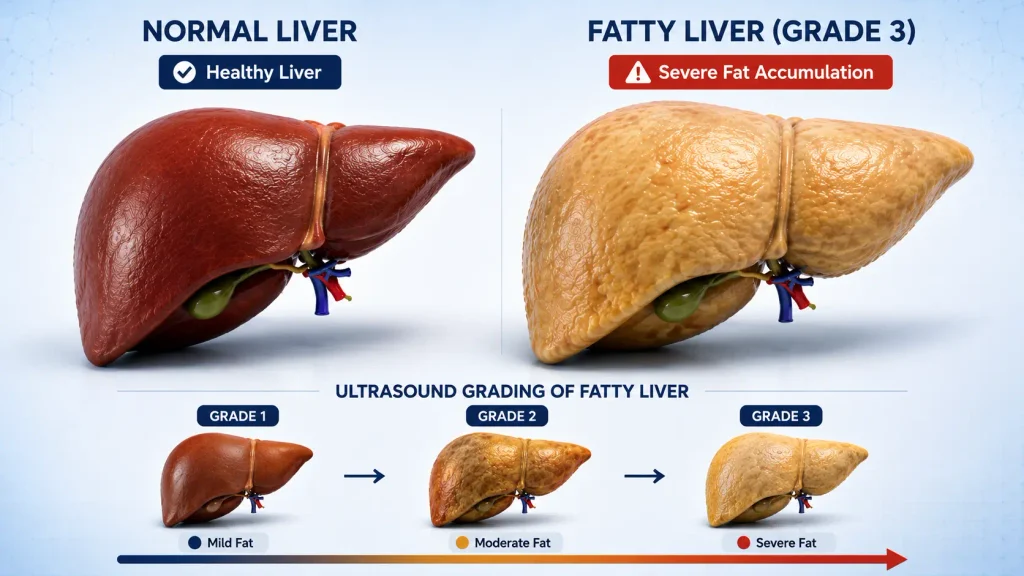
On an ultrasound, fatty liver is commonly described as Grade 1, Grade 2 or Grade 3. Grade 1 is mild, Grade 2 is moderate and Grade 3, also called Grade III, means severe fatty change. The grade shows fat, not liver scarring.
Where does the fat come from?
It is often linked with extra weight, diabetes, high triglycerides or high blood pressure. This is commonly called MASLD, the newer name for NAFLD. Alcohol and some medicines can also cause or worsen fatty liver.
What does grade 3 mean on an ultrasound?
Ultrasound does not directly measure the exact amount of fat. The sonologist looks at how bright the liver appears and how clearly the blood vessels and diaphragm can be seen. In Grade 3, the liver looks very bright and deeper structures may be difficult to see.
This is a visual assessment, so results can sometimes vary between readers. Grade 3 does not tell you whether you have fibrosis or cirrhosis. That needs separate assessment.
| Ultrasound grade | What it means | What may be seen |
|---|---|---|
| Grade 1 | Mild fatty change | Slightly brighter liver |
| Grade 2 | Moderate fatty change | Brighter liver with reduced visibility of some structures |
| Grade 3 | Severe fatty change | Very bright liver with poor visibility of deeper structures |
Table 1: Common ultrasound grades of fatty liver. The grade describes fatty change, not liver scarring.
If your report says Grade 1 instead, read our guide to grade 1 fatty liver.
Is grade 3 fatty liver dangerous?
It can be, but the risk does not come from the fat grade alone. It comes from inflammation and scarring, called fibrosis, which the grade cannot show. The amount of scarring is a key predictor of future liver problems, so doctors check for it separately.
Heart disease is also more common in people with fatty liver, so blood pressure, cholesterol and blood sugar need attention too.
Keep in Mind
A Grade 3 report is a reason to get checked properly. It is not, by itself, a diagnosis of cirrhosis or liver failure.
What symptoms can grade 3 fatty liver cause?
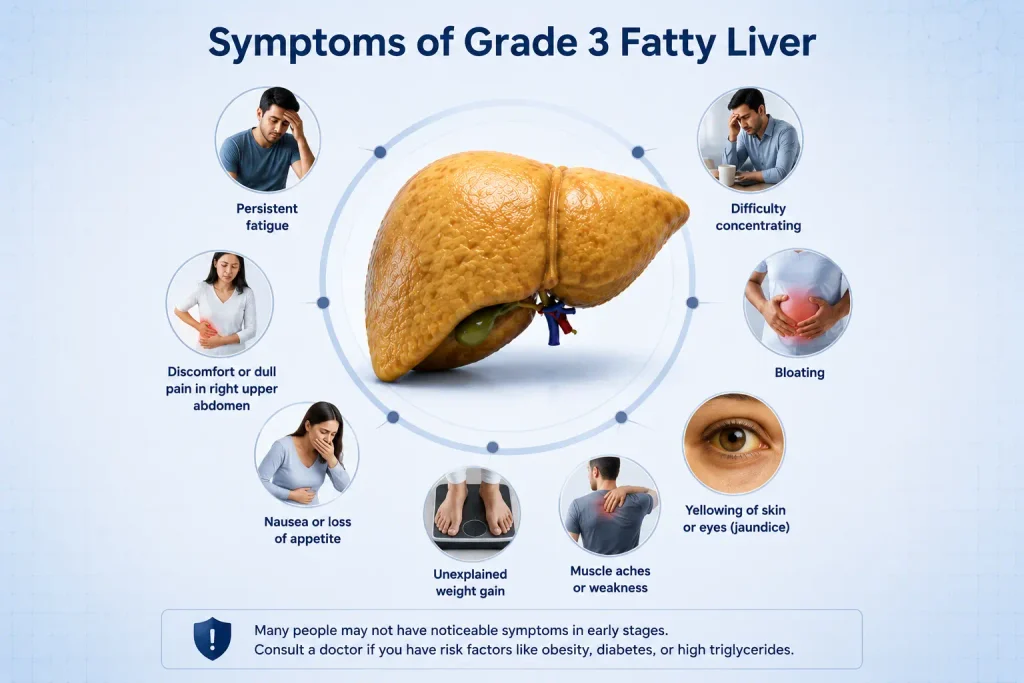
Usually none. Most people find out from a scan done for another reason. Some may notice tiredness or a dull ache or heaviness under the right ribs.
Yellow eyes, a swollen abdomen or swollen ankles can be signs of advanced liver disease. How you feel is not a reliable guide to how much fat or scarring is present.
Does grade 3 fatty liver mean cirrhosis?
No, not by itself. Grade 3 on an ultrasound describes severe fatty change. It does not tell you whether you have liver scarring or cirrhosis. Fibrosis is assessed separately using tests such as FIB-4, FibroScan and sometimes a biopsy.
Cirrhosis is stage F4 on the scarring scale. Some people with Grade 3 fat have no scarring, while others may have early or advanced fibrosis. The ultrasound grade cannot tell the difference, which is why fibrosis testing is important.
Doctor’s Tip
Ask your doctor one question first: what is my fibrosis stage, and which test will tell us?
What is the difference between fatty liver grade and fibrosis stage?
Grade measures fat. Stage measures scar tissue. They are two separate scales, and one does not predict the other.
| Fat grade on ultrasound | What it means |
|---|---|
| Grade 1 | Mild fatty change |
| Grade 2 | Moderate fatty change |
| Grade 3 | Severe fatty change |
| These are separate scales. A person can have Grade 3 fat with F0, or Grade 1 fat with F3. | |
| Fibrosis stage | What it means |
| F0 | No scarring |
| F1 | Mild scarring |
| F2 | Moderate scarring |
| F3 | Advanced scarring |
| F4 | Cirrhosis |
Table 2: Fat grade versus fibrosis stage. Fat is graded on ultrasound, while fibrosis is assessed using blood scores, elastography such as FibroScan, and sometimes biopsy.
Doctors often start with a FIB-4 blood score, calculated from age, ALT, AST and platelet count. A low score helps rule out advanced scarring. A higher score may need a second test such as FibroScan. Interpretation also depends on age and other health factors.
Is grade 3 fatty liver reversible?
Often, yes. Liver fat can improve and sometimes clear when the cause is treated. In a 52 week study of 293 people with fatty liver inflammation, greater weight loss was linked with better results. Among those who lost 10 percent or more of their body weight, 90 percent had inflammation resolve and 45 percent had fibrosis improve.
Results vary between people. Early fibrosis may improve, while established cirrhosis usually cannot be reversed completely. Current guidelines also support sustained weight loss to improve liver fat, inflammation and fibrosis.
Illustrative Example
Ramesh, 44, had Grade 3 fatty liver on a routine scan. His FIB 4 was low and his HbA1c showed prediabetes. Over ten months he lost about 9 percent of his weight, stopped sugary drinks and walked daily. His liver enzymes returned to normal and a repeat scan read Grade 1.
Illustrative example only. Not a real patient.
How long does grade 3 fatty liver take to improve?
There is no fixed recovery time. Liver fat may start improving within months once the cause is addressed, but severe fatty liver can take longer. Recovery depends on weight, diabetes, alcohol, diet, activity, medicines and whether inflammation or fibrosis is present.
What may improve first
Liver enzymes, blood sugar and liver fat on repeat testing.
What may take longer
Inflammation, fibrosis and any advanced liver damage.
Many studies assess improvement after 6 to 12 months. Follow up depends on your fibrosis risk and overall health. Indian guidance suggests annual review for simple fatty liver, while inflammation or significant fibrosis may need review every six months or more often.
What affects recovery time?
Six things decide how fast a Grade 3 liver improves.
- Weight loss: The more weight lost, the greater the improvement. Sustained weight loss can reduce liver fat and inflammation. Greater weight loss may also improve fibrosis in some people.
- Blood sugar: Fatty liver and type 2 diabetes drive each other. Our normal blood sugar chart by age shows where your numbers should be.
- Alcohol: Even moderate drinking makes fatty liver worse. Complete avoidance is advised.
- Diet and activity: Sugary drinks, refined carbohydrates and fried food work against you. Daily movement works for you.
- Medicines: Some drugs, such as steroids, can add fat to the liver. Tell your doctor everything you take, but never stop a prescribed medicine on your own.
- Scarring already present: Fat responds fastest. Scarring is slower to improve.
What treatment is used for grade 3 fatty liver?
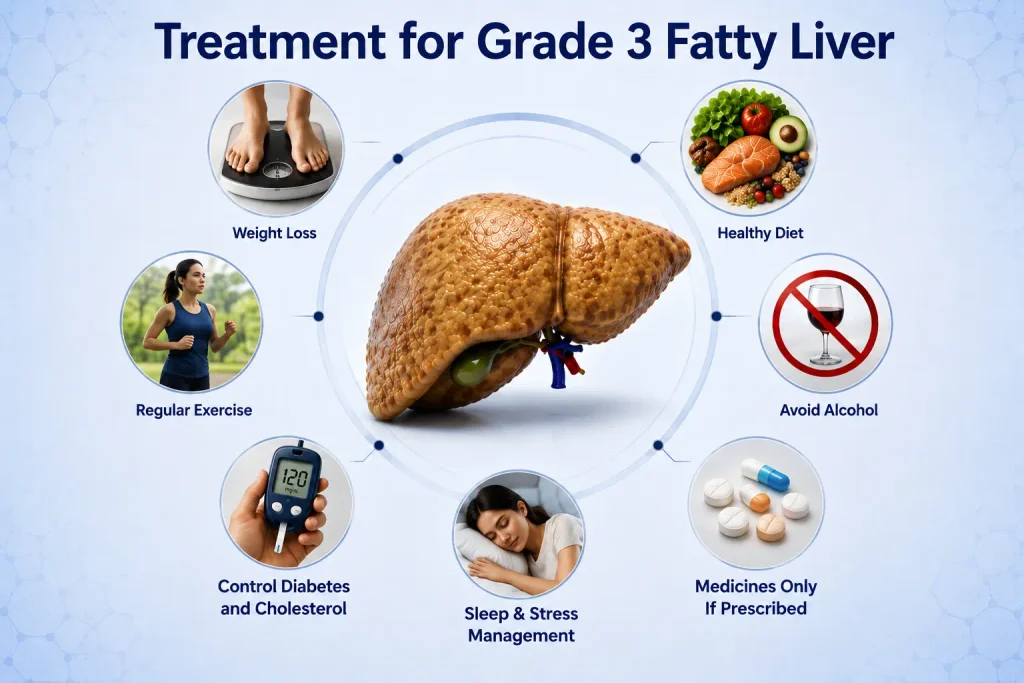
Lifestyle change is the main treatment. India’s Ministry of Health guidelines for fatty liver recommend weight loss, regular exercise and good control of blood pressure, cholesterol and diabetes. Treatment depends on your fibrosis stage and overall health.
Do you need medicine?
Not always. No tablet replaces lifestyle changes. A specialist may consider medicine once your fibrosis stage and other health conditions are known. Your doctor can decide whether a medicine for weight loss, diabetes or liver disease is suitable for you. Do not buy liver tonics or supplements on your own.
What should you eat and avoid?
You do not need a special diet. Focus on whole foods, avoid sugary drinks and eat as little processed food as possible.
- Eat more of: vegetables, dals and legumes, millets and whole grains in controlled portions, whole fruit, a few nuts or seeds, and fish, eggs or curd for protein.
- Cut down or avoid: sugary and aerated drinks, sweets, maida products, fried snacks and packaged food. Ask your doctor about alcohol based on the cause and stage of your liver disease.
Portion size matters too. A steady calorie reduction with enough protein works better than a crash diet.
Note: If you have diabetes or kidney disease, check with your doctor or a dietitian before making major diet changes.
Which tests may be needed next?
The ultrasound is the starting point. These tests help your doctor understand the cause, check your overall health and assess the risk of liver scarring.
| Step | Test or action | Why it matters |
|---|---|---|
| 1. Review the cause | Alcohol history, medicines, weight and family history | The cause helps decide the treatment plan. |
| 2. Liver blood tests | Liver tests and complete blood count | These help assess liver injury and calculate FIB 4. |
| 3. Sugar and metabolic risk | Fasting sugar, HbA1c, lipid profile and blood pressure | Fatty liver is closely linked with diabetes and heart risk. See our HbA1c normal range chart. |
| 4. Fibrosis score | FIB 4 from age, ALT, AST and platelets | It helps estimate the risk of advanced scarring and whether another test is needed. |
| 5. FibroScan when needed | Measures liver stiffness and can estimate liver fat | It gives more information about possible liver scarring. |
| 6. Plan and follow up | Lifestyle goals and treatment of related conditions | Follow up depends on your fibrosis risk and overall health. |
Table 3: Common steps after a Grade 3 fatty liver report.
If liver enzymes remain raised for more than six months, further assessment may be needed to rule out other causes of liver disease.
When should you see a doctor?
If you have a Grade 3 fatty liver report, arrange a medical review soon, even if you feel well, even if you feel well. Your family physician can order the blood tests and work out FIB-4. Ask for a gastroenterologist or hepatologist referral if FIB-4 is 1.3 or higher, if liver enzymes stay raised, or if there are signs of advanced disease.
Take your reports with you. Questions worth asking:
- What is my fibrosis stage, and which test will tell us?
- Is my blood sugar or cholesterol part of the problem?
- How much weight should I aim to lose, and by when?
- When should we repeat the tests?
Good to Know
An ultrasound report showing Grade 3 fatty liver does not automatically tell you your fibrosis stage. A separate fibrosis assessment may be needed, so ask for it.
Emergency warning signs
When to Call Your Doctor
See a doctor urgently, or go to the nearest emergency department, if you have any of these:
- Yellow eyes or skin
- Swelling of the abdomen
- Vomiting blood
- Black or tarry stools
- New confusion or unusual sleepiness
- Severe weakness together with jaundice
These are signs of advanced liver disease or bleeding, not of fatty liver alone. They are uncommon when a Grade 3 scan is the only finding, but they are the reason a fibrosis check matters.
Frequently asked questions
What is fatty liver grade 3?
Grade 3 fatty liver, also written Grade III, is the highest of three ultrasound grades for liver fat. The liver looks very bright and deeper structures are hard to see. It describes fat only, not damage or scarring.
Is grade 3 fatty liver dangerous?
On its own, no. The risk comes from inflammation and scarring, which the fat grade cannot show, and from heart disease, which is more common in people with fatty liver. A Grade 3 report should lead to a fibrosis check and a review of sugar, blood pressure and cholesterol.
Is grade 3 fatty liver reversible?
Often, yes. When the cause is treated, liver fat can improve and sometimes clears completely. In a 52-week lifestyle study, people who lost 10 percent or more of their weight had the best results. Early scarring can improve. Cirrhosis cannot be reversed, but it can often be slowed.
Can grade 3 fatty liver become normal?
Yes, for many people the ultrasound returns to normal or drops to Grade 1 once weight, blood sugar and alcohol are addressed. It depends on whether inflammation or scarring is also present. Progress is usually reviewed after 6 to 12 months.
How long does grade 3 fatty liver take to recover?
There is no fixed time. Liver enzymes and blood sugar often improve first, within months. Liver fat on a repeat scan usually follows after 6 to 12 months of steady change. Inflammation and scarring take longer.
What are the symptoms of grade 3 fatty liver?
Most people have no symptoms, and the scan is the first clue. A few feel tired or notice a dull ache or heaviness under the right ribs. Yellow eyes, a swollen abdomen or black stools mean advanced disease and need urgent care.
Does grade 3 fatty liver mean cirrhosis?
No. Grade 3 describes severe fatty change on ultrasound. Cirrhosis is stage F4 on a different scale that measures scarring. A person can have Grade 3 fat with no scarring at all. Only a fibrosis assessment can tell you where you stand.
Does grade 3 fatty liver require a FibroScan?
Not always as the first step. Guidelines suggest starting with the FIB-4 blood score. Below 1.3, the risk of advanced scarring is low. At 1.3 or higher, a FibroScan or similar test is the usual next step. People with diabetes may be sent for it directly.
What should I eat with grade 3 fatty liver?
Build meals around vegetables, dals, millets, whole grains in controlled portions, whole fruit, a few nuts, and protein such as fish, eggs or curd. Avoid sugary drinks, cut down on sweets, maida, fried and packaged food, and stop alcohol.
Does grade 3 fatty liver need medicine?
Not usually as a first step. Lifestyle change has the strongest evidence. A liver specialist may consider medicine once your fibrosis stage is known. In India, Zydus announced DCGI approval of saroglitazar for non-cirrhotic NASH in 2020, and Novo Nordisk announced CDSCO approval of Wegovy for MASH with scarring in July 2026. These are prescription decisions, not self-medication.
Medical Disclaimer
This article is for general educational purposes only. It does not replace personal medical advice, diagnosis or treatment. Discuss your symptoms and test results with a qualified healthcare professional. If you have any of the emergency warning signs listed above, seek immediate medical care.
References and Sources
- Government of India. NAFLD Operational Guidelines. 2024. View source
- AASLD. Practice Guidance on NAFLD. 2023. View source
- EASL, EASD and EASO. MASLD Clinical Practice Guidelines. 2024. View source
- Strauss S, et al. Ultrasound Assessment of Fatty Liver. AJR, 2007. View source
- Vilar Gomez E, et al. Weight Loss and Fatty Liver Improvement. 2015. View source
- Shalimar, et al. Fatty Liver Prevalence in India. 2022. View source
- Zydus. Saroglitazar Approval for Non Cirrhotic NASH. 2020. View source
- Business Standard. Wegovy CDSCO Approval for Fatty Liver in India. 2026. View source
Written by
Iraphan Khan, BSN, RN, D.Pharm
Founder of RealMedVision and Public Health Researcher. Registered nurse who writes evidence based health explainers using trusted medical and public health sources.
Medically reviewed by
Dr Praveen Verma, MBBS, MD (Pathology)
Dr Himanshu Morya, MBBS, Medical Educator
Last medically reviewed: 26 August 2026