
No confirmed Ebola cases have been reported in India as of. Here is the real risk, and the facts that cut through the fear.
A patient-friendly guide by RealMedVision
10 to 12 minute read
Seen Ebola in the news and wondered whether it has reached India? Here is the short version. As of the latest official updates (confirm the current date before publishing), no confirmed Ebola cases have been reported in India. The current outbreak is concentrated in the Democratic Republic of the Congo, and the World Health Organization has declared it a Public Health Emergency of International Concern. India’s health ministry is watching closely and has tightened airport screening. This page explains the Ebola virus in India situation, what the disease is, how it spreads, the symptoms to know, and the real risk to people here.
Quick answer
- Cases in India: No confirmed cases reported to date. Authorities are monitoring, not managing an active outbreak.
- Where it is active: Mainly the Democratic Republic of the Congo, caused by the Bundibugyo species of the virus. Uganda completed its 42-day monitoring period with no new cases on 27 August 2026.
- How it spreads: Direct contact with the blood or body fluids of an infected person or animal. It does not spread through the air the way flu or COVID-19 does.
- Main symptoms: Sudden fever, deep tiredness, muscle pain, headache and sore throat, followed by vomiting and diarrhoea. Bleeding is less common and tends to come later.
- Risk to India: Low right now, and mostly limited to travellers returning from affected areas. Everyday risk for the general public is very low.
The current Ebola situation in India and Africa
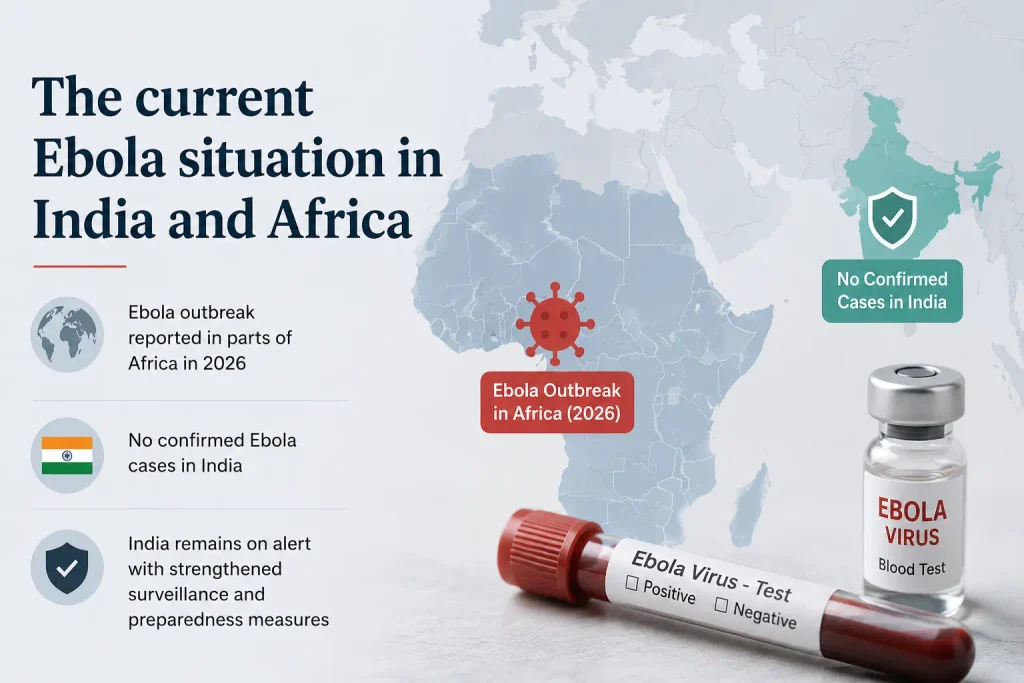
Let us start with the question most people actually have. As of the latest Indian government update available, India has not recorded a single confirmed case of Bundibugyo Ebola disease in this outbreak. Earlier in 2026 a traveller from Uganda was kept in isolation in Bengaluru after showing symptoms that looked worrying, but her tests came back negative. That is the closest the country has come, and it ended in relief rather than a case.
The outbreak was confirmed and officially declared in May 2026, after an illness cluster was detected in Ituri Province in the Democratic Republic of the Congo. It is caused by the Bundibugyo virus, one of the species behind Ebola disease. On 17 May 2026 the WHO declared it a Public Health Emergency of International Concern, its highest level of alert, and that emergency status remains in place. It has since grown into one of the largest Ebola outbreaks reported in the DRC. As of 26 August 2026, the WHO reported 5,794 confirmed cases and 2,786 deaths in the DRC, a case fatality rate of about 48 percent. A separate spread into Uganda was contained quickly. Uganda reported 20 confirmed cases and two deaths, and completed its 42-day enhanced monitoring period without new cases on 27 August 2026. India has managed imported and seasonal outbreaks before, as with H1N1 flu in India.
What India is doing about it
India’s Union Health Ministry has said the country has reported no Bundibugyo Ebola cases so far. As a precaution, it is running enhanced surveillance and airport screening with the National Centre for Disease Control, ICMR and immigration authorities. In late May 2026 the government also advised against non-essential travel to the DRC, Uganda and South Sudan. In plain terms, the response is watchfulness, not crisis management.
Keep in mind: Outbreak numbers change week to week. The figures on this page reflect the situation at the time of writing. For the very latest, the Ministry of Health and Family Welfare and WHO pages are the sources worth trusting over social media forwards. We take the same source-first approach when tracking dengue cases in India.
Ebola virus in India: what we know
Status reflects the latest official position at the time of writing. Travel advice can change as outbreak conditions change, so check the newest MoHFW, NCDC and Ministry of External Affairs guidance before travelling.
What is the Ebola virus?
Ebola is a rare but serious illness caused by a group of viruses in the filovirus family. It was first identified in 1976 near the Ebola River in Central Africa, which is where the name comes from. Three Ebola viruses have caused major documented outbreaks: the Ebola virus itself, the Sudan virus, and the Bundibugyo virus behind the 2026 outbreak.
The disease is severe and can be fatal, but two things are worth keeping in mind. Ebola does not spread as easily as respiratory infections such as flu, because transmission usually needs direct contact with infected body fluids. And early supportive care is an important part of improving the chances of survival. It is not mild, yet not the unstoppable threat headlines suggest.
Where it comes from
Ebola is a zoonotic disease, meaning it starts in animals and passes to people. Fruit bats are considered possible natural hosts for Ebola viruses, though the exact animal reservoir and how the virus circulates remain an area of research. Outbreaks often begin when someone contacts an infected animal, such as a bat or primate, sometimes through bushmeat. Once a person is infected, the virus can pass from human to human.
How Ebola spreads (and how it does not)
Ebola does not spread easily, and this is the part that reassures most people once they understand it. Simply sharing a room with someone, or walking past them, does not usually spread Ebola. It passes mainly through direct contact with blood or other body fluids, and knowing exactly what that means removes a lot of the fear.
Ways it can spread
- Direct contact with the blood or body fluids of a person who is sick with, or has died from, Ebola. This includes saliva, sweat, vomit, urine, stool and breast milk.
- Contact with surfaces or objects, such as needles or bedding, that have been soiled with these fluids.
- Contact with infected animals, especially bats or non-human primates.
- Burial practices where mourners touch the body of someone who has died, which is a major route of spread in affected regions.
How it does not spread
Ebola is not airborne. It does not float through ventilation or spread the way flu and the common cold do. Just as important, people with Ebola are not considered contagious before symptoms begin. Infectiousness then rises as the illness worsens, when the level of virus in body fluids becomes high. This is a key reason screening focuses on people who show symptoms or report a relevant exposure, rather than on healthy travellers.
Good to know: Because transmission usually needs contact with infected body fluids, and people are not considered contagious before symptoms begin, Ebola outbreaks can usually be contained with careful tracing and isolation. This is very different from a fast, silent respiratory virus.
Symptoms of Ebola virus disease
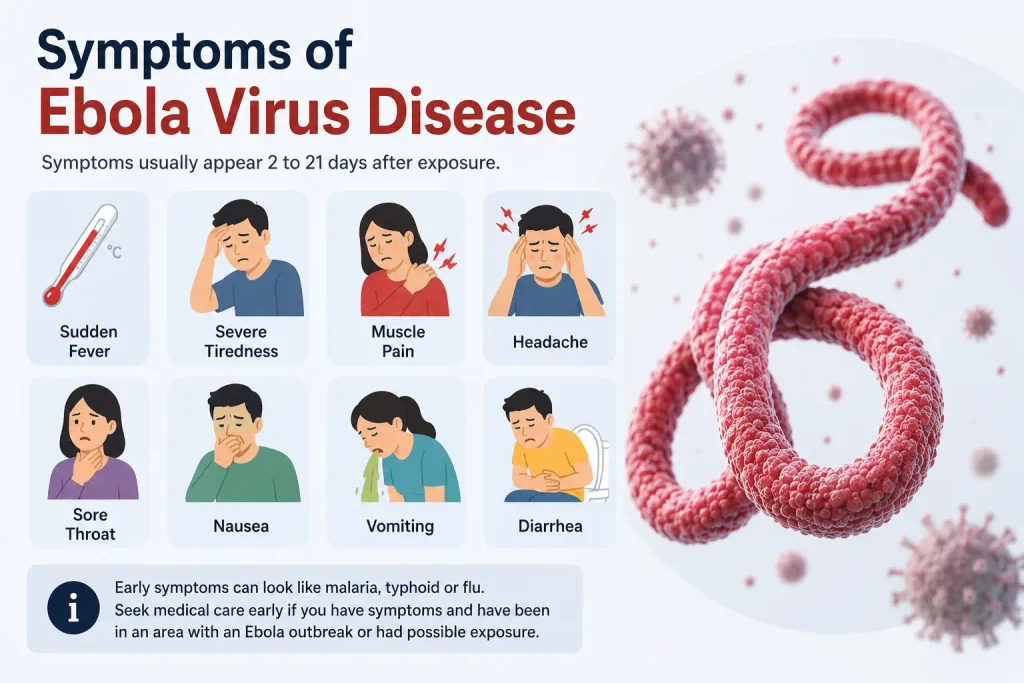
Ebola symptoms can appear suddenly, anywhere from 2 to 21 days after someone is exposed to the virus. The average is around 8 to 10 days. In the early stage, the illness can look a lot like malaria, typhoid or the flu, which is one reason it can be hard to spot quickly.
Early symptoms
- Sudden fever
- Severe tiredness and weakness
- Muscle pain and body aches
- Headache
- Sore throat
Later symptoms
- Vomiting and diarrhoea
- Stomach pain and skin rash
- Signs of reduced kidney and liver function
- In some cases, bleeding from the gums, in vomit or stool, or from injection sites. This is less common than people expect, tends to appear later, and is linked to more severe illness.
A note on the “bleeding” image
Films and news reports often show dramatic bleeding, which has shaped how most people picture Ebola. In reality bleeding is not the most common sign, appears in a minority of patients, and is linked to severe disease. Fever, weakness and stomach symptoms are far more typical, especially early on.
How symptoms tend to appear over time
A simple timeline of when different symptoms usually show up after infection. Exact timing varies from person to person.
2 to 21 days after exposure: possible symptom onset
Incubation period. People are not considered contagious before symptoms begin.
First few days of illness
Fever, weakness, muscle pain, headache, sore throat.
Later stage
Vomiting, diarrhoea, organ strain, and in some cases bleeding.
Timeline is a general guide based on WHO descriptions, not a fixed schedule.
When to see a doctor: If you have recently travelled to an area with an active Ebola outbreak, or been near someone who has, and you develop a sudden fever within 21 days, seek medical care straight away and mention your travel history. For people with no such exposure, a fever is very unlikely to be Ebola and is far more likely to be a common infection.
Can Ebola spread to India?
In theory, yes, any virus can cross borders through travel. In practice, the chance of Ebola spreading widely in India is low. The virus needs direct contact with body fluids, so it does not move quickly through a population the way an airborne infection does. The main concern would be a single imported case arriving from an affected region, which is exactly what airport surveillance is set up to spot. Even if a case did arrive, India’s public health system can isolate suspected cases and trace contacts to reduce the chance of wider spread.
How real is the risk to people in India?
For most people reading this in India, the honest answer is that the day-to-day risk is very low. There are no local cases, no reported community transmission, and the virus does not spread through the air. The main way it could arrive is through a traveller returning from an affected region. Airport surveillance is intended to identify travellers with symptoms or a relevant exposure and connect them with proper public health assessment.
That does not mean the risk is zero, and health teams are right to stay alert. A single imported case can occasionally slip through before it is spotted. Even then, India’s system is set up to isolate and trace contacts, and the virus makes wide community spread far less likely than a respiratory infection.
Who is at higher risk
- Travellers returning from countries with an active outbreak.
- Healthcare workers caring for a suspected or confirmed case without proper protection.
- Family members in close contact with someone who is sick.
Chart 2: Bundibugyo Ebola death rates by outbreak
Death rates for the Bundibugyo virus have varied between outbreaks. Differences in outbreak size, how many cases are detected, access to care and other factors can all affect the reported case fatality. The table below keeps the figures specific to this virus rather than mixing in other Ebola species.
Figures from WHO (data to 26 August 2026). The Uganda figure is the observed proportion of deaths among 20 confirmed cases, not a measure of how effective any single factor was. Early, well-organised care generally improves survival.
How Ebola is diagnosed and treated
Because early Ebola looks like many other tropical illnesses, symptoms alone cannot confirm it. A diagnosis needs laboratory testing. Doctors combine a person’s travel history with blood tests such as PCR, which can detect the virus directly. Typical lab findings include low white blood cell and platelet counts along with raised liver enzymes, which support the diagnosis alongside the clinical picture.
What treatment involves
The foundation of Ebola treatment is supportive care, which means keeping the body stable while it fights the virus. This includes fluids to prevent dehydration, maintaining blood pressure and oxygen, and treating other infections and symptoms as they arise. Started early, supportive care is an important part of improving the chances of survival.
This is one of the most important points about the 2026 outbreak, and it is easy to get wrong. The main licensed Ebola vaccine and the approved monoclonal antibody treatments were developed for the Zaire species of Ebola virus. They are not approved treatments or vaccines for the Bundibugyo virus. As of August 2026, the WHO states that there are no approved vaccines or therapeutics specifically for Bundibugyo virus, although clinical research is ongoing to test possible candidates. For patients with Bundibugyo virus disease, supportive care remains the mainstay of treatment.
Patient tip: If you are travelling to a region with an outbreak, the most useful protection is simple. Avoid contact with sick people, do not handle wild animals or bushmeat, wash hands often, and see a doctor quickly if you feel unwell during or after the trip.
What to do after possible Ebola exposure
This section matters only if you have recently been in an outbreak area or in close contact with a confirmed case. For everyone else, it is simply useful to know. If you think you may have been exposed and you start to feel unwell, the steps below help protect you and the people around you.
- Do not panic. Early symptoms are far more likely to be a common infection than Ebola.
- If symptoms develop, limit close contact with other people until you have been assessed.
- Call a hospital or health facility before you arrive, so they can prepare safely.
- Tell them about your travel and any possible exposure. This is the single most useful thing you can share.
- Do not try to arrange your own testing or treatment. Let the health system guide it.
- Follow any public health instructions about monitoring or isolation.
When to call your doctor: A sudden fever within 21 days of travel to an affected region deserves prompt medical attention. Mention your travel first, before anything else, so the right precautions can be taken.
Prevention and clearing up common myths
For people in India with no travel to affected areas, no special precautions are needed right now. There is no reason to change your daily life, avoid public places, or worry about routine contact with others. The sensible steps below matter most for travellers and health workers, though good hand hygiene is always worth keeping up.
Practical prevention steps
- Avoid non-essential travel to regions with an active outbreak, following official advisories.
- In affected areas, avoid close contact with anyone who is unwell, and with the blood or body fluids of a sick or deceased person.
- Do not touch or eat wild animals or bushmeat in outbreak zones.
- Wash hands regularly with soap and water, a habit that helps against many infections.
Myth versus fact
Key takeaways
- Check the source before you worry. For anything Ebola related, trust MoHFW and WHO updates over forwarded messages.
- Remember how it spreads. Ebola spreads mainly through direct contact with infected body fluids, so casual contact does not usually spread the virus.
- Act on travel history. A sudden fever matters most if you have recently been to an outbreak area. Tell your doctor if so.
- Skip the panic, keep the habits. No lifestyle changes are needed in India now, but regular handwashing is always sensible.
Frequently asked questions
Are there any Ebola cases in India right now?
No. As of the latest government update, India has reported no confirmed Ebola cases. Health authorities are monitoring the outbreak in Africa and have strengthened airport surveillance as a precaution, but there is no active outbreak in the country.
Is the Ebola virus spreading in India?
It is not. There is no reported community transmission of Ebola in India. The virus is currently active mainly in the Democratic Republic of the Congo. The main concern for India would be an imported case involving a traveller from an affected region.
How does Ebola spread from person to person?
Through direct contact with the blood or body fluids of someone who is sick with or has died from Ebola. It can also spread through contaminated objects and infected animals. It does not spread through the air.
What are the first signs of Ebola?
The earliest signs are usually a sudden fever, severe tiredness, muscle pain, headache and sore throat. These can appear 2 to 21 days after exposure and often resemble malaria or flu at first.
Can Ebola be diagnosed from symptoms alone?
No. Symptoms alone cannot confirm Ebola, because early signs look like malaria, typhoid and flu. A laboratory test, usually a PCR blood test, is needed to confirm it, alongside the person’s travel and exposure history.
How dangerous is Ebola?
It is a serious illness. Death rates have varied widely between outbreaks and virus species. In Uganda’s 2026 outbreak, 2 of 20 confirmed cases died, an observed case fatality proportion of 10 percent. A figure like this should not be read as a prediction for any one patient.
Is there a cure or vaccine for Ebola?
The main licensed Ebola vaccine and approved monoclonal antibody treatments were developed for the Zaire species of Ebola virus. They are not approved for the Bundibugyo virus. As of August 2026, the WHO states there are no approved vaccines or therapeutics specifically for Bundibugyo virus. For patients with Bundibugyo virus disease, supportive care remains the mainstay of treatment.
Can Ebola be caught from someone who has no symptoms?
No. People with Ebola are not considered contagious before symptoms begin. Transmission can happen once symptoms develop, particularly through contact with infected body fluids.
Should I be worried about travelling within India?
There is no Ebola-related reason to avoid travel within India. With no cases in the country and no reported community transmission, normal domestic travel does not currently pose a meaningful Ebola risk based on the reported situation. Only travel to active outbreak regions abroad calls for caution.
Sources
- World Health Organization. Ebola disease fact sheet (2025). who.int
- World Health Organization. Disease Outbreak News: Ebola caused by Bundibugyo virus, DRC and Uganda (2026). who.int
- World Health Organization. Disease Outbreak News (DON 616): Ebola caused by Bundibugyo virus, DRC, data to 26 August 2026. who.int
- Press Information Bureau, Government of India. Union Health Minister reviews Ebola preparedness (2026). pib.gov.in
- Ministry of Health and Family Welfare, Government of India. Health advisory on Ebola disease (June 2026).
- WHO Regional Office for Africa. Ebola disease overview. afro.who.int
- Public Health Agency of Canada. Ebola disease: for health professionals (2026). canada.ca
- Hollingshead CM, et al. Ebola Virus Disease. StatPearls, NCBI Bookshelf (2026). ncbi.nlm.nih.gov
- Pan American Health Organization (PAHO/WHO). Ebola virus disease. paho.org
Medical Disclaimer
This article is for general educational purposes only. It does not replace personal medical advice, diagnosis or treatment. If you have symptoms and have recently travelled to an area with an Ebola outbreak or had possible contact with someone who may have Ebola, seek medical advice promptly and tell the healthcare professional about your travel or exposure history.
Written by
Iraphan Khan, BSN, RN, D.Pharm
Founder of RealMedVision and Public Health Researcher. Registered nurse who writes evidence based health explainers using trusted medical and public health sources.
Medically reviewed by
Dr Praveen Verma, MBBS, MD (Pathology)
Dr Himanshu Morya, MBBS, Medical Educator
Last medically reviewed: 26 August 2026