
A patient-friendly guide by RealMedVision
Medically reviewed: 1 September 2026 · Last updated: 1 September 2026 · 9 to 11 minute read
The sac around the heart turns stiff and stops it from filling properly. Here is how to spot it, and why it can often be cured.
In This Article
What is constrictive pericarditis · Symptoms · Causes · The TB link in India · Diagnosis · Vs restrictive cardiomyopathy · Treatment · Can it be cured · FAQs
Quick Answer
Constrictive pericarditis happens when the thin sac around the heart becomes thick, stiff, and scarred. The stiff sac stops the heart from filling properly, which leads to breathlessness, tiredness, and swelling in the legs or belly. In India, tuberculosis is a leading cause. When the scarring is permanent, surgery to remove the sac can often cure it.
Constrictive pericarditis is often mistaken for other conditions, because it does not look like a heart problem at first. People notice swollen legs, a growing belly, and constant tiredness, and blame the liver, the kidneys, or simply age.
Meanwhile the real problem sits quietly around the heart. And unlike many heart diseases, this one can often be cured once it is correctly identified. That is exactly why getting the right diagnosis early matters, and what this guide is for.
What Is Constrictive Pericarditis?
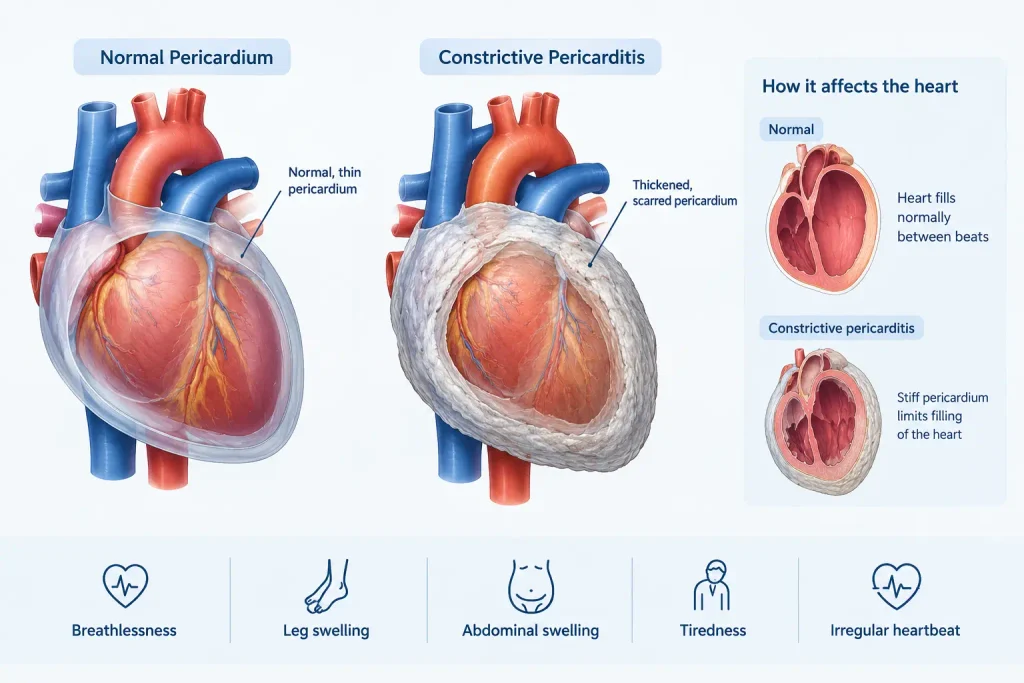
The heart sits inside a thin, slippery sac called the pericardium. Normally this sac moves freely as the heart beats, like a loose glove. In constrictive pericarditis, long-term inflammation scars the sac until it becomes thick and rigid, more like a hard shell than a glove.
A heart wrapped in a rigid shell cannot expand fully between beats. So the problem here is not pumping, it is filling. The pumping strength, measured as the ejection fraction, often looks completely normal on a scan. But because less blood can enter the heart, less goes out, and the blood waiting to get in backs up into the liver, the belly, and the legs. That backup is what creates most of the symptoms.
Symptoms of Constrictive Pericarditis
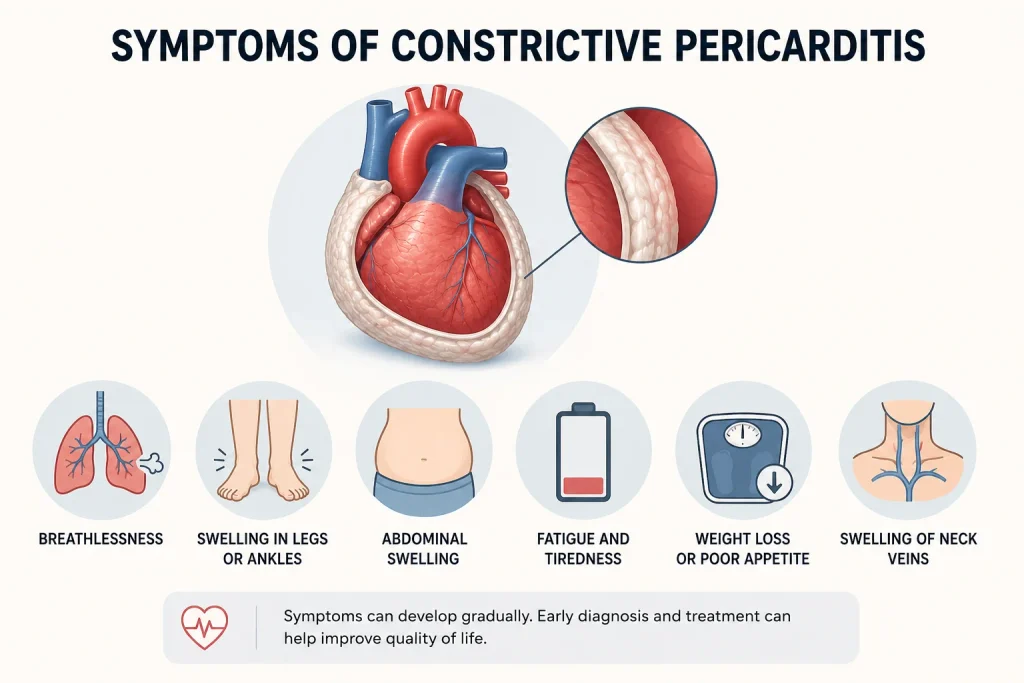
The symptoms build slowly, over months, which is why they are so often blamed on something else. Watch for:
- Breathlessness on activity: walking, climbing stairs, or carrying bags feels harder than it used to.
- Swelling in the legs and ankles that tends to get worse through the day.
- A swollen or heavy belly from fluid build-up (called ascites), often with feeling full after very small meals.
- Deep, constant tiredness that sleep does not fix.
- Palpitations, a fluttering or irregular heartbeat.
In advanced disease, blood pressure may run low and people slowly lose muscle and appetite. Because this whole picture looks like liver disease or general heart failure, many people see two or three doctors before the pericardium is even suspected.
What Causes Constrictive Pericarditis?
Anything that inflames the pericardium for long enough can scar it. An earlier episode of pericarditis is the usual starting point. Constriction is uncommon after a simple viral episode, but the risk rises sharply when the original infection was bacterial or tubercular. Other causes include previous heart surgery, radiation therapy to the chest area, and long-standing kidney disease. In many Western cases no clear cause is ever found.
Is Tuberculosis a Cause of Constrictive Pericarditis?
Yes, and in India it is a major cause. A 12-year study of Indian patients who needed surgery for constrictive pericarditis found tuberculosis behind more than half of those cases, with an average age of just 32 years. This is different from Western countries, where the same study notes viral and unknown causes are more common.
TB can affect the pericardium, and even after treatment, up to half of these cases may still develop constriction as the inflammation heals into scar. So if you have had TB, especially in the chest, and you now have unexplained swelling or breathlessness, tell your doctor about it clearly. That history helps them look for a pericardial cause rather than a general heart or liver problem.
Who is at higher risk: anyone with past TB, a previous bout of pericarditis, earlier heart surgery, radiation treatment to the chest, or long-term kidney disease. Men are affected more often than women.
How Is Constrictive Pericarditis Diagnosed?
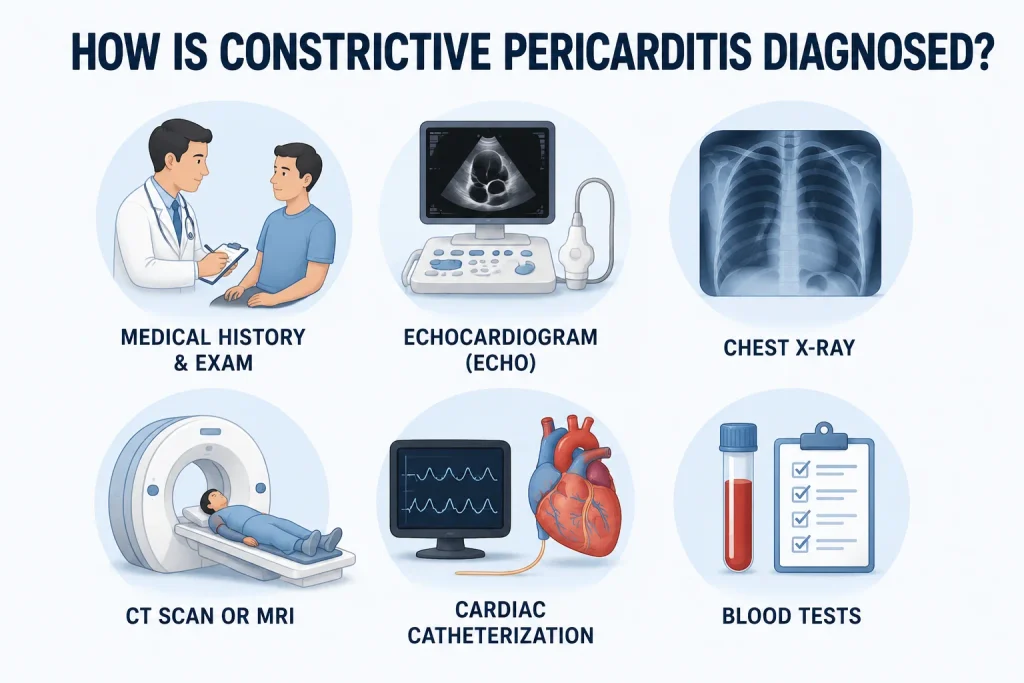
Diagnosis is the hard part of this disease, because the symptoms overlap with so many other conditions. Doctors usually build the picture step by step, using several tests together.
It starts with an echocardiogram, an ultrasound of the heart like a 2D echo, which shows how the heart fills and how the stiff sac affects its movement. An ECG and a chest X-ray are usually done too. The X-ray can sometimes show calcium deposits in the sac, a strong clue. A CT scan measures how thick and calcified the pericardium is, while a cardiac MRI can show both the thickening and whether inflammation is still active, which matters for treatment. If the picture is still unclear, cardiac catheterisation, a thin tube placed into the heart to measure pressures directly, settles the question.
Clinical Note: during catheterisation, doctors look for a pressure pattern called the square root sign, a dip and plateau that stiff-sac filling produces. On examination, the neck veins may bulge further on breathing in, called Kussmaul’s sign. Both point strongly towards constriction.
Constrictive Pericarditis vs Restrictive Cardiomyopathy
These two conditions look almost identical from the outside, same swelling, same breathlessness, same tiredness. But they differ in one way that matters enormously. In constrictive pericarditis the problem is the stiff sac, while the heart muscle itself is usually normal. In restrictive cardiomyopathy it is the heart muscle that has become stiff, which is a form of cardiomyopathy. That difference changes everything, because removing a stiff sac can often cure the first, whereas surgery cannot correct a stiff muscle in the second. This is exactly why doctors test so carefully before deciding.
| Constrictive pericarditis | Restrictive cardiomyopathy | |
|---|---|---|
| What is stiff | The sac around the heart | The heart muscle itself |
| Common cause | TB, past pericarditis, surgery, radiation | Amyloidosis and other muscle diseases |
| Can surgery cure it | Often yes | No |
How Is Constrictive Pericarditis Treated?
Treatment works on four levels, and which one applies depends on how far the scarring has gone.
- Treating the cause: in TB-related cases, a full course of anti-TB medicines is essential, and doctors usually continue it around any surgery.
- Calming active inflammation: when constriction is new and the sac is still inflamed rather than fully scarred, anti-inflammatory treatment can sometimes settle it completely. Doctors call this transient constriction.
- Easing the congestion: water tablets (diuretics) reduce the swelling and breathlessness. They make life easier, but they do not fix the stiff sac.
- Removing the sac: for established, permanent constriction, an operation called pericardiectomy removes the scarred pericardium. This is the definitive treatment, and once the shell is gone, the heart can fill freely again.
Note: the timing and type of treatment is a specialist decision, made by a cardiac team once the tests are complete. It depends on the cause, whether inflammation is still active, the symptoms, and the person’s overall fitness for surgery, which is why no two cases are handled exactly alike.
Can Constrictive Pericarditis Be Cured?
Often, yes, and this is worth saying clearly because most heart diseases cannot make that claim. Transient cases can resolve with medicines alone. For permanent scarring, removing the pericardium can genuinely cure the problem, because the body does not need the sac to live. Many people return to a fully normal life after recovery. The outlook is best when the diagnosis is made early, before years of pressure have strained the heart and liver.
Outlook, and When to See a Doctor
The outlook depends mainly on the cause and how early it is caught. See a doctor promptly if leg or belly swelling keeps growing, breathlessness keeps worsening, or tiredness is out of proportion to your routine, especially if you have ever had TB or pericarditis.
Go straight to emergency care for fainting, severe breathlessness at rest, or severe chest pain, which can also signal a heart attack. Call your local emergency number (108 or 112 in India, 999 in the UK, 911 in the US). Do not wait to see if it passes.
Key Takeaways
- Constrictive pericarditis is a thick, stiff, scarred heart sac that stops the heart from filling normally.
- In India, tuberculosis is the most common cause, and patients are often young, unlike in Western countries where viral and unknown causes lead.
- Swelling in the legs and belly, breathlessness, and deep tiredness are the main clues, because blood backs up when the heart cannot fill.
- Unlike most heart diseases, it can often be cured. New inflammation may settle with medicines; permanent scarring may need surgery (pericardiectomy).
Frequently Asked Questions
What causes constrictive pericarditis?
Long-term inflammation of the heart’s sac, most often from tuberculosis in India, or from past pericarditis, heart surgery, or chest radiation. In many Western cases no cause is found.
Why does it cause swelling in the legs and belly?
The stiff sac stops blood from entering the heart freely, so blood backs up into the veins, the liver, and the belly. That trapped fluid shows up as swollen legs and a heavy, swollen abdomen.
Is constrictive pericarditis the same as acute pericarditis?
No. Acute pericarditis is sudden inflammation of the sac, usually with sharp chest pain, and most cases heal fully. Constrictive pericarditis is the long-term scarring that can follow, where the sac turns stiff.
Does constrictive pericarditis show up on an ECG?
Not reliably. The ECG may show small, non-specific changes or an irregular rhythm, but it cannot confirm the diagnosis on its own. Echo, CT, or cardiac MRI are needed to see the stiff sac itself.
Is pericardiectomy a major surgery?
Yes, it is open-heart surgery and needs an experienced cardiac team. But for permanent constriction it offers the best chance of a real cure, and most people improve clearly once they recover.
Can you live without your pericardium?
Yes. The pericardium is protective but not essential, and the heart works normally without it. That is why removing a scarred sac is a genuine treatment rather than a compromise.
Can constrictive pericarditis come back after surgery?
It is uncommon once the scarred sac has been fully removed. Recurrence is more likely when only part of the pericardium could be taken out, which is one reason surgical experience matters.
What is the life expectancy with constrictive pericarditis?
It depends on the cause, how early it is found, and how the heart has coped. Untreated, it slowly worsens. With timely treatment, and surgery where needed, many people go on to live full, normal lives.
Medical Disclaimer
This article is for general education only. It is not medical advice, diagnosis, or treatment. If you have growing swelling, worsening breathlessness, or any symptom described here, please see a doctor. For fainting, severe breathlessness, or severe chest pain, seek emergency care immediately by calling your local emergency number (108 or 112 in India, 999 in the UK, 911 in the US). Always follow the advice of a qualified doctor.
References and Sources
- Cleveland Clinic. Constrictive Pericarditis: Symptoms, Causes and Treatment.
- StatPearls (NCBI). Constrictive Pericarditis.
- Indian Journal of Thoracic and Cardiovascular Surgery. Pericardiectomy for Chronic Constrictive Pericarditis: 12 Years’ Experience from a Tertiary Centre in India.
- PMC Review. Tuberculous Constrictive Pericarditis.
- American College of Cardiology. 2025 Concise Clinical Guidance on the Diagnosis and Management of Pericarditis, JACC.
- Mayo Clinic. Pericarditis: Symptoms and Causes.
- American Heart Association (AHA). Symptoms and Diagnosis of Pericarditis.
Written by
Iraphan Khan, BSN, RN, D.Pharm
Founder of RealMedVision and a Public Health Researcher who creates evidence-based health content from trusted medical sources.
Medically reviewed by
Dr Praveen Verma, MBBS, MD (Pathology)
Dr Himanshu Morya, MBBS, Medical Educator
Last medically reviewed: 1 September 2026