
Medically reviewed: 3 September 2026 · Last updated: 3 September 2026
Eye flu moves through families fast in monsoon. Here is what truly helps and what quietly harms.
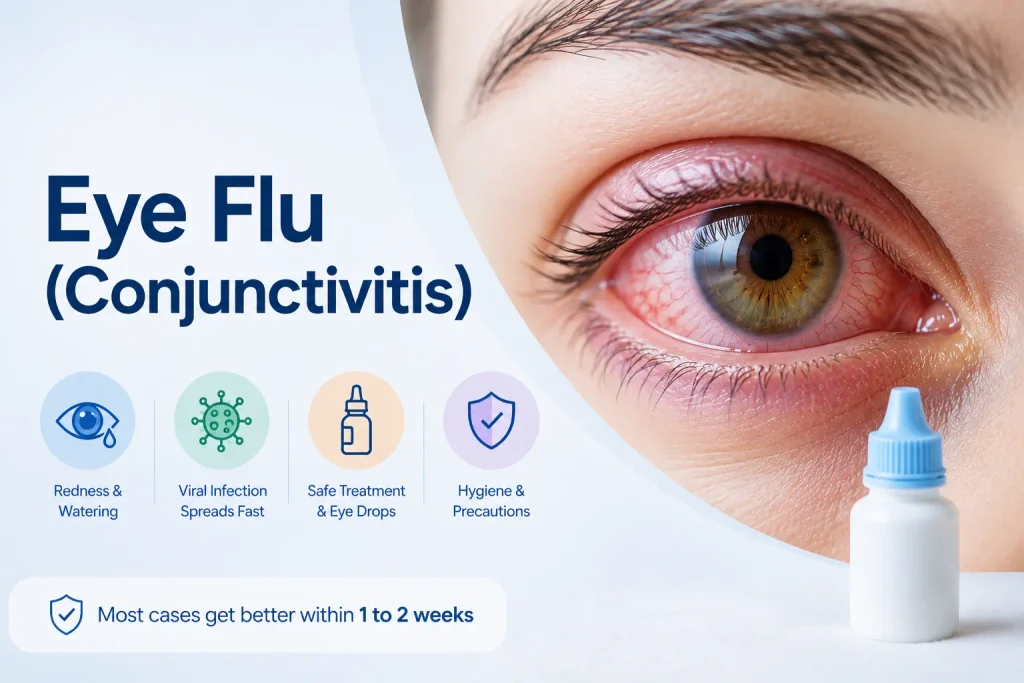
Eye flu is a common Indian term for conjunctivitis, which can make the eyes red, watery and gritty, with sticky lashes in the morning. Most cases are caused by viruses and get better on their own within 1 to 2 weeks. This guide explains the symptoms, treatment, eye drops, recovery time and when to see a doctor.
Quick Answer
- What it is: Eye flu, also called conjunctivitis or pink eye, is an infection of the thin clear layer covering the white of the eye.
- Main cause: Viruses, most often adenovirus. It spreads through hands, towels and shared items, not by looking at someone.
- Common symptoms: Red or pink eyes, watery discharge, a gritty feeling and sticky lashes on waking.
- Treatment: Most cases settle on their own. Lubricating drops, a clean cool compress and hand hygiene ease the recovery. Antibiotic drops help only when a doctor confirms a bacterial cause.
- Recovery time: Most people improve within 1 to 2 weeks, although some cases last longer.
- See a doctor if: There is eye pain, light sensitivity, blurred vision, thick yellow or green discharge, or the patient is a newborn.
What Is Eye Flu?
The conjunctiva is a thin, clear layer that covers the white of the eye and the inside of the eyelids. When it becomes inflamed, the eye can turn red, watery and irritated. This is called conjunctivitis, commonly known as pink eye or eye flu in India.
Most acute conjunctivitis cases are caused by viruses, with adenovirus being a common cause. Viral conjunctivitis can spread easily through hands, eye discharge and shared items, which is why it can move quickly through schools, homes and workplaces.
Eye Flu Symptoms
Symptoms usually start in one eye and reach the other within a day or two. The look of the eye, and the discharge, tell a doctor a lot about the cause.
Common symptoms of eye flu
- Pink or red colour: widened blood vessels across the white of the eye.
- Watery discharge: constant tearing that soaks the lashes.
- Gritty or burning feel: as if sand is trapped under the eyelid.
- Sticky lashes on waking: dried crusting can glue the eye shut.
- Puffy eyelids: mild swelling that makes the lids feel heavy.
- Itching: present in viral cases, strongest when allergy is the trigger.
Symptoms that need a closer look
Eye pain beyond mild irritation, trouble tolerating light, blurred vision, and thick yellow or green discharge point away from a simple viral infection. Any of these, and every case in a newborn, needs a doctor’s examination.
How Does Eye Flu Spread?
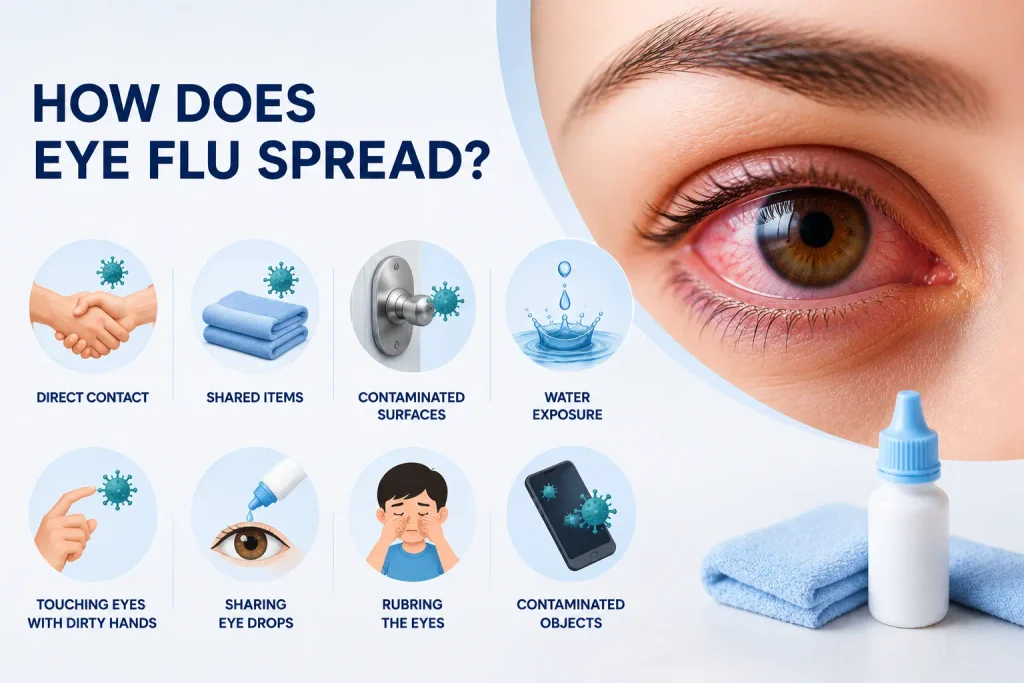
The infection spreads mainly through infected eye secretions carried on hands, towels, pillowcases and shared items such as kajal or eye drops. It can keep spreading for as long as symptoms last, often one to two weeks.
Season matters in India. Cases rise sharply through the monsoon, roughly June to September. The 2023 wave showed the scale: tertiary hospitals in Delhi reported as many as 100 conjunctivitis cases a day, several states shut schools, and dengue cases were climbing through the same weeks.
Crowded spaces speed it up. Packed trains, hostels and shared washrooms pass eye flu along much as they spread the H1N1 virus in flu season.
Example (illustrative only): A nine year old comes home from school with one red, watery eye. Within days both her eyes are affected, her brother has caught it, and her father follows after sharing a towel. This is exactly how eye flu moves through a household.
How Is Eye Flu Treated?
Treatment follows the cause, so the first step is to identify the type. Most acute cases are viral and clear up without medicine, and antibiotic drops do nothing against a virus. They help only when a doctor confirms a bacterial cause.
Viral vs Bacterial vs Allergic Conjunctivitis
| Feature | Viral (eye flu) | Bacterial | Allergic |
|---|---|---|---|
| Discharge | Usually watery and clear | Often thick and pus-like | Usually watery |
| How it starts | May start in one eye and spread to the other | May affect one or both eyes | Usually affects both eyes |
| Contagious | Yes | Yes | No |
| Usual care | Usually settles on its own; comfort care can help | Some cases may need antibiotic eye drops | Avoid triggers; allergy eye drops may help |
| Typical duration | Usually 1 to 2 weeks, sometimes longer | Often improves within a few days, but may last longer | Can continue while the trigger is present |
For the viral form, care means comfort while the body clears the infection: lubricating drops for dryness, a clean cool compress for swelling, and careful hand washing for everyone at home.
Doctor’s Tip: If your doctor prescribes antibiotic eye drops, use them for the full duration advised, even if your eye starts to feel better. Do not stop or change the treatment without checking with your doctor.
Eye Drops for Eye Flu: What Do Doctors Prescribe?
During the 2023 outbreak, a survey in the Indian Journal of Ophthalmology found that 51.4 percent of patients went to a pharmacy before any doctor. This can increase the chance of using the wrong eye drops without knowing the cause.
- Lubricating drops (artificial tears such as carboxymethylcellulose): may help with dryness and irritation in any type of conjunctivitis. A pharmacist or doctor can help you choose a suitable product.
- Antibiotic drops: used only for bacterial conjunctivitis, on a doctor’s prescription. After examining the eye, doctors often prescribe drops such as moxifloxacin or tobramycin.
- Antihistamine drops: used for allergic conjunctivitis, such as olopatadine, again on a doctor’s advice.
- Antiviral medicines: reserved for rare herpes related eye infections and always a specialist decision.
Which drop, the dose and the duration all depend on the cause, and a doctor confirms that by examining the eye. Never share eye drops between two people.
Keep in Mind: Do not use steroid eye drops unless an eye doctor has prescribed them for you. In the wrong infection they can make things worse and raise eye pressure.
How Many Days Does Eye Flu Last?
Most viral cases improve within 1 to 2 weeks, although some can last longer. Bacterial cases often improve within 2 to 5 days once prescribed drops begin. Steady improvement after the first week is reassuring. Worsening at any point is not.
Typical Eye Flu Recovery Timeline
| Stage | What usually happens | What to do |
|---|---|---|
| Days 1 to 3 | Redness, watering and grittiness peak. The second eye often gets involved. | Start compresses and lubricating drops. Separate towels immediately. |
| Days 4 to 7 | Irritation slowly begins to ease. | Continue hygiene and watch for pain or vision change. |
| Days 8 to 14 | Most people feel close to normal again. | Keep washing hands. Discard eye makeup used during the infection. |
| Beyond 14 days | Ongoing redness, discharge or discomfort is not typical. | See an eye doctor for an examination. |
Eye Flu in Children
Children pick up eye flu faster than anyone else and pass it on before the first parent notices. During the 2023 wave, several states closed schools or sent affected children home on health department advisories. Keep a child with red, watering eyes at home until the discharge stops, usually about a week.
Note: A newborn with red, swollen or discharging eyes must see a doctor the same day. Eye infection in the first month of life can turn serious quickly.
When to Call Your Doctor: For a child, act on eye pain, refusal to open the eyes in light, swelling that shuts the eye, fever with unusual sleepiness, or symptoms lasting beyond two weeks. Any one of these deserves a same day call.
Safe Home Care and What Never to Put in Your Eye
Good home care eases symptoms and, above all, stops the spread.

- Clean compress: cool or lukewarm, made with boiled and cooled water, using a fresh cotton pad for each eye.
- Lubricating drops: as often as needed for comfort, from a bottle nobody else uses.
- Separate items: the patient keeps their own towel, pillowcase and handkerchief until recovery.
- Wash hands often: a 20 second wash after every touch near the face.
- Pause lenses and makeup: no contact lenses until the eyes are clear, and bin eye makeup used during the infection.
- Skip swimming: pool water irritates the eye and spreads the infection.
Kajal, honey, ghee, breast milk, urine and rose water do not belong in an infected eye. Home substances scratch an inflamed surface, add new germs and have caused real injuries. Note: If a remedy did not come from a doctor or pharmacist, keep it away from the eye.
Myth vs Fact
Myth: Capsules or tablets can cure eye flu.
Fact: No oral medicine cures viral eye flu. It usually clears on its own, while lubricating drops can ease discomfort.
Myth: Honey or rose water can soothe an infected eye.
Fact: These substances can irritate the eye and introduce germs. Do not put them into an infected eye.
There is no routine vaccine that prevents the common viral forms of eye flu. Good hand hygiene and avoiding shared towels, pillows and eye products can help reduce its spread.
Patient Tip: A separate towel for the patient, washed daily, can help reduce the chance of spreading the infection to others.
When Should You See a Doctor?
Most cases never need a clinic visit. The exceptions below do, and quickly.
- Pain: anything in or around the eye beyond mild irritation.
- Vision and light: blurring that stays, or light that hurts.
- Discharge: thick, yellow or green, returning soon after cleaning.
- No progress: little improvement after a week, or worsening at any stage.
- Higher risk groups: newborns, contact lens users with a painful red eye, and anyone with weak immunity.
- Frequent repeats: conjunctivitis that keeps returning needs a full eye examination.
High fever with severe body ache and pain behind the eyes is a different pattern, not typical of eye flu. During the monsoon that combination needs a proper fever work up, including a platelet count if the doctor suspects dengue.
For most people, eye flu is uncomfortable but not dangerous. Lasting eye damage is rare when the warning signs above are acted on early.
Key Takeaways
- Hand washing and separate towels are the main way to protect the rest of the family.
- Lubricating drops ease symptoms. Antibiotic, antihistamine and steroid drops need a doctor’s prescription.
- Improvement usually comes within 1 to 2 weeks. See a doctor if a week passes with no progress.
- Keep children home from school while the eyes are red and watering.
- Eye pain, light sensitivity, blurred vision, thick discharge or symptoms in a newborn need quick medical attention.
Frequently Asked Questions About Eye Flu
How many days does eye flu take to heal completely?
Typically 1 to 2 weeks for viral cases, although some can last longer. Bacterial cases usually improve within 2 to 5 days once prescribed drops begin. Slow, steady improvement is normal. Worsening at any stage is not.
What is the best medicine for eye flu?
No tablet, capsule or syrup cures viral eye flu. The infection clears on its own while lubricating drops keep the eye comfortable. Antibiotic drops work only for bacterial cases, which a doctor confirms. Do not use steroid eye drops unless an eye doctor has prescribed them for you.
Can you get eye flu just by looking at someone who has it?
No. Eye flu usually spreads through infected secretions on the hands or contaminated items such as towels and pillows. Simply looking at someone with eye flu does not usually spread the infection.
In which month does eye flu spread the most in India?
Cases often increase during the monsoon months in India, roughly June to September. During the 2023 wave, some parts of India reported a sharp rise in conjunctivitis cases. Good hand and eye hygiene can help reduce the spread.
Is eye flu dangerous?
Rarely. For most people it is a self limiting infection that heals without damage. Newborn babies, people with weak immunity, contact lens users with eye pain, and anyone whose vision changes should see a doctor rather than waiting at home.
Can children go to school with eye flu?
Children may need to stay home while symptoms are active, especially when there is eye discharge and frequent eye touching. Follow the school’s policy and your doctor’s advice about returning to school.
Is cold water good for eye flu?
Splashing water into the eye repeatedly does not help and can irritate it further. A clean, cool compress on closed eyelids can help ease discomfort.
How do you treat eye flu at home?
Rest the eyes, use lubricating drops for comfort, apply a clean cool compress, and wash hands after touching the face. Keep personal towels and pillowcases separate. If symptoms worsen or do not start improving, see a doctor.
Medical Disclaimer: This article is for education and awareness. It does not replace an eye examination, diagnosis or prescription. Always follow your doctor’s advice, especially for children, newborns and anyone with existing eye disease.
References
- Centers for Disease Control and Prevention. How to Treat Pink Eye. 2024. cdc.gov/conjunctivitis/treatment
- Centers for Disease Control and Prevention. About Pink Eye. 2024. cdc.gov/conjunctivitis/about
- Hashmi MF, Gurnani B, Benson S. Conjunctivitis. StatPearls, NCBI Bookshelf. Updated 2024. ncbi.nlm.nih.gov/books/NBK541034
- Solano D, Fu L, Czyz CN. Viral Conjunctivitis. StatPearls, NCBI Bookshelf. Updated 2023. ncbi.nlm.nih.gov/books/NBK470271
- Cleveland Clinic. Pink Eye (Conjunctivitis). Reviewed 2026. my.clevelandclinic.org
- Health-seeking behaviors during an outbreak of acute conjunctivitis in Central India. Indian Journal of Ophthalmology. 2024. pmc.ncbi.nlm.nih.gov/articles/PMC11831936
- The never-seen upsurge of eye flu cases in India: One more menace due to a virus. 2023. sciencedirect.com
- Directorate of Health and Family Welfare, Nagaland. Advisory on Conjunctivitis (Eye Flu). July 2023. ipr.nagaland.gov.in
Written by
Iraphan Khan, BSN, D.Pharm
Founder of RealMedVision and creator of evidence-based health content.
Medically reviewed by
Dr Praveen Verma, MBBS, MD (Pathology)
Dr Himanshu Morya, MBBS, Medical Educator
Last medically reviewed: 3 September 2026