
Medically reviewed: 6 September 2026 · Last updated: 6 September 2026
In a healthy person the two numbers match. When they do not match, that gap itself is the finding.

The difference between heart rate and pulse rate comes down to one thing: heart rate counts how often the heart beats, and pulse rate counts how many of those beats can be felt in an artery. Your doctor listens to your chest with a stethoscope while the nurse holds your wrist, and most of the time both get the same number.
Quick Answer
- Heart rate is how many times the heart contracts in a minute, counted at the chest.
- Pulse rate is how many of those beats you can feel as a wave in an artery, usually at the wrist.
- In a healthy person the two are the same number, which is why the words get used interchangeably.
- A gap between them is called a pulse deficit, and it usually points to an irregular heart rhythm.
What Heart Rate Measures
Heart rate is the number of times your heart muscle contracts in one minute. Every contraction is triggered by an electrical signal that travels through the heart, and every one of those signals counts, whether or not it manages to push much blood out.
The most direct way to count it is to listen at the chest with a stethoscope, over the point where the tip of the heart sits. Nurses call this the apical pulse. An ECG test does the same job electrically, recording every signal the heart produces.
What Pulse Rate Measures
Pulse rate is the number of times you can feel that beat as a pressure wave travelling through an artery. When the heart squeezes, it pushes blood into the aorta with enough force to briefly stretch the artery walls. That stretch travels outward and reaches your wrist a fraction of a second later.
You feel it most easily at the radial artery in the wrist, or at the carotid artery in the neck. A fingertip pulse oximeter and many smartwatches use optical sensors to estimate the same thing without touch.
A beat only becomes a felt pulse if it moves enough blood. A weak contraction can happen inside the chest and never register at the wrist.
Heart Rate vs Pulse Rate at a Glance
| Heart rate | Pulse rate | |
|---|---|---|
| What it counts | Every contraction of the heart | Only beats that reach the artery |
| Where it is measured | Chest, with a stethoscope or ECG | Wrist, neck, or a fingertip sensor |
| Normal adult range | 60 to 100 beats per minute | 60 to 100 beats per minute |
| In a healthy person | Same as the pulse rate | Same as the heart rate |
| When rhythm is irregular | Stays accurate | Can read lower than the true rate |
The apical rate is never lower than the radial pulse. It can only be equal or higher.
When the Two Numbers Do Not Match
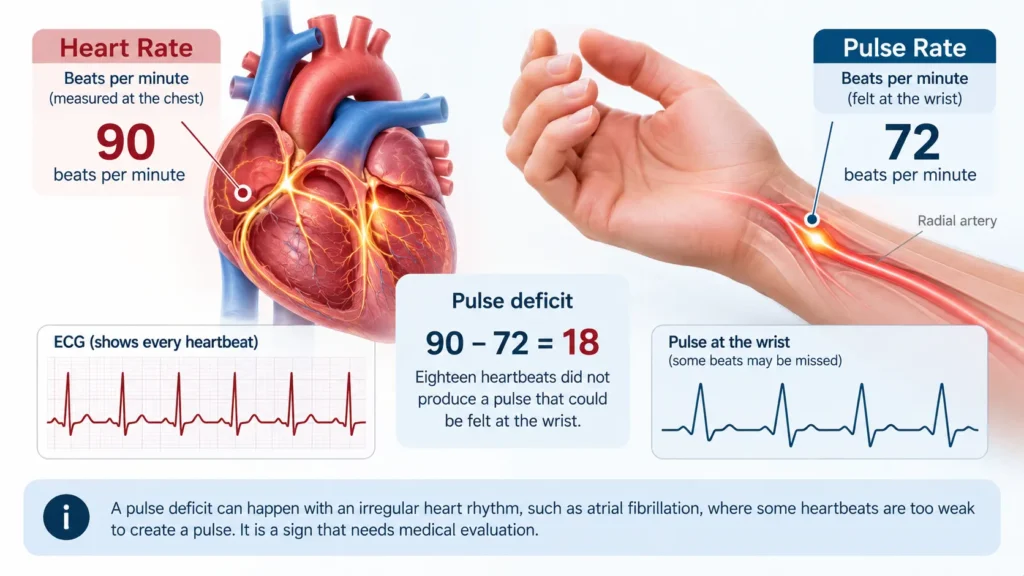
This is where the difference between heart rate and pulse rate stops being academic. If a clinician counts 90 beats at the chest and only 72 at the wrist, the gap of 18 is called a pulse deficit. Eighteen times in that minute, the heart contracted but did not produce a pulse that could be felt.
Why a Beat Goes Missing
The heart fills with blood between beats. When a beat arrives too early, the chambers have not had enough time to fill, so the contraction pushes out less blood. That heartbeat is real and shows up on an ECG, but it may not create a pulse strong enough to feel.
Atrial fibrillation is one important cause, because the rhythm is irregular and the filling time keeps changing. Atrial flutter and frequent early beats can do the same. This is why a doctor assessing an irregular rhythm compares both counts rather than trusting the wrist alone.
Clinical Note: Atrial fibrillation raises the risk of stroke, so finding it early can change treatment. A pulse deficit may be the first clue, and it usually leads to an ECG and, depending on the findings, further heart testing.
Heart Rate vs Pulse Rate: Which Should You Trust?
There is no winner between the two. In a steady rhythm both give the same answer anyway.
The difference starts to matter when the rhythm turns irregular. A smartwatch or a finger on the wrist can miss the weak beats, so the number you see may sit below what the heart is actually doing. That is why doctors trust the chest count or an ECG when the rhythm is in doubt, not the wrist.
Normal Ranges by Age
Because the two normally match, the same ranges apply to both. Children run faster than adults, and the numbers settle by the teenage years. Heart rate is not blood pressure either. That reading has an age wise BP chart of its own.
| Age group | Resting rate, beats per minute |
|---|---|
| Newborn, 0 to 1 month | 100 to 160 |
| Infant, 1 to 12 months | 100 to 150 |
| Child, 1 to 5 years | 80 to 130 |
| Child, 6 to 10 years | 70 to 110 |
| Teenagers and adults | 60 to 100 |
| Trained athletes | Often below 60 |
The adult range of 60 to 100 applies to older adults too. Resting rate does not narrow with age, though the maximum rate during exercise does fall. Our normal heart rate by age guide covers this in detail.
How to Check Your Own Pulse
- Find your pulse. Turn your hand palm up. Place two fingers on the thumb side of your wrist, just below the crease. Do not use your thumb. It has its own pulse. Press gently until you feel the beat.
- Count the beats. Count for 30 seconds and multiply by two if the rhythm feels regular. If the beat feels uneven, count for a full 60 seconds for a more reliable result.
- Notice the rhythm. Pay attention to whether the beats feel even or seem to skip or come early. This information can be useful to share with a doctor.
- Check while resting. Sit quietly for a few minutes before checking your pulse. If you want a consistent resting baseline, you can also check it first thing in the morning.
When to See a Doctor
A single unusual reading after coffee or a flight of stairs does not usually mean there is a problem. A pattern that keeps happening matters more, especially when you have symptoms.
Book an appointment if your resting heart rate is consistently outside the usual range without an obvious reason, if your heartbeat feels irregular or keeps skipping, or if your smartwatch repeatedly flags an irregular rhythm. Chest pain is the exception. If it comes with a fast, slow, or irregular heartbeat, treat it as an emergency, not an appointment.
Call 112 or 108
Chest pain, severe breathlessness, fainting or collapse with an abnormal heartbeat needs emergency care. Do not wait for a routine appointment.
Key Takeaways
- Count for a full 60 seconds whenever the beat feels uneven.
- Watch the rhythm as much as the number. Skipped or early beats matter even when the count looks normal.
- Take a repeated smartwatch rhythm alert seriously, even when the rate reads normal.
- Leave the pulse deficit check to a clinician. It needs a chest count against the wrist.
Frequently Asked Questions
Is pulse rate the same as heart rate?
In most healthy people, yes. Each heartbeat produces a pulse that can be felt in an artery, so both counts give the same number. They only separate when some beats are too weak to produce a felt pulse, which happens with an irregular rhythm.
Is heart rate or pulse rate more accurate?
Neither is simply better, because they answer different questions. Heart rate counts every contraction the heart makes, including the weak ones. Pulse rate counts how many of those beats produce a pulse you can detect in an artery.
What is a pulse deficit?
It is the gap between the rate counted at the chest and the rate felt at the wrist. If the chest gives 90 and the wrist gives 72, the pulse deficit is 18. A healthy pulse deficit is zero, and a gap usually points to atrial fibrillation or frequent early beats.
Is 72 to 80 a normal pulse rate?
Yes. For adults, anything from 60 to 100 at rest is within the usual range, and 72 to 80 sits comfortably in the middle. What matters more than the exact figure is whether it is steady for you and whether the rhythm feels regular.
Is a pulse rate of 112 normal?
A resting pulse of 112 is above the usual adult range and would be called tachycardia. It is often explained by exercise, fever, stress, caffeine or dehydration, and settles once the cause passes. A reading that stays above 100 at rest with no clear reason should be checked, especially alongside breathlessness or dizziness.
What is a good pulse rate by age?
Newborns run 100 to 160, infants 100 to 150, young children 80 to 130, older children 70 to 110, and teenagers and adults 60 to 100. Some trained athletes rest below 60, which is normal for them rather than a problem.
Can a smartwatch tell the difference?
A watch uses an optical sensor at your wrist, so it estimates pulse rate rather than measuring the heartbeat itself. When the rhythm is irregular it can read lower than the true heart rate. Many watches flag an irregular rhythm, and that flag is worth showing to a doctor even if the number looks fine.
Why does my pulse feel like it skips?
A skipped or extra beat often comes from a premature beat that arrives too early to be felt. Occasional palpitations are common and usually harmless, but an irregular heartbeat can have several causes, so frequent or persistent skipping should be assessed by a doctor.
References
- Pulse vs heart rate: why they are different. Cleveland Clinic.
- Heart rate: normal rates and what to know. Cleveland Clinic, 2026.
- All about heart rate and pulse. American Heart Association.
- Apex to radial pulse deficit. Primary Care Notebook.
- Auscultation of the apical pulse and calculating pulse deficit. Introduction to Health Assessment for the Nursing Professional.
- Pulse deficit in atrial fibrillation. Polish Heart Journal.
- Apical pulse: how doctors measure it and what it shows. Healthgrades, 2025.
- Pulse and how to take it. MedlinePlus, US National Library of Medicine.
Written by
Iraphan Khan, BSN, RN, D.Pharm, Public Health Researcher
Founder of RealMedVision, writing patient-focused health content based on clinical guidelines and peer-reviewed research.
Medically reviewed by
Dr Praveen Verma, MBBS, MD (Pathology), Pathologist and Clinical Laboratory Specialist
Dr Himanshu Morya, MBBS, Medical Educator
Medical Disclaimer
This page is published for education and awareness. It is not medical advice, a diagnosis or a treatment plan. Speak to a qualified doctor about your own readings and symptoms. If an abnormal heartbeat comes with chest pain, severe breathlessness or fainting, call 112 or 108 immediately.