
Last updated 30 October 2026. Last medical review 30 October 2026.
The numbers labs use, why your report may say TLC instead of WBC, and the counts that need a same day call to your doctor.
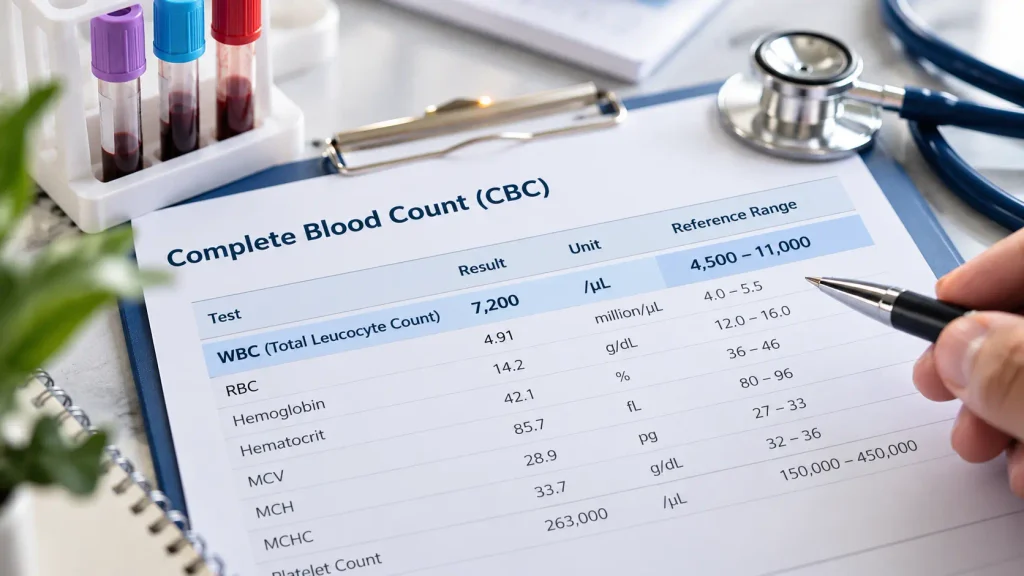
The WBC normal range for most adults is 4,500 to 11,000 white blood cells per microlitre of blood, written on some reports as 4.5 to 11.0 × 10⁹/L. Indian labs often print the same number as TLC, short for total leucocyte count. A result a little outside this band is common and often harmless. A result far outside it needs a doctor. On its own the count never confirms or rules out an illness.
Quick Answer
- WBC and TLC are the same test. Both count your white blood cells.
- Adults: 4,500 to 11,000 per microlitre. Newborns and pregnant women run higher.
- Below 4,500 is low on most reports. Some labs use 4,000. Above 11,000 is high.
- Fever with a low neutrophil count needs urgent assessment. A very high or steadily rising count needs a doctor’s review.
What Is A White Blood Cell Count?
White blood cells (WBCs), also called leucocytes, are part of your immune system and help your body fight infections. A WBC count measures the number of these cells in a specific volume of blood. It is one part of a complete blood count (CBC), which also measures components such as haemoglobin, red blood cells and platelets.
Doctors may order a WBC count to help assess infections, inflammation and some allergic conditions. It can also help investigate certain blood cancers, although a WBC count alone cannot diagnose them. A CBC may also be included in pre-surgery testing or ordered alongside other tests, such as a kidney function test.
WBC Normal Range Chart By Age And Sex
Age and pregnancy both shift the WBC normal range, so always compare your result with the reference printed on your own report. One microlitre equals one cubic millimetre, so 4,500 per microlitre and 4,500 per cumm are the same thing.
Units: cells per microlitre (µL), also written as cells per cubic millimetre (mm³). To convert to × 10⁹/L, divide by 1,000. Sources: MedlinePlus, Cleveland Clinic (2022) and American Family Physician (2015). These are reference examples, not universal limits. Pregnancy and childhood ranges vary by age, study and laboratory.
Normal WBC Range By Life Stage
Newborn: 13,000 to 38,000
Infant, two weeks: 5,000 to 20,000
Pregnancy, third trimester: 5,800 to 13,200
Adult, not pregnant: 4,500 to 11,000
Each bar shows the upper limit of the normal range. Bars are scaled to 40,000 cells per microlitre. Source: age and pregnancy table, American Family Physician, December 2015.
TLC Normal Range On Indian Lab Reports
Many Indian labs label this line TLC, for total leucocyte count, rather than WBC. It is the same measurement. So the TLC normal range is the same 4,500 to 11,000 per cumm that applies to WBC, and some reports use 4,000 as the lower cut off.1 Below it sits the DLC, the differential leucocyte count, which splits the total into percentages.
Good To Know
Your report may print the count as 7,200 per cumm, 7.2 × 10³/µL or 7.2 × 10⁹/L. All three mean the same thing: 7,200 white cells in each microlitre of blood. Check the unit column before you worry.
What Is A Dangerous White Blood Cell Count?
No single number turns a result into an emergency. Doctors look at how far the count sits outside the WBC normal range, how fast it moved, which cell type changed and how you feel. Some bands still matter more than others.
On The Low Side
Anything under the lab’s lower limit is called leucopenia. What matters most is the absolute neutrophil count (ANC), the number of neutrophils alone. Neutrophils are the cells that fight bacteria, so a low ANC raises infection risk more than a low total does.
To get the ANC, multiply the total by the combined percentage of neutrophils and bands (young neutrophils), then divide by 100. For example, a WBC of 3,000 with 40 per cent neutrophils and bands gives an ANC of 1,200.
An ANC under 1,500 per microlitre in adults is called neutropenia. American Family Physician (December 2025) grades it as mild at 1,000 to 1,500, moderate at 500 to 999 and severe under 500. In the severe band the risk of serious infection rises sharply, and any fever needs urgent assessment.
On The High Side
Above 11,000 per microlitre is leucocytosis. Results between 11,000 and 30,000 are usually a reaction to infection, surgery, stress or medicines. They settle once the cause is treated. A count between 30,000 and 50,000 needs a prompt doctor’s review to find the cause.
Counts of 50,000 to 100,000, called a leukaemoid reaction, can still come from severe infection but need urgent assessment. Above 100,000 a bone marrow disorder is the usual cause and a haematologist review is needed. These bands come from American Family Physician (2015), and none is a diagnosis by itself.
Why Is My WBC Count High?
Bacterial infection is a common reason for a count above the WBC normal range, and some viral infections can raise it too. Other causes listed by MedlinePlus and American Family Physician include:
- Smoking: raises the baseline count
- Inflammation: rheumatoid arthritis, allergy, burns or tissue injury
- Stress: severe physical or emotional stress, including surgery
- Medicines: steroids such as prednisolone, salbutamol inhalers, adrenaline, lithium
- Pregnancy: the count rises naturally, most in the third trimester
- Spleen removal: the count can stay higher afterwards
- Blood cancers: leukaemia and other bone marrow disorders, which are uncommon
A high count does not mean leukaemia on its own. The usual next step is a repeat CBC with differential, sometimes with a peripheral smear, where the cells are checked under a microscope. Infections that keep coming back also deserve a closer look with your doctor.
Why Is My WBC Count Low?
A viral fever is one of the common reasons for a sudden dip. The CDC lists leucopenia as a usual lab finding in dengue, and typhoid and other infections can do the same.
In dengue the white cell count usually starts to rise in the recovery phase, with platelets following. Fever settling is not the all clear, because the critical phase begins as the fever drops. Watch for severe abdominal pain, persistent vomiting, bleeding gums, restlessness or unusual drowsiness.
Longer lasting causes include bone marrow problems, chemotherapy or radiotherapy, lupus and other autoimmune conditions, HIV, deficiency of vitamin B12, folate or copper, and liver or spleen disease. Medicines matter as well. Some antibiotics, anti seizure drugs, clozapine, water tablets and the antithyroid medicines used for an overactive thyroid can all lower the count.
Some people have a naturally lower baseline. Those with the Duffy null blood group, linked to the ACKR1 gene and common in people of African and some Middle Eastern ancestries, keep more neutrophils in the tissues and fewer in the blood. This is called Duffy null associated neutrophil count (DANC).
A 2020 study using UK and Danish population data found that people with this genotype had lower neutrophil counts but no higher risk of viral or bacterial infection. It is something your doctor weighs up after assessment, not a reason to ignore a low count.
The Five Types Of White Blood Cells
The DLC on your report shows each type as a percentage of the total. MedlinePlus gives these adult reference percentages, reviewed February 2025:
- Neutrophils: 40 to 60 per cent. They fight bacteria.
- Bands: 0 to 3 per cent. These are young neutrophils.
- Lymphocytes: 20 to 40 per cent. They fight viruses.
- Monocytes: 2 to 8 per cent. They clear debris.
- Eosinophils: 1 to 4 per cent. They respond to allergy and parasites such as worms.
- Basophils: 0.5 to 1 per cent. They are part of the allergic response.
Patient Tip
A percentage can look abnormal when a different cell type is the one that changed. A high lymphocyte percentage during a viral fever often means neutrophils dropped. Ask your doctor to read the absolute numbers.
When To See A Doctor
How urgently you need medical advice depends on your WBC count, ANC, previous results, symptoms and medical history. A mildly abnormal result without symptoms may only need a routine medical review or a repeat test, depending on the clinical context.
Arrange a prompt medical review if your count is outside the WBC normal range and you also have:
- Fever, night sweats or unexplained weight loss
- Easy bruising or mouth ulcers
- Infections that keep coming back
- Abnormal haemoglobin or platelet levels on the same report
Take the full report along, including the DLC.
Keep In Mind
Go to an emergency department straight away if your ANC is below 500 per microlitre, or is expected to fall below 500 within 48 hours, and you develop a fever. Fever here means a single reading of 38.3°C (101°F) or higher, or 38.0°C (100.4°F) or higher lasting one hour. This is called febrile neutropenia and is a medical emergency. In people with cancer, guidelines advise starting antibiotics within one hour of triage.
Also seek emergency care for:
- Shaking chills, breathlessness or confusion
- Bleeding that will not stop
- With dengue: severe abdominal pain, persistent vomiting, bleeding gums, restlessness or unusual drowsiness
India 112, or 108 for an ambulance where available. United States 911. United Kingdom 999. European Union 112.
Key Takeaways
- The WBC normal range for most adults is 4,500 to 11,000 per microlitre. TLC on an Indian report is the same test.
- Read the reference column on your own report before comparing with any chart online.
- If your total is low, ask for the absolute neutrophil count. It predicts infection risk better than the total.
- Fever with a low neutrophil count is an emergency. Go to hospital straight away.
- Tell your doctor about every medicine, inhaler and supplement, because some can raise or lower the count. A change that lasts weeks needs a repeat CBC with differential. A blood smear may be recommended depending on the findings.
Frequently Asked Questions
Is a WBC count of 3.7 normal?
A count of 3.7 × 10⁹/L, meaning 3,700 per microlitre, is slightly below many adult laboratory reference ranges. Its significance depends on your absolute neutrophil count (ANC), symptoms, medical history and previous results. Your doctor may recommend a repeat CBC or further tests.
What is the danger zone for WBC?
There is no single danger zone for total WBC count. An ANC below 500 per microlitre carries a high risk of serious infection. A WBC count between 50,000 and 100,000 may indicate a leukaemoid reaction and needs prompt medical assessment. Counts above 100,000 are strongly associated with blood or bone marrow disorders and need urgent specialist evaluation. Symptoms and the blood differential also matter.
Is TLC the same as WBC?
Yes. TLC stands for total leucocyte count, while WBC means white blood cell count. Both refer to the total number of white blood cells in a blood sample. Indian laboratories commonly use TLC, while many laboratories in the US and UK use WBC. The interpretation depends on the laboratory’s reference range.
What is the WBC normal range in females?
Cleveland Clinic lists 4,500 to 11,000 per microlitre for women and 5,000 to 10,000 for men. These are source-specific reference figures, not universal ranges. During the third trimester of pregnancy, the WBC count can rise naturally.
Does dengue lower the WBC count?
Yes. A low white blood cell count is a common laboratory finding in dengue. During recovery, the WBC count usually starts to rise, followed by platelet count recovery. However, the timing varies. A fall in fever does not always mean the illness is over, because the critical phase can begin as the fever drops.
Which cancers cause a low WBC count?
Leukaemia and cancers that spread into the bone marrow can lower the WBC count. Chemotherapy and some forms of radiotherapy can also reduce white blood cells. These are possible causes, but a low WBC result on its own does not mean cancer.
Is a TLC of 12,000 high?
Yes. A TLC of 12,000 per cubic millimetre is slightly above the commonly used adult upper reference limit of 11,000. Infection, surgery, pregnancy, smoking and some medicines can cause a temporary rise. Your doctor can interpret the result using your symptoms, differential count and previous reports.
Does a high WBC count mean leukaemia?
No. Most high WBC counts are related to infections, inflammation, physical stress or medicines. Leukaemia may be considered when the count is very high or keeps rising, particularly if the blood smear shows abnormal cells or there are other findings such as low haemoglobin, low platelets, unexplained night sweats or swollen lymph nodes. A high WBC count alone cannot diagnose leukaemia.
Do I need to fast for a WBC test?
No. Fasting is not usually needed for a CBC or WBC count alone. If your blood test includes other tests, such as fasting blood glucose or a lipid profile, the laboratory may give separate fasting instructions.
References and Medical Sources
- MedlinePlus, US National Library of Medicine: WBC Count. Reviewed February 2025
- MedlinePlus, US National Library of Medicine: Blood Differential Test. Reviewed February 2025
- Cleveland Clinic: Low White Blood Cell Count (Leukopenia). Reviewed October 2022
- Riley LK, Rupert J: Evaluation of Patients with Leukocytosis. American Family Physician, December 2015
- Kim MJ, Forlini C, Kremsreiter K: Neutropenia, Evaluation and Management in the Primary Care Setting. American Family Physician, December 2025
- Legge SE, et al: The Duffy-null Genotype and Risk of Infection. Human Molecular Genetics, 2020
- Centers for Disease Control and Prevention (CDC): Clinical Features of Dengue. Updated February 2026
- Taplitz RA, et al: Outpatient Management of Fever and Neutropenia in Adults Treated for Malignancy. ASCO and IDSA Guideline Update. Journal of Clinical Oncology, 2018
About the Author

Founder of RealMedVision, writing patient-focused health content based on clinical guidelines and peer-reviewed research.
Medically Reviewed By

Dr Parveen Verma, MBBS, MD Pathology

Dr Himanshu Morya, MBBS, Medical Educator
Last reviewed 30 October 2026.
Disclaimer: This article is for general education and is not a substitute for personal medical advice or diagnosis. Reference ranges vary between laboratories. If you have a known low neutrophil count and develop a fever, seek immediate medical assessment. Also seek emergency care for any warning signs listed above. Follow your healthcare professional’s advice about your individual blood test results.