
Last updated 29 October 2026. Last medical review 29 October 2026.
What the test measures, how to read the normal range on your own report, and why troponin can rise even when the heart is not having an attack.
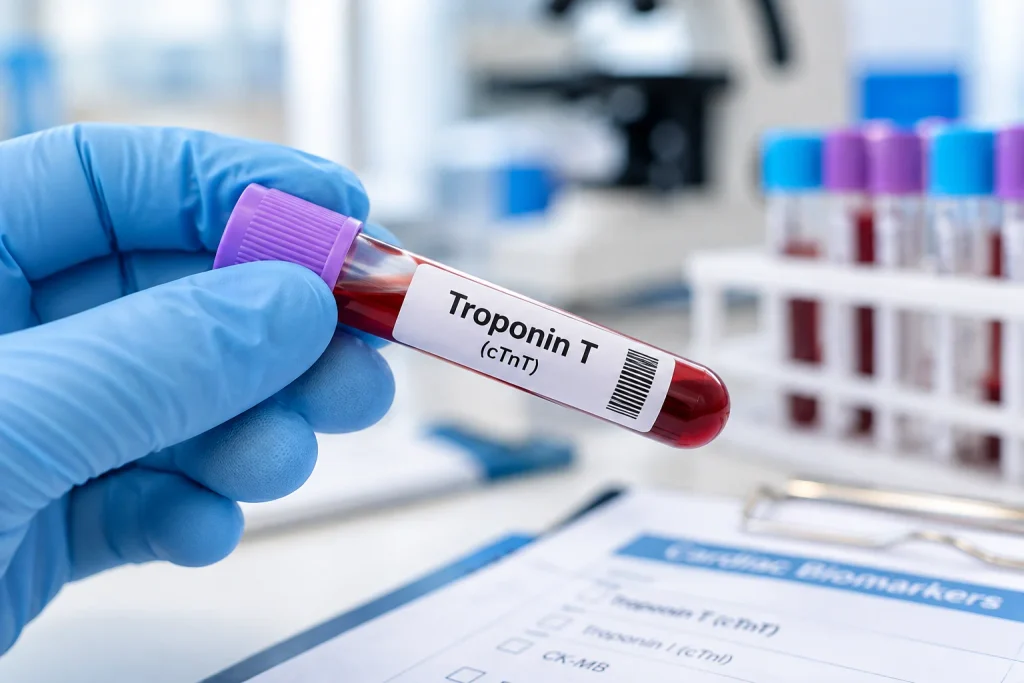
A trop T test measures cardiac troponin T, a protein that leaks into the blood when heart muscle cells are injured. Doctors use it with your symptoms and an ECG to work out whether chest pain is a heart attack. A raised result means heart muscle injury has happened. It does not automatically mean a heart attack.
Quick Answer
- Trop T, short for cardiac troponin T, is a blood test for heart muscle injury.
- There is no single normal number. Each lab sets its own cutoff, and many use a lower one for women.
- One reading is often not enough, because a repeat sample shows whether the level is climbing.
- Kidney disease, severe infection, heart failure and lung clots can also push troponin up.
What Is A Trop T Test?
Troponins are proteins inside heart muscle cells that help the heart contract. Doctors measure two of them, troponin T and troponin I. The trop T test looks at cardiac troponin T, written on reports as cTnT.
When heart muscle cells are stressed or damaged, this protein escapes into the blood. Healthy hearts leak almost none of it, which is why small amounts matter. That sensitivity is also why the result is read alongside an ECG, never alone.
Why Your Doctor Ordered It
Most trop T tests are ordered in a casualty department when someone arrives with chest discomfort, breathlessness, sweating, or pain spreading to the jaw, back or left arm. The 2025 ACC and AHA guideline on acute coronary syndromes advises measuring cardiac troponin as early as possible, preferably with a high sensitivity assay.
It is also used after a known heart attack to follow recovery. If your symptoms felt more like gas or acidity, that confusion is common and worth reading about separately.
Trop T Test Normal Range
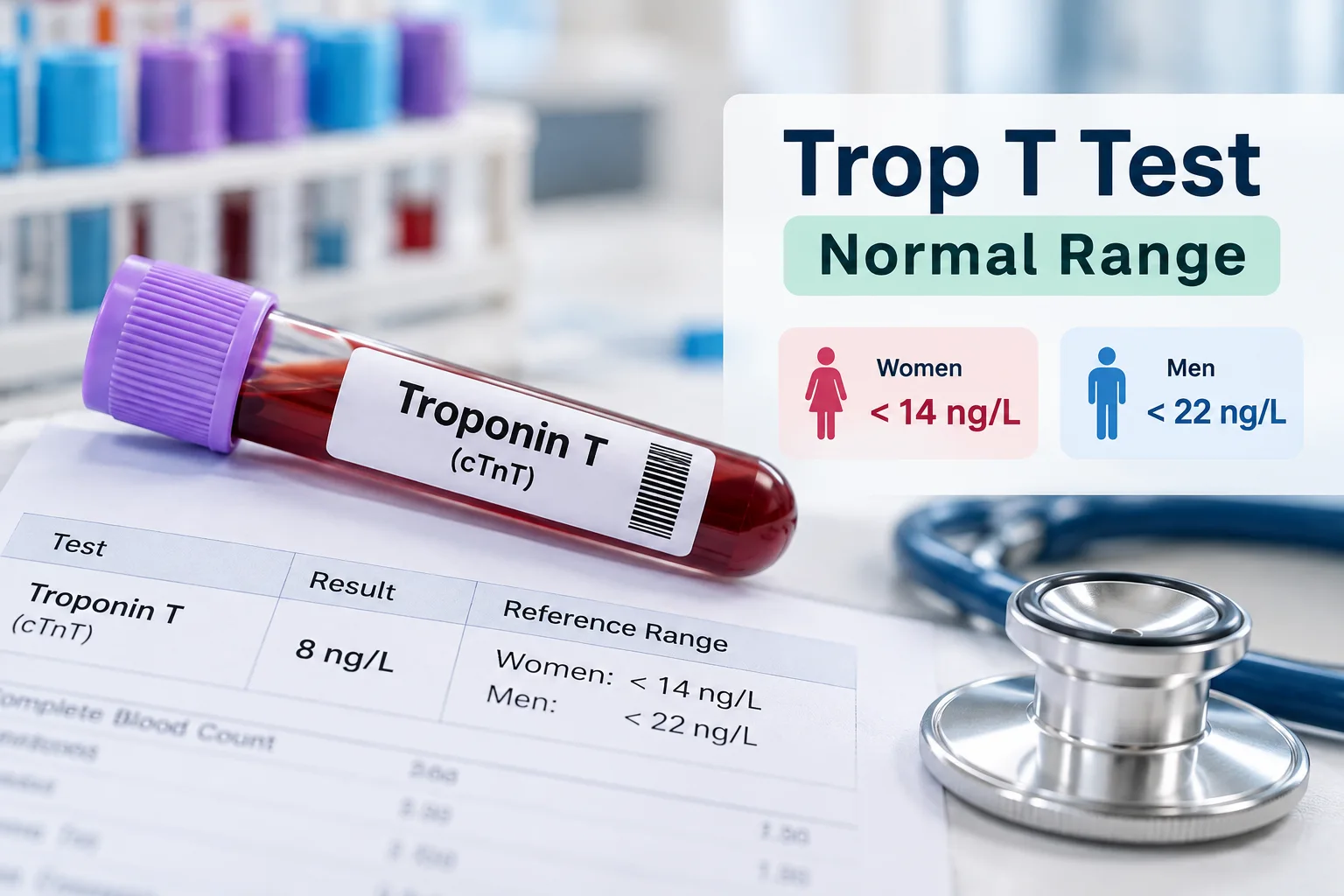
This is where most online charts mislead people. There is no universal normal value for troponin. Every assay sets its own cutoff at the ninety ninth percentile of a healthy population, and a result above it is called myocardial injury.
For one widely used high sensitivity troponin T assay, published cutoffs have been reported at about 14 ng/L for women and about 22 ng/L for men. Those numbers belong to that assay alone. Your report carries the range your own lab uses, printed beside the result.
Units trip people up too. Some reports use ng/L and others ng/mL, so the same result can look wildly different.
How To Read Your Own Report
What Does A Positive Trop T Test Mean?
Positive means the troponin level is above your lab’s cutoff, so heart muscle has been injured. It is a serious finding and it needs a doctor the same day. It is not, by itself, a diagnosis of heart attack.
To call it a heart attack, doctors need a troponin level that is rising or falling with at least one value above the cutoff, together with evidence that heart muscle was short of blood. That evidence can take more than one form, such as typical symptoms, new ischaemic changes on the ECG, or imaging showing a part of the heart not moving as it should. Not every finding has to be present in every patient. A high level that stays flat usually points elsewhere.
What follows is usually a repeat sample, another ECG and often an echocardiogram. If pumping strength comes up, our guide on EF 60 percent on a 2D echo explains that figure.
A Negative Result Is Not A Clean Chit
Two things can make a negative trop T result misleading. The first is timing, because blood taken within an hour or two of symptoms starting may be drawn before troponin rises.
The second is the type of test. Rapid card tests used at smaller centres are quick, but studies show they are less sensitive than laboratory assays and can miss real injury on an early sample. For this reason a repeat sample is usual. Some hospitals can rule out a heart attack on a single high sensitivity result, but only under a validated protocol, when the value is very low, the ECG shows no ischaemia and enough time has passed since symptoms began.
Keep In Mind
Never use a single negative card test to talk yourself out of ongoing chest pain. If the pain is still there, stay in medical care and ask about a repeat sample.
High Troponin Without A Heart Attack
Troponin leaks whenever heart muscle is strained or injured, and plenty of conditions do that without any blocked artery. Reported causes include:
- Chronic kidney disease, where ongoing strain and injury to heart muscle are thought to be the main drivers, with slower clearance playing a smaller part
- Sepsis and other severe infections
- A blood clot in the lungs, which strains the right side of the heart
- Heart failure and inflammation of the heart muscle
- Very fast heart rhythms and stroke
- Prolonged endurance exercise in some people
Kidney function is checked most often alongside troponin, which is why a kidney function test often sits on the same request form. Diabetes raises cardiac risk too, so the early warning signs after forty are worth knowing.
Good To Know
A mildly raised troponin that stays flat across two samples usually reflects long standing strain rather than something that happened today. Your doctor reads the trend, not one number.
Illustrative Scenario
A man in his fifties reaches a small clinic an hour after chest tightness starts. A rapid card test reads negative and he feels reassured. The clinic sends him on to a hospital anyway, where a repeat sample three hours later is clearly raised and the ECG has changed. The first test was simply too early.
Composite example, not a specific patient.
Trop T And Trop I: What Is The Difference?
Both come from heart muscle and both detect the same injury. Hospitals pick one based on the analyser they own, so you may see trop T at one centre and troponin I at another.
Their numbers are not interchangeable, which matters if you move between hospitals during the same illness. Carry your earlier reports so the next team can see the trend.
Trop T Test Price In India
Rates vary by city, lab and test type. Checked in October 2026, Bajaj Finserv Health listed the troponin T rapid card test from about 800 rupees, with partner lab rates between roughly 990 and 1,820 rupees. Max Lab listed 1,050 rupees in Lucknow and 1,700 rupees in Pune, and Metropolis Healthcare listed 1,975 rupees in Mumbai.
Treat these as reference rates, not a ceiling. In a casualty department the test is usually billed with the rest of your emergency care, and cost should never delay it. We have also covered echo test pricing in India.
When To Get Medical Help
Holding a report that says troponin is raised? Speak to a doctor today rather than waiting for a routine appointment. Carry the printed report with its units and reference range, and mention any kidney problem, recent infection or heart condition you already have. If the report also mentions relaxation of the heart, our page on grade 1 diastolic dysfunction may help.
Call Emergency Services
Call an ambulance straight away for chest pain or pressure lasting more than a few minutes, pain spreading to the jaw, back or arm, sudden breathlessness, cold sweating, fainting or severe weakness. Do not drive yourself.
India 108 or 112. United States 911. United Kingdom 999. Europe 112.
Key Takeaways
- Read the reference range and the unit printed on your own report before trusting any chart online.
- Ask whether a repeat sample is being taken, since the trend matters more than one value.
- Tell the doctor if you have chronic kidney disease, where troponin can stay persistently raised, often from ongoing heart muscle injury and strain.
- If chest pain continues, stay in medical care even after a negative rapid card test.
Frequently Asked Questions
What is a trop T test used for?
It checks for heart muscle injury by measuring cardiac troponin T in the blood. Doctors order it when chest pain could be a heart attack, and read it with an ECG and your symptoms.
What is the normal range for a trop T test?
No single number applies everywhere. Each assay sets its own cutoff and many use a lower one for women. One widely used high sensitivity troponin T assay reports about 14 ng/L for women and 22 ng/L for men. Use the range printed on your report.
What does trop T positive mean?
Positive means troponin is above the lab cutoff, so heart muscle has been injured. That needs same day assessment. A heart attack is confirmed when a rising or falling troponin comes with evidence that the muscle was short of blood, shown by symptoms, ECG changes or imaging.
Can a trop T test be negative during a heart attack?
Yes, mainly when blood is taken very early before levels rise. Rapid card tests are also less sensitive than laboratory assays. A repeat sample is usual, although some hospitals can rule out a heart attack on one very low high sensitivity result under a validated protocol.
How long does troponin stay raised after a heart attack?
Levels usually climb within a few hours and peak between about twelve and forty eight hours. Troponin I then settles in roughly five to seven days, while troponin T can stay detectable for around two weeks.
What is the difference between trop T and trop I?
Both detect the same heart muscle injury and hospitals pick one based on their analyser. Their values cannot be compared, so keep earlier reports if you change hospitals during the same illness.
Can kidney disease raise troponin?
Yes. In chronic kidney disease the main drivers are thought to be ongoing heart muscle injury and strain, with slower clearance adding a smaller part. Doctors read the result alongside kidney function and repeat samples.
How much does a trop T test cost in India?
Checked in October 2026, listed rates ran from about 800 rupees for a rapid card test to around 1,975 rupees at a large laboratory chain. Inside a casualty department it is normally billed with your emergency care.
References and Medical Sources
- Rao SV and colleagues: 2025 ACC, AHA, ACEP, NAEMSP and SCAI Guideline for the Management of Patients With Acute Coronary Syndromes, Circulation, 2025
- Medscape: Troponins, Reference Range and Interpretation
- Cleveland Clinic Journal of Medicine: Are Serum Troponin Levels Elevated in Conditions Other Than Acute Coronary Syndrome
- Academic Emergency Medicine: Using Sex Specific Cutoffs for High Sensitivity Cardiac Troponin T to Diagnose Acute Myocardial Infarction, 2020
- Clinica Chimica Acta: The 99th Percentile Upper Reference Limit for the Fifth Generation Cardiac Troponin T Assay
- Internal Medicine: The Usefulness and Limitations of Point of Care Cardiac Troponin Measurement in the Emergency Department
- Journal of the American College of Cardiology: Single Troponin Measurement to Rule Out Myocardial Infarction, 2023
- Cleveland Clinic Journal of Medicine: Evaluating Troponin Elevation in Patients With Chronic Kidney Disease and Suspected Acute Coronary Syndrome, 2023
- Metropolis Healthcare: Troponin T Test Price, checked October 2026
- Bajaj Finserv Health: Troponin T Rapid Card Test Price, checked October 2026
- Max Lab: Troponin T Test Price, checked October 2026
About the Author

Founder of RealMedVision, writing patient-focused health content based on clinical guidelines and peer-reviewed research.
Medically Reviewed By

Dr Praveen Verma, MBBS, MD (Pathology)

Dr Himanshu Morya, MBBS, Medical Educator
Last reviewed 29 October 2026.
Medical disclaimer: this article is general education, not personal medical advice or a diagnosis. Troponin cutoffs differ between laboratories and assays. Always follow what your own doctor tells you, and treat ongoing chest pain as an emergency.