
Last updated 28 October 2026. Last medical review 28 October 2026.
What the numbers mean, why the direct and indirect split matters more than the total, and when yellow eyes need same day care.
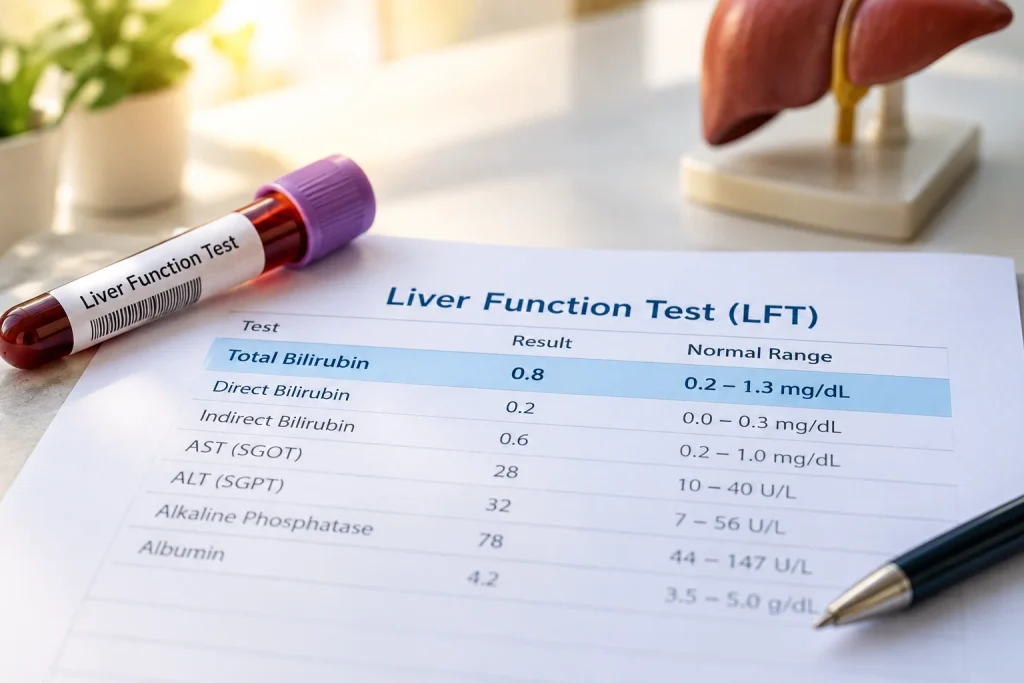
A bilirubin value looks frightening the moment it crosses the printed limit on your report. Most of the time the rise is small with a simple explanation. This guide covers the total bilirubin normal range in adults and children, what the direct and indirect split tells your doctor, and the signs that need same day attention.
Quick Answer
- The total bilirubin normal range for adults is usually reported as roughly 0.2 to 1.3 mg/dL, though cut-offs differ between labs.
- Direct bilirubin is normally under 0.3 mg/dL. Indirect is whatever is left after subtracting direct from total.
- The split narrows the cause. A high indirect value points towards red cells and a high direct value towards the liver or bile ducts, but neither pattern confirms a diagnosis on its own.
- Yellow eyes usually appear only once total bilirubin climbs past about 2.5 to 3 mg/dL.
What Is Bilirubin?
Bilirubin is the yellow pigment your body makes when old red blood cells break down. The liver picks it up, changes it into a water soluble form, and sends it out through bile into the gut.
The pigment passes through red cells, liver and bile ducts in that order, so a raised reading hints at which step is struggling. It rarely gives the diagnosis alone.
This pigment is one row in a wider panel. The rest of your liver function test is read alongside it.
Total Bilirubin Normal Range
Trusted sources do not agree on one cut-off, worth knowing before you panic over 1.4. Cleveland Clinic gives 0.2 to 1.3 mg/dL for children and adults. Mayo Clinic lists a typical adult result as up to 1.2 mg/dL.
Laboratories report bilirubin in mg/dL or micromol/L. To convert mg/dL to micromol/L, multiply by 17.1. Compare your result with the total bilirubin normal range and the units printed on your own report.
Adult total bilirubin on a linear scale
Drawn to scale.
Up to 1.3 mg/dL, the usual reported range
1.3 to 2.5 mg/dL, above the usual range, jaundice often not yet visible
Above 2.5 to 3 mg/dL, yellowing usually visible
Adults only. Newborn levels are judged against the baby’s age in hours.
Direct And Indirect Bilirubin Explained
Indirect bilirubin, also called unconjugated, is the raw form not yet processed by the liver. Direct bilirubin, also called conjugated, is the processed form ready to leave the body in bile.
Your doctor looks at which half is raised. A mostly indirect rise suggests red cells breaking down faster than usual, or an inherited variation in how the liver handles the pigment. A mostly direct rise suggests bile that is not draining or liver cells that are inflamed.
Neither pattern settles the cause by itself. American Family Physician advises reading fractionated bilirubin with a full blood count, liver enzymes, clotting time and albumin.
Good To Know
If your report shows only a total, ask for the split. A total of 1.6 mg/dL means two different things depending on whether the direct part is 0.2 or 1.1.
What Does High Total Bilirubin Mean?
A raised total is called hyperbilirubinaemia. Common reasons fall into a few groups:
- Red cell breakdown: haemolytic anaemia and related blood conditions, which push up the indirect fraction
- Liver problems: hepatitis, alcohol related damage and advanced fatty liver, usually alongside raised enzymes. Uncomplicated fatty liver often leaves bilirubin normal
- Bile duct blockage: gallstones and other obstruction, which push up the direct fraction
- Gilbert syndrome: a harmless inherited variation causing mild indirect rises, often spotted on a routine test
Some medicines also nudge it up, and the enzyme rows beside it matter, which is why a raised bilirubin is read with your SGPT result.
When High Bilirubin Becomes Jaundice
Jaundice is the yellow tinge in the whites of the eyes and the skin that appears when the pigment builds up. It usually shows once total bilirubin rises above roughly 2.5 to 3 mg/dL. MedlinePlus puts the visible point for adults near 2.5 mg/dL and American Family Physician above 3 mg/dL. Around 1.5 mg/dL yellowing is usually absent, although visibility differs from person to person.
The eyes yellow before the skin does, and it shows more clearly in daylight. Dark urine and pale stools often arrive with it. Our full guide covers the early signs of jaundice.
Patient Tip
Check your eyes near a window rather than in the bathroom mirror. Warm indoor bulbs hide early yellowing, and on darker skin tones the eyes are a more reliable place to look than the skin.
Bilirubin Levels In Newborn Babies
Newborn figures are not judged against the adult range, and yellowing shows at a lower level. MedlinePlus notes that 2.0 mg/dL can already produce visible jaundice in a baby. Babies make bilirubin faster and clear it more slowly at first, so levels rise then settle. Doctors read the value against the baby’s age in hours, gestation and risk factors, using a treatment threshold chart.
Timing is the part parents can act on. For suspected or obvious jaundice in the first 24 hours of life, NICE advises measuring serum bilirubin urgently within 2 hours and arranging an urgent medical review as soon as possible and within 6 hours, because this timing more often has a cause that needs treatment.
Keep In Mind
If a baby looks yellow within the first 24 hours of birth, get medical help straight away rather than waiting for the next scheduled check. Pale chalky stools or dark urine staining the nappy also need prompt review.
What Does Low Bilirubin Mean?
A low result is usually nothing to chase. Mayo Clinic notes that lower bilirubin levels are generally not a concern.
When the rest of your results are normal and you feel well, a low bilirubin usually needs no treatment on its own.
What Happens After An Abnormal Result
What comes next depends on your symptoms, how high the value is and what the rest of the panel shows. A borderline rise in someone who feels well is often simply repeated. Jaundice, pain or a clearly abnormal panel moves to fuller evaluation.
- Fractionated bilirubin with liver enzymes, clotting time and albumin, the starting panel AAFP recommends
- A full blood count to check whether red cells are breaking down, read with the MCV value
- Red cell indices such as MCHC
- A kidney function test when the wider panel is reviewed
- Abdominal ultrasound first when a blockage is suspected, which AAFP calls the least invasive and least expensive option, with a CT scan or other imaging if the findings call for it
Illustrative Scenario
A 26 year old man has a pre employment check and his total bilirubin comes back at 1.8 mg/dL. He feels fine, the direct value is 0.2, and his enzymes and blood count are normal. His doctor repeats the test and explains that once haemolysis and liver disease are ruled out, this pattern may fit a harmless inherited variation.
Composite example, not a specific patient.
When To See A Doctor
New jaundice in an adult is not a wait and watch finding. American Family Physician describes it as a possible sign of significant underlying disease, so yellow eyes, dark urine or pale stools should be seen the same day where you can. Carry the report and list every medicine and supplement you take.
Call Emergency Services
Do not wait for an appointment if yellowing comes with fever or shaking chills, severe abdominal pain, vomiting blood, confusion or unusual drowsiness, or if a newborn is yellow, floppy and feeding poorly. Treat these as an emergency.
India 108 or 112. United States 911. United Kingdom 999. 112 across the European Union and much of Europe.
Key Takeaways
- Compare your figure with the total bilirubin normal range printed on your own report, not one you read online.
- Ask for the direct and indirect split if your report only shows a total.
- Bring older reports so your doctor can see if the value is new or long standing.
- Treat yellow eyes with dark urine as a reason to be seen, whatever the number says.
Frequently Asked Questions
What does it mean if my bilirubin total is high?
It means the pigment is building up faster than your body clears it. The usual reasons are faster red cell breakdown, a liver problem or blocked bile flow. The split narrows the possibilities without confirming any, so a single high total is a starting point and not a diagnosis.
Is a total bilirubin level of 0.3 normal?
Yes. A total of 0.3 mg/dL falls inside many commonly used adult reference ranges. Compare it with the range on your own report. Low readings are generally not treated when the rest of the panel is normal.
How can I reduce total bilirubin?
Nothing you take at home lowers the number directly. The level settles when the cause is treated, whether that is a blocked bile duct, an infection or a medicine that needs changing. Avoid alcohol and supplements that may affect the liver until your doctor has explained the cause.
What is a dangerous bilirubin level in adults?
No single figure separates safe from dangerous. Risk depends on how fast the level rose, which fraction is raised and what the rest of your liver panel shows. Yellowing with fever, severe pain or confusion needs urgent care at any value.
What is bilirubin encephalopathy?
This is brain injury caused by very high unconjugated bilirubin in newborn babies. It is rare, and it is why newborn jaundice is monitored closely and treated early. The mild rises on routine adult reports do not carry this risk.
Does fasting change the bilirubin result?
Yes, in some people. Going without food for a long stretch raises the indirect fraction, which is one reason a borderline result is often repeated. Follow the lab’s fasting instruction and tell your doctor if you skipped meals.
What is Gilbert syndrome?
Gilbert syndrome is a mild inherited condition in which unconjugated bilirubin builds up because the enzyme that processes it works slowly. Around 30 per cent of people who have it notice nothing, and it is often found only on a routine blood test.
Why do my lab and an online chart give different normal ranges?
Different machines and methods produce different reference intervals, and published sources disagree. Mayo Clinic lists adults as up to 1.2 mg/dL while Cleveland Clinic gives 0.2 to 1.3 mg/dL. The total bilirubin normal range printed on your own report is the one that applies.
References and Medical Sources
- Mayo Clinic: Bilirubin blood test, results and typical values
- Cleveland Clinic: Bilirubin Test
- MedlinePlus (US National Library of Medicine): Bilirubin blood test
- University of Rochester Medical Center: Direct Bilirubin
- MedlinePlus Genetics: Gilbert syndrome
- MedlinePlus: Newborn jaundice
- Fargo MV, Grogan SP and Saguil A: Evaluation of Jaundice in Adults, American Family Physician, 2017
- Nelson M, Mulani SR and Saguil A: Evaluation of Jaundice in Adults, American Family Physician, 2025
- National Institute for Health and Care Excellence (NICE) CG98: Jaundice in newborn babies under 28 days, 2016
About the Author

Founder of RealMedVision, writing patient-focused health content based on clinical guidelines and peer-reviewed research.
Medically Reviewed By

Dr Praveen Verma, MBBS, MD (Pathology)

Dr Himanshu Morya, MBBS, Medical Educator
Last reviewed 28 October 2026.
Medical disclaimer: this article is general education, not personal medical advice or diagnosis. Reference ranges vary between laboratories. Always follow what your own doctor tells you.