
Published: 13 October 2026 | Last reviewed: 13 October 2026
Your MCV is the average size of your red blood cells. That word average is the catch, and the reason a normal result does not always mean a normal report.
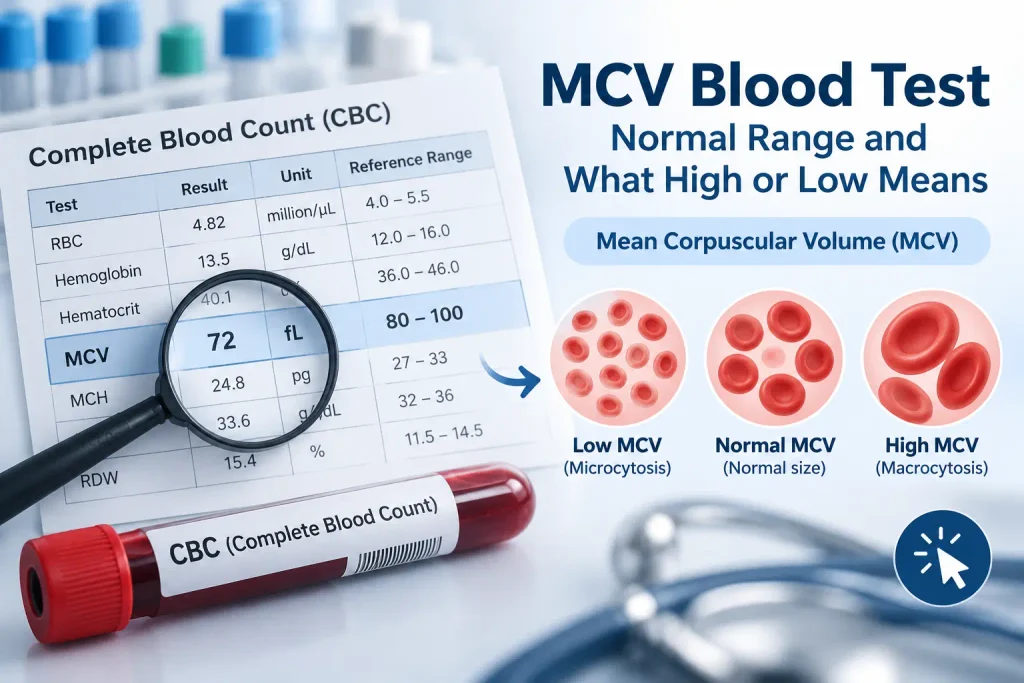
You picked up your blood report and one row has an arrow next to it. MCV. Nobody at the collection centre explained it, and the leaflet in the envelope does not mention it either.
It is one of the more useful numbers on the page, and one of the easiest to over-read. Here is what it measures, what the arrow means in each direction, and the one case where a normal value still deserves a second look.
Quick Answer
- The MCV full form is mean corpuscular volume, the average size of one red blood cell.
- For adults, the MCV normal range is usually 80 to 100 femtolitres. Each laboratory sets its own limits.
- A low MCV usually points to iron deficiency or thalassaemia trait. A high MCV points to vitamin B12 or folate deficiency, alcohol, thyroid or liver problems.
- A normal MCV does not rule out anaemia, or iron and vitamin deficiencies, because two opposite problems can cancel out in the average.
MCV Full Form and What the Test Measures
MCV stands for mean corpuscular volume. Corpuscular refers to the red blood cell, so the MCV blood test reports the average volume of a single red cell, measured in femtolitres and written as fL.
You do not book it on its own. It is one of the red cell indices that come with a complete blood count, alongside MCH and MCHC. Size matters because the body commonly builds small red cells when iron runs short, and large ones when the ingredients for making DNA run short. Those are the usual patterns rather than the only causes. Hold on to that word average, because it matters later.
MCV Normal Range
For adults, MedlinePlus and other standard references put the MCV blood test normal range at roughly 80 to 100 fL. Children have their own ranges that shift with age, and newborns sit higher. Laboratories set their own limits, so one report may flag 79 while another leaves it alone. Go by the range printed beside your result.
What a Low MCV Means
A low MCV means your red blood cells are smaller than expected. Iron deficiency is a common cause in India, though thalassaemia trait and other conditions also make red cells small, so a low MCV on its own does not confirm the reason. Without enough iron the body cannot make haemoglobin normally, and cells may come out smaller. For scale, the Ministry of Health and Family Welfare, citing NFHS-5 for 2019 to 2021, reports anaemia in 57 percent of women aged 15 to 49. That figure describes anaemia, not low MCV specifically.
Beta thalassaemia trait is the other common one, and it is inherited rather than dietary. Published Indian estimates put carrier rates between 2.7 and 14.9 percent across regions, averaging around 4.5 percent. Long-term inflammation, chronic kidney disease and lead exposure can also shrink red cells.
Telling Iron Deficiency Apart From Thalassaemia Trait
This matters because iron helps when iron deficiency is present, but it does not treat thalassaemia trait itself. The clue sits in two numbers beside MCV. In thalassaemia trait the red cell count is often high or normal despite the small cells, and RDW, which measures how much cell sizes vary, may be normal. In iron deficiency the count may be lower and RDW higher. Indian research finds that reading all three together separates the two far better than MCV alone, though the pattern is a pointer rather than a diagnosis, and both conditions can be present at once.
What a High MCV Means
A value above 100 fL is called macrocytosis. The American Family Physician review of macrocytosis lists vitamin B12 or folate deficiency, regular alcohol use and certain medicines as common causes. Thyroid underactivity, liver disease and bone marrow conditions are other possibilities. How often each one turns up varies with age, medicines and drinking history, so the list is not a ranking for any individual.
Both vitamins are needed to copy DNA. When either runs short the cell keeps growing while its division stalls, so it ends up oversized. B12 deserves attention in India, since it comes mainly from animal foods, so people who avoid them may have a lower intake unless they get it from fortified foods or supplements.
Alcohol can raise MCV through its effect on red cell production, and poor nutrition or vitamin deficiency may contribute alongside it in some people. The rise can appear before any anaemia shows. Alcohol related macrocytosis often falls below about 110 fL, although higher values do occur. One Indian hospital study recorded values up to 114 fL in alcohol related cases and up to 146.8 fL where B12 or folate was the cause. Those are findings from a single hospital series, not cutoffs that identify the cause in any one person.
Does a High MCV Mean Liver Disease
Not on its own. Liver disease is one recognised cause of high MCV, including in people who do not drink. A doctor would order liver function tests alongside B12, folate and thyroid rather than read anything into MCV by itself. If liver enzymes are raised, what follows depends on your history and the rest of your results. Raised enzymes on their own do not confirm fatty liver or anything else.
When a Normal MCV Still Hides a Problem
Here is what the arrow on your report cannot show you. If iron deficiency is shrinking some of your red cells while B12 or folate deficiency is enlarging others, the two pull in opposite directions and the average lands in the middle. The report reads normal while both problems are present.
This is not a theoretical worry. In a study of 62 adults with dimorphic anaemia, meaning two different red cell populations in one sample, published in the Indian Journal of Pathology and Oncology, MCV came back inside the normal range in 56 percent of cases. The authors concluded that MCV is unreliable on its own for picking up B12 or folate deficiency, because one anaemia can mask the other.
RDW can give an important clue. When two sizes of cell are mixed, the variation rises even though the average does not move. It does not confirm anything by itself. If your haemoglobin is low but MCV looks fine, your doctor may want to read RDW alongside iron studies, vitamin B12 and folate together.
Reading MCV With the Rest of the Report
These combinations are what a doctor actually reads. They point towards a cause rather than confirm one.
How the MCV Test Is Done
Blood is drawn from a vein in your arm, and the analyser reports MCV from the same sample as the rest of your count, including your white cells and platelets. There is no separate MCV test to book, and no fasting unless other tests that visit call for it.
When to Get Help
Get emergency medical care, or go to the nearest emergency department, if you have chest pain, breathlessness that is severe or comes on at rest, or heavy bleeding. Do not wait for an appointment.
An abnormal MCV on its own is not an emergency. Seek urgent medical advice the same day for any of these.
- Black stools, blood in stool, or bleeding that is heavy or will not stop
- New yellowing of the eyes or skin, or unusually dark urine
Arrange a prompt appointment, rather than waiting for a routine slot, for these.
- Numbness, tingling or pins and needles in the hands or feet
- A sore smooth tongue, mouth ulcers, or new memory trouble
- Periods heavier than usual, or tiredness that keeps worsening
Illustrative Scenario
A 41-year-old is tired for months. Her haemoglobin is low, yet MCV reads 89, comfortably normal. Rather than treat on the MCV alone, her doctor notes that the two do not fit together, sees a clearly raised RDW on the same report, and sends ferritin along with vitamin B12 and folate. Both ferritin and B12 come back low. Starting iron by itself would have corrected only half the problem.
Composite example, not a specific patient.
What To Do Next
- Read MCV with RDW, the red cell count and your haemoglobin. Alone it answers little.
- If haemoglobin is low but MCV is normal, ask whether B12 and folate should be checked with iron.
- If cells are small but iron studies are normal, ask whether thalassaemia trait has been ruled out.
- Do not start supplements on your own. Taking them without knowing the cause can delay the right diagnosis, so ask which deficiencies need testing first.
Frequently Asked Questions
What is the normal range for an MCV blood test?
For adults it is usually 80 to 100 fL. Children are read against age-specific ranges, and each laboratory sets its own limits, so go by the range printed on your own report.
What is the MCV full form?
Mean corpuscular volume. Corpuscular refers to the red blood cell, so it is the average volume of one red cell, in femtolitres.
What does a low MCV mean?
Your red cells are smaller than expected. Iron deficiency is a common cause in India, but the value alone does not confirm it. Thalassaemia trait is another possibility, especially if iron studies are normal.
What does a high MCV mean?
Larger red cells than expected. Common causes include vitamin B12 or folate deficiency, alcohol use and certain medicines, with thyroid, liver and bone marrow conditions as other possibilities.
Does a high MCV mean liver disease?
Not by itself. Liver disease is one recognised cause of high MCV among several, including in people who do not drink. Liver function tests are checked with B12, folate and thyroid before any conclusion.
Can MCV be normal if I still have anaemia?
Yes. Iron deficiency shrinks cells and B12 or folate deficiency enlarges them, so with both present the average can land inside the normal range while haemoglobin stays low.
What is the difference between MCV and MCH?
MCV is how big the average red cell is, in femtolitres. MCH is how much haemoglobin that cell carries, in picograms. Size and content, measured separately.
How do I bring my MCV back to normal?
By treating whatever moved it, which is why the cause matters more than the number. How long MCV takes to settle depends on the underlying cause and how it is treated.
References
- MCV (Mean Corpuscular Volume). MedlinePlus, National Library of Medicine. Accessed October 2026. medlineplus.gov
- Red Blood Cell (RBC) Indices. MedlinePlus, National Library of Medicine. Accessed October 2026. medlineplus.gov
- Evaluation of Macrocytosis. American Family Physician, 2009. aafp.org
- Veda P. Evaluation of macrocytosis in routine hemograms. Indian Journal of Hematology and Blood Transfusion, 2013, volume 29, issue 1, pages 26 to 30. pmc.ncbi.nlm.nih.gov
- Deepthi A, Prasad CSBR, Raghavendra Prasad BN. Study of dimorphic anemia in adults with reference to basic etiology. Indian Journal of Pathology and Oncology, 2018, volume 5, issue 1, pages 61 to 66. ijpo.co.in
- Mean Corpuscular Volume (MCV Blood Test). Cleveland Clinic. Accessed October 2026. my.clevelandclinic.org
- A Search for Beta Thalassemia Trait in India. National Library of Medicine, 2013. ncbi.nlm.nih.gov
- Anaemia among women. Lok Sabha Unstarred Question No. 1867, Ministry of Health and Family Welfare, Government of India, 2 August 2024, citing NFHS-5 (2019 to 2021). eparlib.nic.in
Written By
Iraphan Khan, BSN, RN, D.Pharm, Public Health Researcher. Founder of RealMedVision, writing patient-focused health content based on clinical guidelines and peer-reviewed research.
Medically Reviewed By
Dr Praveen Verma, MBBS, MD (Pathology)
Dr Himanshu Morya, MBBS, Medical Educator. Reviewed 13 October 2026.
Disclaimer
This article is general education and does not diagnose any individual. Reference ranges differ between laboratories, so read your result against the range printed on your own report. Always follow what your doctor tells you.