
Last updated 27 October 2026. Last medical review 27 October 2026.
The numbers doctors actually act on, what your report is telling you, and the point where high uric acid stops being harmless.
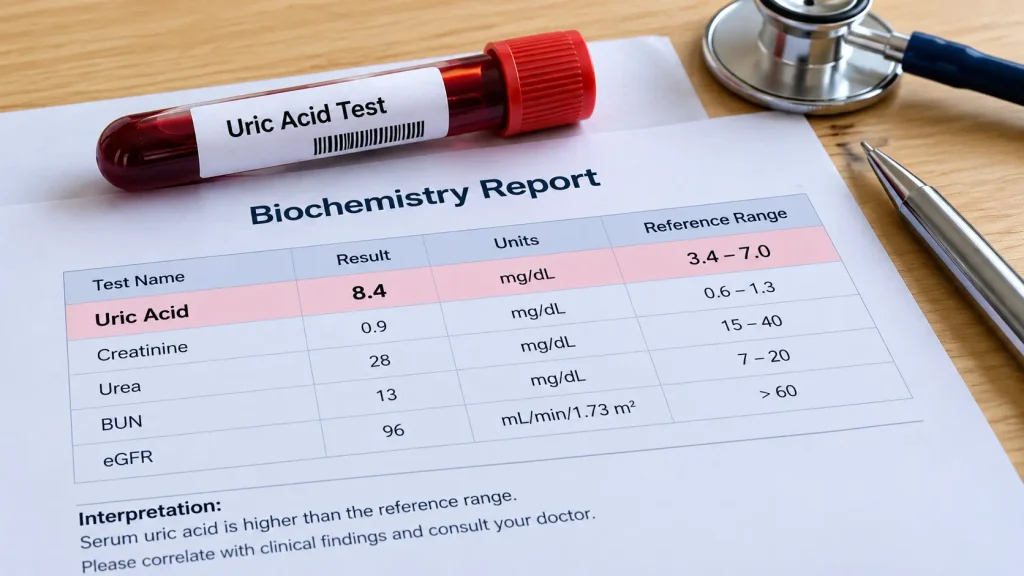
A uric acid report gives you one number and no context. What you want to know is whether it is fine, borderline or worth acting on. This guide explains what level of uric acid is dangerous, using the thresholds doctors work with, and what happens once the level crosses the point where crystals begin to form.
Quick Answer
- Around 6.8 mg/dL (about 405 micromol/L) uric acid reaches its solubility limit, and above that crystals can begin to form in some people.
- A blood level above 7.2 mg/dL (about 430 micromol/L) is reported as high by MedlinePlus.
- Above 9 mg/dL (about 535 micromol/L) counts as marked hyperuricaemia and changes the treatment conversation.
- A high number on its own is not a disease. Plenty of people with raised uric acid never develop gout or stones.
What Is Uric Acid?
Uric acid is waste left when your body breaks down purines, which come partly from food and partly from your own cells being replaced. Blood carries it to the kidneys and most of it leaves in urine.
Problems start when your body makes more than the kidneys can clear, or the kidneys stop clearing it properly. The level climbs, stays up, and the uric acid no longer stays dissolved. That is the part that matters, not the number itself. A kidney function test is usually ordered alongside it.
What Level Of Uric Acid Is Dangerous?
There is no single line where safe becomes dangerous. There are three numbers that change what a doctor does next.
6.8 mg/dL, Where Crystals Become Possible
It dissolves poorly in blood, and its solubility limit sits near 6.8 mg/dL (about 405 micromol/L) under body conditions. Above that it can settle out as monosodium urate crystals in joints and tissues. Can, not will. Plenty of people stay above this level for years without a single attack. The 2020 American College of Rheumatology (ACR) gout guideline uses the same figure to define raised uric acid in someone with no symptoms.
7.2 mg/dL, One Commonly Quoted Mark
The MedlinePlus page on gout describes a blood uric acid above 7.2 mg/dL as high. Treat that as one commonly quoted figure, not a universal cutoff. Reference intervals differ between laboratories and between published sources, and some labs set an upper limit above 8 mg/dL for men. The same holds for other values on a blood report, such as MCHC.
The number that applies to you is the one printed beside your result. What the figures agree on is direction. Once you are into the 7s, you are above the point where crystals can form.
9 mg/dL, Where Doctors Change Their Approach
Past 9 mg/dL (about 535 micromol/L) the level counts as marked hyperuricaemia. The 2020 ACR guideline lists it, with moderate to severe chronic kidney disease or kidney stones, as a reason to consider urate lowering medicine earlier than usual. Treatment is still not automatic. Observational data cited there found about 1 in 5 people above 9 mg/dL with no symptoms developed gout within five years. That is a group average, not a forecast for any one person.
Does Uric Acid Change With Age?
Levels drift up with age, and the pattern differs by gender. Boys and girls sit at similar levels in childhood. From puberty male levels rise and stay higher. Female levels stay lower until menopause, then climb and the gap narrows. Age itself does not shift the solubility point. The 6.8 mg/dL figure is a physical threshold, not a diagnostic or treatment cutoff, and it is the same at 25 as at 65. What a doctor does with your reading still depends on your lab range, your symptoms, your kidney function and whether you have had gout before.
What High Uric Acid Can Lead To
Gout
Crystals settling in a joint trigger sudden, severe pain. The NHS describes it most often in the big toe, with hot, swollen, red skin over the joint, though ankles, knees, wrists and elbows can be affected too. An untreated attack usually settles in one to two weeks. Repeated attacks over years can damage the joint and leave hard lumps called tophi under the skin.
Kidney Stones And Kidney Risk
Very high levels can also lead to uric acid kidney stones, which the NHS lists among the complications of long standing untreated gout. MedlinePlus notes that high blood uric acid is associated with a higher risk of kidney disease. Association is not proof that uric acid damaged the kidney. Reduced kidney function also raises uric acid, so the two move together and the direction is not always clear. Kidney function is therefore checked alongside the result, not assumed from it.
The Heart Question
High levels have been studied alongside heart and blood vessel disease for years. The two are linked in population studies, but whether uric acid itself does the damage is still argued over. A high reading does not mean heart trouble. It is still worth knowing the warning signs that can feel like gas or acidity, because those get ignored far too often.
Good To Know
Crystals can also form while your level sits inside the normal range, which is why a painful, swollen joint is worth showing a doctor even when your report looks fine.
Signs You Might Notice
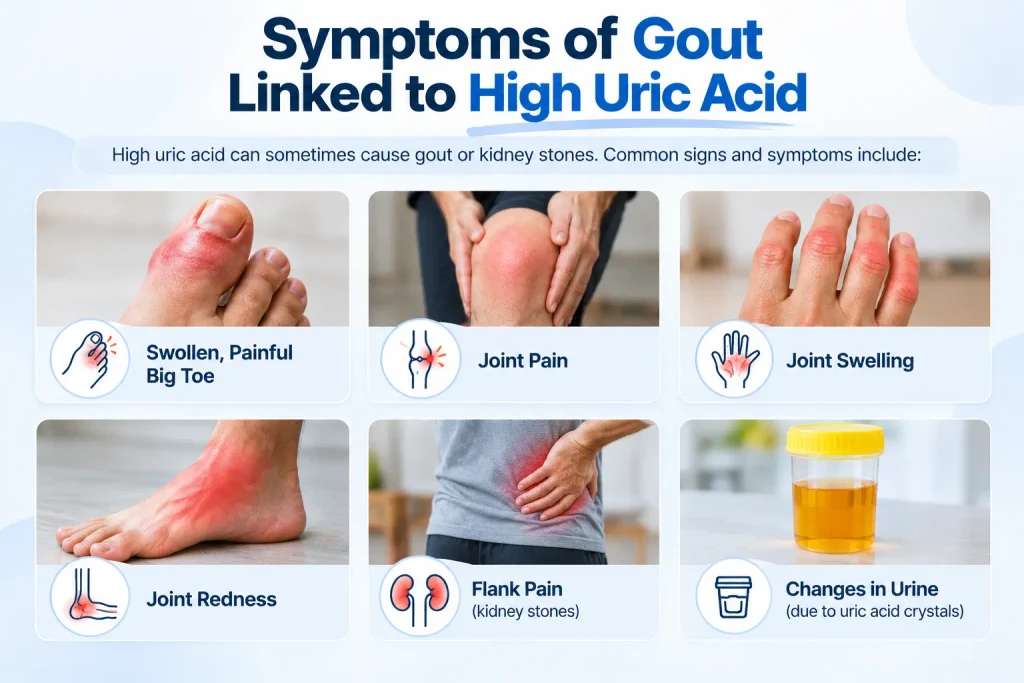
Raised uric acid usually causes nothing you can feel. What you notice are the problems it leads to:
- Sudden severe pain in one joint, often starting at night
- Swelling with skin that looks red or darker and feels hot
- A joint so tender that even a bedsheet hurts
- Hard lumps under the skin on ears, fingers or elbows
- Severe one sided pain in the back or side, which can point to a stone
What Pushes Uric Acid Up
Food gets the blame, but it is rarely the whole story. The NHS lists excess weight, alcohol, menopause, diuretics (water tablets), some blood pressure medicines, high cholesterol, kidney problems and diabetes among the things that raise your chances.
Purine heavy foods such as organ meat, certain fish and sugary drinks with fructose add to the load. Dehydration, a heavy meal, an illness with fever or a joint injury can tip things into an attack. If your blood sugar is drifting up too, our HbA1c normal range chart explains what those numbers mean.
Patient Tip
Never stop a blood pressure tablet or a water tablet on your own because you read it raises uric acid. Take the report to the doctor who prescribed it and ask about alternatives.
Can Uric Acid Be Too Low?
It can, and it worries people more than it should. MedlinePlus describes low blood uric acid as uncommon and says it usually does not cause health problems. If it keeps coming back low, your doctor may look at diet, medicines and how your kidneys handle uric acid before deciding whether anything needs following up.
When To See A Doctor
Book an appointment if you get joint pain and swelling for the first time, if your usual gout treatment stops helping, or if your level keeps coming back high. Carry the report, your medicine list and any other recent blood work, including a kidney panel or a full blood count with values such as MCV.
Keep In Mind
The NHS advises urgent medical help for sudden joint pain and swelling where the pain is getting worse, or you have a very high temperature or feel hot, cold or shivery, or you feel sick and cannot eat. These can mean infection inside the joint rather than gout.
Emergency numbers. India 108 or 112. United States 911. United Kingdom 999. Europe 112.
How Doctors Manage A High Level
Treatment follows symptoms, not the number alone. For people with gout, the 2020 ACR guideline strongly recommends adjusting urate lowering medicine until the blood level sits below 6 mg/dL and stays there. NICE guideline NG219 sets the same target of below 360 micromol/L, and a lower one below 300 micromol/L (5 mg/dL) for people with tophi, long standing gouty arthritis or repeated flares.
For raised uric acid with no gout and no tophi, the ACR guideline advises against starting urate lowering medicine in most people. Weight, alcohol and diet get looked at first, and the level is kept under review. Cutting back on alcohol does more than move this one number, since heavy drinking also sits behind advanced fatty liver disease.
At the appointment a doctor works through four things:
- Whether you have ever had a swollen, painful joint, since that changes everything
- How your kidneys are working, and whether you have had stones
- Which of your current medicines could be pushing the level up
- Whether the reading holds on a repeat test taken on a different day
Clinical Note
A level measured during an attack can read lower than usual. NICE advises repeating the test at least two weeks after a flare settles when gout is strongly suspected but the result comes back low.
Illustrative Scenario
A man in his fifties has a company health check and his uric acid comes back at 8.1 mg/dL. He has no joint pain and has never had an attack. His doctor checks kidney function and blood pressure, talks through weight and drinking, and plans a repeat test rather than a tablet.
Composite example, not a specific patient.
Key Takeaways
- Compare your result with the range printed on your own report, not a figure from a website.
- Treat a single high reading as a reason to repeat the test, not a reason to panic or self medicate.
- Show a doctor any joint that becomes suddenly painful, swollen and hot, whatever your number says.
- Ask for kidney function to be checked alongside uric acid if your level stays high.
Frequently Asked Questions
What Should A Normal Uric Acid Level Be?
Sources disagree on an exact figure. One published review quotes about 2.5 to 7.0 mg/dL for men and 1.5 to 6.0 mg/dL for women, while some laboratories use higher upper limits. The range on your own report is the one that applies to you.
Is Uric Acid 7.5 Dangerous?
A reading of 7.5 mg/dL sits above the level where crystals can form and above most quoted upper limits, but it is not an emergency. Many people at this level have no symptoms. Repeat the test and have your kidney function checked.
Is Uric Acid 9 Dangerous?
Anything above 9 mg/dL counts as marked hyperuricaemia, and the 2020 ACR guideline lists it as a reason to consider treatment earlier. Even so, observational data cited there found about 1 in 5 such people developed gout within five years.
Can High Uric Acid Damage Your Kidneys?
MedlinePlus reports that high blood uric acid levels are linked with a higher risk of kidney disease, and very high levels can lead to uric acid stones. Ask for kidney function to be checked if your level stays raised.
Does High Uric Acid Always Mean Gout?
No. Gout is diagnosed from symptoms and signs, with the blood level supporting the diagnosis rather than making it. Many people with raised uric acid never have an attack.
What Is A Dangerous Uric Acid Level In Women?
Women usually run lower than men before menopause, so a result above roughly 6.0 mg/dL is often flagged, though lab limits vary. The crystal forming threshold of 6.8 mg/dL applies to everyone.
Can Uric Acid Come Down Without Medicine?
Sometimes. The NHS points to weight, alcohol and diet as things that affect gout flares and symptoms. Where gout is already established, guidelines rely on medicine to reach and hold the target level.
How Often Should Uric Acid Be Tested?
That depends on your situation. NICE suggests considering a yearly check for people with gout who continue urate lowering treatment after reaching their target. Your doctor sets the interval for everyone else.
References and Medical Sources
- National Institute for Health and Care Excellence (NICE): Gout, Diagnosis and Management, NG219, 2022 Treatment targets and repeat testing.
- FitzGerald JD and colleagues: 2020 American College of Rheumatology Guideline for the Management of Gout, Arthritis Care and Research The 6.8 and 9 mg/dL thresholds and the five year figure.
- National Health Service (NHS): Gout, reviewed August 2023 Symptoms, risk factors, complications and urgent advice.
- MedlinePlus Medical Encyclopedia: Gout The 7.2 mg/dL figure and the kidney association.
- MedlinePlus Medical Tests: Uric Acid Test Low uric acid and laboratory range variation.
- Jin M and colleagues: Uric Acid, Hyperuricemia and Vascular Diseases, Frontiers in Bioscience Solubility limit and quoted adult reference intervals.
- Roddy E and Mallen CD: Diagnosis and Management of Gout, Comparison of BSR and NICE Guidance, Rheumatology Advances in Practice, 2024 Differences between UK target levels.
About the Author

Founder of RealMedVision, writing patient-focused health content based on clinical guidelines and peer-reviewed research.
Medically Reviewed By

Dr Praveen Verma, MBBS, MD (Pathology)

Dr Himanshu Morya, MBBS, Medical Educator
Last reviewed 27 October 2026.
Medical disclaimer: this article is general education, not personal medical advice or a diagnosis. Reference ranges differ between laboratories. Always follow what your own doctor tells you.