
Medically Reviewed: 22 October 2026 • Last Updated: 22 October 2026 • 7 minute read
Shamonda virus, known for decades only in farm animals, has now been found in one person in France. Here is what that means for you, in plain words.
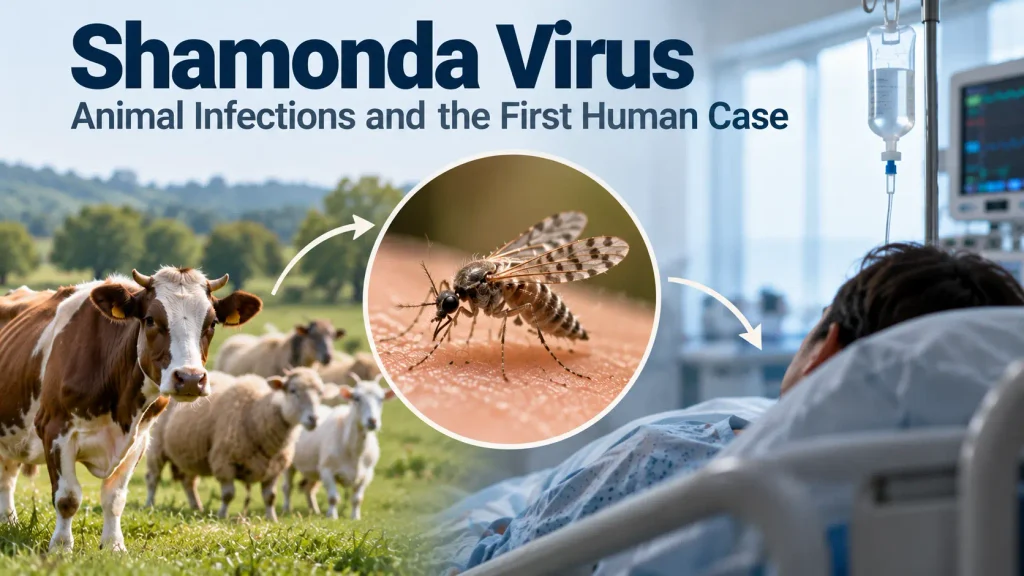
Shamonda virus (SHAV) is a virus spread by tiny biting midges. It mainly infects cattle, and sometimes sheep, goats and horses. On 22 October 2026, France reported the first known human infection in a patient with a very weak immune system who was treated in Lyon and later died. Officials say there is no known risk to the general public so far.1, 2, 6
If the headline worried you, that is a normal reaction. Below is what health authorities have confirmed, what they still do not know, and when to see a doctor.
Quick Answer
- What It Is: A virus that spreads through midge bites and mostly affects farm animals in Europe.1
- What Happened: One patient in Lyon with severe immune weakness was infected and died in early October 2026. This is the first human case ever documented.2
- Risk To You: French authorities say no health risk for the general population has been identified at this stage.2
- What To Do: Most people need no special steps. Get urgent care for confusion, fits or sudden weakness, which can point to a brain infection from any cause.8
What Is Shamonda Virus?
Shamonda virus belongs to a group called orthobunyaviruses. These are viruses carried and passed on by insects. Within that group it sits in the Simbu serogroup, a family of closely related viruses that also includes Schmallenberg virus and Akabane virus.3
Scientists first found it in Nigeria in the mid 1960s. After that it turned up only now and then, in parts of West, East and southern Africa and in Japan.3
How Shamonda Virus Reached Europe in 2026
In June 2026, vets in eastern France began seeing dairy cows with diarrhea, low energy, poor appetite and sometimes fever. In the first nine herds studied, milk output dropped by 15 to 75 percent. Gene testing then showed a new line of Shamonda virus never seen before.4
By 22 October 2026, the European Centre for Disease Prevention and Control (ECDC) listed it in farm animals in Austria, Belgium, France, Germany, Ireland, Italy, Liechtenstein, Luxembourg, the Netherlands, Portugal, Spain and Switzerland, and on the island of Jersey.1
Shamonda Virus in Humans: What Happened in France?
The patient was being treated at the Hospices Civils de Lyon for a serious illness. That illness had left their immune system severely weak. They died in early October 2026.2
French officials say the brain complications seen before death were very likely linked to the infection. Whether the virus actually caused the death, or only added to it, is still being investigated.1, 2
The virus had circulated in Africa and Asia for decades without a single documented human case. Authorities call this an exceptional event.2
How Did the Patient Get Infected?
The main theory is a bite from an infected midge in eastern France. That is where the virus was moving through animals in spring and summer 2026. Doctors, vets and environmental experts are looking into it together.2
The World Health Organization (WHO) says more studies are needed to understand how the virus is transmitted. It is working with French authorities to find out how this infection happened and whether there is any risk to the public.9
How Does Shamonda Virus Spread?
Between animals, it usually spreads through bites from infected Culicoides midges. These are very small biting flies. The exact midge species carrying it in Europe is not yet known.1
A pregnant animal can pass the virus to her unborn young. French officials warn this may cause abortions and serious birth defects, as seen with the related Schmallenberg virus.3
Can It Spread From Person to Person?
No spread between people has been reported. With only one known human case, there is simply not enough data to say more.
One piece of good news. European midges are most active from spring to autumn, and ECDC says most species are now slowing down as the weather cools.1
What Are the Symptoms of Shamonda Virus?
In Humans
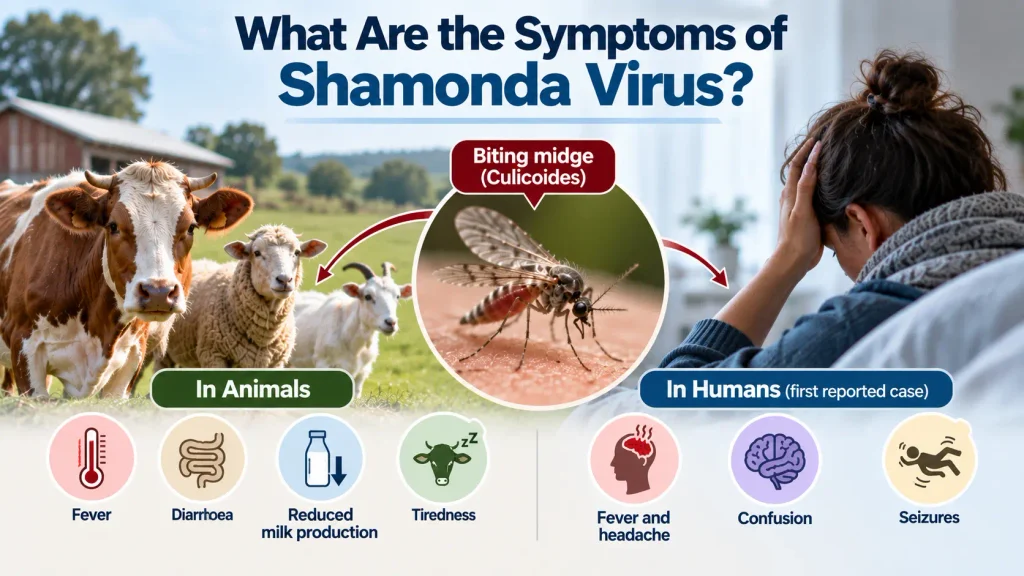
With only one case, there is no known list of human symptoms yet. In that patient, the virus was linked to problems in the brain. Nobody knows yet what infection would look like in a healthy person, or if it would cause any illness at all.2
A brain infection, called encephalitis, often starts like the flu with fever and headache. More serious signs can follow over hours or days.8 Most fevers have far more common causes, and our guide to viral fever symptoms explains what is usual and what is not.
In Animals
Infected cattle usually get fever, diarrhea, tiredness and a sharp fall in milk. In most cases these signs are mild and pass with time.3, 6 In Switzerland, the virus was also found in horses with nervous system problems. Experts are still checking whether the virus caused those signs.5
| Question | In Animals | In Humans |
|---|---|---|
| How common | Found in 12 European countries and Jersey | One case, in France |
| Main signs | Fever, diarrhea, tiredness, less milk | Brain complications in the one patient |
| How it spread | Midge bites, mother to unborn young | Midge bite suspected, still under study |
| How serious | Mostly mild in adults, risk in pregnancy | Patient had very weak immunity and died |
| Vaccine or cure | None available | None announced |
Source: ECDC, French Ministries of Health and Agriculture, Irish Farmers Journal quoting the Irish agriculture minister. Checked 22 October 2026.
Is Shamonda Virus Dangerous to Humans?
For most people, no. Based on what is known today, French authorities have found no health risk for the general population.2
The one person infected was already being treated for a serious illness that made them more open to infections than other people.1 The case shows the virus can infect a person. It does not show that healthy people are at risk.
What We Know and What We Do Not Know Yet
| Confirmed | Still Unknown |
|---|---|
| One human infection in France | Whether the virus caused the death |
| Patient had a severely weak immune system | Exactly how the infection happened |
| Spreads in animals through midge bites | Which midge species carries it in Europe |
| No risk to the public identified so far | Whether more human cases will be found |
Source: ECDC and French Ministries of Health and Agriculture, 22 October 2026.
Is Shamonda Virus in India?
We found no official report of Shamonda virus infection in people or livestock in India as of 22 October 2026.
A 2024 study by the ICMR National Institute of Virology in Pune tested Aedes mosquitoes from different parts of India. It picked up small traces of Shamonda virus genetic material, at low levels.7 That means pieces of the virus showed up in insect samples. It does not mean anyone in India has been sick with it. Also, Shamonda virus normally spreads through midges, not mosquitoes.1
A fever in India right now is far more likely to be something familiar, such as dengue or scrub typhus.
India has faced rare viruses before. Our guides on Nipah virus symptoms and Chandipura virus show how those outbreaks played out.
Is There a Test, Treatment or Vaccine?
For animals, there is no vaccine and no treatment that clears the virus. Vets treat the symptoms.3, 6 The World Organisation for Animal Health (WOAH) also says no vaccine is commercially available.9
For people, no specific treatment or vaccine has been announced. A brain infection of any cause needs hospital care, and doctors choose treatment based on the cause.8
ECDC is working with the EU reference laboratory to expand testing so other possible cases can be found.1
How Can You Protect Yourself?
For most readers, nothing changes. Near farms in affected European countries, simple bite protection makes sense.
- Cover Up: Wear long sleeves and long pants near cattle, sheep and goats.
- Use Repellent: Apply insect repellent on exposed skin.
- Weak Immunity: Ask your doctor before farm visits in affected areas.
Patient Tip
If you get fever with headache after time on farms in Europe, tell your doctor about that trip and any animal contact. That one detail can change which tests are done.
When Should You See a Doctor?
See a doctor if you have a fever that lasts more than a few days or keeps getting worse. Go sooner if you have a weak immune system.
Keep in Mind
Get emergency help right away if you or someone near you has any of these signs of a possible brain infection:8
- Confusion or not knowing where they are
- A fit or seizure
- Sudden change in behavior or trouble speaking
- Weakness or loss of movement in part of the body
- Passing out
Call 108 or 112 in India, 112 in Europe, 999 in the UK or 911 in the US.
Key Takeaways
- Shamonda virus spreads mainly through midge bites and mostly affects cattle.
- The first human case ever documented was a patient in Lyon with a severely weak immune system who died in early October 2026.
- Authorities see no risk to the general public so far, and no spread between people has been reported.
- No infection has been reported in India. Fevers here have far more common causes.
- Confusion, fits or sudden weakness need emergency care, whatever the cause.
Frequently Asked Questions
Can humans get Shamonda virus?
Yes, but it is extremely rare. Only one human infection has ever been documented. France reported it on 22 October 2026 in a patient with a severely weak immune system.
Is Shamonda virus dangerous?
For the general public, health authorities have found no risk so far. The one infected patient was already seriously ill and died. Whether the virus caused the death is still being investigated.
How does Shamonda virus spread?
It spreads mainly through bites from infected Culicoides midges. The French patient was most likely infected by a midge bite in eastern France, where the virus was circulating in animals.
Is Shamonda virus contagious?
No spread between people has been reported. Only one human case is known so far, so experts are still studying the virus.
Is Shamonda virus in India?
No official report of Shamonda infection in people or livestock in India was found as of 22 October 2026. One study of mosquitoes in India found only low levels of the virus genetic material.
Is it safe to drink milk and eat meat?
In August 2026, French officials said milk and meat posed no risk. Their 22 October update raised no food concern, and the one human case is thought to have come from a midge bite.
Is there a vaccine or treatment for Shamonda virus?
No vaccine is available for animals and none has been announced for people. There is no treatment that clears the virus in animals. A serious brain infection of any cause is treated in the hospital.
References
- European Centre for Disease Prevention and Control. Severely ill patient in France becomes first ever human infected with Shamonda virus. 22 October 2026. ecdc.europa.eu
- French Ministries of Health and Agriculture. Virus Shamonda: une première détection chez l’être humain. 22 October 2026. agriculture.gouv.fr
- French Ministry of Agriculture. Cas d’infections de vaches laitières par un orthobunyavirus. 2026. agriculture.gouv.fr
- Kelleci M, et al. Detection of a novel Shamonda Orthobunyavirus in dairy cattle, France, June 2026. Euro Surveill. 2026;31(33):2600689. doi.org
- Swiss Federal Food Safety and Veterinary Office. Virus Shamonda in Svizzera: informazioni dell’IVI e raccomandazioni. 25 August 2026. blv.admin.ch
- Irish Farmers Journal. Shamonda virus confirmed on two Cork dairy farms. October 2026. farmersjournal.ie
- Gangopadhayya A, et al. Metagenomic Analysis of Viromes of Aedes Mosquitoes across India. Viruses. 2024;16(1):109. doi.org
- NHS. Encephalitis overview. nhs.uk
- UN News. First human case of Shamonda virus reported in France as patient dies. 22 October 2026. news.un.org
All sources checked 23 October 2026. This is a developing story, and we will update this page as new official information comes out. More guides on infections are in our health insights library.
Written By
Iraphan Khan, BSN, RN, D.Pharm, Public Health Researcher. Iraphan writes evidence-based patient guides that turn medical reports and research into plain language.
Medically Reviewed By
Dr Parveen Verma, MBBS, MD Pathology
Dr Himanshu Morya, MBBS, Medical Educator
Last reviewed: 22 October 2026.
Disclaimer: This article is for general education and is not a diagnosis or treatment plan. Always follow what your doctor tells you.